The Prayer Before The Prayer

Listen to the podcast of this post by clicking on the player below, and you can also subscribe on AppleSpotify, or Audible. 

Last week I shared this thought with you from Pastor Tim Keller: “Your prayer must be firmly connected to and grounded in your reading of the Word. This wedding of Bible and prayer anchors your life down in the real God. … Without immersion in God’s words, our prayers may not be merely limited and shallow but also untethered from reality.” 

“Untethered from reality” means that we determine the manner in which we come to God in prayer, the way prayer works, and the way God must respond to our prayer. But what we read in the Bible is the opposite of this (Isaiah 1:11-15). 

(Check out all of the Scriptures in this post by clicking here.)

I think there are two opposite and equal erroneous thoughts about how we approach prayer:

  1. I’m not worthy to come into the presence of an all-holy God 
  2. I can waltz right into God’s presence whenever and however I please 

Both are wrong and both are strategies the devil has used to keep us prayerless. Either we don’t go to God at all or our prayers are unheard because the Bible says that our arrogance has made our prayer ineffectual. 

Our Prayer Book—the Bible—helps us find the balance. George Whitefield noted, “Reading the Bible is a good preparative for prayer, as prayer is an excellent means to render reading effectual.” So here’s what we read about those two errors. 

  1. I’m not worthy. God is unapproachable in His holiness, but Jesus has made it possible for us to enter in through His righteousness (1 Timothy 6:15-16; Isaiah 6:1-5; Hebrews 4:1, 14, 16; John 16:23-24). 
  2. I can come anyway I want to. Passages like Psalm 15:1-5 and Isaiah 58:2-4 make it clear that we cannot simply approach God in a way of our choosing. 

Let’s unpack that second error a little more. We have to be clothed in righteousness in order to come into God’s presence, but we cannot be clothed in a righteousness that is apart from Jesus. When we say that we are praying in the name of Jesus, it means we are praying in the nature of Jesus and through the righteousness of Jesus. We must be wearing His righteous robe (Romans 3:22-24; Isaiah 61:10). 

So I think we need to pray before we pray. Let’s try these actions which are tethered to the reality of our Prayer Book. 
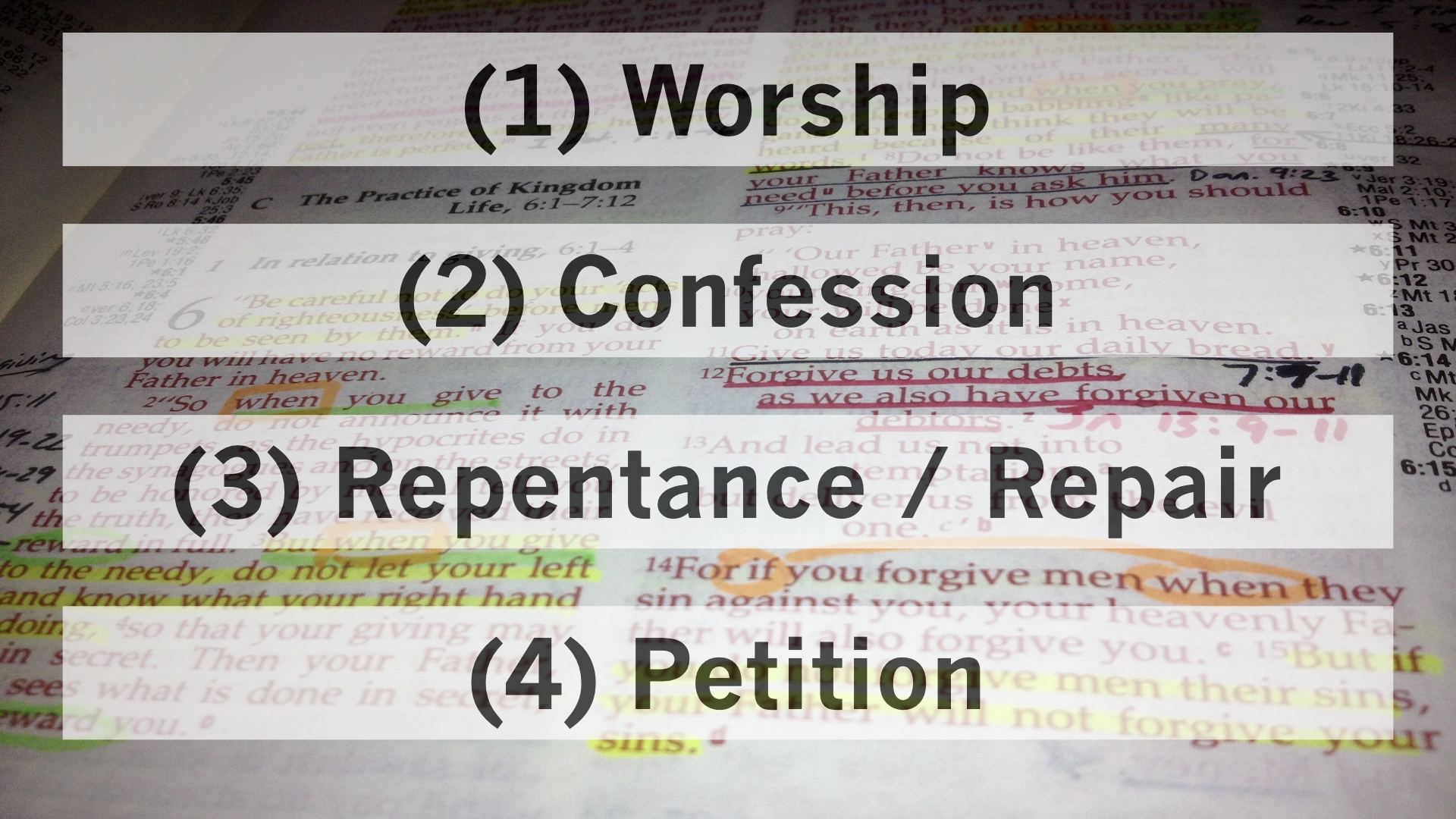
  1. Worship. This is a deep pondering of who God is; it is humbly assigning Him the highest worth. In face, the Old English spelling of this word (“worthship”) gives us insight into what worship does. It is this kind of humility that God responds to (Isaiah 6:5-7; 57:15; Luke 18:9-14).
  1. Confession. As we are worshiping, we will see our inadequacies (much like Isaiah did in Isaiah 6, or the tax collector did in Luke 18). We then need to confession these shortcomings. Dick Brogden wrote, “Confessed sin opens the portals of heaven into our darkness, and light and glory overwhelm shame. Confession is our glory for it lifts our heads and eradicates shame.” We see this so vividly lived out in the prayers of David (Psalm 139:23-24; 51:1-2; 19:12-14). 
  1. Repentance. I think we could also call this Repair. After confession where we have fallen short, we resolve now to both take a different path and repair what was damaged (Matthew 5:23-24; Mark 11:25-26; 1 Peter 3:7). 
  1. Petition. After worship, confession, and repentance / repair, our heart’s attitude is now in the place for God to heed our cries for His help (1 Peter 3:12). 

Let’s learn to pray before we pray. Don’t just rush in and rush out of God’s presence. Take time to worship, confession any sins the Holy Spirit reveals, make things right, and then present your petitions. 

Our hearts need to be prepared to present our petitions. This is how we know that God will hear our voice. 

If you’ve missed any of the messages in our prayer series, you can find them all here. 

►► Would you please prayerfully consider supporting this ministry? My Patreon supporters get behind-the-scenes access to exclusive materials. ◀︎◀︎

Links & Quotes

My wife and I just celebrated our anniversary. We enjoyed the many words of congratulations we received, but that got me thinking about marriages where only one spouse is a Christian and I then recorded this thought—

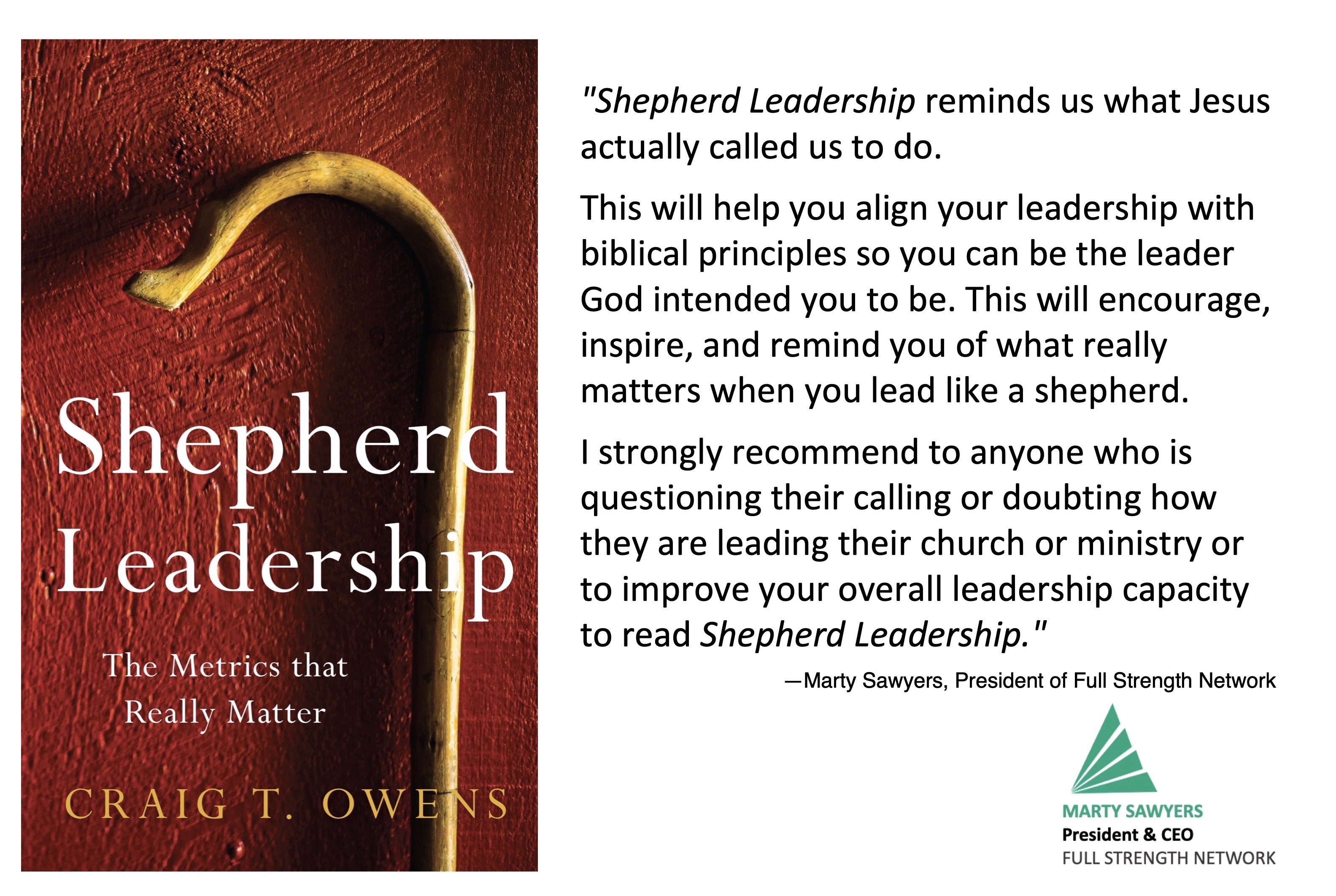
I was so honored to receive another great endorsement for my book Shepherd Leadership: The Metrics That Really Matter.

“It is not your business to succeed, but to do right; when you have done so, the rest lies with God.” —C.S. Lewis

“Homosexuality is not about some issue to debate; it’s about people to love.” —Dr. Preston Sprinkle, Living In A Gray World 

“It is better to fail in originality than to succeed in imitation.” —Herman Melville 

More fascinating news for creationists. Plants know how to defend themselves. “There are two main types of threat-detection mechanisms in plant cells—the ability to recognize distinctive chemical patterns that signify an invader, such as components of a bacterial cell, and the ability to recognize a disruption caused by invading pathogen.” Check out the full article here.

I shared an important reminder with my fellow pastors—

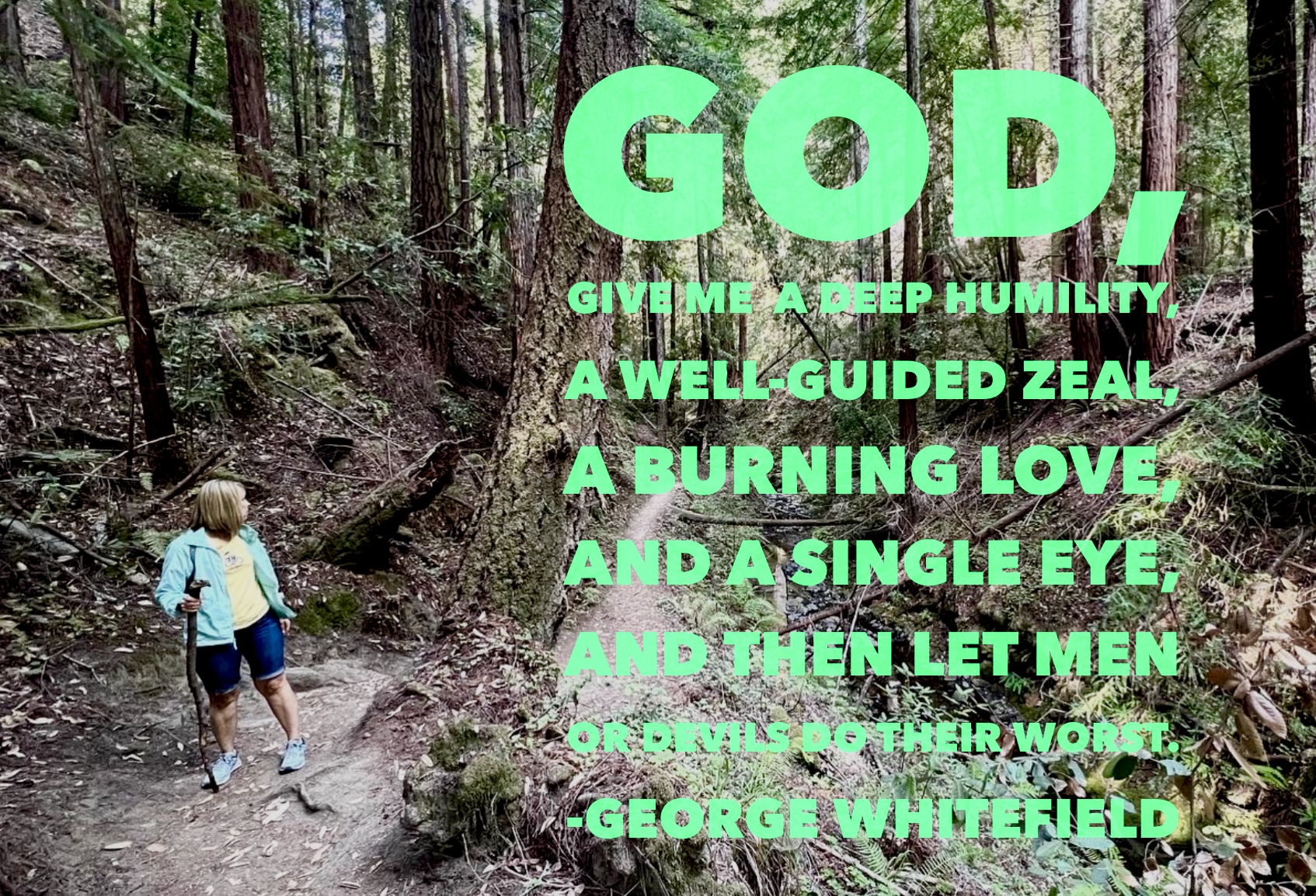
“God, give me a deep humility, a well-guided zeal, a burning love, and a single eye, and then let men or devils do their worst.” —George Whitefield, prayer when sailing for Georgia, December 30, 1777

Book Reviews From 2021

Listen to the podcast of this post by clicking on the player below, and you can also subscribe on AppleSpotify, or Audible.

I love reading, and I love sharing my love of good books with others! Here is a list of the books I read and reviewed in 2021. Click on a title to be taken to that review.

24

AC/DC

Churchill’s Ministry Of Ungentlemanly Warfare

Faithlife Illustrated Study Bible

George Whitefield

Hal Moore On Leadership

His Last Bow

Holy Sexuality And The Gospel

How Christianity Changed The World

How I Got This Way

How To Bring Men To Christ

Jesus On Trial

John Adams

Miracles Out Of Somewhere

My Lucky Life

Out Of The Silent Planet

Perelandra

Pilgrim’s Progress

Prayer

Prophet With A Pen

QB

Reading The Bible With The Founding Fathers

Secrets Of Dynamic Communication

Seeing Beauty And Saying Beautifully

Shepherd Leadership

Star Struck

Talking To GOATs

That Hideous Strength

The Art Of Writing And The Gift Of Writers

The Hidden Smile Of God

The Hiding Place

Thompson Chain-Reference Bible

To The Work!

Voice Of A Prophet

Washington’s Immortals

Word-For-Word Bible Comic: Jonah

Here are my book reviews for 2011.

Here are my book reviews for 2012.

Here are my book reviews for 2013.

Here are my book reviews for 2014.

Here are my book reviews for 2015.

Here are my book reviews for 2016.

Here are my book reviews for 2017.

Here are my book reviews for 2018.

       Here are my book reviews for 2019.

Here are my book reviews for 2020.

►► Would you please prayerfully consider supporting this ministry? ◀︎◀︎

George Whitefield (book review)

Listen to the podcast of this post by clicking on the player below, and you can also subscribe on AppleSpotify, or Audible. 

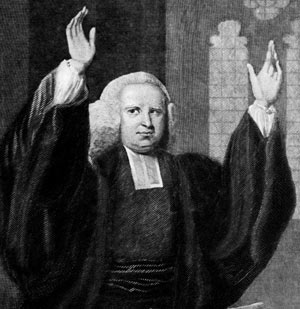
The ministry of George Whitefield in both the British Isles and the American colonies is still unequaled today. Of very few men could it be said that they both initiated a revival and put mechanisms in place for the long-range growth of the church in two entirely different cultures. Arnold Dallimore captures this well in his biography George Whitefield: God’s Anointed Servant in the Great Revival of the Eighteenth Century. 

Previously, I read and reviewed J.C. Ryle’s biography of George Whitefield. Bishop Ryle wrote this book to correct some of the maliciously untrue reports that were circulating about Whitefield. Rev. Dallimore’s book has the benefit of more years of history in which to test the assertions of Bishop Ryle. The result is a well-rounded work that takes us through the beginning of Whitefield’s ministry, his maturing thoughts and practices, and the lasting legacy that is still being felt today. 

Rev. Dallimore does address some of the same falsehoods that Bishop Ryle sought to debunk, but he goes farther to give us a sweeping overview of the tireless and highly effective ministry Whitefield undertook for nearly all of his life. Students of church history will definitely want to add this excellent book to their library. 

►► Would you please prayerfully consider supporting this ministry? ◀︎◀︎

Seeing Beauty And Saying Beautifully (book review)

Listen to the podcast of this post by clicking on the player below, and you can also subscribe on Apple or Spotify.

Seeing Beauty And Saying Beautifully is, in my mind, a grand slam! It features one of my favorite poets (George Herbert), possibly the most prolific evangelist of history (George Whitefield), my all-time favorite author (C.S. Lewis), all tied together by my go-to theologian (John Piper). Seeing Beauty And Saying Beautifully is part 6 in Piper’s series called “The Swans Are Not Silent.” 

George Herbert was a pastor of a small country church and a prolific poet who wrote almost all of his poems uniquely. “Of the 167 poems in The Temple, 116 are written with meters that are not repeated,” which even modern poets find astounding. George Whitefield spent more hours of his life preaching than he did sleeping, and he spoke with such a captivating style that he was quite possibly the first celebrity of the American colonies. C.S. Lewis wrote everything from history to fantasy, autobiography to poetry, theology to children’s novels. Peter Kreeft says of him, he “was not a man: he was a world.” 

John Piper finds in all three of these men a common thread: They all were able to not only see the beauty of God in everything, but they were able to express it in a beautiful way that drew in others to see the beauty of God for themselves. Pastor John calls this “poetic effort.” 

Pastor John also wrestles with how the profound creativity and eloquence of his three subjects meshes with the apostle Paul’s admonition that human eloquence could drain the Cross of Jesus of its power (see 1 Corinthians 1:17-2:5). He concludes that poetic effort for the sake of exalting the speaker or poet does turn people’s eyes to man and away from God. But that poet, evangelist, or author that uses the beauty in God’s creation to point people to the Creator is doing so in a way in which God is supremely exalted. This, Pastor John says, is exactly what Herbert, Whitefield, and Lewis have done, and done so well that their poetic efforts are still fruitful and God-glorifying long after their deaths. 

Seeing Beauty And Saying Beautifully is a wonderful book for those who enjoy biographies, theology, or the craft of skilled artisans. If you don’t know about the poems of George Herbert, the preaching of George Whitefield, or the vast library of literature of C.S. Lewis, let this book be your doorway to a rich new world of discovery, enjoyment, and God-glorification. 

►► Would you please prayerfully consider supporting this ministry? ◀︎◀︎

Thursdays With Spurgeon—The Most Unlikely Recruits

This is a weekly series with things I’m reading and pondering from Charles Spurgeon. You can read the original seed thought here, or type “Thursdays With Spurgeon” in the search box to read more entries.

The Most Unlikely Recruits

     Men and women have come in simply out of curiosity—a curiosity often created by some unfounded story or malicious slander of prejudiced minds. Yet Jesus Christ has called them and they have become both His disciples and our warmhearted friends. Some of the most unlikely recruits has been, in after days, our most valuable soldiers. They began with aversion and ended with enthusiasm. They came to scoff but remained to pray. Such cases are not at all uncommon.

     They were not unusual in the days of Whitefield and Wesley. They tell us in their journals of persons who came with stones in their pockets to throw at the Methodists, but whose enmity was slain by a stone from the sling of the Son of David. Others came to create disturbances, but a disturbance was created in their hearts that could never be quelled till they came to Jesus Christ and found peace in Him. The history of the church of God is studded with the remarkable conversions of persons who did not wish to be converted, who were not looking for grace but were even opposed to it, and yet, by the interposing arm of eternal mercy, were struck down and transformed into earnest and devoted followers of the Lamb. 

From The Autobiography of Charles Spurgeon

It is true that “the history of the church of God is studded with the remarkable conversions.” Think of the murderous persecutor Saul of Tarsus who encountered Jesus on a road near Damascus. This unlikely recruit to Christianity spread the Gospel of Jesus Christ far and wide. 

Think of an atheistic college professor named C.S. Lewis who eventually surrendered to the truth in the Bible, calling himself the most dejected and reluctant convert in all of England. Lewis went on to write some of the most influential Christian apologetic books of the 20th century. 

And most personally, think of yourself. Paul reminds us, “Brothers and sisters, think of what you were when you were called. Not many of you were wise by human standards; not many were influential; not many were of noble birth” (1 Corinthians 1:26). Yet God is using you right now to build His Church.

Keep on loving Jesus. Keep on sharing Jesus with your unsaved friends—no matter how antagonistic they may seem to your message. You never know what God may do with those “reluctant recruits.” 

Thursdays With Spurgeon—Honorable Disagreement

This is a weekly series with things I’m reading and pondering from Charles Spurgeon. You can read the original seed thought here, or type “Thursdays With Spurgeon” in the search box to read more entries.

Honorable Disagreement

     If you ask me, do I hold the doctrinal views that were held by John Calvin, I reply, I do in the main hold them, and rejoice to avow it. … 

     Most atrocious things have been spoken about the character and spiritual condition of John Wesley, the modern prince of Arminians. I can only say concerning him that, while I detest many of the doctrines that he preached, yet for the man himself I have a reverence second to no Wesleyan; and if there were wanted two apostles to be added to the number of the Twelve, I do not believe that there could be found to men more fit to be so added than George Whitefield and John Wesley. The character of John Wesley stands beyond all imputation for self-sacrifice, zeal, holiness, and communion with God; he lived far above the ordinary level of common Christians and was one of whom the world was not worthy.

From The Autobiography Of Charles Spurgeon

Calvinists and Arminians have appeared at odds with each other for centuries. Spurgeon teaches us a valuable truth—

Men can disagree on doctrines without vilifying the men who believe and teach those doctrines. 

Spurgeon (an avowed Calvinist) and Wesley (an outspoken Arminian) strongly believed and forcefully and persuasively taught what they saw to be true in Scripture. Yet they did so without attacking or demonizing each other. They practiced what the Apostle Paul taught—

If it is possible, as far as it depends on you, live at peace with everyone. (Romans 12:18) 

Oh, that today we would again follow the counsel of Paul and the example of Spurgeon and Wesley!

8 Prayers From “Dangerous Prayers”

Dangerous Prayers give a brief biography of 50 culture-shifting people, and the world-changing prayers they prayed. Check out my full book review by clicking here, and then enjoy just a few of the prayers from this excellent book. 

“Listen to my supplication, Master, so that my soul doesn’t stagger under Your instruction, so that I don’t stumble in testifying to Your mercies, by which You tore me away from all my ruinous pathways. Thus You’ll grow sweet to me beyond all that led me wrong, in my willingness to follow it. Thus I’ll love You most mightily, and grasp Your hand with all the strength of my inmost being. Thus You’ll tear me away from every trial, clear to the end.” —Augustine 

“Restore me to liberty, and enable me so to live now that I may answer before Thee and before the world. Lord, whatever this day may bring, may Thy name be praised. Amen.” —Dietrich Bonhoeffer, while awaiting execution in a Nazi concentration camp 

“Give us grace, O God, to dare to do the deed which we well know cries to be done. Let us not hesitate because of ease, or the words of men’s mouths, or our own lives. Mighty causes are calling us—the freeing of women, the training of children, the putting down of hate and murder and poverty—all these and more. But they call with voices that mean work and sacrifice and death. Mercifully grant us, O God, the spirit of Esther, that we may say: ‘I will go unto the king and if I perish, I perish.’” —W.E.B. DuBois 

“Because we have need continually to crave many things at Your hands, we humbly beg You, O heavenly Father, to grant us Your Holy Spirit to direct our petitions, that they may proceed from such a fervent mind as may be agreeable to Your holy will.” —John Knox 

“O keep us, we beseech Thee, Lord, for without Thy keeping we cannot keep ourselves.” —Charles Spurgeon 

“Oh Jesus, You who suffer, grant that today and every day I may be able to see You in the person of Your sick ones and that, by offering them my care, I may serve You. Grant that, even if You are hidden under the unattractive disguise of anger, of crime, or of madness, I may recognize You and say, ‘Jesus, You who suffer, how sweet it is to serve You.’” —Mother Teresa 

“I now make it my earnest prayer, that God would have you, and the State over which you preside, in His holy protection, that He would incline the hearts of the Citizens to cultivate a spirit of subordination and obedience to Government, to entertain a brotherly affection and love for one another, for their fellow Citizens of the United States at large, and particularly for their brethren who have served in the Field, and finally, that He would most graciously be pleased to dispose us all, to do Justice, to love mercy, and to demean ourselves with that charity, humility, and pacific temper of mind, which were the Characteristics of the Divine Author of our blessed Religion, and without an humble invitation of whose example in these things, we can never hope to be a happy Nation.” —George Washington 

“God give me a deep humility, a well-guided zeal, a burning love, and a single eye, and then let men or devils do their worst.” —George Whitefield 

George Whitefield On Developing Godly Attributes

George Whitefield“The fruit of the Spirit (Galatians 5:22-23) do not automatically become evident in our lives. If we are not discerning enough to recognize their availability to us, to desire them, and then to nourish them in our thoughts, they will never become embedded in our nature or behavior. Every further step of spiritual growth in God’s grace must be preceded by acknowledging our lack of a godly attribute and then by exhibiting a prayerful determination to obtain it. …

“Today many people are attempting to use their mental capacity and logical thinking to obtain sanctification, yet this is nothing but a religious fabrication. They believe that if they just mentally put themselves on the altar and believe the altar provides the gift of sanctification, they can then logically conclude they are fully sanctified. Then they go happily on their way, expressing their flippant, theological babble about the ‘deep’ things of God.

“Yet the heartstrings of their old nature have not been broken, and their unyielding character, which they inherited from Adam, has not been ground to powder. Their soul has not throbbed with the lonely, gushing groans of Gethsemane. Having no scars from their death on Calvary, they will exhibit nothing of the soft, sweet, gentle, restful, victorious, overflowing, and triumphant life that flows like a spring morning from an empty tomb.” —George Whitefield

Book Reviews From 2015