Listen to the podcast of this post by clicking on the player below, and you can also subscribe on Apple, Spotify, or Audible. Check out the video content in this post by clicking here.
Charles Spurgeon, the man called the Prince of Preachers, knew how important it was for his congregation to be praying for him. He said,
“It is for your own benefit to remember in your prayers those who preach the Word of God to you, for what can they do without divine assistance and how can you be profited by them unless they are first blessed of God?”
If you love your pastor, please check out my book Amen Indeed. This is a book for prayers for pastors to pray for themselves, and you can also learn how to pray for your shepherd along the way.
Amen Indeed has topical prayers, weekly prayers for each Sunday morning, and some classic quotes about the important link between prayer and effective pastoring.
Praying for your pastor has huge benefits for you too!
Spurgeon went on to say, “The man who comes up to God’s house, having prayed for God to bless the preacher, is not likely to go away unprofited.”
Order a copy of Amen Indeed today for your favorite pastor.
If leaders want to get the best ideas and implement the best strategies, they must invite everyone on their team to share from their unique perspective. This is the only way to get the whole picture. Check out this full conversation from The Craig and Greg Show.
T.M. Moore writes, “We can know that we love our neighbors when, like Jesus, we go seeking them, in order to touch them with His love.”
This last week marked the 187th anniversary of the first time “O.K.” was first published as an abbreviation. The word’s origin is an interesting story, with some calling it “one of the most ubiquitous terms in the world, and certainly one of America’s greatest lingual exports.”
“Meekness and gentleness are two of the ornaments of our faith. I would that some professed Christians would understand that unholy contentiousness is not after the mind of Christ, it is not according to that gracious command, ‘Take My yoke upon you, and learn of Me; for I am meek and lowly in heart and ye shall find rest unto your souls.’ No, the Christian must be willing to suffer wrongfully, and to bear it in patience; he is never to be one who renders evil for evil, or railing for railing.” —Charles Spurgeon, commenting on Titus 3:2
“Then, since according to the Lord’s warnings the blood of so many will be sought for at the hands of their shepherds, careful watch must be kept, that is, the Word of the Lord must be often preached, and preached by the shepherds, by the Church’s bishops and teachers, that none may perish through ignorance; for he perishes through lack of heed, his blood will be on his own head.” —Columbanus, Letter to Pope Boniface
“Knowledge will forever govern ignorance.” —James Madison
“A good friend is like a four-leaf clover, hard to find and lucky to have.” —Irish proverb
“When a man is getting better he understands more and more clearly the evil that is still left in him. When a man is getting worse he understands his own badness less and less. A moderately bad man knows he is not very good: a thoroughly bad man thinks he is all right. This is common sense, really. You understand sleep when you are awake, not while you are sleeping. You can see mistakes in arithmetic when your mind is working properly: while you are making them you cannot see them. You can understand the nature of drunkenness when you are sober, not when you are drunk. Good people know about both good and evil: bad people do not know about either.” —C.S. Lewis, Mere Christianity
“If you want to win the day, you’ve got to flip the script. How? The Bible is a good starting point. Scripture is more than our script; it’s our script-cure. And that’s more than a play on words. Scripture confronts the false identities and false narratives perpetrated by the Father of Lies. It reveals the heavenly Father’s metanarrative and the unique role that each one of us plays in it.” —Mark Batterson, Win The Day
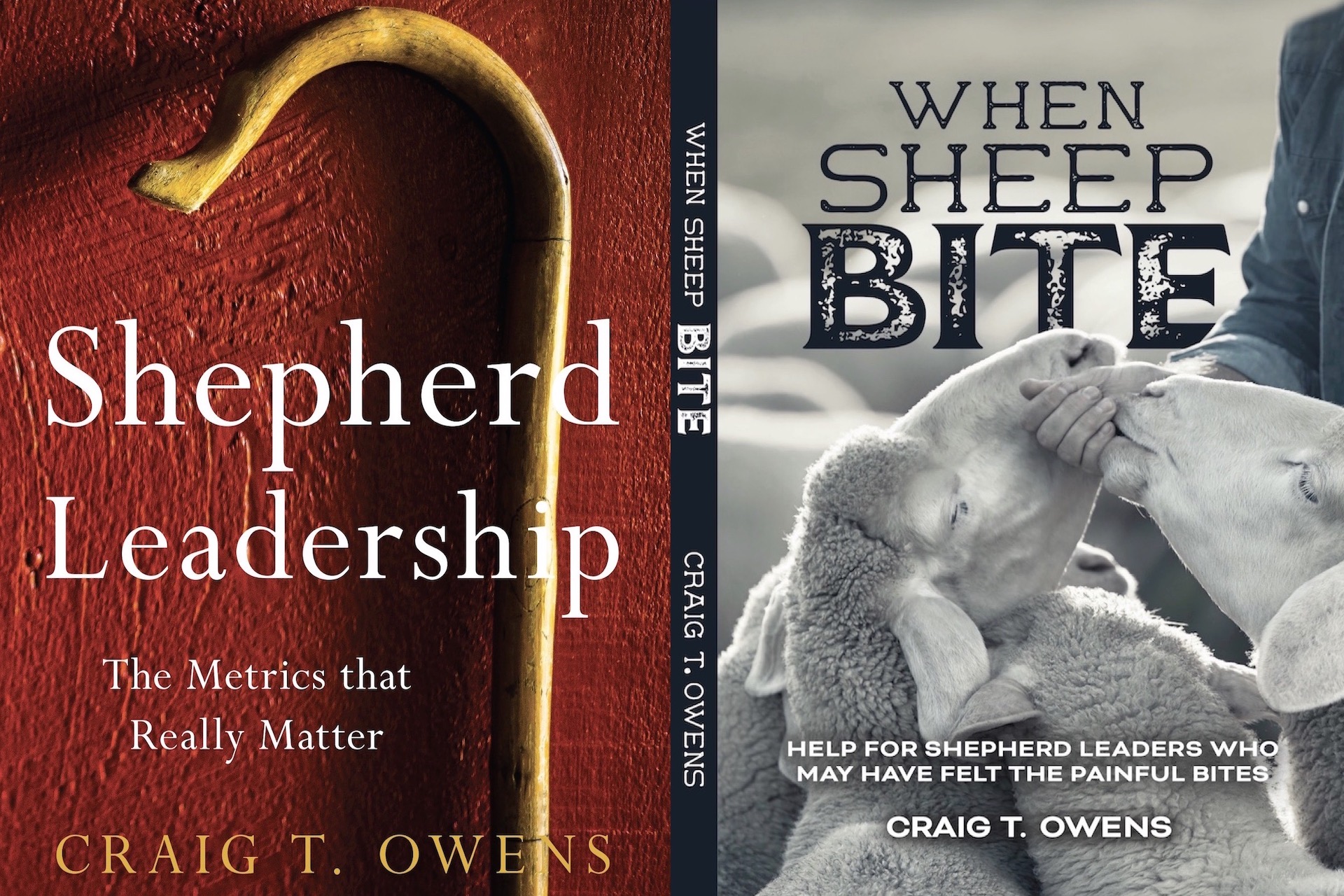
My books are for my fellow pastors. Shepherd Leadership will help us keep the biblical metrics in mind when we are thinking about our leadership roles. When Sheep Bite is an invaluable resource to help pastors continue to serve their flock, even after being painfully attacked. And Amen Indeed is a book of prayers for pastoral effectiveness.
If you are a pastor—or if you love your pastor—please pick up copies of these books today!
Listen to the podcast of this post by clicking on the player below, and you can also subscribe on Apple, Spotify, or Audible.
Paul salutes his friend Titus, “Grace, mercy, and peace from God the Father and the Lord Jesus Christ our Savior” (Titus 1:4).
I’m not sure why several English translations of the Bible leave the word mercy out of this verse, because the Greek clearly says charis, eleos, eirene. Especially when we consider that this was an intentional word Paul was inspired to pen to a specific person.
In every letter Paul writes to a church (plus in his personal letter to his friend Philemon), he greets the saints with “grace and peace” (Romans 1:7; 1 Corinthians 1:3; 2 Corinthians 1:2; Galatians 1:3; Ephesians 1:2; Philippians 1:2; Colossians 1:2; 1 Thessalonians 1:1; 2 Thessalonians 1:2; Philemon 3). This is also the greeting of Peter and John to the churches (1 Peter 1:2; 2 Peter 1:2; Revelation 1:4).
But in Paul’s three pastoral letters, he says, “Grace, mercy, and peace” (1 Timothy 1:2; 2 Timothy 1:2; Titus 1:4). Only John in the New Testament uses this salutation in a personal correspondence to another church leader (2 John 3).
From this, I think we would be wise to note that Paul feels his pastoral proteges need to keep mercy in the forefront of their minds. Not that pastors—and the “dear lady” in John’s second letter—don’t know that God has been merciful to them, but as a reminder of just how importantmercy truly is to both pastors and to the saints under their care.
Charles Spurgeon wrote that pastors need to be reminded of mercy “as if the higher the office, the greater the liability to sin.” I think one of the biggest temptations for leaders is to believe their elevated title means they are to be served by others, rather than to continually take the role of a servant serving others.
Pastoral leaders will also do well to recall that “all we like sheep have gone astray” (Isaiah 53:6; 1 Peter 2:25), and that “all” includes both pastors and saints. Pastors need to quickly recognize anytime they may be straying from their servant’s role, repent, and receive God’s mercy.
Shepherd leaders also need to guard against the frustration that can creep into their heart when they see the sheep in their flock going astray. Paul and John are reminding these pastors to keep in mind how merciful the Chief Shepherd has been to them, and how this should stir up their mercy toward the flock around them.
Shepherd leaders have a vital need to keep mercy always in mind.
I think a good prayer for pastors might be—
Holy Spirit, in my moments of frustration, remind me of the “grace, mercy, and peace from God the Father and the Lord Jesus Christ [my] Savior” which has been extended to me innumerable times. May that recollection awaken in me increased depths of mercy toward the flock around me, despite how frequently they may stray. In Jesus’ name. Amen!
P.S. If you are interested in going deeper on the topic of pastors as leaders, please check out my book Shepherd Leadership.
Controlling leaders shut down creativity among their teammates, which leads to higher turnover. If your team isn’t sharing their good ideas with you or if they are leaving you, that may be an indicator that you are too controlling. Check out the full conversation on The Craig and Greg Show
“As a fact, men only become greedily and gloriously material about something spiritualistic. … Take away the supernatural, and what remains is the unnatural.” —G.K. Chesterton
Astronomical technology like the James Webb Space Telescope (JWST) are providing breathtaking images. They are also creating problems for the scientific theories of the origins of our universe. University of California Santa Barbara physicist Caitlin Casey, said, “It makes sense—the Big Bang happens and things take time to gravitationally collapse and form, and for stars to turn on. There’s a timescale associated with that…. And the big surprise is that with JWST, we see roughly 10 times more galaxies than expected at these incredible distances.” There is a more straightforward answer found in Genesis 1:1, “In the beginning, God created the heavens and the earth.”
“Knowing where God wants people to be and taking the initiative to use God’s gifts and God’s methods to get them there, in reliance on God’s power through Christ, with God’s appointed people following.” —John Piper, giving his definition of godly leadership
The Bible records the names of five Persian kings. One of them called “Darius the Persian” in Nehemiah 12:22 requires some historical cross-referencing to identify. The Bible Archeology Report presents another one of their fascinating archeological biographies on this Persian king.
“The greatness of a leader is in his humility before God, not in his eloquence before men.” —Anonymous
The most viewed and downloaded resource on my blog is my chart of the kings of the united kingdom of Israel and the divided kingdoms of Israel and Judah. I was thrilled to discover this week that Jacob Edson at Biblegateway has taken my chart even deeper!
T.M. Moore has vital counsel for pastors, “Jesus must increase in us, and we must decrease. But that doesn’t just happen by carrying out whatever our ‘spiritual work’ requires of us week-in and week-out. Our ‘natural gifts’ cannot replace spiritual ones, and ‘mental powers’ are no match for the mind of Christ. It is a shepherd’s ‘duty’ to attend to the care and nurture of his soul, for unless we are diligent in this, we will not be able to lead the Lord’s sheep into a greater experience of our great salvation or a fuller realization of His Kingdom.”
Listen to the podcast of this post by clicking on the player below, and you can also subscribe on Apple, Spotify, or Audible.
In March 1966, at the height of Beatlemania, John Lennon was quoted—
“Christianity will go. It will vanish and shrink. I needn’t argue about that; I’m right and I will be proved right. We’re more popular than Jesus now; I don’t know which will go first—rock ’n’ roll or Christianity. Jesus was all right but His disciples were thick and ordinary. It’s them twisting it that ruins it for me.”
Maureen Cleave, the reporter who included this quote in her article about the Beatles, tried to clarify that John was talking specifically about the Church of England, especially when John mentions the disciples of Jesus twisting the words and example of Jesus as it is recorded for us in the New Testament.
But I wonder if the same argument could be made today about the “stars” in the evangelical movement? Many of those who claim to be preachers of the Gospel have both an online and in-person following that rivals that of the Beatles of the 1960s. Their gatherings are rock concert-esque, with their fans spending lavishly on their books, videos, and seminars.
But here’s my question: Are these “rock star preachers” making Jesus famous or themselves famous?
How would John the Baptist’s words sound coming out of the mouths of these mega-stars: “[Jesus] must increase, but I must decrease. He must grow more prominent; I must grow less so” (John 3:30 AMPC)?
Before John was born, the angel Gabriel told Zechariah that John “will be great in the eyes of the Lord” (Luke 1:15).
Notice: “Great in the eyes of the Lord” is so infinitely better than “great in the eyes of the world”!
John’s whole life was one of confident humility (or humble confidence). He spoke God’s Word confidently, but wasn’t seeking the praise of men nor intimidated by the criticism of men. As a result, God’s Spirit remained on him in an unmistakable way.
God will use anyone in the way that He used John, if they will only have the same attitude John had: “I must decrease and Jesus must increase.”
May I suggest this attitude-adjusting prayer for everyone who has been called by God to herald the Good News about Jesus—
Heavenly Father, as I preach today may all eyes move past me and turn to Jesus. “He must increase, but I must decrease. He must grow more prominent; I must grow less so.” Thank You for this opportunity You have given me today to point people to You. May I only be seen as great in Your eyes, but may the world view me only as Your humble servant.
The closing chapter of my book When Sheep Bite is entitled ‘Faithfulness > Fight or Flight.’ In that chapter I wrote—
Remember that we are all striving to not succumb to the natural fight-or-flight response, but to attain the supernatural response of faithfulness. In this, we have a perfect example in our Good Shepherd.
In the Book of Revelation, Jesus is called the One who is “Faithful” (Revelation 19:11), and Paul says that the Faithful One who has called us will empower us to remain steadfast: “He who calls you is faithful, who also will do it” (1 Thessalonians 5:24 NKJV).…
Yes, fight-or-flight is our natural response, but with the empowerment of the Holy Spirit, we can respond in supernatural faithfulness. We don’t have to sit unmoving and unfeeling, but we can continue to serve even biting sheep until God removes us or them.
We glorify God by faithfully serving the sheep He has placed under our care, giving our very best, even if our words and actions are unappreciated or ignored by those we are serving.
If you are in a difficult place in your leadership assignment, I encourage you to check out When Sheep Bite.
T.M. is beginning a series on the ministry of the apostle Paul. He writes, “Paul was able to accomplish great things against great odds not because he was such an enthralling preacher (he was not) or had so many resources to invest in his work (he did not), but because he had such great confidence in his message and his Lord.” Check out this series.
As a father, it always got my attention when my kids would remind me, “Dad, you said….” Not that God ever forgets anything He has promised, but when He hears Moses say, “You swore by Your own self and said to them,” He is pleased because this means that Moses is banking his faith on God’s unchangeable word. Let’s follow this example from Moses and use God’s Word to form our prayers to Him.
The ICR reports, “If the earth is 4.6 billion years old, virtually every square inch of the Earth’s surface would experience a host of erosive events.” But the fact that paleontologists have found so many well preserved foot tracks is a testament to both the Creation and Flood accounts recorded in biblical history.
“When ‘Aunt’ Fanny Lack, a 100-year-old Hoopa Indian woman, accepted Christ and was healed in 1920, she became a local sensation on the Hoopa Indian Reservation in northern California.” This is an amazing story!
“When you hate, the only person that is suffering is you because most of the people you hate don’t know it and the rest don’t care.” —Medgar Evers
Axis’ Culture Translator reported, “A study from World found that 26% of respondents admitted to flirting with a chatbot or AI, either for fun or unknowingly.” I love Axis’ conclusion: “Although social media was initially pitched as a supplement to real-life social interactions, the slope from supplement to replacement is steep. This Valentine’s Day, remind your teens that although real-life relationships can be difficult, we need both the affirmation and pushback that comes with them.”
Greg Morse shares the very real danger of shepherding God’s flock. He writes, “I enlisted to teach, preach, shepherd, and guide—but also to suffer, defend, and die, if the Lord should choose. As a son with his mother, a husband with his wife, a father with his children, so a pastor with his sheep. I am to defend them against all enemies foreign and domestic—spiritual and physical.” Pastors, I encourage you to read this article.
Listen to the podcast of this post by clicking on the player below, and you can also subscribe on Apple, Spotify, or Audible.
This one is for my fellow pastors. I want to give you THE question to ask to help you in crafting the most applicable and memorable sermons.
It’s a question that Paul asks in Romans 4: “What does the Scripture say?” (v. 3). Preachers must make sure they get their ideas from the text of the Bible, not just from their own good ideas. Look at this amazing example from Paul in just this one chapter of his letter to the saints at Rome.
He starts off with a question: “What then shall we say?” (v. 1).
Then he answers his question with another question: “What does the Scripture say?” and he proceeds to give his answer by quoting from the Book of Genesis.
From this, Paul makes a conclusion in vv. 4-5 that is signaled by the word “Now…”.
In order to support his conclusion, Paul then quotes from Psalm 32: “David says the same thing” (vv. 6-8).
Next Paul alternates between questions and answers in vv. 9-12, bringing this Q&A to a logical conclusion in vv. 13-16.
He supports his conclusion with even more Scripture: “As it is written” (v. 17), and “Just as it had been said” (v. 18).
Finally, Paul wraps up this part of his sermon by both quoting more Scripture (vv. 22-23) and then reminding his audience, “The words ‘it was credited to him’ were written not for him alone, but also for us” (vv. 23-24). This shows that God’s words weren’t just for Abraham, nor just for Paul’s audience, but for anyone reading the Scripture today.
This is a short, masterful, and powerful sermon! Why? Simply because it is totally banked on God’s timeless words.
The way that preachers can design THE perfect sermon—that is both applicable and memorable—is to start with the same question Paul did: “What does the Scripture say?”
Listen to the podcast of this post by clicking on the player below, and you can also subscribe on Apple, Spotify, or Audible.
As Paul is on his way to Jerusalem, he makes time to meet with the leaders of the Church in Ephesus. An important reminder Paul gives them comes from the example he lived out while he was in Ephesus: “For I have not hesitated to proclaim to you the whole will of God” (Acts 20:27).
Some translations say “the whole counsel of God,” but I like the simple, straightforward wording in the KJV: “all the counsel of God.” In other words, Paul’s textbook was everything in the Scriptures.
One of Paul’s traveling companions was Luke, who made frequent use of the Greek word boulē, which is translated “counsel.” He is the only Gospel writer to use this word, and then he uses it seven more times in the Book of Acts. Putting together Luke’s usage of boulē with the three other appearances in the New Testament, we can come up with a good overview of what Paul meant by “the whole will of God.”
Keep watch over yourselves and all the flock of which the Holy Spirit has made you overseers. Be shepherds of the church of God, which He bought with His own blood. I know that after I leave, savage wolves will come in among you and will not spare the flock. Even from your own number men will arise and distort the truth in order to draw away disciples after them. So be on your guard!… (Acts 20:28-31, emphasis added)
In my book When Sheep Bite I have a chapter called’ Driving Away the Wolves.’ In that chapter I point out—
There is a phrase that is often associated with the behavior of wolves: a lone wolf. Normally, wolves travel and live in packs. The phrase “lone wolf” is associated with those who leave in order to find a mate, carve out their own territory, and then form their own pack.
Jesus said that His sheep hear His voice and follow Him. Lone wolves hear the shepherd’s voice but ignore it to follow their own pursuit of forming their own pack. Remember that these lone wolves don’t want to stay alone: they want to build their own following.
Jesus said we could spot imposters—wolves in sheep’s clothing—by their fruits (Matthew 7:15-20). Two evident fruits are:
Mutating the immutable counsel of God’s Word to suit their own needs
Ignoring or criticizing the whole counsel of God’s Word that godly shepherd leaders faithfully teach and preach
For shepherd leaders and their flocks, the whole counsel of God’s Word is the best wolf deterrent you can find! Another passage from my book says—
David’s beautiful description of the Good Shepherd in Psalm 23 has a phrase that sounds unusual to my ears. He writes, “Your rod and Your staff, they comfort me.” How can such wooden instruments bring comfort to sheep? When the sheep know their shepherd has the rod of God’s Word in his hand and is skilled at using it, the sheep are far more relaxed around the shepherd. This is because a shepherd’s rod is not used against the sheep, but only against the enemies of the sheep.
Throughout the Old Testament, the rods in the hands of leaders were the symbol of their God-appointed authority (think of the staffs of Moses and Aaron). Those rods were symbolic of the words God had spoken to these shepherds to empower them to lead His sheep. In the New Testament setting, the Bible is described in similar terms. Shepherds are directed to correctly handle the rod of God’s Word, knowing that His Word is the only thing that can reliably care for the sheep by teaching, rebuking, correcting, and training (2 Timothy 2:15, 3:16). The sheep will welcome this; the wolves will fight against this.
Pastors, immerse yourself in the whole counsel of God’s Word. Not just the parts that are comfortable for you or pleasant to preach about, but all of God’s Word! This will strengthen the rod of leadership God has given you, it will bring health and comfort to the sheep in your flock, and it will be a strong deterrent against the wolves that would seek to infiltrate your pasture.
I would also humbly recommend that you pick up a copy of my book When Sheep Bite to help resource you to heal from old or ongoing injuries, and to fortify you to remain faithful to the call God has on your ministry.