Listen to the podcast of this post by clicking on the player below, and you can also subscribe on Apple, Spotify, or Audible. Check out the video content in this post by clicking here.
Over the course of 10 verses in the second chapter of the Book of Philippians, Paul uses the personal pronoun “I” eleven times! (see Philippians 2:19-28). This is an important autobiographical part of Paul’s letter, but it also shows us the intimacy of this godly man’s relationship with both Jesus and with the saints at Philippi.
We also see that becoming a Christian doesn’t mean our unique personality gets toned down to be like every other Christian’s personality. In actuality, I become more me when I am in Jesus and when I am allowing the Holy Spirit to actively work in my life. At the moment of conception, the breath of God created a unique combination that makes me me. Then through the process of sanctification, my me becomes more of the me God created.
Look at these “I” statements in Philippians 2:
Paul has plans—I hope in the Lord Jesus to send Timothy to you soon … I hope to send him to you as soon as I see how things go with me (vv. 19, 23)
Paul has aspirations—I am confident in the Lord that I myself will come soon (v. 24)
Paul has a mind—I think it is necessary to send back to you Epaphroditus (v. 25)
Paul has emotions—I am all the more eager (v. 28)
Intermingled with Paul’s personal pronouns are six explicit references to his Savior and God. All Paul’s aspirations, plans, friendships, and work were channeled through his intense desire for both himself and these saints to stand together around the throne of God (2:16-18; 1: 3-8).
So it should be for us too. I am most me when I am allowing the Holy Spirit to direct my plans, thoughts, emotions, words, and actions in a way that exalts Jesus.
My unique personality shines brightest and I feel the most alive when I am abiding in Jesus and submitting to the sanctifying work of the Holy Spirit
Listen to the podcast of this post by clicking on the player below, and you can also subscribe on Apple, Spotify, or Audible. Check out the video content in this post by clicking here.
As we rejoin our series asking, “Is that in the Bible?” we have come to statement #16—The lion will lay down with the lamb.
Is that in the Bible?No!
You may be surprised by that because it is one of those phrases repeated so often that people assume it has to be in the Scripture. Even those who don’t have a religious persuasion for their life still accept this phrase as meaning world peace, where former adversaries now live together in harmony.
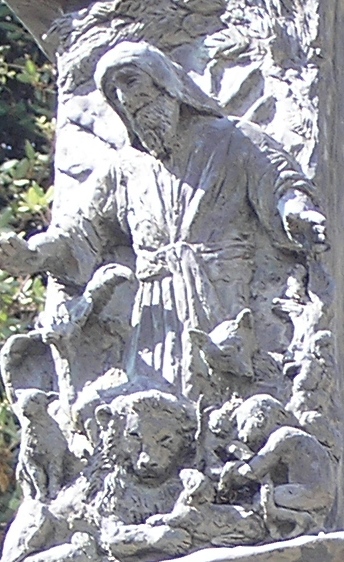
There are some verses in the prophesies of Isaiah from which this phrase may have originated, like Isaiah 11:6. On the 8th anniversary of the modern independence of the nation of Israel (in April 1956), the British parliament presented a bronze Menorah to the Israeli Knesset. Benno Elkan designed this beautiful piece, modeled after the lampstand in the Holy Place of the Temple. On one of the branches, Benno portrays the prophet Isaiah, and at his feet are images of a lion, a wolf, a lamb, and a small child.
But in the images on this menorah, based on so many Kingdom-anticipating passages throughout the Old Testament, is the hope for which we long. Peace is coming. It is peace purchased by the Prince of Peace and it is a peace that only He can establish and maintain.
To see the peace that will exist in God’s kingdom, we must look back to the beginning of Time. The Book of Isaiah has been called “the Bible within the Bible.” Partly because it is near the middle of the Bible, but partly because its 66 chapters (like the 66 books of the Bible) trace the perfection of God that was marred by sin, the ravages of sin, the redemption that comes only through the Messiah, and His eternal kingdom of peace that is for all who put their faith in Jesus. So today I want us to look at the first book of the Bible, the “Bible within the Bible,” and the last book of the Bible.
God created perfection in the Earth. Part of His plan included man and animals as herbivores (Genesis 1:29-30). At least one of God’s animals could talk (Genesis 3:1). Given the fact that neither Adam nor Eve were distressed by a talking snake, perhaps there was a way for man and animals to navigate their differences.
This encounter with the devil led to sin, which also opened the door for further pain and hardship—self-awareness that brought embarrassment, pain in childbirth, difficulty farming the land, and removal from the Garden of Eden (3:16-19).
Sin continued to ravage (Genesis 6:6). At the time of the Flood, it appears men and animals were still herbivores (vv. 20-21), but that changes after the Flood (9:1-6).
Sin ravages and destroys and enslaves people in their ungodly passions. God does forgive, but many times the consequences of sin still remain—as we witness in our world today.
Remember that after Adam and Eve sinned, they were aware of their nakedness. Their attempt to cover themselves was with what they had dominion over: fig leaves (Genesis 3:7). The very first animal sacrifice was performed by God Himself—an innocent calf or lamb had to shed its blood so that God could cover the shame of sin (v. 21).
Sinful man tries to copy what God did without calling on God Himself, and God sees it for what it is: a sham (Isaiah 65:1-7; Revelation 7:9-10).
Only Jesus can bridge the gulf between sinful man and righteous God (Isaiah 11:1-9; Revelation 5:1-6; 11-13).
“[Jesus] endured death as a lamb; He devoured it as a lion.” —Augustine
(see John 1:29; Revelation 1:18)
We get a small glimpse of the eternal kingdom during the Millennial Reign (Isaiah 65:17-25), but the eternal kingdom is the Reality for the saints of God forever (Isaiah 35:8-10; Revelation 21:1-8, 22:1-5)!
The next time you hear someone long for the day when “the lion will lay down with the lamb,” remind them that the Lion and the Lamb are one in the same. Jesus is BOTH our sacrificial Lamb that died in our place to pay the penalty of our sin AND He is the Lion that devoured death once for all!
There is an eternal Kingdom where peace and joy and wholeness are indescribable and unending. But we only get into this Kingdom by the blood of the Lamb and the power of the Lion!
Check out the previous statement we have discussed in this series by clicking here.
Listen to the podcast of this post by clicking on the player below, and you can also subscribe on Apple, Spotify, or Audible.
Charles Spurgeon said, “The resurrection of Christ is the cornerstone of the glorious temple of truth, the keystone of the arch of revelation.”
What we believe about the resurrection gives meaning and purpose to everything else. The resurrection is the defining Truth. In 2 Timothy 2:19 we read two important truths about this foundation: (1) God knows those who truly know Him, and (2) Those who really know Him must unabashedly stand for the Truth.
Words are powerful, they are creative. At the very beginning of Time, God said, “Light” and light existed (Genesis 1:1-3). God’s Word is still creating today (Hebrews 4:12). There are words we need to let go, and there is the Word for which we must stand without wavering or backing down.
In 1 Timothy 1:3-7, Paul essentially says we have two choices: Do we want to promote controversy or do we want to promote God’s work? We have to learn to distinguish what is biblical and what is not.
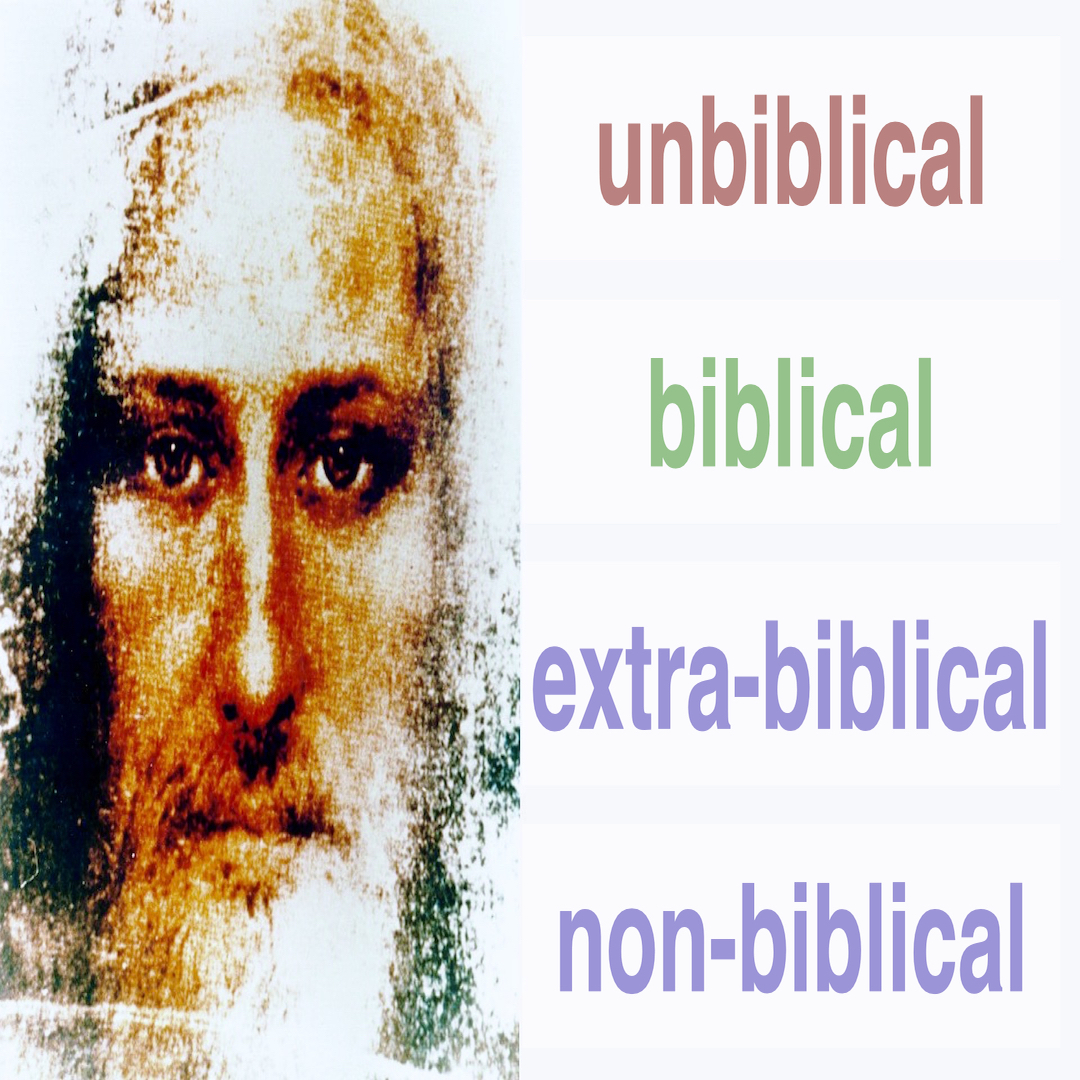
Biblical things—God’s Word clearly tells us “Yes” (2 Timothy 3:14-17)
Unbiblical things—God’s Word clearly tells us “No” (like: do not murder, do not commit adultery, etc.)
These two are fairly straightforward. As Dr. Donald Stamps wrote, “The Church has the responsibility to safeguard the true and original apostolic doctrines found in Scripture and commit it to others without compromise or corruption.”
What is harder to sort out is:
Extra-biblical things—something in addition to or outside of God’s Word
Non-biblical things—something not specifically addressed in God’s Word
Passages like 1 Timothy 4:1-7 and 2 Timothy 2:14-19 help us sort out biblical and non-biblical things.
Are extra-biblical things wrong? Not necessarily. Paul quoted poets, and even uses an extra-biblical example of Jannes and Jambres [who] opposed Moses (3:8).
Are non-biblical things wrong? Not necessarily. But both extra-biblical and non-biblical things can become wrong when we give these things biblical status (Mark 7:9).
“Church” and “Christian” can completely lose their biblical meaning if we allow unbiblical, extra-biblical, or non-biblical ideas to define them. We must stand firm on God’s Word to give biblical meaning to everything we say and do.
Jesus said, “I will build MY Church.” He’s going to build it His way, not our way. We don’t want to fight the Architect, but neither do we want to fight the erring saint or the scoffing skeptic (2 Timothy 2:22-26).
Let me give you four applications for this:
Do get into God’s Word everyday.
Don’t define the words but let God define His own words.
Do gently challenge those saints who are getting caught up in non-biblical or extra-biblical things.
Don’t quarrel with those who are living an unbiblical lifestyle (Colossians 4:5; Jude 1:22).
You can find all of the other messages in this series called “I will build My Church” by clicking here.
You may also be interested in these posts and videos:
A cold-case detective examines the universe as he would a crime scene. “The universe is an incredibly complex, finely tuned environment—so precise that carbon-based life like ours can exist at all. This point isn’t just made by those who believe in God; it’s widely recognized, even by critics and naturalists who try to account for the remarkable, razor-edge calibration of cosmological constants like the weak and strong nuclear forces, as well as electromagnetism. These are set within the narrowest tolerances. Just a slight deviation, and our universe would not be capable of sustaining life—yet, here we are.”
InThe Screwtape Letters, C.S. Lewis gives these words to Screwtape about politics: “About the general connection between Christianity and politics, our position is more delicate. Certainly we do not want men to allow their Christianity to flow over into their political life, for the establishment of anything like a really just society would be a major disaster. On the other hand we do want, and want very much, to make men treat Christianity as a means; preferably, of course, as a means to their own advancement, but, failing that, as a means to anything—even to social justice.”
A Christian brother or sister says or does something just a little “off.” How do you respond? “Now you’re pretty sure you should say something. But you’re also busy. Or you think someone else might be in a better position to bring it up. Or you hate uncomfortable conversations. (Or all of the above.) So you convince yourself to stay quiet.” Scott Hubbard shows us from Scripture why staying silent is not an option for Christians who love each other.
“According to Big Bang cosmology, we should be seeing these very distant galaxies, not as they are now, but as they were shortly after the Big Bang. Since star and galaxy formation should take many millions of years, theorists were not expecting to see many galaxies in the ‘early’ universe, and those that did exist were expected to be unevolved and immature. Yet data from the James Webb Space Telescope have been shattering these Big Bang expectations.” Check out this astronomical evidence that points to an all-wise Creator.
“Metabolomics is the study of chemical processes involving small molecules that were part of fats, proteins, amino acids, and nucleic acids.” This study has recently been applied to fossilized bones that have been excavated. The results: “Tiny chemical clues trapped inside ancient bones are revealing what animals ate, the diseases they carried, and the environments they lived in.”
“[God] unrolls before Job a long panorama of created things, the horse, the eagle, the raven, the wild ass, the peacock, the ostrich, the crocodile. He so describes each of them that it sounds like a monster walking in the sun. The whole is a sort of psalm or rhapsody of the sense of wonder. The Maker of all things is astonished at the things He has Himself made. This we may call the third point. Job puts forward a note of interrogation; God answers with a note of exclamation. Instead of proving to Job that it is an explicable world, He insists that it is a much stranger world than Job ever thought it was.” —G.K. Chesterton
There the angel of the Lord appeared to Moses in a blazing fire from the middle of a bush. (Exodus 3:2 NLT)
Chris Quilala said, “Throughout history God has revealed Himself in many different ways, leaving those touched by Him forever changed. … God’s miraculous display is never without purpose.”
Even outside the Bible, William Wilberforce was convinced of God’s creative power by watching a spider weave her web; C.S. Lewis believed in God’s presence by watching the wind swirl some leaves; John Newton fell to his knees in surrender on board a ship as he experienced God’s awesome power in a massive storm at sea.
God is always revealing Himself—always speaking to us.
Are you open to hearing His voice in both miraculous and everyday ways?
When we ready the Bible and it confronts us, the first place we need to look is in the mirror. The Bible is speaking first to me about changes I need to make. It’s only after I have applied God’s Word to my own life that I can talk about it authentically to others.
“Righteousness is nothing more or less than the character of Jesus Himself, manifesting in and through us into all our relationships, roles, and responsibilities.” —T.M. Moore
“At one time in Earth’s recent past people and all animals, including crocodiles, lions, T. rex, sharks, spiders, alligators, etc., were vegetarian. It is not known exactly when the transition to carnivorous and predatory behavior occurred, but we do know it happened after Adam and Eve sinned and did not involve evolution.” A recent analysis of a pterosaur’s stomach contents shows this vegetarian diet.
Cold-case detective J. Warner Wallace explains why the different accounts of the ministry of Jesus (as recorded in the four Gospels) actually bolster the case for their accuracy and historicity.
“It is when the thoughts of heaven are long out of the Christian’s sight, that he forgets his hope of that glorious place, that he begins to set up some idol…. Keeping the joy of heaven always before you will help you to run your race with patience. It will help you endure your short scuffles with temptation and affliction.” —William Gurnall, The Christian In Complete Armor
T.M. Moore wrote these sober words to the church: “The Lord sees His Church as the joy and beauty of the earth (Psalm 48:1-2), reflecting His splendor and goodness to the watching world. But when churches spend the bulk of their budgets and energies on themselves, it’s hard to see how they can be of much good in their local communities.”
“I love to think of nature as unlimited broadcasting stations, through which God speaks to us every day, every hour and every moment of our lives, if we will only tune in and remain so.” —George Washington Carver
J. Warner Wallace writes, “Some object, saying, ‘Christians are biased.’ But there’s an obvious oversight here. Yes, Matthew ultimately became a Christian, but look closely at his background. He started out as a tax collector named Levi—not a member of John the Baptist’s group, not a friend of Peter or Andrew, not one who grew up expecting a Messiah. He encountered Jesus, witnessed miracles, listened to teaching, and after observing all these things firsthand, became a follower. Don’t hold his subsequent transformation against him as if it poisons the well. The fact that someone who wasn’t predisposed to belief chose to follow Christ after seeing what he saw lends real weight to the testimony.” Read more about how our judicial system vets courtroom witnesses.
The writer of the Book of Hebrews challenges Christians to learn how to better encourage others and spur them on to their very best. This means we have to go deeper in our relationships with people. Here’s one way not to do this.
T.M. Moore cautions us against having a “too small God” mindset. He writes, “We are short-changing the people of God unless our preaching and teaching fits them to seek the Kingdom of God and the restoration of the world in all our life and work. We do not expect to recreate the original conditions that existed before the fall, but to remember them, to recall them, to recover a measure of them for the life of the world and, by so doing, to point ahead to the new and better and fully remade world that is to come.”
More archeological evidence from the city of Jericho helps scholars date the exodus from Egypt more precisely as well. All of this reinforces the absolute historicity of the biblical accounts.
“The Pentecostal movement emerged at the turn of the 20th century, resulting from a series of overlapping revivals that occurred around the world.” One of those revivals was in Wales.
“Although [traditional scientists] feel certain that dinosaurs went extinct 66 million years ago, unremitting soft tissue discoveries from dinosaur fossils openly challenge such age options and validate the creation model.” Check out how the Raman spectroscopy tests are aligning paleontological discoveries with the biblical timeline of Creation.
We have a culture where respect for others is eroding quickly. The Bible makes it clear that reverence for God results in respect for people, and respect for people helps us reverence the God who created them.
“The real great man is the man who makes every man feel great.” —G.K. Chesterton
Dr. Louis A. Markos has an insightful article on the works of C.S. Lewis that help us learn how to stay human. “Christians today who are committed to restoring a proper view of man have an ally in the greatest apologist of the twentieth century, C.S. Lewis (1898–1963). Though Lewis offers much help in his best-known apologetics books (Mere Christianity, The Problem of Pain, The Screwtape Letters, The Great Divorce) and his beloved Chronicles of Narnia, we would do well to expand our reading of Lewis to include his searing critique of modern educational philosophy (The Abolition of Man) and his anthropologically incisive science fiction novels, The Ransom (or Cosmic) Trilogy: Out of the Silent Planet, Perelandra, That Hideous Strength.”
The ICR has an article about a fascinating new dinosaur that was unearthed. “Even now in the twenty-first century, paleontologists are still at a loss as to the origin of the dinosaurs. As recently as 2024, five evolutionists stated, ‘Today, inspired by clues from fossils and footprints from a lost world, scientists continue to piece together the puzzle of how various dinosaur groups arose, behaved, and diversified.’ In contrast, the creation model argues that all dinosaur kinds were created during the same period—specifically on Day 6 of the creation week—several thousand years ago. From this perspective, the lack of definitive transitional forms or ancestral precursors in the fossil record aligns with the expectation that dinosaur kinds appeared fully formed and distinct, as observed in the fossil record.”
Axis’ Culture Translator discusses an article posted in Harper’s: “Many have written about how porn warps the expectations users have for relationships; this article demonstrates that, for young men in particular, pornography is often willingly embraced as a complete replacement for human connection. … Woven throughout this subculture is also conscious self-degradation; as the Harper’s article points out, ‘ruin your mind,’ ‘go deeper,’ and ‘give up on life’ are embraced as the movement’s rallying cries. Many young men and women are trapped in this spiritual prison, convinced there is nothing better to live for. Who will show them the way out?” Two helpful resources are Fight The New Drug and Pure Desire.
Leaders need to learn that disagreement on your team is normal and can be healthy. Disagreement doesn’t mean people distrust their leader, but it may mean that they want the bring out the best in their leader. Check out the full conversation Greg and I had on this subject.
Controlling leaders shut down creativity among their teammates, which leads to higher turnover. If your team isn’t sharing their good ideas with you or if they are leaving you, that may be an indicator that you are too controlling. Check out the full conversation on The Craig and Greg Show
“As a fact, men only become greedily and gloriously material about something spiritualistic. … Take away the supernatural, and what remains is the unnatural.” —G.K. Chesterton
Astronomical technology like the James Webb Space Telescope (JWST) are providing breathtaking images. They are also creating problems for the scientific theories of the origins of our universe. University of California Santa Barbara physicist Caitlin Casey, said, “It makes sense—the Big Bang happens and things take time to gravitationally collapse and form, and for stars to turn on. There’s a timescale associated with that…. And the big surprise is that with JWST, we see roughly 10 times more galaxies than expected at these incredible distances.” There is a more straightforward answer found in Genesis 1:1, “In the beginning, God created the heavens and the earth.”
“Knowing where God wants people to be and taking the initiative to use God’s gifts and God’s methods to get them there, in reliance on God’s power through Christ, with God’s appointed people following.” —John Piper, giving his definition of godly leadership
The Bible records the names of five Persian kings. One of them called “Darius the Persian” in Nehemiah 12:22 requires some historical cross-referencing to identify. The Bible Archeology Report presents another one of their fascinating archeological biographies on this Persian king.
“The greatness of a leader is in his humility before God, not in his eloquence before men.” —Anonymous
The most viewed and downloaded resource on my blog is my chart of the kings of the united kingdom of Israel and the divided kingdoms of Israel and Judah. I was thrilled to discover this week that Jacob Edson at Biblegateway has taken my chart even deeper!
T.M. Moore has vital counsel for pastors, “Jesus must increase in us, and we must decrease. But that doesn’t just happen by carrying out whatever our ‘spiritual work’ requires of us week-in and week-out. Our ‘natural gifts’ cannot replace spiritual ones, and ‘mental powers’ are no match for the mind of Christ. It is a shepherd’s ‘duty’ to attend to the care and nurture of his soul, for unless we are diligent in this, we will not be able to lead the Lord’s sheep into a greater experience of our great salvation or a fuller realization of His Kingdom.”