Proving My Claims

Listen to the podcast of this post by clicking on the player below, and you can also subscribe on Apple, Spotify, or Audible. 

Whoever claims to live in Him must live as Jesus did. (1 John 2:6) 

If I claim…
…I have fellowship with Jesus
…I know the truth
…I am done with sinning
…I live in the light

Then I must think, speak, and act like Jesus. 

To prove my claims I must show that…
…I know the Truth and live in it
…I quickly confess and repent of sin
…I know His commands and obey them
…I know His love and I love others

There is no better proof for my claims than Christlikeness! 

As Charles Spurgeon said,

“When we try to be, in every respect, what God’s Word tells us we ought to be, then may we know that we are in God; but if we walk carelessly, if we take no account of our actions, but do, after a random fashion, whatever comes into our foolish hearts, then have we no evidence at all that we are in God.” 

The proof of our claims is self-evident. John uses the phrase “this is how we know” 8 times in this letter, and he uses the word “know” another 35 times! 

It’s not enough for me to verbally make the claims, but people should hear the words of Jesus in my mouth, see His compassion in my actions, and know His love fills my heart and informs my mind. 

I’ll say it again: There is no better proof for my claims than Christlikeness. I know it, everyone who sees or hears me knows it, and, most importantly, Jesus knows it. 

Dear children, let’s not merely say that we love each other; let us show the truth by our actions. Our actions will show that we belong to the truth, so we will be confident when we stand before God. (1 John 3:18-19 NLT) 

►► Would you please prayerfully consider supporting this ministry? My Patreon supporters get behind-the-scenes access to exclusive materials. ◀︎◀︎

Helping Others Follow Jesus

Listen to the podcast of this post by clicking on the player below, and you can also subscribe on Apple, Spotify, or Audible. 

Remember your leaders… (Hebrews 13:7). 

As the writer of Hebrews closes his epistle, he speaks to the saints about how they should interact with their leaders (Hebrews 13:7-21). He concludes this section by saying their confidence in their leaders brings joy to their leaders. 

But I would like to flip the script on this to describe how leaders are supposed to live in a way that makes it a joy for people to follow their leadership. 

So, leaders, let’s make sure we are…

…speaking the Word of God, not any kinds of “strange teachings” (vv. 7, 9). 

…living a life worthy of imitation. This requires a consistent and steadfast example of Christ-like living (vv. 7-8). 

…strengthening people with grace, not man-made strategies (v. 9). 

…not giving ourselves special privileges just because we are in leadership positions (v. 10). 

…not concerned with public perceptions while we stand for Jesus (vv. 11-13). 

…keeping in mind that our reward is in Heaven, so we don’t look for human accolades here but in “the city that is to come” (v. 14). 

…setting the example in hospitality (v. 16). 

…leading with the integrity and gentleness that makes it easy for saints to have confidence in our leadership (v. 17a). 

…serving with sober joy (v. 17b). 

…praying for others to be empowered “to live honorably” and with a clear conscience (vv. 18-19). 

A mark of a godly leader is one who makes it desirable for others to follow Jesus. 

Jesus is “that great Shepherd of the sheep” (v. 20). We are merely under-shepherds of small flocks, but we have been appointed to this pasture by Him. 

He will equip us “with everything good for doing His will” (v. 21a), which means we don’t have to attempt to equip ourselves. Instead, we can operate in His empowerment. 

He will also work in us “what is pleasing to Him” (v. 21b). We are not trying to please people, but we should want to please the One to Whom we must give an account. 

All “glory for ever and ever” goes to Him! We are not serving as His under-shepherds so that we can be recognized, but so people can draw closer to Him. We shepherd people to make Jesus known. 

If we will keep these things in mind, we are free to serve. Leaders who are secure—who are humbly confident in their calling—are leaders who are easy to follow. 

Let’s pray: Holy Spirit, help me to lead in a way that allows others to see Jesus because of my lifestyle. I want to be an example that helps others draw ever closer to Him. Amen! 

This is part 88 in my series on godly leadership. You can check out all of my posts in this series by clicking here. And you may also want to check out my books for church leaders—Shepherd Leadership and When Sheep Bite. 

►► Would you please prayerfully consider supporting this ministry? My Patreon supporters get behind-the-scenes access to exclusive materials. ◀︎◀︎

Be Careful About Arguing

Listen to the podcast of this post by clicking on the player below, and you can also subscribe on Apple, Spotify, or Audible. Check out the video content in this post by clicking here. 

If you are reading the Gospels with the words of Jesus printed in red, there is one place where the red ink virtually disappears: When Jesus is on trial before Pilate, Herod, and the Sanhedrin. There’s an important lesson here for us. 

This clip was from a sermon entitled The Essential Confession. The Scripture I reference in this clip is Matthew 16:24-27.

I allude to three related blog posts: 

My book When Sheep Bite addresses some biblical responses to the attacks that come our way. I encourage you to check it out. 

►► Would you please prayerfully consider supporting this ministry? My Patreon supporters get behind-the-scenes access to exclusive materials. ◀︎◀︎

The Perfection Race

Listen to the podcast of this post by clicking on the player below, and you can also subscribe on Apple, Spotify, or Audible.  

I am wrapping up my first full school year at Cedar Springs Public Schools. It has been a challenging journey—much more challenging than I could have anticipated before I started in this role. Together with my administrators and teammates we have put some new things in place that I hope will serve our staff and students well for years to come. It’s not perfect, but it’s better than it was. Now we get to watch to see what happens next. 

There is another amazing and challenging journey I am on (and so are you). But this is a journey toward perfection.

Some amazing faith-filled people have already ran their race well and their lives are recorded for us in Hebrews 11. The writer tells us, “all these people were still living by faith when they died” (11:13). “These all were commended for their faith, yet none of them received what had been promised, since God had planned something better for us so that only together with us would they be made perfect” (vv. 38-39). 

(See all of the Scriptures verses in this post by clicking here.)

Jesus is the one who makes this perfection accessible:

  • Once made perfect, He became the Source of eternal salvation for all who obey Him (5:9)
  • The Son, who has been made perfect forever (7:28) 
  • For by one sacrifice [Jesus] has made perfect forever those who are being made holy (10:14) 

Even before our forerunners were on earth, the Lamb of God was already slain as the perfect sacrifice to make us perfectly holy in God’s sight. They ran their race by faith without seeing this reality fulfilled (11:13). Now they make up the “cloud of witnesses” (12:1) who are cheering us on in our race. 

They were empowered by faith in their coming Messiah; we are empowered by our faith in the Messiah who has been revealed to us. Their race was as vital to our race, as our race is to theirs. Our race shows them how invaluable their race was. 

It is a race toward the perfection for which Jesus paid such a steep price. 

“You have come to Mount Zion…to the church of the firstborn, whose names are written in heaven. You have come to God, the Judge of all, to the spirits of the righteous made perfect” (12:22–23). 

“Only together” (11:40) do we all get there. My race—the way I am living right now—is as important and indispensable as their race was. So I will keep my “eyes on Jesus, the Pioneer and Perfecter of [our] faith” (12:2) so that I can run and finish my race with perfection! 

I hope you will run with me, with all the saints who have come before us, and with those saints who are still running alongside us today. Your race, run in the perfection of Jesus, matters! 

►► Would you please prayerfully consider supporting this ministry? My Patreon supporters get behind-the-scenes access to exclusive materials. ◀︎◀︎

A Gentleman For Jesus

Listen to the podcast of this post by clicking on the player below, and you can also subscribe on Apple, Spotify, or Audible. 

In some of the final words Paul wrote to his friends in Philippi, he said, “Let your gentleness be evident to all” (Philippians 4:5). 

Today, we don’t often refer to people as gentlemen or gentlewomen, but Paul suggests that saints should strive to earn this title every day. 

The Greek word means behavior that is suitable for the occasion; not someone given to extremes nor being unpredictable. Paul uses this word in his leadership qualifications to both Timothy and Titus (1 Timothy 3:3; Titus 3:2). Peter uses this word for servants in relationship to their masters (1 Peter 2:18), and James uses it to describe what godly wisdom looks and sounds like (James 3:17). 

(See all the Scriptures I use in this post here.) 

When Paul says that our gentleness is to be “evident to all,” he uses a word that means intimate relationships. In other words, those who are closest to us should be the most aware of our gentleness. But it also means that anyone should be able to predict quite accurately how a gentleman or gentlewoman is going to behave or respond in the situations they are in. 

Look how this phrase is rendered in other Bible translations:

  • AMPC: Let all men know and perceive and recognize your unselfishness. 
  • NLT: Let everyone see that you are considerate in all you do. 
  • KJV: Let your moderation be known unto all men. 

How do I know if I am being a gentleman for Jesus? I must look in the mirror of others’ faces. If they are wondering how I am going to respond, or if they are shocked at how I just responded, then they must not know my gentlemanliness. I cannot excuse my unpredictable or unseemly response with excuses like, “I was caught off guard,” “I was having a bad day,” or “They just don’t know me very well.” 

Being a gentleman for Jesus is totally on me. It’s up to me to allow the Holy Spirit to develop the fruit of gentleness in me; it’s not on others to excuse my poor behavior. 

Christians, I pray that we may be known as the best of gentlemen or gentlewomen wherever we go and in whatever circumstances we find ourselves. After all, Paul concludes this verse in Philippians 4:5 with a heavy reminder for us: “The Lord is near.” 

►► Would you please prayerfully consider supporting this ministry? My Patreon supporters get behind-the-scenes access to exclusive materials. ◀︎◀︎

Faith Works

I pray that your partnership with us in the faith may be effective in deepening your understanding…. (Philemon 6 NIV) 

Faith works! As Dr. Henry Halley noted, “Working faith is a sharing faith.” 

Faithful working deepens our understanding of all the good things Jesus has given us. Those good things should then fuel us to share the good things—and the Source of all good things—with others. 

I pray that the faith you share with us may deepen your understanding of every blessing that belongs to you in Christ. (Philemon 6 NET) 

A faith that merely believes without acting would be an ineffective faith. A faith that works becomes a lifestyle testimony that points others to Jesus. 

And I keep praying that this faith we hold in common keeps showing up in the good things we do, and that people recognize Christ in all of it. (Philemon 6 MSG) 

It is a double blessing to do good things for others: 

  1. I get to see more of Christ’s blessings. 
  2. Others get to see more of Christ Jesus. 

You may also want to check out:

Integrity And Godly Sincerity

Listen to the podcast of this post by clicking on the player below, and you can also subscribe on Apple, Spotify, or Audible. 

The apostle Paul had spent 18 months living and teaching in Corinth, he had likely visited them at least a couple of times, he had written two letters to them, and his associates had visited Corinth on his behalf. Bottom line: The Corinthians knew Paul well. 

With that in mind, Paul boldly states, “Now this is our boast: Our conscience testifies that we have conducted ourselves in the world, and especially in our relations with you, with integrity and godly sincerity” (2 Corinthians 1:12). 

Integrity means “the virtue of one who is free from pretense and hypocrisy.” Some biblical translations use the word holiness here. Indeed, for Christians integrity and holiness should be synonymous. The conclusion of this verse goes on to state that Paul could live this way “not according to worldly wisdom but according to God’s grace.” Paul knew that even more than the Corinthians, God knew Paul’s holy integrity. 

Paul also says that his conduct was with godly sincerity. You might think that the idea of sincerity or mental honesty is implied in the word integrity, but godly sincerity is a pureness that stands up to intense scrutiny. It’s not just a public act, but it is a consistently God-honoring way of living both publicly and privately. 

These two qualities give a godly leader moral authority like nothing else can. It’s authority that is felt as well as seen—it’s the “It Factor” that marks the Holy Spirit’s anointing on a leader. 

Paul is aware that his lifestyle could cause people to think well or to think poorly of the Gospel of Jesus. Just a few verses later, Paul uses the phrase “yes and no” twice (vv. 18-19). 

First, Paul reminds the Corinthians that he doesn’t “in the same breath say both ‘Yes, yes’ and ‘No, no.’” This means he doesn’t want his lifestyle to negate his preaching. 

Second, Paul wants to assure them that all of the promises of God are “‘Yes’ in Christ” (v. 20). He knows that a preacher who lives contrary to his preaching—whose walk doesn’t align with his talk—is not only a hypocrite before God, but a stumbling block to all who have put their faith in Jesus as a result of that preacher’s message. 

Integrity and godly sincerity are absolutely essential for those who proclaim the Gospel. 

Godly leaders must be vigilant. They must be ruthless with themselves so there isn’t even the slightest lapse of integrity. Any infractions in a leader’s integrity and godly sincerity could cause others to doubt that Christ’s “Yes” is truly a trustworthy “Yes.” 

May we all live in such a way that we, like Paul, can stand before those who know us best and assuredly say, “I have lived with all integrity and godly sincerity before both God and you!” 

►► Would you please prayerfully consider supporting this ministry? My Patreon supporters get behind-the-scenes access to exclusive materials. ◀︎◀︎

Praying To Hallow God’s Name

Listen to the podcast of this post by clicking on the player below, and you can also subscribe on Apple, Spotify, or Audible. 

We said our protocol in approaching Almighty God in prayer is found in just two words: Our Father. 

Notice the transition: your Father (3x in Matthew 6:6, 8) to Our Father (6:9). How does this happen? Jesus makes it possible and the Holy Spirit continually reminds us of Christ’s completed work (Hebrews 2:11; John 14:13-14; Romans 8:15-16). 

It’s not just “our Father” but “our Father in Heaven.” Let’s remember that our Father is both All-loving and All-powerful. The phrase in Heaven reminds us of His absolute sovereignty. “Our God is in heaven; He does whatever pleases Him” (Psalm 115:3). What pleases Him? To give us His kingdom (Luke 12:32). 

Then there’s another phrase that is vital: Our Father in Heaven, hallowed be Your name. 

Hallowed means both to acknowledge His greatness and to keep Him separate from any profane things. What is profane? The dictionary says it is irreverence or contempt for God. The opposite of profane is holiness—something set apart exclusively for God. This is not something better than something else, but something exclusively that will bring glory to our Father in Heaven.

The root word for hallowed is “holy.” We see this literally translated in the name Holy Spirit. It is a word also referring to Jesus when He is called “the Holy One of God” (see Mark 1:24). The angel uses the word twice when he says, “The Holy Spirit will come on you, and the power of the Most High will overshadow you. So the Holy One to be born will be called the Son of God” (Luke 1:35). 

And that same word translated hallowed and holy is also translated saints. Literally that means “holy ones” or set apart people. 

Jesus is teaching us that our prayer is BOTH an acknowledgment of how God’s name is to be hallowed AND a request that He would empower us to pray and live in ways that makes that happen. 

This means our attitude needs to be focused on God’s reputation not my reputation (as in Matthew 6:5, 7:21-23). 

“Our Father in Heaven, hallowed be Your name” is both an attitude of prayer and a lifestyle. 

We hallow God’s name when our prayer and daily lifestyle bring Him the supreme glory that is due exclusively to His awesome name! When we keep our eyes and hearts on Him, He will provide everything else we need (see Matthew 6:32-33). 

To follow along with all of the message in this prayer series called Kingdom Praying, please click here. 

►► Would you please prayerfully consider supporting this ministry? My Patreon supporters get behind-the-scenes access to exclusive materials. Like this exceptional Bible study tool to help with Creation apologetics. ◀︎◀︎

Thursdays With Spurgeon—Understanding Repentance

This is a weekly series with things I’m reading and pondering from Charles Spurgeon. You can read the original seed thought here, or type “Thursdays With Spurgeon” in the search box to read more entries.

Listen to the podcast of this post by clicking on the player below, and you can also subscribe on Apple, Spotify, or Audible. 

Understanding Repentance

     Repentance is an old-fashioned word, not much used by modern revivalists. 

     “Oh!” said a minister to me one day, “it only means a change of mind.” This was thought to be a profound observation. “Only a change of mind”; but what a change! A change of mind with regard to everything! 

     Instead of saying, “It is only a change of mind,” it seems to me more truthful to say it is a great and deep change—even a change of the mind itself. But whatever the literal Greek word may mean, repentance is no trifle. You will not find a better definition of it than the one given in the children’s hymn:

     Repentance is to leave
     The sins we loved before
     And show that we in earnest grieve,
     By doing so no more.

From The Soul Winner

The Greek word Spurgeon references that is rendered as repentance is metanoia. Many have translated this as a “new mind.” But a more literal translation is “with new understanding.” When my carnal mind has been replaced by a spiritual mind, I now see everything differently—I understand everything differently. 

The Amplified Bible elaborates it like this: Bring forth fruit that is consistent with repentance—let your lives prove your change of heart (Matthew 3:11). 

More than just an about-face away from my old sinful habits, repentance is a more profound understanding of just how grievous my sinful lifestyle was to God. It repulses me to even consider indulging in those sins again because now that I understand how joy-filled my relationship with Jesus is when I walk in righteousness, I never want to even dabble in that slime again! 

I don’t want to see how close I can get to sin, but I want to see how close I can get to Jesus! When I truly have repented of my sins, the Holy Spirit has given me a whole new understanding of both the pain of sin and the joy of righteousness. Let’s become people so quick to repent anytime the Holy Spirit convicts us of even the smallest of sins.

►► Would you please prayerfully consider supporting this ministry? My Patreon supporters get behind-the-scenes access to exclusive materials. ◀︎◀︎
Thursdays With Spurgeon—Keep Moving Forward

This is a weekly series with things I’m reading and pondering from Charles Spurgeon. You can read the original seed thought here, or type “Thursdays With Spurgeon” in the search box to read more entries.

Listen to the podcast of this post by clicking on the player below, and you can also subscribe on iTunes or Spotify.

Keep Moving Forward  

For we walk by faith, not by sight. (2 Corinthians 5:7) 

     God does not say to us, ‘This is the way,’ and then stop. He says, ‘This is the way, walk in it.’ We are always to be making advances. We are to be going from faith in its beginnings to faith in its perfections, from faith to assurance, from assurance to full assurance. And from there, we are to go to the full assurance of hope to the full assurance of understanding, always forward, waxing stronger and stronger. …  

     The Christian’s motto is ‘Upward and onward.’ Not as though he has already obtained, either is already perfect, he presses forward to the mark for the prize of his high calling in Christ Jesus. …  

     Can you perform the common activities of the household and the daily duties that fall to your lot in the spirit of faith? This is what the apostle means. He does not speak about running or jumping or fighting, but about walking—and he means to tell you that the ordinary life of a Christian is different from the life of another man—that he has learned to introduce faith into everything he does. 

From Faith Versus Sight

I have a t-shirt that says on the front, “Keep moving forward.” But the back of the t-shirt has the real-life challenge: “Crawling is acceptable. Falling is acceptable. Puking is acceptable. Crying is acceptable. Pain is acceptable. Quitting is not!” 

How true! 

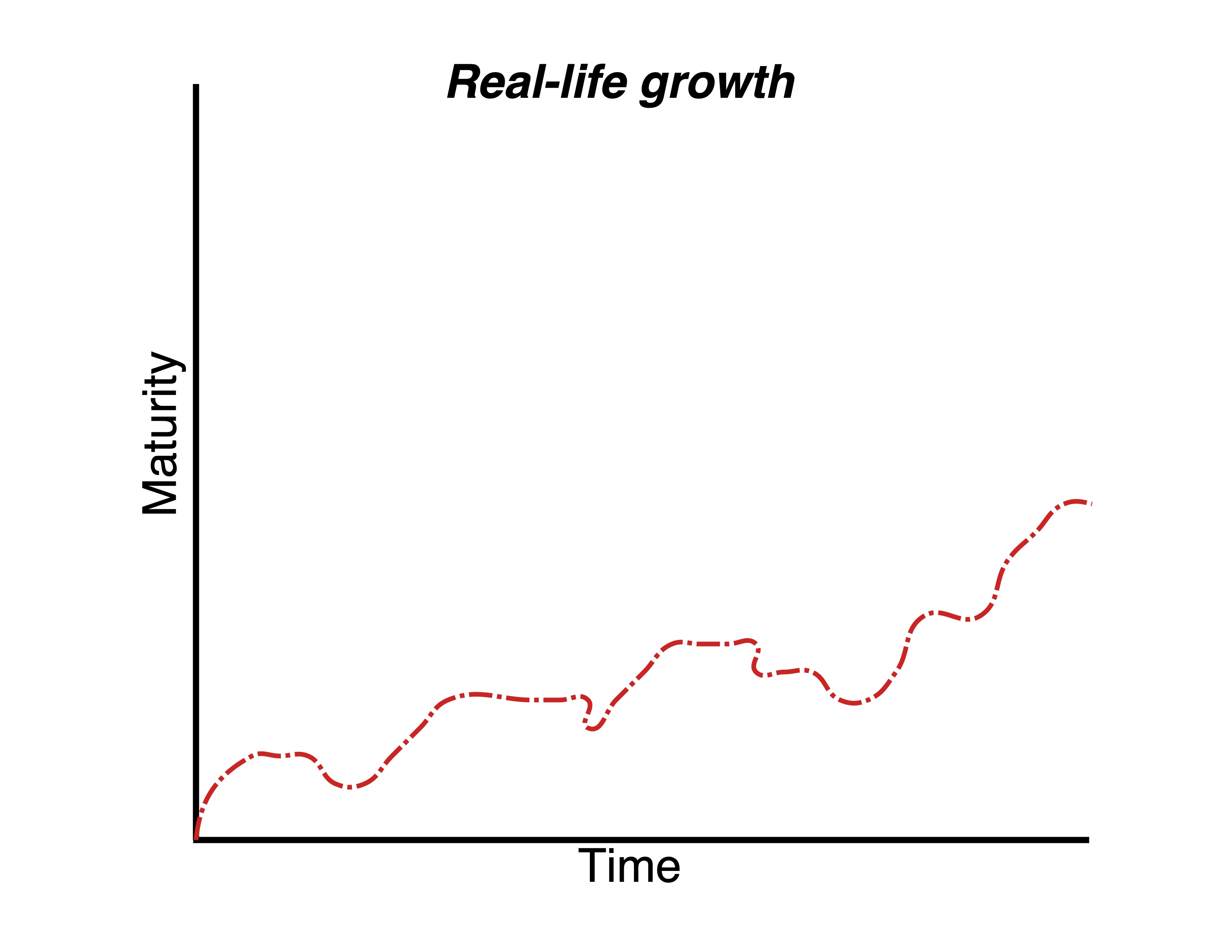
I think the problem for many Christians is that they have an unrealistic expectation of growth. Somehow we’ve come to believe that our Christian growth is a constant upward trajectory to maturity, and that if there are ever any stumbles along the way, that means we’ve blown it. (By the way, Oswald Chambers has some helpful thoughts on our stair-step growth.)

But Paul tells us, “We walk”: We keep moving forward. That doesn’t mean there aren’t times of stumbling, or a plateau, or even a pause to catch our breath. Paul tells us that an important aspect of our walk is that we forget what’s behind us and we keep moving forward—keep walking—keep going. 

Every single day, let us say along with Paul, “I don’t mean to say that I have already achieved these things or that I have already reached perfection. But I press on to possess that perfection for which Christ Jesus first possessed me. No, dear brothers and sisters, I have not achieved it, but I focus on this one thing: Forgetting the past and looking forward to what lies ahead, I press on to reach the end of the race and receive the heavenly prize for which God, through Christ Jesus, is calling us” (Philippians 3:12-14 NLT). 

My friend, keep moving forward in faith, believing that the Holy Spirit is with you—maturing you, strengthening you—on every single step on your Christian walk.

►► Would you please prayerfully consider supporting this ministry? ◀︎◀︎