The Daily Transformation And Testimony

Listen to the podcast of this post by clicking on the player below, and you can also subscribe on AppleSpotify, or Audible.  

Recently, I read two wise authors who spoke the same message to my heart on the same day. 

C.S. Lewis in Mere Christianity wrote—

     “And now we begin to see what it is that the New Testament is always talking about. It talks about Christians ‘being born again’; it talks about them ‘putting on Christ’; about Christ ‘being formed in us’; about our coming to ‘have the mind of Christ.’ 

    “Put right out of your head the idea that these are only fancy ways of saying that Christians are to read what Christ said and try to carry it out—as a man may read what Plato or Marx said and try to carry it out. They mean something much more than that. They mean that a real Person, Christ, here and now, in that very room where you are saying your prayers, is doing things to you. It is not a question of a good man who died two thousand years ago. It is a living Man, still as much a man as you, and still as much God as He was when He created the world, really coming and interfering with your very self; killing the old natural self in you and replacing it with the kind of self He has. At first, only for moments. Then for longer periods. Finally, if all goes well, turning you permanently into a different sort of thing; into a new little Christ, a being which, in its own small way, has the same kind of life as God; which shares in His power, joy, knowledge and eternity.”

And Andrew Murray wrote in The Inner Life

    “It is not the interest or success of my Bible study. It is not the increased insight or understanding I am obtaining that brings health and growth to my spiritual life. Rather, this often leaves me very unspiritual with little of the holiness or humility of Christ Jesus. Something else is necessary in order for spiritual growth to take place. 

    “Jesus said: ‘…My meat is to do the will of Him that sent Me…’ (John 4:34). We must take a small portion of God’s Word, some definite command or duty of the new life, and quietly receive it into our will and our heart. We must yield our whole being to its rule and vow in the power of the Lord Jesus to perform it. Then, we must go and do it—this is eating the Word. We take it into our inmost being until it becomes part of our very life.” 

Praying a prayer in which I ask God to forgive me of my sins because I believe what Jesus did for me on the Cross is the first step into a new life. 

But, tragically, many people stop there. 

They believe praying this prayer was both the means and the end. They think that now they have secured their place in heaven and they can simply resume their daily routine—with the exception of adding in some church attendance during their weekend—until “the end.” 

They expect that this end will be a very long way off, and it will come to them peacefully, only after they have lived a full and pain-free life. In short, they love the idea of Jesus as their Savior, but they very much want to remain the lord and master of their own life. So they will express their gratitude to God when things are going as they have planned, and they will sulk and angrily, tearfully implore His help in prayer when their plans have gotten off track. 

Jesus cannot be merely our Savior—He must be our Lord and Master as well. 

The Holy Spirit wants to transform our lives. The Bible calls this process sanctification, but I like to call it saint-ification. This is the daily and ongoing process to bring increasingly more Christ-likeness to us. This is not a replacing of our personality, but a revealing of our real selves as God intended. 

Our lives are to grow, expand, and glow with the presence of Christ in us. We are to become more and more satisfied in God as the Holy Spirit conforms us into the image of Christ. Our eternal abiding in God’s presence is to begin the moment we invite Him into our heart—and then continue uninterrupted even after we take our last breath on earth. 

As our lives are transformed, we become living, breathing testimonies to others of the life-changing power of God’s love in us and through us. 

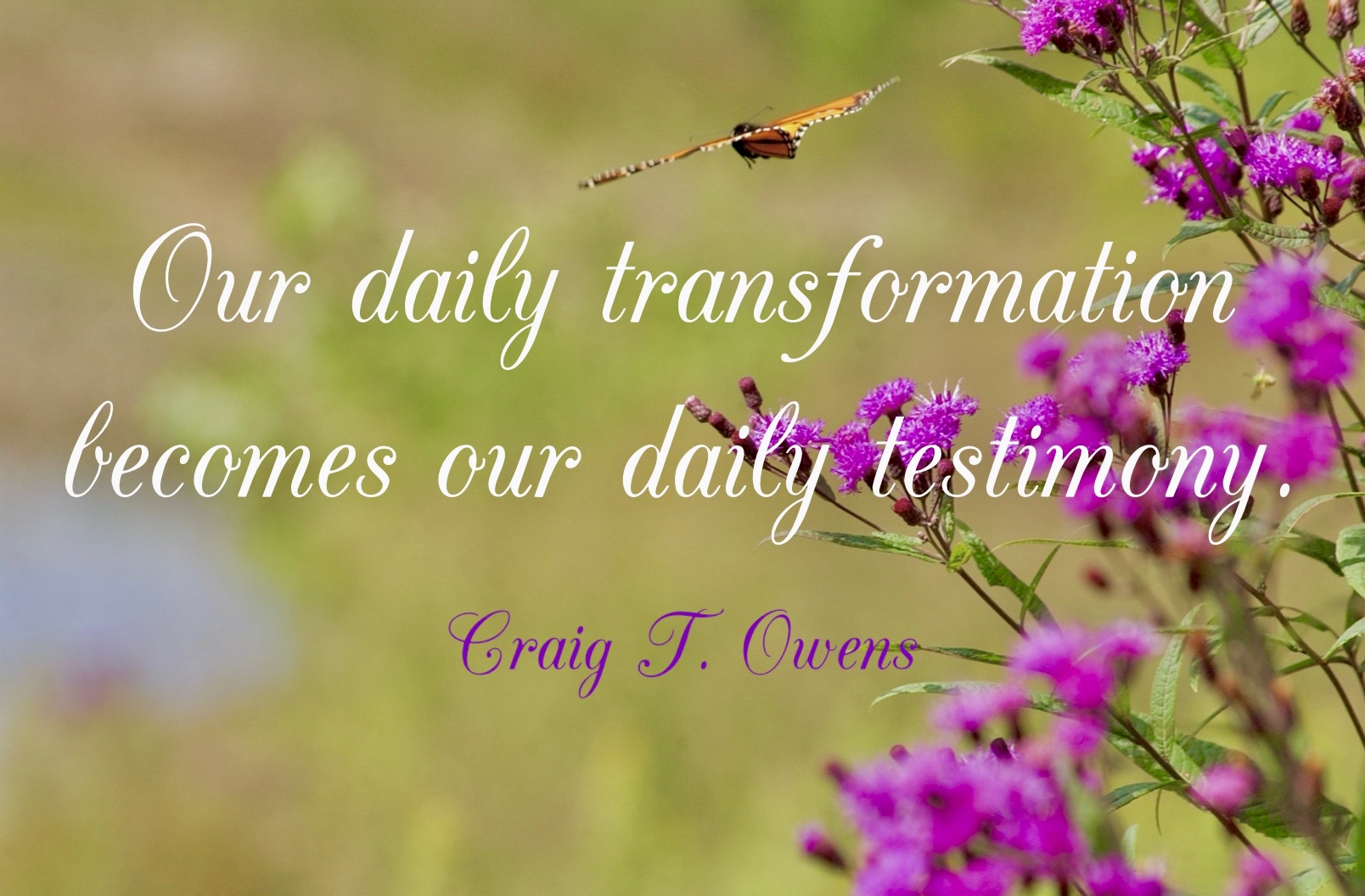
Our daily transformation becomes our daily testimony. What joy and fulfillment there is in allowing this to happen! 

Knowing Jesus as your Savior is amazing, but don’t miss out on the best part of all: Knowing Jesus as your Lord, allowing the Holy Spirit to transform you, and becoming a living testimony of God’s love! 

►► Would you please prayerfully consider supporting this ministry? My Patreon supporters get behind-the-scenes access to exclusive materials. ◀︎◀︎

Links & Quotes

It’s not possible for you to have experienced everything that those around you have experienced. But you can still empathize with them through an empathetic volley of statements and questions. This is what exemplary leaders do.

I have a lot of new video content on my YouTube channel every week. Please check it out and subscribe so you don’t miss anything.

“The Christian way is different: harder, and easier. Christ says ‘Give me All. I don’t want so much of your time and so much of your money and so much of your work: I want You. I have not come to torment your natural self, but to kill it. No half-measures are any good. I don’t want to cut off a branch here and a branch there, I want to have the whole tree down. I don’t want to drill the tooth, or crown it, or stop it, but to have it out. Hand over the whole natural self, all the desires which you think innocent as well as the ones you think wicked—the whole outfit. I will give you a new self instead. In fact, I will give you Myself: My own will shall become yours.’” —C.S. Lewis, in Mere Christianity 

There are so many resources today to help Christians defend their faith. Check out this post from John Stonestreet and the numerous books you might want to add to your library. 

“If we are to influence the Church and the world around us, we must be full of God and His presence. Everything else must be secondary to this one question: How can we have the power of Christ resting on us all day long?” —Andrew Murray 

Clinton Manley wants to know why Christians don’t play more. “The Hebrew word most often translated as ‘play’ (śāḥaq) comes from a verb meaning ‘to laugh.’ Intensify that verb, and you get ‘to sport, play, or celebrate.’ So we can say play is to action as laughter is to sound. At its best, laughter is a sound that both expresses and intensifies joy; similarly, play is an action that expresses and intensifies joy. Thus, play can involve almost any activity…as long as it is done from joy and for joy.” 

“None are more hopelessly enslaved than those who falsely believe they are free.” —Goethe 

J. Warner Wallace shares writings from ancient historians—in fact, those hostile to the claims of Christianity—that point to the historicity of Jesus. 

Links & Quotes

When Queen Esther went into the king’s throne room, she was unsure if the king’s favor would be extended toward her. But because of what Jesus did for us on the Cross, we can be assured that God’s favor is extended toward us before we even approach His throne. 

I have a lot of new video content on my YouTube channel every week. Please check it out and subscribe so you don’t miss anything.

“Christian, there is a terrible danger to which you stand exposed in your inner chamber of prayer. You are in danger of substituting prayer and Bible study for living fellowship with God. … Your Bible study may so interest you that the very Word of God may become a substitute for God Himself. The greatest hindrance to fellowship is anything that keeps the soul occupied instead of leading it to God Himself. … Separation from others, in solitude with God—this is the sure, the only way to live in harmony with people in the power of God’s blessing.” —Andrew Murray 

John Stonestreet writes, “In light of the 250th anniversary of the Declaration of Independence, much ink is being spilled over the document’s significance…[and] one way to understand the Declaration is through the lens of science.”

“If we are slandered and evil spoken of, let us not be quick to reply, or to grow angry. Let us be slow—very slow—to wrath; it will be our wisdom, for no good comes of human wrath.” —Charles Spurgeon 

“A Christian society is not going to arrive until most of us really want it: and we are not going to want it until we become fully Christian. I may repeat ‘Do as you would be done by’ till I am black in the face, but I cannot really carry it out till I love my neighbor as myself: and I cannot learn to love my neighbor as myself till I learn to love God: and I cannot learn to love God except by learning to obey Him.” —C.S. Lewis, in Mere Christianity 

In looking at 1 Corinthians 7:2–5, Tilly Dillehay writes, “Paul does not deal here with sex as procreation—though we know from the whole testimony of Scripture that sex and procreation are blessedly intertwined. Instead, this passage highlights other purposes of sex.” Here are three biblical ways to view marital sexual activity.

J. Warner Wallace notes, “Yes, Matthew emphasizes things Luke doesn’t. John includes moments Mark skips. But that’s exactly what you’d expect if independent witnesses were describing the most significant events in human history. If the Gospel writers had colluded to fabricate a story, the accounts would have matched perfectly—and then I’d be suspicious. But they didn’t.”

T.M. Moore writes, “The power of God’s Kingdom is His Holy Spirit. The Spirit Who brooded over the entire creation. The Spirit Who roams and pervades the world. The Spirit Who inspired the prophets, raised Jesus from the dead, birthed the Church on the first Christian Pentecost, gave words to the apostles, and has given us a new heart and resides within our soul, that Spirit, that Light and Power, is at work within us, that we should be willing and able to do that which leads to the pleasure of God (Philippians 2:12-13).” Check out his post Plug Into the Power. 

Links & Quotes

Quality leaders empathize with their teammates, but struggling leaders use their teammates’ stories as a lead-in to tell their own stories. Don’t be a one-upper! Check out our full conversation about the power of a leader’s empathy.

I have a lot of new video content on my YouTube channel every week. Please check it out and subscribe so you don’t miss anything.

“Personal devotion to a friend or a pursuit means that they will always hold a place in our heart, even when other people and things occupy our attention. Personal devotion to Jesus means that we allow nothing to separate us from Him for a moment. To abide in Him and His love, to be kept by Him and His grace, to be doing His will and pleasing Him—this cannot possibly be an irregular practice if we are truly devoted to Him.” —Andrew Murray 

“Let us all seek out the good points of our brethren, and consider them, that we may afterwards be the means of guiding them to those peculiar good works for which they are best adapted.” —Charles Spurgeon, commenting on Hebrews 10:24 

AI deepfakes are a very real and present concern. This is a long article from Fight The New Drug about how innocent photos and videos are being manipulated into sexualized content. Parents: “A practical rule: before posting, ask, ‘Could this image embarrass my child later, reveal personal information, identify their location, or be misused if copied?’ If the answer is yes, do not post it publicly.” This post also lists several resources to remove AI-generated photos and videos that have been shared online.

“Have a heart that never hardens, and a temper that never tires, and a touch that never hurts.” —Charles Dickens 

“Not all who wander are lost forever. By the mercy of God, even now, may your wanderer return home.” Jill Noble has encouraging words for parents who are praying for their prodigal child. 

“Servant leadership is all about the person you serve. To grow in effectiveness, you must value what is valuable to that person. It is not enough to just ‘get better.’ We must get better in the areas that are important to the ones we serve. As a leader, do you possess what your team members need, specifically in the areas that can benefit your people?” —John Maxwell 

“How many preachers mimic Achan with his stolen plunder? Contraband discourses, borrowed knowledge, unlawful paragraphs copied and pasted because a quick AI prompt was easier than doing the work themselves. To me, these have the glimmer of cursed objects, gold and silver under the ban. … What is a studied and well-expressed sermon built largely on the foundations of artificial intelligence? Is it not stolen plunder? What value is that orthodox teaching, conjured with a few keystrokes, when bereft of orthodox affection? Is this the blessing that Jacob wrestled all night for, the blessing that marked him the rest of his days? Men’s sacred trains of thought ought never run on AI search engines. There may be gold in their orthodoxy or oratory, but too often these are nuggets taken by the hand of laziness, inexperience, and lack of prayer. A lifetime of AI-produced sermons, Bible studies, and Sunday school lessons will not honor God and will end in defeat. … What is the point? Ministers must never replace their reliance upon God and His Spirit with any tools. The warrior of God does not trust in his spear or his chariots or his ChatGPT.” Greg Morse has more to say to preachers about the reliance on AI. 

“The work of a Beethoven and the work of a charwoman become spiritual on precisely the same condition, that of being offered to God, of being done humbly “as to the Lord.” This does not, of course, mean that it is for anyone a mere toss-up whether he should sweep rooms or compose symphonies. A mole must dig to the glory of God and a cock must crow. We are members of one body, but differentiated members, each with his own vocation.” —C.S. Lewis, in The Weight of Glory 

The Normalcy of Extraordinary Power

Listen to the podcast of this post by clicking on the player below, and you can also subscribe on AppleSpotify, or Audible. Check out the video content in this post by clicking here. 

I’m not sure that any other aspect of the Christian faith generates as much discussion as the role of the Person of the Holy Spirit. Specifically, I would say “nuanced discussion.” By that I mean, people carefully choosing their words to remain biblically accurate but not sound weird. “After all,” they might say, “we don’t want people looking at us strangely because we’re talking about signs, wonders, and speaking in unknown languages. Yet at the same time, we don’t want to grieve the Holy Spirit.” 

I believe there is a better way to handle this: Let Scripture speak for itself. 

Let me share one recent example with you that will address this point. A rather well-known Christian apologist, who happens to be quite skilled in ancient biblical languages, was recently asked in an interview, “Can you explain the gift of speaking in tongues?” 

Here are some of the main things he said in reply: “I think there is something going on in the New Testament that is different. … There is a uniqueness to that time period. It’s normative in a way that it is not now” because, he says, we don’t see today what we see in the New Testament, “because the disciples are building the foundation of the Church. … Now we have the books of Scripture where God speaks to us in a different way. … Speaking in tongues, prophesying happen; I just don’t think they’re normative in the way we see them happening in the New Testament.” 

There’s a lot to unpack here, but I want to focus on a word he repeated: normative. 

The dictionary defines that word: implying, creating, or prescribing a norm or standard; especially an assumed norm regarded as the standard of correctness in behavior, speech, writing, etc. 

So I guess we need to ask, “What is normal?” 

Let’s begin with this question: What did the pre-Ascension followers of Jesus consider normal? 

First, Jesus was with them bodily form, and He regularly explained Scripture to them. Jesus healed people and so did His followers. Jesus told them He was leaving in bodily form, but that He would send the Holy Spirit to be with them (John 14:16-17). 

(Check out all of the Scriptures in this sermon here.) 

The next question is: What did the post-Ascension followers of Jesus consider normal? 

There was a joy of anticipating the Holy Spirit’s outpouring (Luke 24:50-53). Jesus was no longer with them bodily, but they still operated in His name and authority. They understood Scripture without Jesus in bodily form explaining it to them. They wrote the books of the New Testament, which are really a commentary on Scripture (the Old Testament) in light of the life, death, and resurrection of Jesus. They healed people. 

Our final question should be: What should we consider normal? 

Let’s go back to John 14:16-17 where Jesus promised the arrival of the Counselor. The baptism in the Holy Spirit is empowerment in a wholly different level. At salvation, He is “with” us; at baptism, He is “in” us. Jesus is still not with us in bodily form, but we can still operate in His name, we understand Scripture without Jesus in bodily form explaining it to us, and we can operate in a realm of power that seems extra-ordinary to others! 

Listen to a couple of key phrases from Peter’s Pentecost Sunday sermon. He says this outpouring of the Holy Spirit is the fulfillment of a promise made by Jesus, and it is proof of the resurrection and ascension of Jesus (Acts 2:33, 38-39). 

Nowhere is this implied that this is a one-time empowerment, nor an exclusive empowerment for those living in that time, nor is it exclusively for those called apostles. The saints lived this out as their normal daily life. See just a few examples in Acts 4:20, 30-31; 6:3, 8-10; 8:4-8, 14-17. 

“The secret of our strength is the living testimony that Jesus Christ is every moment with us, inspiring, directing and strengthening us. This is what made the disciples so bold in preaching Him as the Crucified One in the midst of His enemies. They never for a moment regretted His bodily absence, for they had Him with them, and in them, in the divine power of the Holy Spirit.” —Andrew Murray 

I think we have accepted sub-normal as normative for so long, that we now call that normal. Instead our normal should be a lifestyle, a language, a power that is called extraordinary by others. 

Spirit-baptized Christians should live in the normalcy of extraordinary power! 

Please check out the other messages we have covered in this series called We Are: Pentecostal by clicking here.

►► Would you please prayerfully consider supporting this ministry? My Patreon supporters get behind-the-scenes access to exclusive materials. ◀︎◀︎

The Legacy Of A Mother’s Sincere Faith

Listen to the podcast of this post by clicking on the player below, and you can also subscribe on AppleSpotify, or Audible. Check out the video content in this post by clicking here. 

“To be a mother is the greatest vocation in the world. No being has a position of such great power and influence.” —Hannah Whitall Smith 

A mother’s power impacts her children while she is alive, and a mother’s influence continues to empower them after she is gone. Other than Jesus Himself, I’m not sure who has a greater influence than a God-fearing mother. 

A mother’s influence is seen in her children. 

Paul was a prolific evangelist and letter writer. His letters make up a huge part of the New Testament of the Bible. Much of his travel and his letters were thanks to a faithful traveling companion named Timothy. 

  • Paul’s very last letter was written to Timothy, in which he called him my dear son (2 Timothy 1:2) 
  • Paul met him in Lystra where Timothy was well spoken of (Acts 16:1-2) 
  • Paul knew the anointing that was on Timothy (2 Timothy 1:6; 1 Timothy 1:18) 
  • Timothy stepped right into the fire of ministry—persecution in Philippi and Thessalonica; then he followed Paul to Corinth (Acts 18:1-5) 
  • Timothy was entrusted to deliver valuable letters and answer questions (1 Corinthians 4:17, 16:10-11; Philippians 2:19-23; 1 Thessalonians 2:18—3:6) 
  • In his first pastoral epistle, we see that Paul commissioned Timothy to pastor in Ephesus (a challenging place), and he reminds Timothy that he is my true son (1 Timothy 1:2) 

(Check out all of the Scriptures in this post by clicking here.)

Paul knows that this godly man, this trusted friend, this faithful companion is a product of the power and influence of his mother, who in her turn was influence by her mother (2 Timothy 1:5). 

There is very little mention of Timothy’s father, other than he was a  Greek. That could mean he was of Greek nationality or that he was a Gentile. We know Gentiles were looking for Jesus (John 12:20-21) and were turning to Jesus (Acts 14:1), but it would seem this wasn’t the case for Timothy’s dad, since neither Luke nor Paul mention him by name. 

The fact that we don’t know his name may means that he passed away or he may have been uninvolved in Timothy’s upbringing. We can at least tell that his father—who had the right to name his children—was hoping for great things from his son. The name Timotheus means honoring God. 

The main influence in Timotheus’ life was his mother and grandmother. Already he was known as a disciple. Recall that Luke seldom used the word “Christian” but usually called the followers of Jesus saints, believers, and disciples. We also read that the fellow brothers at Lystra and Iconium spoke well of him (Acts 16:2). 

Paul says this is because Lois (mimi) and Eunice (mama) had a sincere faith (2 Timothy 1:5), which literally means “without any hypocrisy.” Andrew Murray wrote, “Your motherhood is in God’s sight holier and more blessed than you realize.” This was in a time before the Church was very well established, so there were very few supports around them; certainly Timothy’s father wasn’t a supporter. 

Timothy felt this impact just as King David did (Psalm 86:16). Paul tells Timothy to follow my example (v. 13-14) and follow the example of your godly mother and grandmother (v. 5). 

Mothers and grandmothers, keep the faith! 

Your life has power and it has influence. Charles Spurgeon said, “The devil never reckons a man to be lost so long as he has a good mother alive. O woman, great is thy power!” 

Great, indeed, is your power, Mom! Don’t give up, don’t give in to despair. 

I hope you get to see your power and your influence in your lifetime, but even if you don’t, be assured that your influence will outlive you—I am persuaded [the faith of your mother] now lives in you also! 

Kids, today would be an especially good day to let your mother and grandmother know the positive influence they have had on your life. Trust me: nothing would make their day more than hearing those words from you! 

►► Would you please prayerfully consider supporting this ministry? My Patreon supporters get behind-the-scenes access to exclusive materials. ◀︎◀︎

Links & Quotes

Our anxiety is usually tied to our insecurity about our needs being met. Philippians 4:6-7 counsels us to turn those anxieties into prayer. It’s not what we can provide for ourselves, but trusting what our Heavenly Father has already provided for us. Check out this amazing series on prayer. I have lots of new content every week, which you can check out on my YouTube channel.

A recent post at the Institute for Creation Research says, “despite popular perception, the impact theory of dinosaur extinction has problems and is still a source of contention among even conventional scientists.” In fact, “Despite uniformitarian claims to the contrary, these rocks and fossils are best explained by the Genesis Flood that covered the earth about 4,500 years ago. All the air-breathing, land-dwelling creatures outside the Ark perished. However, the representatives of these animals that God brought on board the Ark, including dinosaurs, survived, reproduced, and spread across the Earth after the Flood. Many ancient peoples wrote about and described what appear to be dinosaurs, even though they called them by other names, e.g., dragons. In the creation Flood model, impacts may have hit the earth during the Flood, but none of them caused the dinosaurs to go extinct.” This article is a good overview of the geological and paleontological evidence that supports the biblical account of the Flood.

“Scripture teaches us that there are two points of view from which we may regard Christ’s death upon the Cross. The one is the redemption of the Cross: Christ dying for us as our complete deliverance from the curse of sin. The other, the fellowship of the Cross: Christ taking us up to die with Him and making us partakers of the fellowship of His death in our own experience. … O Christian, when the world crucified Christ, it crucified you with Him, when Christ overcame the world on the Cross, He made you an overcomer too. He calls you now, at whatever cost of self-denial, to regard the world, in its hostility to God and His kingdom, as a crucified enemy over whom the Cross can ever keep you conqueror. What a different relationship to the pleasures and attractions of the world the Christian has who by the Holy Spirit has learned to say: ‘I have been crucified with Christ;…[the crucified] Christ lives in me!’ (Galatians 2:20).” —Andrew Murray

Sullivan and Addie Chainey were both deaf, but that didn’t stop them from becoming premier missionaries in the Assembly of God fellowship. Their work with other deaf people was amazing! I love this concluding thought in this short biography of their ministry work: “The Chaineys’ story testifies that God can empower those who are marginalized in society to do redemptive work in their own communities and beyond.”

“Earth, I think, will not be found by anyone to be in the end a very distinct place. I think earth, if chosen instead of Heaven, will turn out to have been, all along, only a region in Hell: and earth, if put second to Heaven, to have been from the beginning a part of Heaven itself.” —C.S. Lewis, in The Great Divorce

Years later, Boaz was obeying this commandment in Leviticus 19:9. That allowed Ruth to be in his field, which led to a marriage that began the family line of King David, which traces all the way to Jesus! Obedience matters. Just imagine if Boaz had been disobedient in this. The Messiah still would have come, but Boaz and Ruth (and their children and grandchildren) would have missed out on this blessing.

Andrew Murray On Preaching

“When the Lord chose His twelve disciples, it was ‘that they might be with Him and that He might send them out to preach’ (Mark 3:14). A life in fellowship with Him prepared them for the work of preaching. … 

“The law of their first calling remained unchanged: their unbroken fellowship with Him was the secret of their power to preach and to testify of Him. … 

“The same principle stands for all His servants, for all time: without the experience of His presence with us, our preaching has no power. The secret of our strength is the living testimony that Jesus Christ is every moment with us, inspiring, directing and strengthening us. … 

“But remember that this power is never meant to be experienced as if it were our own. It is only as Jesus Christ as a living Person dwells and works with His divine energy in our own hearts and lives that there can be power in our preaching as a personal testimony. … 

“For it’s only when His servants show in their lives that they obey Him in all His commands can they expect the fullness of His power and His presence to be with them. Only when they themselves are living witnesses to the reality of His power to save and to keep from sin can they expect to experience His abiding presence, and the power to train others to the life of obedience that He asks.

“The living experience of the presence of Jesus is an essential element in preaching the gospel. If this becomes clouded, work becomes a human effort, without the freshness and power of the heavenly life. Nothing can bring back the power and blessing but a return to the Master’s feet so that He may breathe into the heart, in divine power, His blessed word, ‘I am with you always!’” —Andrew Murray

Links & Quotes

Mental health tip: Stop beating yourself up because of what you did or didn’t do in the past. Learn from it and keep moving forward. Check out a whole series of posts and videos on a Christian’s mental healthI have lots of new content every week, which you can check out on my YouTube channel.

“God cannot part with His grace, or goodness, or strength, as an external thing that He gives us, as He gives the raindrops from heaven. No; He can only give it, and we can only enjoy it, as He works it Himself directly and unceasingly. And the only reason that He does not work it more effectually and continuously is, that we do not let Him. We hinder Him either by our indifference or by our self-effort, so that He cannot do what He would.” —Andrew Murray, Waiting on God 

The unlimited genius of our All-wise Creator is seen so clearly in the unique and beautiful design of each snowflake. Check out these amazing photographs!

“You don’t have to be a fantastic hero to do certain things—to compete. You can be just an ordinary chap, sufficiently motivated to reach challenging goals.” —Sir Edmund Hillary

Biblical archaeologist Joel Kramer takes viewers into a hidden cave to show them an ancient Christian inscription that offers direct extra-biblical, archaeological evidence for Jesus.

8 Thankful Quotes

“…May we also unite in most humbly offering our prayers and supplications to the great Lord and Ruler of Nations and beseech Him—To pardon our national and other transgressions, To enable us all, whether in public or private stations, to perform our several and relative duties properly and punctually, To render our national government a blessing to all the people, by constantly being a government of wise, just, and constitutional laws, discreetly and faithfully executed and obeyed, To protect and guide all nations and to bless them with good government, peace, and concord, To promote the knowledge and practice of true religion and virtue, and the increase of science, And generally to grant unto all mankind such a degree of temporal prosperity as He alone knows to be best.” —George Washington’s Thanksgiving Proclamation in 1789 

“Let your soul lose itself in wonder, for wonder is in this way a very practical emotion. Holy wonder will lead you to grateful worship and heartfelt thanksgiving. It will cause within you godly watchfulness; you will be afraid to sin against such a love as this.” —C.H. Spurgeon 

“As flowers carry dewdrops trembling on the edge of the petals, and ready to fall at the first waft of wind or brush of bird, so the heart should carry its beaded works of thanksgiving, and, at the first breath of heavenly flavor, let down the shower perfumed with the heart’s gratitude.” —Henry Ward Beecher 

“Thanksgiving will draw our hearts toward God and keep us in fellowship with Him; it will take our attention from ourselves and give the Spirit room in our hearts.” —Andrew Murray 

“If we pray without ceasing, we shall not want matter for thanksgiving in everything. We shall see cause to give thanks for sparing and preventing, for common and uncommon, past and present, temporal and spiritual mercies. Not only for prosperous and pleasing, but also for afflicting providences, for chastisements and corrections; for God designs all for our good, though we at present see not how they tend to it.” —Matthew Henry 

“Blessed is that home which has in it an altar of sacrifice and of prayer, where daily thanksgivings ascend to heaven and where morning and night praying is done.” —E.M. Bounds 

“Not to lose myself and reader in this digression, the sum is, the unspeakable blessings which the priesthood of Christ hath obtained for us are a strong obligation for the duty of praise and thanksgiving; of which that in some measure we may discharge ourselves, He hath furnished us with sacrifices of that kind to be offered unto God.” —John Owen

“Gratitude is from the same root word as ‘grace,’ which signifies the free and boundless mercy of God. Thanksgiving is from the same root word as ‘think,’ so that to think is to thank.” —Willis P. King