
Friending Like Jesus

Listen to the podcast of this post by clicking on the player below, and you can also subscribe on Apple, Spotify, or Audible. Check out the video content in this post by clicking here. 
The words we use are important and can be quite revealing of what’s going on in our heart and mind. I often find it quite funny listening to some of our students and their choice of words. For instance, I heard this exchange the other day between some guys: 

“Do you like her?” 

“Yeah, I like her.” 

“But do you like her like her?” 

“No way! I like her as a friend. I don’t like her that way!” 

This may be both cute and confusing for adults relating to young men and women. But I have learned that these young people are setting some clear boundaries about what their relationship with that other person entails. They’re really saying, “I don’t dislike her, but I’m not ready to say that I love her yet either.” 

However, this kind of language and this kind of mindset should never be said about Christians! We are coming to the pinnacle of this progression of virtues that Peter is listing for saints, so let me remind you of what built up to this point (see 2 Peter 1:1-7).

(Check out all of the Scriptures in this post by clicking here.) 

I read the words brotherly kindness in v. 7 because nearly every English translation has it rendered that way, and it’s probably the closest to the Greek word philadelphia. 

  • The root word (adelphos) is used over 300 times in the New Testament. 
  • Adelphos can be literally translated as a biological sibling (Matthew 1:2), but it is most often used in the NT as a spiritual brother or sister (2 Peter 3:15, 1:10). The first Christians recognized that their faith in Jesus—a faith as precious as ours—adopted us all into the same family of God. 
  • The prefix philos means the most straightforward, uncomplicated definition of “friend” that come readily to your mind. 

So when we are talking about the precious faith of precious friends, we are talking about something distinctively Christian. 

Last week we saw how Jesus taught us the importance of abiding in Him (see John 15:4-11). Our abiding produces a fruitful harvest. In the next verses, Jesus goes on tell us what this harvest looks like (John 15:12-17).

Notice the word command (v. 12, 17) is singular. Jesus said the same thing in John 13:34-35, and John again highlights this in 1 John 3:23. 

The word for love is agape, which Peter uses in 2 Peter 1:7. He says philos grows into agape. But now Jesus says, when we are abiding in His agape, something amazing happens: We are called friends (philos) of Jesus (John 15:13-15). Unlike my young friends, it appears that Jesus sees no difference between liking (philos) and loving (agape) for those who are called His saints. Lovers of Jesus will love their friends so much that they will like their friends too! 

Solomon describes friendship like this:

  • Always loving—Proverbs 17:17, 18:24 
  • Speaking truthful, loving words—Proverbs 27:6 
  • Giving helpful counsel—Proverbs 27:9 

This growth of philadelphia to agape, which then demonstrates itself by looking like philadephia has some powerful benefits. 

  1. It sharpens all of us (Proverbs 27:17). 
  2. It adds power to our prayers, which also benefits everyone (John 15:7, 16; James 5:16). D.L. Moody expressed it the opposite way: “If we do not love one another, we certainly shall not have much power with God in prayer.” 
  3. It enhances our witness (John 13:35, 17:21). 

My friend T.M. Moore wrote this about a healthy, growing family of saints—

“Oh look: ‘the Lord added to the church daily…’ [Acts 2:42-47]. Now we’re talking. Let’s get those numbers up, shall we? Let’s do, but let’s remember that adding people to our church is the Lord’s work, and He does it His way. And His way is to cause people to respond to the lived and spoken witness of a body of believers who love one another, encourage one another, build one another up, share with one another, and present a united voice, speaking truth in love to their community. When they see our oneness, Jesus insisted, they will believe the Father has sent Him.” 

This whole progression we have seen in 2 Peter becomes a continually growing, continually God-glorifying, Christ-revealing, Spirit-led testimony! Your part in this is invaluable and indispensable! 

So we must ask ourselves: How would Jesus be a friend? Am I friending like Jesus? 

If you have missed any of the previous messages in this series, you can find them all by clicking here. 

►► Would you please prayerfully consider supporting this ministry? My Patreon supporters get behind-the-scenes access to exclusive materials. ◀︎◀︎

Sincere Love

Listen to the podcast of this post by clicking on the player below, and you can also subscribe on Apple, Spotify, or Audible. 

The apostle Paul begins a lengthy series of commands for Christians with a simple statement: “Love must be sincere” (Romans 12:9). 

Let’s define a couple of those key words. “Love” (Greek: agape) is not self-focused but others-serving. And “sincere” (anypokritos) means genuine, not hypocritical; or as the Amplified Bible says, “a real thing.” 

Love is the motivating force for us to be able to carry out every one of the commands listed in verses 9-21 with God-honoring sincerity. 

  • Love clings to what is good and drives away evil 
  • Love is devoted to God and to its neighbor 
  • Love honors others more than itself 
  • Love is zealous 
  • Love serves God in everything 
  • Love is joyful in hope 
  • Love is patient in affliction 
  • Love is faithful in prayer 
  • Love is hospitable to its neighbors 
  • Love blesses persecutors 
  • Love rejoices with those who rejoice 
  • Love mourns with those who mourn 
  • Love finds a way to live in harmony with others 
  • Love is not proud 
  • Love never repays evil for evil 
  • Love always does what is right 
  • Love lives at peace with everyone 
  • Love doesn’t seek revenge 
  • Love serves its enemies 
  • Love overcomes evil with good 

This is a great list—a lofty, noble, Christ-glorifying list! 

How do I know if I am fulfilling these mandates? Quite simply, I could ask myself, “What does it sound like if I replace the word ‘love’ in those statements with my own name?” Do each of those statements sound accurate if I do that? 

If not, that means I need to continue to offer my body as a living sacrifice (Romans 12:1) so that the Holy Spirit can continue to sanctify me. 

►► Would you please prayerfully consider supporting this ministry? My Patreon supporters get behind-the-scenes access to exclusive materials. ◀︎◀︎

T-I-M-E

Listen to the podcast of this post by clicking on the player below, and you can also subscribe on Apple, Spotify, or Audible. 

My podcast partner Greg Heeres asked me if I had found one thing that really worked in developing or deepening relationships. My answer is short and to the point. 

Check out the full episode of The Craig and Greg Show where we use my book Shepherd Leadership to talk about the all-around healthiness of leaders. 

The Scriptures I reference in this video are John 13:1-4 and Proverbs 27:6. 

Here is a poem from one of my children that keeps me aware of the value of my presence in their lives. It’s called He’s Here To Keep. 

You might also be interested in these related posts:

►► Would you please prayerfully consider supporting this ministry? My Patreon supporters get behind-the-scenes access to exclusive materials. ◀︎◀︎

Links & Quotes

My wife and I just celebrated our anniversary. We enjoyed the many words of congratulations we received, but that got me thinking about marriages where only one spouse is a Christian and I then recorded this thought—

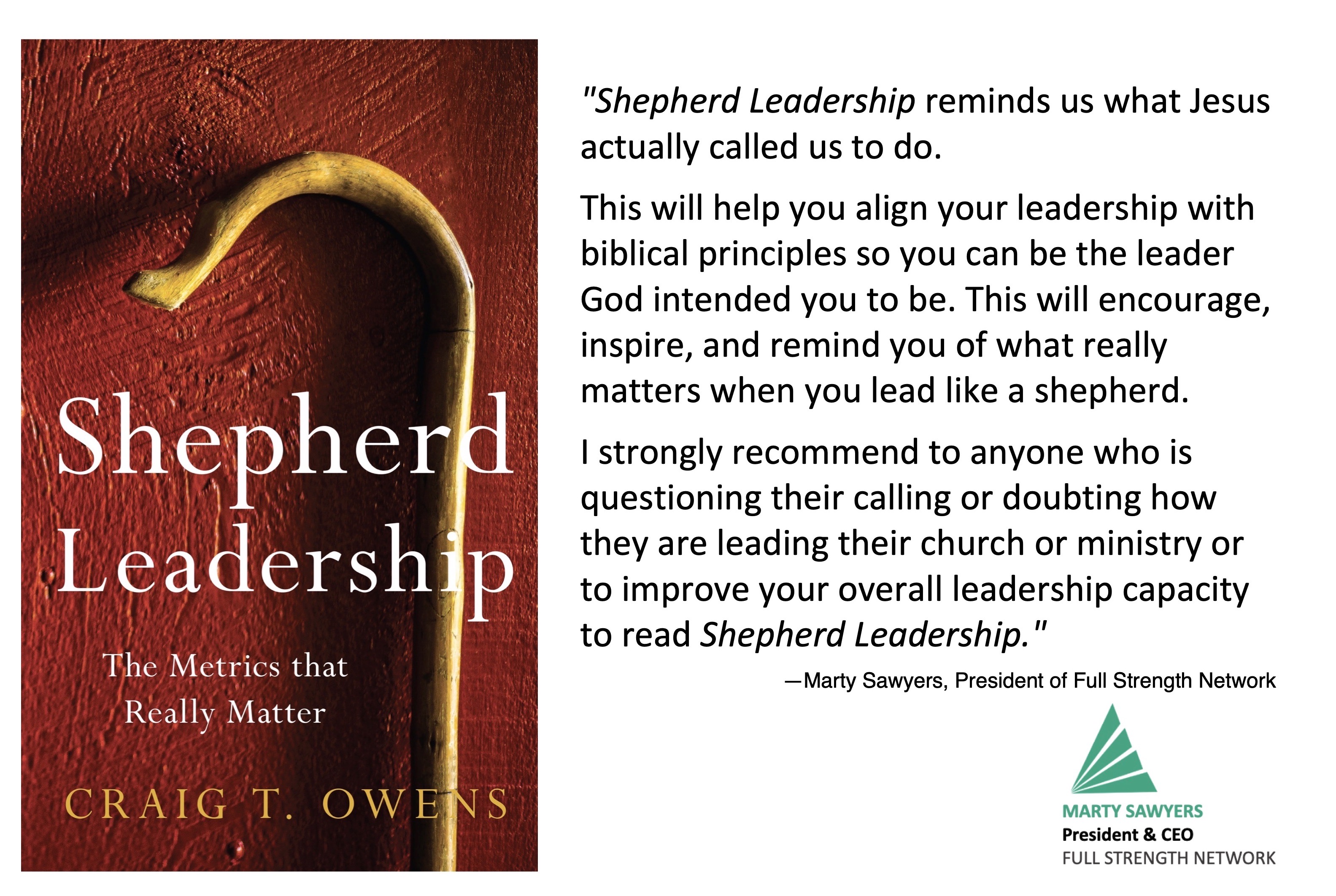
I was so honored to receive another great endorsement for my book Shepherd Leadership: The Metrics That Really Matter.

“It is not your business to succeed, but to do right; when you have done so, the rest lies with God.” —C.S. Lewis

“Homosexuality is not about some issue to debate; it’s about people to love.” —Dr. Preston Sprinkle, Living In A Gray World 

“It is better to fail in originality than to succeed in imitation.” —Herman Melville 

More fascinating news for creationists. Plants know how to defend themselves. “There are two main types of threat-detection mechanisms in plant cells—the ability to recognize distinctive chemical patterns that signify an invader, such as components of a bacterial cell, and the ability to recognize a disruption caused by invading pathogen.” Check out the full article here.

I shared an important reminder with my fellow pastors—

“God, give me a deep humility, a well-guided zeal, a burning love, and a single eye, and then let men or devils do their worst.” —George Whitefield, prayer when sailing for Georgia, December 30, 1777

Living In A Gray World (book review)

Listen to the podcast of this post by clicking on the player below, and you can also subscribe on Apple, Spotify, or Audible. 

So many terms in our culture seem to be taking on new definitions. Things that used to be thought of as black-and-white issues now appear to have multiple shades of gray in between. Nowhere is this more true than in the modern expressions and definitions of sexuality. So Dr. Preston Sprinkle’s book Living In A Gray World is perfectly timed to help bring us some understanding. 

Dr. Sprinkle is a professor at a Bible college, but this book is anything but academically heavy or overly theological. It is straightforward and easy to understand for anyone from a teenager on up. But don’t mistake that assessment as also meaning that this book waters down the clear teaching in the Bible on sexuality, because Dr. Sprinkle doesn’t compromise on this at all. 

Living In A Gray World will walk you through what the Bible says about marriage and homosexuality. You will get a clearer understanding of the terms used in today’s discussions about gender and sexual orientation. But most importantly you will hear Dr. Sprinkle’s impassioned call for Christians to focus on loving people with the agape love of God. 

Although the subtitle of this book is “A Christian teen’s guide to understanding homosexuality,” I believe this book would be hugely beneficial to teens, parents, and pastors. We all have a lot to learn, and I think our conversations would be much more productive when we all come from the same understanding of both cultural terms and biblical teachings. So parents and teens alike should get this book, read it together, and then start talking. 

My Patreon supporters also have access to the quotes that I compiled from this book. 

If you would like to dig even deeper into this topic, check out my book review of Dr. Christopher Yuan’s Holy Sexuality And The Gospel. 

►► Would you please prayerfully consider supporting this ministry? My Patreon supporters get behind-the-scenes access to exclusive materials. ◀︎◀︎
Giving Preference To Others

Listen to the podcast of this post by clicking on the player below, and you can also subscribe on Apple, Spotify, or Audible.

“Be kindly affectionate to one another with brotherly love, in honor giving preference to one another” (Romans 12:10). 

What does it mean to give preference to a friend or loved one? Here are a few suggestions to get the ball rolling. 

Giving preference means I am…

  1. …speaking their “language.” I am a classic Doer, which means my style is, “Ready, Fire! aim.” I need to give grace to those who move a bit slower than me.
  1. …moving at their “speed.” My temperament is highly choleric, so I get fired up quickly and attack situations head-on. I need to give grace to those temperaments that are less emotional and want to handle things more strategically. 
  1. …sensitive to their “fears.” It’s insensitive for me to say, “It’s no big deal” about something that troubles them. Empathy is important so I can see and feel things like they see and feel them. 
  1. …helping them battle their “demons.” Perhaps viewing pornography isn’t a temptation for me, but it may be for someone else. So I need to seek out resources and accountability to help them fight this battle like I was fighting my own battle. 
  1. …avoiding their “stumbling blocks.” Perhaps I can watch certain genres of movies without compromising my Christian testimony, but it may cause my brother or sister a lot of grief. If I am going to prefer them in love, I will avoid talking about those movies in their presence, and I certainly won’t try to get them to “lighten up” to see things my way. 

Agape love is never selfish—it doesn’t want “my way” but it wants others to be edified. So, ultimately, what it means to give preference to another is to only promote those things that will build them up. Remember: saints is always plural in the New Testament, so we must build each other up to bring out the saintliness in all of us. 

►► Would you please prayerfully consider supporting this ministry? My Patreon supporters get behind-the-scenes access to exclusive materials. ◀︎◀︎

“Dear Woman”

Listen to the podcast of this post by clicking on the player below, and you can also subscribe on Apple or Spotify.

The crucifixion of Jesus lasted about six hours. This was mercifully short compared to what typically happened to crucifixion victims. It was hard enough for Jesus to get enough air just to breathe, let alone enough air to talk, so His words are few but precious! From 9:00 until about noon, He speaks three times; from noon until about 3:00, He has no recorded words; at 3:00 there are four final statements that come pretty close together. 

As Jesus speaks His final declaration before wordlessly suffering for the next three hours, let’s take a look at who was there. They were people who deeply cared about Jesus, and people about whom Jesus deeply cared: His mother, His aunt, the mother of one of His disciples, Mary Magdalene, and His beloved disciple John. 

Also notable was who wasn’t present on Golgotha: none of Christ’s siblings or other close relatives. 

This last word from Jesus before His long silence was an incredibly loving word. As the oldest of His siblings, and with His earthly father Joseph dead, Jesus had head-of-the-household responsibilities, especially the care of His mother Mary. 

When Jesus speaks to her, He says, “Dear woman.” This is a term of kindness, respect, and endearment. To both His mother and to John, there is a Greek word that is omitted in some English translations of the Bible: Behold. Since Christ’s words were at a premium, this word was Jesus saying, “Listen very closely. Pay careful attention to this important word I’m about to speak.” 

To His mother, Jesus says, “Dear woman, behold your son.” Jesus was saying, here is one on whom you can depend. And to His dear friend Jesus says, “Behold your mother.” Literally, Jesus was asking John to care for Mary as though she were his own biological mother. 

Think about the dying declarations we’ve already heard. To those who treated Him so horribly, Jesus said, “Father, forgive them.” This was a word of forgiveness that required agape love. To the hardened criminal crucified next to Him, Jesus said, “Today you will be with Me in paradise.” This was a word of salvation that also required agape love. 

Agape love is only possible in a regenerated heart. It’s an utterly selfless love that Jesus described this way: “Greater love has no one than this: to lay down one’s life for one’s friends” (John 15:13). To forgive the unforgivable, to grant salvation to a lifelong criminal, takes the other-worldly agape love. We expect this from Jesus. 

But there are two other loves in this scene. When Jesus says, “Dear woman,” He is expressing this natural love of son to mother. This Greek love is labeled storgé. C.S. Lewis calls this “the most natural, emotive, and widely diffused of loves.” To His dear friend John, Jesus speaks a word of philos love. C.S. Lewis says philos is “the love between friends as close as siblings in strength and duration [and] the least natural of loves.” 

Jesus cared deeply for His mother and He deeply trusted His friend John. This tells me an important truth: Jesus doesn’t just care about spiritual things. 

In fact, there isn’t anything that you care about that Jesus doesn’t feel too: “He had to be made like [us] fully human in every way” (Hebrews 2:17). 

Sadly, I think we frequently hold on to some cares because we think they are too small or too insignificant—or maybe “unspiritual”—so we think they are unworthy of Christ’s attention. Let me say it again: There isn’t anything that you care about that Jesus doesn’t feel too! 

Jesus intercedes before the Father’s throne of grace on our behalf. He knows exactly what to ask for because He experienced all of our earthly pains Himself. Then the Father and Son send the Holy Spirit into our hearts to give us the love and strength we need (see Hebrews 4:14-16; Romans 5:5). 

When Jesus showed us His full love—storgé, philos, and agape—He made it possible for us to fulfill His command: “A new command I give you: Love one another. As I have loved you, so you must love one another. By this everyone will know that you are My disciples, if you love one another” (John 13:34-35). 

Jesus showed every kind of love so that we can live every kind of love! As we live as love-filled people, we show others the path to Christ’s love for their own love-starved hearts. 

Jesus spoke this loving declaration from the Cross to show us that His love covers any need that we have to encounter. Let me repeat it again so that you don’t forget it: There isn’t anything that you care about that Jesus doesn’t feel too!

If you’ve missed any of the other messages in our series on the dying declarations of Jesus from the Cross, you can access the full list by clicking here.

►► Would you please prayerfully consider supporting this ministry? ◀︎◀︎

10 Quotes From C.S. Lewis

Any day is a good day for some C.S. Lewis quotes! 

“To be ignorant and simple now—not to be able to meet enemies on their own ground—would be to throw down our weapons, and to betray our uneducated brethren who have, under God, no defense but us against the intellectual attacks of the heathen.” —C.S. Lewis 

“Good philosophy must exist, if for no other reason, because bad philosophy needs to be answered.” —C.S. Lewis 

“Do not waste time bothering whether you ‘love’ your neighbor; act as if you did.” —C.S. Lewis 

“If you do him a good turn, not to please God and obey the law of charity, but to show him what a fine forgiving chap you are, and to put him in your debt, and then sit down to wait for his ‘gratitude,’ you will probably be disappointed.” —C.S. Lewis 

“Good and evil both increase at compound interest. That is why the little decisions you and I make every day are of such infinite importance. The smallest good act today is the capture of a strategic point from which, a few months later, you may be able to go on to victories you never dreamed of. An apparently trivial indulgence in lust or anger today is the loss of a ridge or railway line or bridgehead from which the enemy may launch an attack otherwise impossible.” —C.S. Lewis 

“For many of us the great obstacle to charity lies not in our luxurious living or desire for more money, but in our fear—fear of insecurity.” —C.S. Lewis 

“The battle is between faith and reason on one side and emotion and imagination on the other.” —C.S. Lewis 

“Faith, is the art of holding on to things your reason has once accepted, in spite of your changing moods.” —C.S. Lewis 

“And as a matter of fact, if you examined a hundred people who had lost their faith in Christianity, I wonder how many of them would turn out to have been reasoned out of it by honest argument? Do not most people simply drift away?” —C.S. Lewis 

“A man who gives in to temptation after five minutes simply does not know what it would have been like an hour later. That is why bad people, in one sense, know very little about badness. They have lived a sheltered life by always giving in. We never find out the strength of the evil impulse inside us until we try to fight it: and Christ, because He was the only man who never yielded to temptation, is also the only man who knows to the full what temptation means—the only complete realist.” —C.S. Lewis

Love Changes Everything (book review)

One of the most fascinating love stories in the Bible is between Hosea and Gomer. In this story, we see a picture of God’s unconditional love so clearly. Using this story as a backdrop, Micah Berteau explains how this love is still potent for all of us today. His book is called Love Changes Everything.

Micah believes our culture has watered down and diminished what love really means. And I heartily agree with him! There’s an old children’s song that says, “Jesus loves me this I know,” but Micah entitles one of his chapters: “Jesus loves me… this I don’t know.” This book is meant to help us recapture what real love is. 

Weaving aspects of the rescuing love Hosea had for Gomer throughout the entire book, Micah teases out thoughts that many may not have considered. He then skillfully uses his own personal life journey to bring a modern-day feel to this love story. Each chapter opens a new facet of God’s love that is intended to dismantle all of the false definitions of love too many have previously taken to heart. 

Although this book is a good reminder for a wide audience, I especially think this would be a good discussion guide for a mature Christian to use with someone who is struggling to believe that God can unconditionally love and forgive them. 

I am a Revell book reviewer. 

C.S. Lewis On Relationships

All of these quotes from C.S. Lewis appear in the book Yours, Jack.

“The modern tradition is that the proper reason for marrying is the state described as ‘being in love.’ … Doesn’t the modern emphasis on ‘love’ lead people either into divorce or into misery, because when that emotion dies down they conclude that their marriage is a ‘failure,’ though in fact they have just reached the point at which real marriage begins.” 

“There is a terrible comment on this in I Cor VI 16 ‘he that is joined to a harlot is one flesh.’ You see? Apparently, if Christianity is true, the mere fact of sexual intercourse set up between human beings a relation which has, so to speak, transcendent repercussions—some eternal relation is established whether they like it or not.” 

“Agape is best seen, I think, in the words ‘love your neighbor as yourself,’ i.e., by an act of will, aim at your neighbor’s good in the same way as you aim at your own. Now you don’t ‘love’ yourself because of your own ‘lovable qualities.’ You may, in moments of vanity, attribute lovable qualities to yourself, but that is not the cause of your self-love but one of the results of it. At other moments, when you dislike yourself, you still wish for your own happiness. This attitude to one’s own self is dictated by nature: towards other selves it has to be acquired.” 

“The great thing in friendship as in all other forms of love is, as you know, to turn from the demand to be loved (or helped or answered) to the wish to love (or help or answer).” 

“When I have learnt to love God better than my earthly dearest, I shall love my earthly dearest better than I do now. In so far as I learn to love my earthly dearest at the expense of God and instead of God, I shall be moving towards the state in which I shall not love my earthly dearest at all. When first things are put first, second things are not suppressed but increased.” 

“I take it that in every marriage natural love sooner or later, in a high or low degree, comes up against difficulties (if only the difficulty that the original state of ‘being in love’ dies a natural death) which forces it either to turn into dislike or else to turn into Christian charity. For all of our natural feelings are, not resting places, but points d’appui, springboards. One has to go on from there, or fall back from there. The merely human pleasure in being loved must either go bad or become the divine joy of loving.” 

“It is right and inevitable that we should be much concerned about the salvation of those we love. But we must be careful not to expect or demand that their salvation should conform to some ready-made pattern of our own. … God has His own unique way with each soul.” 

“The real trouble about the duty of forgiveness is that you do it with all your might on Monday and then find on Wednesday that it hasn’t stayed put and all has to be done over again.”

You can read my review of Yours, Jack by clicking here. And you can check out some other quotes I shared from this collection of Lewis’ personal correspondence here and here.