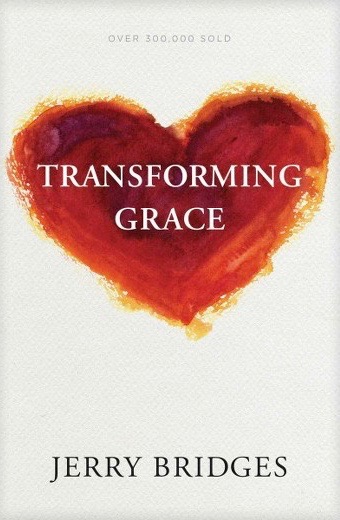
8 Quotes From “Transforming Grace”

Jerry Bridges’ book Transforming Grace is an amazing read! Check out my book review by clicking here.

“One of the best-kept secrets among Christians today is this: Jesus paid it all. I mean all. He not only purchased your forgiveness of sins and your ticket to heaven, He purchased every blessing and every answer to prayer you will ever receive. Every one of them—no exceptions.

“Why is this such a well-kept secret? For one thing, we are afraid of this truth. We are afraid to tell even ourselves that we don’t have to work anymore, the work is all done. We are afraid that if we really believe this, we will slack off in our Christian duties. But the deeper core issue is that we don’t really believe we are still bankrupt. Having come into God’s kingdom by grace alone solely on the merit of Another, we’re now trying to pay our own way by our performance. We declared only temporary bankruptcy; we are now trying to live by good works rather than by grace.”

“To be justified means more than to be declared ‘not guilty.’ It actually means to be declared righteous before God.”

“God not only blots our sins from His record, He also remembers them no more. This expression means He no longer holds them against us. The blotting out of our transgressions is a legal act. It is an official pardon from the Supreme Governor. The remembering them no more is a relational act. It is the giving up by an injured party of all sense of being offended or injured. It is a promise never to bring up, either to Himself or to you, your sins.”

“God’s reward is out of all proportion to our service and sacrifice.”

“God often does bless people who seem to us to be quite unworthy. But that is what grace is all about, because we are all unworthy.”

“We all want grace, but we cannot enjoy grace when there is an attitude of comparing.”

“The Bible is full of God’s promises to provide for us spiritually and materially, to never forsake us, to give us peace in times of difficult circumstances, to cause all circumstances to work together for our good, and finally to bring us safely home to glory. Not one of those promises is dependent upon our performance. They are all dependent on the grace of God given to us through Jesus Christ.”

“Our love for God, expressed through obedience to Him, is to be a response to His love, not a means of trying to earn it.”

Questions To Ask Myself

“When you are tempted to walk toward vanity, look at Christ’s holy walk and ask yourself…

  • Am I like Him in my thoughts and in the way I spend my time?
  • If He were physically living on earth right now, would He do what I am doing?
  • Would He not choose His words more carefully than I do?
  • Would silly speech come from His lips?
  • Would He enjoy my friends?
  • Would He spend a fortune pampering His body, and swallow enough food at one meal to feed hungry people for a week?
  • Would He be fashion-conscious, even if that made His appearance ridiculous and offensive?
  • Would His hands be busy with games that drive time away?
  • Should I do anything that would make me unlike Christ?”

—William Gurnall, in The Christian In Complete Armor

Thursdays With Oswald—What Does It Mean To ‘Confess’ Christ?

Oswald ChambersThis is a weekly series with things I’m reading and pondering from Oswald Chambers. You can read the original seed thought here, or type “Thursdays With Oswald” in the search box to read more entries.

What Does It Mean To ‘Confess’ Christ? 

     We receive the Spirit of Christ as a gift, but we do not receive His mind, we have to construct that [see Philippians 2:5], and this is done in the same way that we construct the natural mind, viz., by the way our disposition reacts when we come in contact with external things. …  

     “You call Me Master and Lord, and rightly so, for that is what I am”; but does it mean any more to us than the mere saying of it? “Now that I, your Lord and Teacher, have washed your feet, you should do as I have done for you” and we cannot do it by sentiment. It was in the hour when Jesus knew “that the Father had put all things under His power, and that He had come from God and was returning to God” that He began to wash the disciples’ feet; and it is when we realize our union with Jesus Christ as our Lord and Master that we shall follow His example. [see John 13:1-4, 12-15] … 

     To “confess” Christ means to say, not only with the tongue, but with every bit of our life, that Jesus has come into our flesh.

From So Send I You

It’s one thing to say, “I am a Christian,” and it’s a completely different thing to live like Christ.

The Holy Spirit will continually bring a Christian into situations where we had the opportunity to develop the mind of Christ. As we develop His mind in us, it will naturally mean that we will “confess” Christ with our thoughts, words, and actions.

My prayer is that we will continually be focused on our Christ-like “confession.”

Praying Against Spiritual Strongholds

“This week we pray that God will demolish the Antichrist’s strongholds

“We are surrounded by systems and strongholds that oppose Christ the Lord and King. There are social, political, economic, and legal structures and schemes that try to disparage God.

“We are not for or against a particular political system. We are Bible-believers, Christ-worshippers; and we come from all walks of life and backgrounds. We seek the glory of God and His alone. We align ourselves with His Word.

“We should not harbor enmity or hatred toward anyone. Even if they oppose us, deride our faith, doubt our God, and insult our Savior and King, they are not our enemies. The real enemy is satan who manipulates them. Our war is against satan and his strongholds.

“Such people are poor humans who need love and compassion from us, and mercy and forgiveness from God. We do not depend on human methods or material weapons, because this is spiritual warfare against satanic powers. Rather, our method is prayer, and that is all.

“Our prayer—O Lord our God, may You be praised for ever and ever! Why do the nations rage? Why do the peoples plot in vain? The kings of the earth set themselves, and the rulers take counsel together, against You and against Your Anointed One (Psalm 2:1-2).

“Help us arm ourselves with the weapons You gave us in Your Word: the belt of truth, the breastplate of righteousness, the readiness of the gospel of peace, the shield of faith, the helmet of salvation, and the sword of the Spirit (Ephesians 6:14-17).

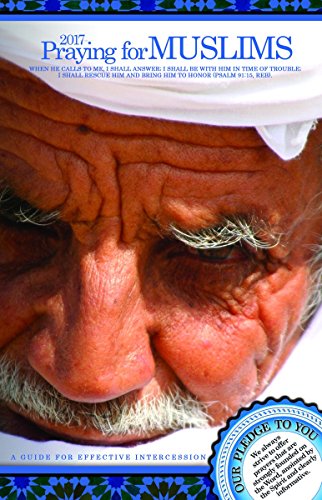
He who sits in the heavens laughs; the Lord derides them … at the name of Jesus every knee will bow, in heaven and on earth and under the earth, and every tongue confess that Jesus Christ is Lord, to the glory of God the Father (Psalm 2:4; Philippians 2:10-11). I pray in the mighty name of Jesus. Amen.” —a prayer from Praying For Muslims

Thursdays With Oswald—Is Jesus My Master?

Oswald ChambersThis is a weekly series with things I’m reading and pondering from Oswald Chambers. You can read the original seed thought here, or type “Thursdays With Oswald” in the search box to read more entries.

Is Jesus My Master?

     To have a master and to be mastered are not the same thing, but diametrically opposed. If I have the idea that I am being mastered, it is a sure proof that I have no master. If I feel I am in subjection to someone, then I may be sure that that someone is not the one I love. To have a master means to have one who is closer than a friend, one whom I know knows me better than I know myself, one who has fathomed the remotest abyss of my heart and satisfied it, one who brings me the secure sense that he has met and solved every perplexity of my mind—that, and nothing less, is to have a master. … 

     Our Lord never takes measures to make us obey Him. Our obedience is the outcome of a oneness of spirit with Him through His Redemption. That is why, whenever Our Lord talked about discipleship, He prefaced it with an “IF”—“you do not need to unless you like”; but—“If any man will be My disciple, let him deny himself.” 

From So Send I You

After reading Oswald Chambers’ definition of a loving master, would you say Jesus is your Master?

After reading what Chambers says about obedience being an expression of love, would you say you obey your master out of love or out of duty?

How you answer these questions makes all the difference in how you live as a disciple of Jesus.

8 Quotes From “Live Dead Journey”

Live Dead Journey are notes from missionaries on the front lines. You can check out my book review by clicking here. One of the things that stood out to me was the focus of these “tour guides” on their time abiding with Jesus. Here are some quotes that share their heart on this.

“Abiding time is extravagant daily time with Jesus.” –Dick Brogden

“Jesus spent close to 90 percent of His life in a village of twelve families, and even His three years of ministry were characterized by time alone with the Father. Moses spent forty years in Midian and had multiple trips to the mountain with God. Paul spent thirteen years in preparation, some of it in the Arabian Desert, and prayed constantly. Adam, Joseph, David, Elijah, Daniel, Mary, John, and others all gave God extravagant time. When we examine the lives of any heroes of the faith, we can see that they lingered daily with Jesus.” –Dick Brogden

“Jesus has become my safe place. When stability is not present in life here, I can lean on Him. When friends are not constant, Jesus is. He knows what I need and provides everything. Jesus is enough for me.” –Joy Hawthorne

“I’ve learned that not spending time with Jesus today is one step in not spending time with Him tomorrow.” –Miriam Davis

“One thing I have discovered is that I can’t survive throughout the day on just one block of time with Jesus. So at some other point in my day, I spend time basking in His presence. … Abiding is a lifestyle.” –Eva Bridges

“To help draw out the lessons from a passage, I now look for the following. Is there:

  • A command for me to obey?
  • A promise for me to claim?
  • A sin for me to avoid or repent of?
  • An example for me to follow (good) or avoid (bad)?
  • A truth to believe?
  • A prayer to pray?” –Jeff Griffin

“I’ve realized that what I desire I become–Jesus is my desire, and I want to be like Him.” –Cathy Stone

“How extravagant are you toward Jesus with your time? Do you lavish time on Jesus? Do you give Jesus the most energetic and focused times of your day? Or do you tend to give Jesus the crumbs of your schedule?” –Dick Brogden

Handling Tough Texts

How do you handle a hard passage in the Bible? Peter wrote this about Paul, “His letters contain some things that are hard to understand….” But if we don’t take the time to wrestle with that passage, Peter says this is what happens next: “…which ignorant and unstable people distort, as they do the other Scriptures, to their own destruction” (2 Peter 3:16).

So here’s a 5-step plan I use when I am working through a challenging passage of Scripture.

  1. Ask the Holy Spirit to help you

All Scripture is inspired by the Holy Spirit (2 Timothy 3:16), and the same Holy Spirit lives in a Christian (1 John 2:20). Think about that: the same Holy Spirit that inspired an author to write the words of Scripture is the same Spirit that will illuminate them to you!

  1. Read the difficult passage in context

We will make our task much easier when we “zoom out” from the difficult text and read the whole passage surrounding the difficult verse/phrase. Perhaps we need to “zoom out” even farther to understand why the whole chapter or book was written.

  1. Identify the parts that are clear

Start off by identifying the parts that you do understand, and then see what light that shines on the tricky text.

  1. Cross reference with other Scriptures

Never, ever, ever draw a conclusion from just one passage of Scripture. Paul reminded his audience that he used the “whole counsel of God’s Word” (Acts 20:27) in forming his sermons. If the challenging passage contains an Old Testament passage, look it up; if it references an historical event, read that history. I also like to use biblegateway.com’s excellent search feature to find cross references.

  1. Draw conclusions on what appears to be the main point

Only after you have done step #1-4 should you attempt to draw some conclusions. You will set yourself up for error if you draw a conclusion first, and then try to find other texts in the Bible that agree with you.

The Apostle Peter writes something rather challenging in his first letter. In fact, Martin Luther said this about 1 Peter 3:18-22: “A wonderful text is this, and a more obscure passage perhaps than any other in the New Testament, so that I do not know for a certainty just what Peter means.” If you would like to see how I walk through the 5-step plan on this “obscure passage,” please check out the video below.

If you’ve missed any messages in this series, you may find the complete list by clicking here.

Thursdays With Oswald—Ordinary Preparation For Extraordinary Service

This is a weekly series with things I’m reading and pondering from Oswald Chambers. You can read the original seed thought here, or type “Thursdays With Oswald” in the search box to read more entries.

Ordinary Preparation For Extraordinary Service

     What are the workshops that supply the munitions for God’s enterprises? The workshop of missionary munitions is the hidden, personal, worshiping life of the saint. …  

     We imagine we should be all right if a big crisis arose; but the crisis only reveals the stuff we are made of, it does not put anything into us. “If God gives the call, of course, I shall rise to the occasion.” You will not, unless you have risen to the occasion in the workshop. If you are not the real article before God there, doing the duty that lies nearest, instead of being revealed as fit for God when the crisis comes, you will be revealed as unfit. … 

     “Jesus, knowing that the Father had given all things into His hands, and that He came forth from God and goeth unto God…”—we might have expected the record to go on: “He was transfigured before them”; but we read that the next thing Our Lord did was of the most menial commonplace order—“He took a towel, and girded Himself. Then He began to wash the disciples’ feet.” Can we use a towel as Our Lord did? Towels and basins and feet and sandals, all the ordinary sordid things of our lives, reveal more quickly than anything what we are made of. It is not the big occasions that reveal us, but the little occasions. 

From So Send I You

Are you spending time every day abiding with Jesus and worshiping Him? Are you willing to do “the little things” that God gives you to do?

These are the things that will make God’s saints ready for “the big things” that come along. Don’t look for the big things, just do the ordinary things God desires of you every day, and then you will be more than ready for the extraordinary things in which God places you.

Fear God, Honor The King

Give to Caesar what belongs to Caesar, and give to God what belongs to God (Matthew 22:21).

The Bible has much to say to God-followers about how to interact with earthly governments:

  • Wise King Solomon told us to “fear the Lord and the king” and not go along with rebels against the government (Proverbs 24:21)
  • Daniel said several times that “the Most High is sovereign over all kingdoms on earth and gives them to anyone He wishes” (Daniel 4 & 5)
  • The Apostle Paul declared he was no rebel to either the civil or religious governors: “I have done nothing wrong against the Jewish law or against the temple or against Caesar” (Acts 25:8)
  • Later on, Paul reminded the church that government officials are God’s servants, and that we need to give them the respect that is owed to them (see Romans 13:1-7)
  • Peter counseled Christians: “Submit yourselves for the Lord’s sake to every human authority: whether to the emperor, as the supreme authority, or to governors … Show proper respect to everyone, love the family of believers, fear God, honor the emperor” (1 Peter 2:13-17)

But a man that exemplifies this balance between fearing God and honoring the king best is Mordecai. Mordecai was a Jew who served the Babylonian king faithfully—

  • He protected the king from would-be assassins
  • But disobeyed the king when the law of the land conflicted with God’s law
  • Then Mordecai helped the king get out of a bad law written by an evil man

A mark of a godly leader is one who knows the difference between fearing God and honoring earthly kings.

How can today’s leaders live out this principle? This is something that should lead us to prayerfully search the Scriptures, and then boldly live out what the Holy Spirit reveals to us.

This is Part 13 in my series on godly leadership. You can check out all of my posts by clicking here.

Welcomed Into God’s Presence

“Jesus hasn’t left us with an unapproachable God. ‘There is one God and one mediator between God and men, the Man Christ Jesus” (1 Timothy 2:5). When Jesus’ flesh was torn on the Cross, the curtain was torn in two. It was as if the hands of heaven had been gripping the veil, waiting for this moment. One instant it was whole; the next it was ripped in two from top to bottom. No delay. No hesitation. We are welcome to enter into God’s presence—any day, any time. God has removed the barrier that separates us from Him. The barrier of sin? Down. No more curtain. But we have a tendency to put the barrier back up with the curtain of our heart. Sometimes, no, oftentimes, we allow our mistakes and guilty conscience to keep us from God. Don’t allow a veil of guilt to keep you from your Father. Trust the Cross. The curtain is down, the door is open, and you are welcome in God’s presence.” —Max Lucado, On Calvary’s Hill (emphasis mine)