


Listen to the podcast of this post by clicking on the player below, and you can also subscribe on Apple, Spotify, or Audible. Check out the video content in this post by clicking here.
 Hate is not the opposite of love—apathy is. Those who love something will hate anything that attacks what they love. On this Father’s Day, I’m calling for men to show their strength on behalf of what they love—to shake off apathy and move into action!
I will warn you up front that this is not something you can work up on your own because the Bible says that “human anger does not produce the righteousness that God desires” (James 1:20). Instead, we will need some really strong guardrails to keep us from going off course.
(Check out all of the Scriptures in this Father’s Day message by clicking here.)
The culture is decaying.
Those in government are doing whatever they can to keep themselves in power, and the church isn’t much better. As a result, families are at each other’s throats and among neighbors it’s hard to tell who’s an enemy and who’s a friend. I’m describing Judah about 840 BC, but I’ll bet you thought I was describing today. Even though I’m going to tell you about a righteous father who came on the scene 2800 years ago, we will learn some lessons that we should apply today.
Look at the plight Judah is in:
- King Jehoram died to no one’s regret (2 Chronicles 21:20)
- The only heir to the throne left alive is 22-year-old Ahaziah, who was so evil and inept that he only reigned for one year (22:1-9)
- Since there was no one in the house of Ahaziah powerful enough to retain the kingdom, his mother Athaliah ruthlessly grabbed control and hung onto it for six long years (22:10)
There is a psalm written by the Sons of Korah, which may have been written during this time (Psalm 42:1-4, 9-10).
This Psalm has a glimmer of hope in v. 5. Indeed, in Judah at the height of Athaliah’s reign of terror, there was a small light still glimmering. God had made a promise to King David: “If your descendants watch how they live, and if they walk faithfully before Me with all their heart and soul, you will never fail to have a successor on the throne of Israel” (1 Kings 2:4).
But was there such a successor, or had the line of David been snuffed out? There was one heir that had been rescued from Athaliah’s slaughter (2 Chronicles 22:11-12). And this is the passion that burned hotter and hotter in one father’s heart.
Do you remember the cartoon character Popeye saying, “That’s all I can stands; I can’t stands no more”? That is what was said about Jehoiada: In the seventh year Jehoiada showed his strength (23:1).
- The AMPC says: Jehoiada took strength and courage
- The NCV says: Jehoiada decided to do something
Jehoiada finally reached a place where his internal fortitude overcame his fear of external things. The Hebrew word gives the sense of being bound to something which makes me stronger than I am on my own.
The same Hebrew word is used over 30 times in the Book of Nehemiah for all the parts of the walls and gates that were repaired—they were made stronger because they were attached to the brick and mortar around them. Nehemiah uses the same word when he said, “I also told them about the gracious hand of my God on me” (Nehemiah 2:18). And the same word is also used when he wrote, “Those who carried materials did their work with one hand and held a weapon in the other” (4:16-17).
Jehoiada had to come to a place where he trusted God’s promise more that he feared Athaliah’s wrath. He gripped God’s promise and clung to it unswervingly, and God held Jehoiada as His weapon. This is what gave him strength and courage to act righteously—not in his own power.
The outcome was by no means assured. He had no idea how the leaders would respond to his plan. But despite the odds stacked against him, despite the uncertainty of the outcome, Jehoiada was going to cling to God and move forward.
The same Hebrew word for being gripped by something that makes us stronger was used by David when he wrote, “Wait and hope for and expect the Lord; be brave and of good courage and let your heart be stout and enduring. Yes, wait for and hope for and expect the Lord” (Psalm 27:14 AMPC).
Jehoiada told the people to stay close to the king (2 Chronicles 23:7), to declare their allegiance to the one true king (v. 11), and to remain in covenant with the rightful king no matter what (v. 16).
Men, this is what we must still do today:
- Take hold of God and let Him take hold of you—Philippians 3:12-13
- Remember that Jesus took hold of God’s promises for us—Hebrews 6:17-20
- This Christ-gripping empowerment means we can fight the good fight—1 Timothy 6:12
Jesus speaks to one of the churches in the end times—
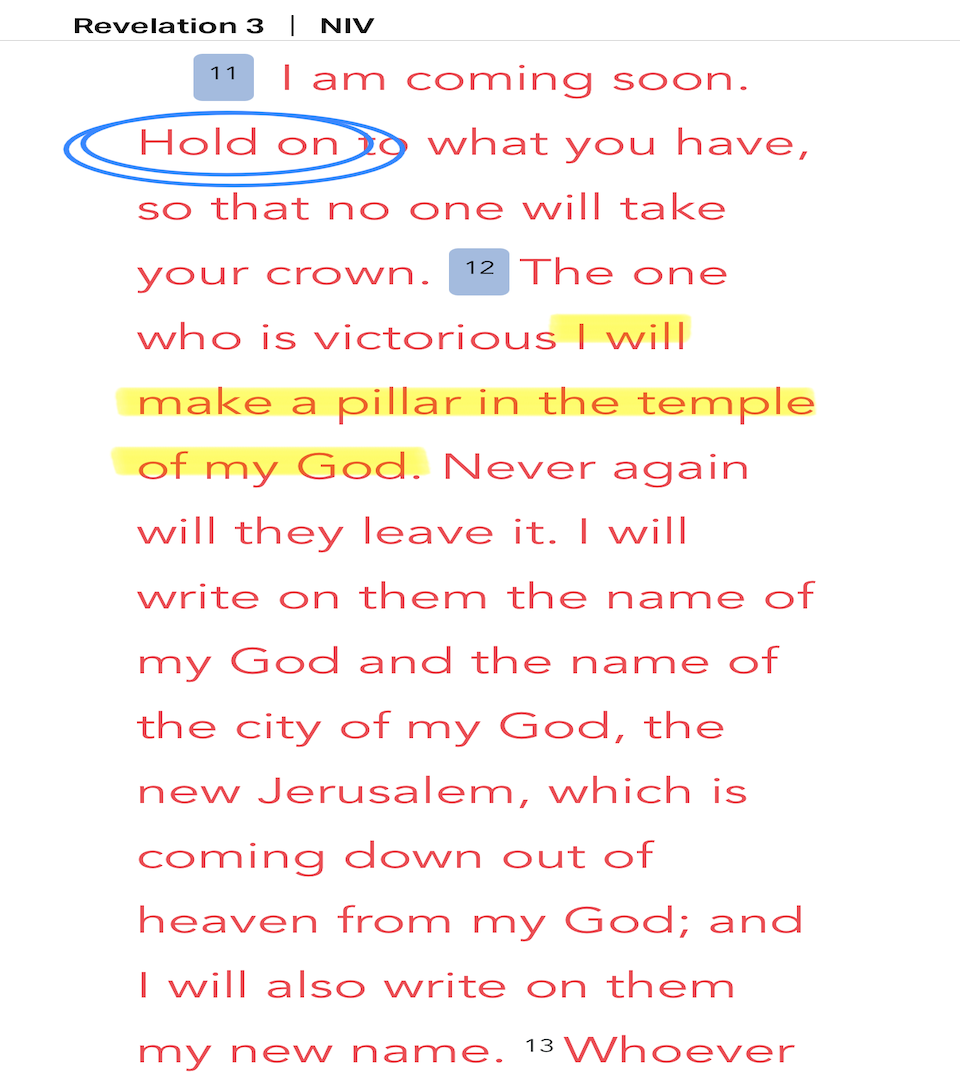 I am coming soon. Hold on to what you have, so that no one will take your crown. The one who is victorious I will make a pillar in the temple of My God. Never again will they leave it. I will write on them the name of My God and the name of the city of My God, the new Jerusalem, which is coming down out of heaven from My God; and I will also write on them My new name. (Revelation 3:11-12)
I’m intrigued about the promise to be a pillar in God’s temple, because that is what Jehoiada became—
Now Jehoiada was old and full of years, and he died at the age of a hundred and thirty. He was buried with the kings in the City of David, because of the good he had done in Israel for God and His temple. (2 Chronicles 24:15-16)
Men, will you rise up?
We need you to take hold of God’s promises. To let His Spirit stir up in you a righteous strength against the evil that comes against your wives, children, friends, and culture.
Don’t swing the sword in your own strength; instead, let God grip you and use you to be a pillar in your family, in your community, and, ultimately, in His temple.
Let me repeat what David said: “Wait and hope for and expect the Lord; be brave and of good courage and let your heart be stout and enduring. Yes, wait for and hope for and expect the Lord”!
►► Would you please prayerfully consider supporting this ministry? My Patreon supporters get behind-the-scenes access to exclusive materials. ◀︎◀︎




 Craig T. Owens