Listen to the podcast of this post by clicking on the player below, and you can also subscribe on Apple, Spotify, or Audible.
…oh no… (2 Kings 6:5, 15).
The words “Oh no!” are actually a single word in the Hebrew language (Hebrew: ‘ahahh) that has been transliterated into English as “Aha!”
But I think the old English translation is better in this context: ALAS!
ALAS is usually a painful realization of the situation, not a cry of enlightened discovery. Here are the other times that this Hebrew/English word for ALAS! is used:
Joshua said it after his army was defeated at Ai
Gideon said it after realizing he had been face-to-face with God
Jephtha cried it out after he knew that his daughter would have to be sacrificed
King Joram uttered this when he realized his troops and animals had no water in the desert
Jeremiah said this to God after he was called to be a prophet, and after he was asked by God to speak countercultural words (he actually said ALAS! four times!)
Ezekiel also cried out ALAS! four times when God asked him to do or to watch difficult things
Joel cried it out when he saw the Day of the Lord quickly approaching
In all of these ALAS! painful moments, these men were at their wits’ end, at the end of their own abilities—they couldn’t do anything to help themselves.
In all of these ALAS! moments, they came to just one important realization: Only Yahweh can help me. That realization is truly the AHA! of an enlightened discovery!
Calling on God turns a painful ALAS! moment into a God-glorifying AHA! moment. God alone can provide where no one else can.
Don’t despair in the ALAS! times, but cry it out loud to the only One who can help you, and then watch to see how He alone will turn your situation into a defining, God-glorifying AHA! testimony.
“The Law of God teaches us how to love Him and our neighbors (Matthew 22:34-40). The Law of God is critical for seeking the Kingdom of God (Matthew 5:17-19). The Law of God liberates us from the blinding and binding power of sin (James 2:8-13). The Law of God marks the path of love that Jesus walked, and that all must walk who would follow Him (1 John 2:1-6; 5:1-3). The Law of God provided the framework within which the apostles ordered their churches (cf. 1 Corinthians 5, 9; James 2:5; 1 John 5). The Law of God is the core curriculum of the Spirit, as He brings us into the presence of God’s glory and transforms us into the image of Jesus Christ (Ezekiel 36:26-27; 2 Corinthians 3:12-18). Neglecting the Law of God is a major cause for the decline of true and selfless love in the world; it licenses the progress of evil; and it threatens to render the prayers of Law-neglecting believers an ‘abomination’ or, we might say, ‘a dead and a useless thing’ (Matthew 24:12; Proverbs 28:4, 9).
“It’s no wonder the psalmist, echoing Moses, insisted that the righteous person, the one who embodies the goodness of God in all his ways, meditates on the Law of God day and night, hides it in his heart and embodies it in all his ways (Psalm 119:9-11; Deuteronomy 6:1-9), keeps it diligently, delights in and loves it, and hastens to make sure his feet follow in its path (cf. Psalm 1; Psalm 119:4, 5, 35, 59, 60, 97).
“If you are missing the Law of God in your relationship with Jesus, you are depriving yourself of a most important resource for bringing the goodness of God to light in the land of the living. The good works outlined in the Law of God are those ‘ordained of old’ which God intends us to do in all our ways (Ephesians 2:10). Yes, understanding the Law can be difficult. But we can learn from the prophets, Jesus, and the apostles how to read, study, and meditate in this most important corpus of Biblical literature, and thus we can discover the true freedom for goodness and love that God has prepared for us.” —T.M. Moore
“The disciples had life before our Lord breathed on them, but then they attained more. They had life before Pentecost, but then they obtained more. … Thus a man may be very like a saint and yet not be one. A church or a congregation may be very like a Christian one, with a fair appearance and compact organization; all in excellent bustling order, numerous, liberal, united, earnest after a sort; and yet lack one thing which neutralizes and paralyzes all the rest—the breath of life.
“Our creed may be sound, and yet we may not be Christians.
“Our religion may be externally complete, and yet we may not be Christians. … Mechanical religion may do for the gods of Greece and Rome, but not for the living and true God. … Your sanctuary attendance may be regular and reverent; but what if there be no breath in it? Your prayers and praises may be punctual and unexceptionable, but what if there be no breath in them? Will God accept them? Will they satisfy you? Will they make you happy? Will they not be irksome and intolerable? And the more you multiply them, the more intolerable.
“Our good works may be numerous and praiseworthy, yet we may not be Christians. It is not the work that makes the Christian, but the Christian that makes the work.
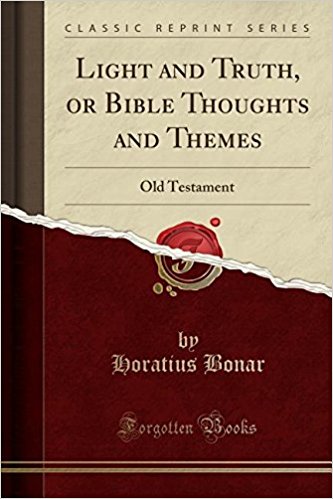
“Our life may be exemplary, and yet we may not be Christians.” —Horatius Bonar, in Light & Truth—The Old Testament
That’s what the Holy Spirit does for us: He opens up God’s Word like we’ve never seen it before! It wasn’t just for Peter, or the original 12 disciples, or the first-century Church. This is still available to you and me today!
Please note that it’s not just a relationship with Jesus that opens up the Scriptures to us. No one spent more time in the presence of Jesus than His disciples. And yet even after Jesus explicitly shared truth with them, we read, “His disciples didn’t understand at the time that this was a fulfillment of prophecy. But after Jesus entered into His glory, they remembered what had happened and realized that these things had been written about Him” (John 12:16).
Notice those words “after…they remembered…and realized.”
This is still available to you and me today! Jesus told us that He had more to say to us, and that’s why the Holy Spirit would come. The same Holy Spirit that inspired the Word of God is available today to illuminate it to us!
R.T. Kendall made this observation about the teachings of Jesus, “[His teachings] cannot be truly understood until you see that it is our Lord’s doctrine of the Holy Spirit. It means we must embrace His interpretation of the Law and how it is fulfilled in us.”
This is what God foretold through Ezekiel—I will give them an undivided heart and put a new spirit in them; I will remove from them their heart of stone and give them a heart of flesh. Then they will follow My decrees and be careful to keep My laws… (Ezekiel 11:19-20). In other words,God is saying, “When the Holy Spirit is in you, you will know how to apply My laws to your every-day life. You will become skilled in the correct and timely biblical application.”
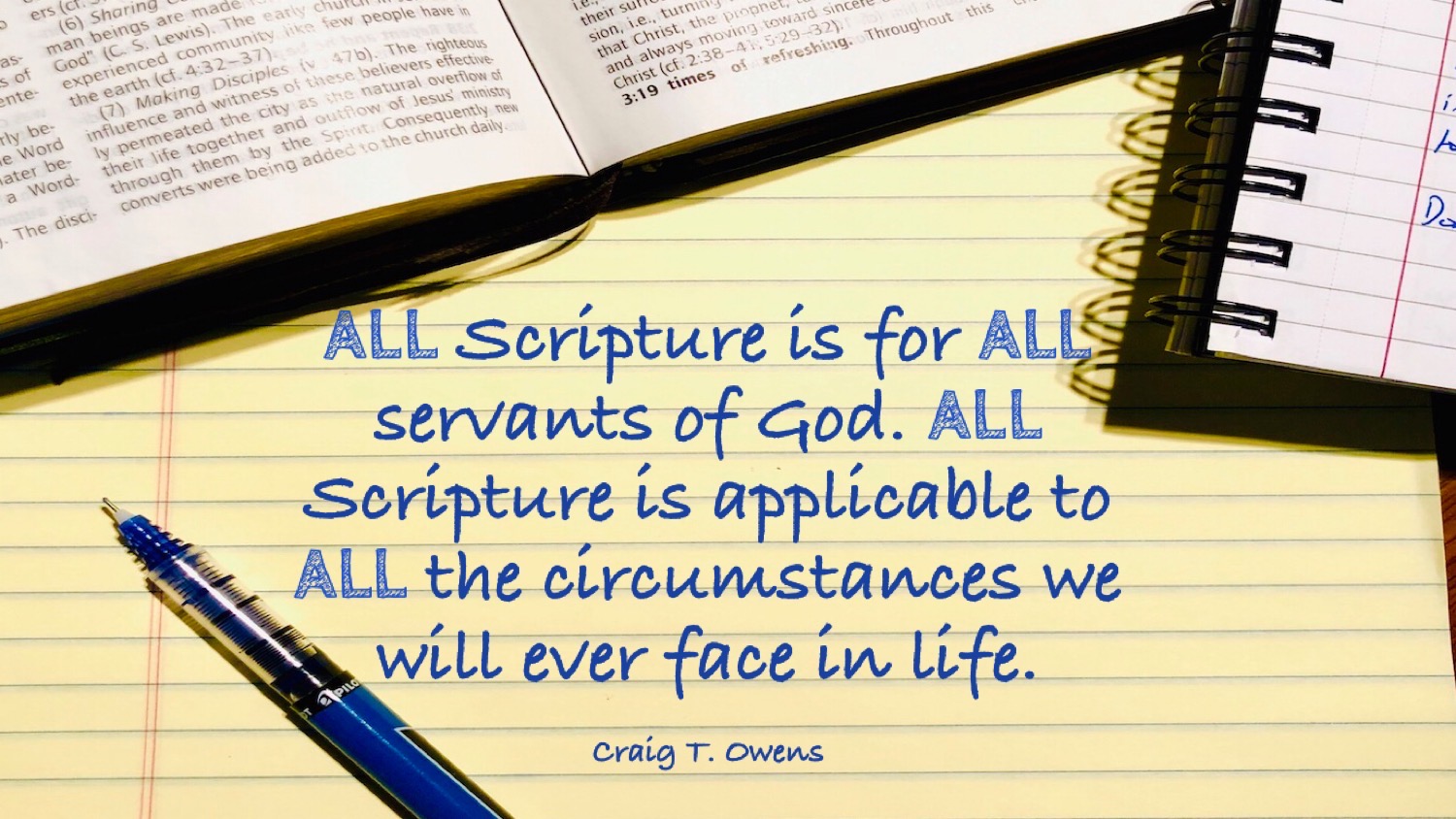
ALL Scripture is for ALL servants of God. ALL Scripture is applicable to ALL the circumstances we will ever face in life. But we need the illumination of the Holy Spirit in order to make the connection from the written Word to the real-life application.
So don’t stop at salvation—press on to be baptized in the Holy Spirit.
When it comes to the Holy Spirit’s involvement in a Christian’s life: In > On.
Sometimes, instead of referring to the two major divisions of the Bible as Old Testament and New Testament, I prefer to use First Testament and Second Testament. This helps me remember that “Old” doesn’t mean outdated, and “New” doesn’t mean forgetting what came before it.
B.B. Warfield had a great analogy. He imagined the First Testament to be a perfectly-constructed mansion. Only the finest materials had been used, and the mansion had been constructed by the best craftsmen being overseen by the world’s premier Architect. The only problem was this mansion had no lights. With the appearing of Jesus in the Second Testament, finally the lights are turned on. Jesus reveals the beauty that was already there!
In the First Testament, we frequently read that the Holy Spirit comes ON people, usually for leadership functions. We see this phrase with Moses and his co-leaders, several of the judges, Israel’s first two kings, and many of the prophets (see Numbers 11:25; Judges 3:10, 6:34, 11:29, 15:14; 1 Samuel 11:6, 16:13; 2 Kings 2:15).
However, there is one leader in the First Testament about which we notice the Spirit came IN him. Twice Ezekiel says this (2:2, 3:24). This was hinting at a to-be-fulfilled promise in the Second Testament (36:25-27).
The Holy Spirit being IN God’s people—which makes them God’s leaders—is described by Jesus in Acts 1:5. Many translations render this verse, “You will be baptized with the Holy Spirit.” But the NIV footnote and The Message both say “in the Holy Spirit.” Indeed, the Greek word means “by, with, or in.” But in context to being baptized (which means immersed, submerged, cleansed, overwhelmed), I think the best word is: baptized IN the Holy Spirit.
Let me say it again: When it comes to the Holy Spirit’s involvement in a Christian’s life: In > On.
“You hardly need to pray to have the Spirit poured out, for that has been done. What you need is a baptism of the Holy Spirit; to go down personally into that glorious flood that has been poured forth. Oh, to be immersed in the Holy Spirit and into fire—covered with His holy influence—plunged into the Godhead’s deepest sea and lost in His immensity! Here is our life and power.” —Charles Spurgeon
Jesus wants all of His followers to be baptized IN the Holy Spirit. So He told us to keep on asking, keep on seeking, keep on knocking, keep on waiting for God’s promised infilling (Luke 11:9-13; Acts 1:4-8).
Don’t stop at salvation—with just the Holy Spirit deposited in you—press on to be submerged deep into the Holy Spirit.
[I originally posted this about 10 years ago(!), but recently came across it as I was studying the book of Ezekiel. I hope you (re)enjoy this classic.]
Here’s what God said to His people—five times!—through the prophet Ezekiel, “I will judge you according to your conduct.”
It’s not what I believe. It’s not what I discuss. It’s not what I intend to do. It’s not what I know is right and wrong. It’s what I do.
I have to give an account for my conduct. I have to answer to God for how I lived out my beliefs. I have to show God what I did with what I believed about Him. I have to put into practice what’s in my heart.
Do I believe God is God? Do I have idols?
Do I believe God is holy? Do I sin?
Do I believe God forgives? Do I repent?
Do I believe God looks after orphans and widows? Do I?
Do I believe God is my Provider? Do I steal? Do I get jealous or envious?
Do I believe He is Lord? Do I give Him control of everything?
Do I believe I should do something for the hungry, thirsty, naked, sick and imprisoned? Do I actually do something?
What God judges is not just godly beliefs, but godly actions motivated by those godly beliefs.
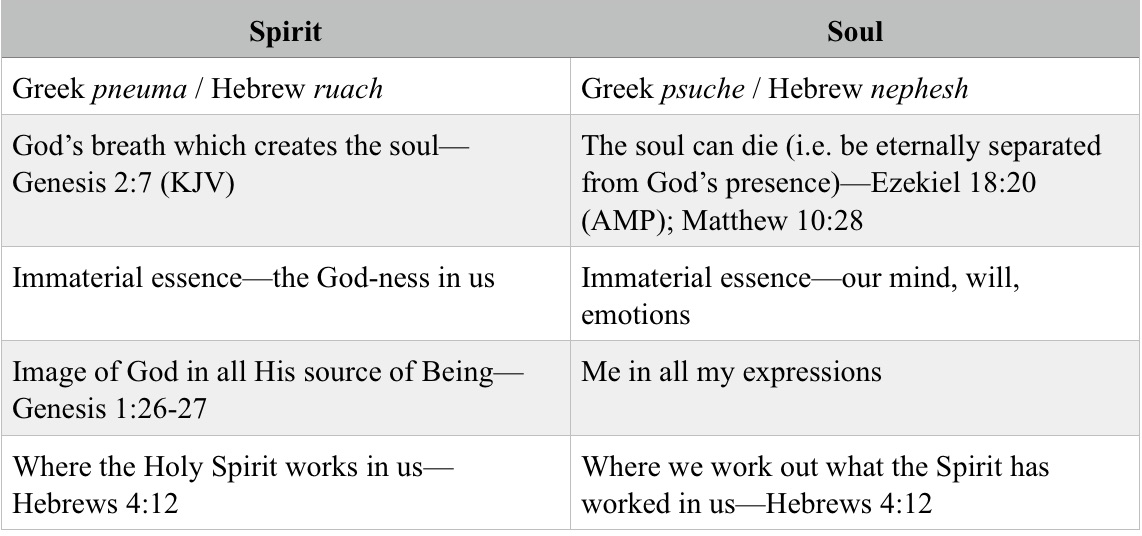
If I were to ask you to define the material/physical part of you versus the immaterial part of you, it probably wouldn’t be too difficult. Obviously, we can touch the physical part but we cannot touch the immaterial part.
But human as a three-part being—we have a body, a soul, and a spirit. So if I were to now ask you to describe the “dividing line” between the two immaterial parts of us (the soul and the spirit), you would probably have a more difficult time coming up with a definition.
Both terms are used throughout the Bible. Sometimes it seems the words soul and spirit are almost used interchangeably, but they are most assuredly two separate parts of what makes us us.
Please check out this chart that I shared with my friends at Calvary Assembly of God, and perhaps even take a few minutes to watch the video below. If you would like to download a PDF version of this chart, you may do so by clicking here →Soul and spirit side-by-side←
When C.S. Lewis first introduces us to the land of Narnia in The Lion, The Witch and The Wardrobe, we discover that the White Witch has Narnia seemingly under her iron fist, and has made it so that it’s always winter but never Christmas.
“Come on!” cried Mr. Beaver, who was almost dancing with delight. “Come and see! This is a nasty knock for the Witch! It looks as if her power is already crumbling. … Didn’t I tell you, that she’d made it always winter and never Christmas? Didn’t I tell you? Well, just come and see!”
And then they were all at the top and did see.
It was a sledge, and it was reindeer with bells on their harness. But they were far bigger than the Witch’s reindeer, and they were not white but brown. And on the sledge set a person whom everyone knew the moment they set eyes on him. He was a huge man in a bright red robe (bright as holly-berries) with a hood that had fur inside it and a great white beard that fell like a foamy waterfall over his chest. … Some of the pictures of Father Christmas in our world make him look only funny and jolly. But now that the children actually stood looking at him they didn’t find it quite like that. He was so big, and so glad, and so real, that they all became quite still. They felt very glad, but also solemn.
“I’ve come at last,” said he. “She has kept me out for a long time, but I have got in at last. Aslan is on the move. The Witch’s magic is weakening.”
I think the Israelites waiting for their Messiah must have felt a little like the Narnians: always winter, but never Christmas; trapped under the iron-fisted rule of Babylon, and Persia, and Rome.
But as they approached what we now call the year 1 AD, winter is about to end and the Advent of CHRISTmas is about to occur at long last!
You might think that the birth of Jesus brought us the King of Kings. But actually, there were three other “king of kings” that preceded Jesus, who all helped to fulfill God’s ultimate plan.
Nebuchadnezzar was the king of Babylon. God called him “My servant” and also gave him the title “king of kings” (Jeremiah 27:6; Ezekiel 26:7). It was he who defeated Judah and took captives with him to Babylon. Among those captives was a young man named Daniel.
God gave Daniel the ability to interpret Nebuchadnezzar’s dream which foretold of three other kingdoms which would follow Babylon, with the fourth kingdom being called a kingdom of iron. History shows us that Babylon was defeated by the Medes, who were in turn defeated by the Persians, who were themselves defeated by the Greco-Romans.
Artaxerxes was king of the Persians, and he called himself “king of kings” (Ezra 7:12). He helps to facilitate the Jews’ return back to Jerusalem, and even helped fund their efforts to rebuild the temple of Solomon and reestablish worship there.
In 44 BC, Julius Caesar was assassinated, and Octavius was named in Caesar’s will as his adopted son and heir. Eventually, Octavius quelled a 20-year-long civil war and established himself as the unquestioned ruler of the Roman Empire. He changed his name to Caesar Augustus, which means the exalted one. But all throughout the Mediterranean world archeologists have discovered numerous other titles for Caesar Augustus—Divine, Son of God, God Incarnate, God from God, Lord, Redeemer, Liberator, Savior of the World, and King of Kings.
Historian Luke records these words, “In those days Caesar Augustus issued a decree” (Luke 2:1). This decree called everyone to return to his hometown to be registered in Rome’s census. This decree meant that Joseph was obligated to return to Bethlehem. He took his pregnant wife with him to arrive just in time for Jesus to be born.
Jesus—THE eternal and ultimate King of Kings—was born in Bethlehem just as had been prophesied 700 years earlier in the winter of Israel’s captivity:
But you, Bethlehem Ephratah, you are little to be among the clans of Judah; yet out of you shall One come forth for Me Who is to be Ruler in Israel, Whose goings forth have been from of old, from ancient days (eternity). (Micah 5:2)
The coming of THE King of Kings is proof that God sees you too. God brought the king of kings named Nebuchadnezzar, and Artaxerxes, and Caesar Augustus to power just to move two “average Joes” 70 miles from Nazareth to Bethlehem so that THE King of Kings could be born there to fulfill the prophesy.
God has a plan for your life. His plan for you was in place before you were even conceived in your mother’s womb. And—even this very moment—He is watching over world events to make sure that every detail of His plan is fulfilled (see Ephesians 2:10; Psalm 139:16; Jeremiah 1:12)!
If you ever feel like you are in a “winter” season of your life—always winter and never Christmas—just remember that God sees you, He has a plan for you, and He will bring an end to your winter just in time to bring you CHRISTmas!
God had an important message to deliver to not only the people currently alive but all the people who would walk the face of the Earth from that moment onward. God chose Ezekiel to deliver this message.
But here’s the important concept for all leaders—A leader cannot take people anywhere unless he has gone there himself.
And it’s corollary—A godly leader cannot take people anywhere that God is blessing unless he lets God take him there first.
If a leader tries to take people where he hasn’t been himself, at best he’s a tourist; at worst he’s a hypocrite.
When God prepared to take Ezekiel to where He needed Ezekiel to take other people, God wanted Ezekiel fully engaged:
Son of man, LOOK with your eyes and HEAR with your ears, and FIXyour mind on everything I show you; for you were brought here so that I might show them to you. Declare to the house of Israel everything you see (Ezekiel 40:4).
A mark of a godly leader is one who lets God take him “there” before he tries to take anyone else there.
This is part 25 in my series on godly leadership. You can check out all of my posts in this series by clicking here.



 …oh no… (2 Kings 6:5, 15).




 Craig T. Owens