Listen to the podcast of this post by clicking on the player below, and you can also subscribe on Apple, Spotify, or Audible.
When Jesus was talking about the attitude and activities of His servants who were awaiting His return, He was talking directly to you and me—
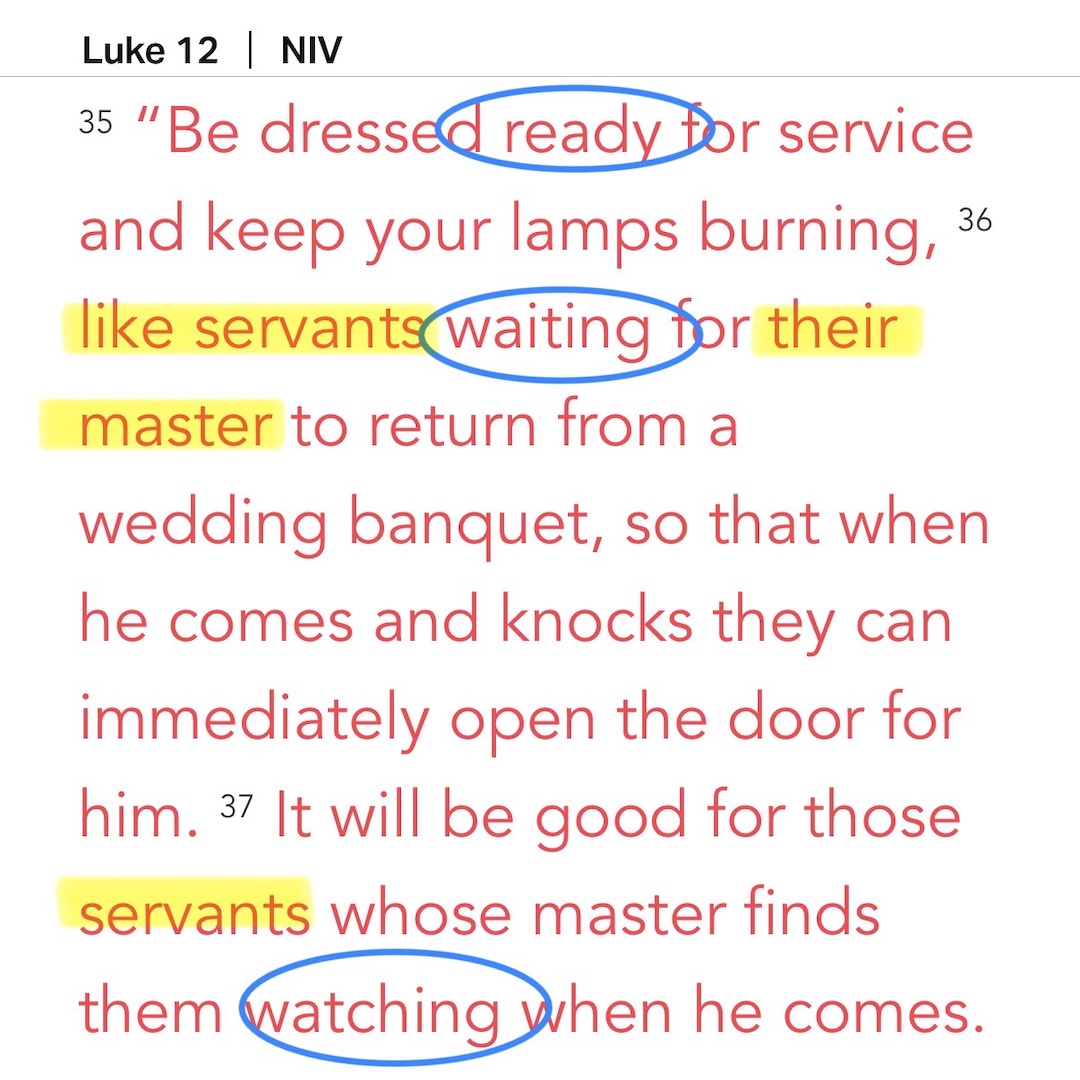
Be dressed ready for service and keep your lamps burning, like servants waiting for their Master to return from a wedding banquet, so that when He comes and knocks they can immediately open the door for Him. It will be good for those servants whose Master finds them watching when He comes. (Luke 12:35-37)
There are three important words for Christ’s servants here.
(1) Ready. This adjective is describing the servant. This word’s etymology is from the noun that means “fitness for service.” As Christ’s servants…
- …we keep everything we need for serving close at hand and in good working order
- …we are prepared for opportunities to serve whenever they present themselves
- …we maintain a servant’s atitude
(2) Waiting. This verb is in the present tense and active voice. “Waiting” doesn’t mean sitting around with nothing to do, but it is eagerly anticipating any opportunities to be hospitable to other servants of Jesus.
(3) Watching. This verb is also in the present tense and active voice. “Watching” means giving our service our undivided attention—listening closely for the Master’s voice and being quick to respond.
Christians need to keep themselves in a state where they are always prepared to do what their Master calls them to do—ready and willing to respond to any opportunity to put our love for Jesus into action.
I want to be intensely occupied in heavenly service until the very moment Jesus returns to earth or calls me Home!
No off days. No wasting time on frivolous matters. Only attending to things that matter for eternity.
For those servants who are ready, waiting, and watching when Jesus returns, there is an amazing reward that is promised by Jesus Himself—
It will be good for those servants whose Master finds them watching when He comes. Truly I tell you, He will dress Himself to serve, will have them recline at the table and will come and wait on them. It will be good for those servants whose Master finds them ready, even if He comes in the middle of the night or toward daybreak. (vv. 37-38)
What an amazing reward!
We are servant leaders by serving Jesus and by serving those Jesus puts in our lives. Let’s remain ready, waiting, and watching to serve until the very end.
►► Would you please prayerfully consider supporting this ministry? My Patreon supporters get behind-the-scenes access to exclusive materials. ◀︎◀︎