The Normalcy of Extraordinary Power

Listen to the podcast of this post by clicking on the player below, and you can also subscribe on AppleSpotify, or Audible. Check out the video content in this post by clicking here. 
I’m not sure that any other aspect of the Christian faith generates as much discussion as the role of the Person of the Holy Spirit. Specifically, I would say “nuanced discussion.” By that I mean, people carefully choosing their words to remain biblically accurate but not sound weird. “After all,” they might say, “we don’t want people looking at us strangely because we’re talking about signs, wonders, and speaking in unknown languages. Yet at the same time, we don’t want to grieve the Holy Spirit.” 

I believe there is a better way to handle this: Let Scripture speak for itself. 

Let me share one recent example with you that will address this point. A rather well-known Christian apologist, who happens to be quite skilled in ancient biblical languages, was recently asked in an interview, “Can you explain the gift of speaking in tongues?” 

Here are some of the main things he said in reply: “I think there is something going on in the New Testament that is different. … There is a uniqueness to that time period. It’s normative in a way that it is not now” because, he says, we don’t see today what we see in the New Testament, “because the disciples are building the foundation of the Church. … Now we have the books of Scripture where God speaks to us in a different way. … Speaking in tongues, prophesying happen; I just don’t think they’re normative in the way we see them happening in the New Testament.” 

There’s a lot to unpack here, but I want to focus on a word he repeated: normative. 

The dictionary defines that word: implying, creating, or prescribing a norm or standard; especially an assumed norm regarded as the standard of correctness in behavior, speech, writing, etc. 

So I guess we need to ask, “What is normal?” 

Let’s begin with this question: What did the pre-Ascension followers of Jesus consider normal? 

First, Jesus was with them bodily form, and He regularly explained Scripture to them. Jesus healed people and so did His followers. Jesus told them He was leaving in bodily form, but that He would send the Holy Spirit to be with them (John 14:16-17). 

(Check out all of the Scriptures in this sermon here.) 

The next question is: What did the post-Ascension followers of Jesus consider normal? 

There was a joy of anticipating the Holy Spirit’s outpouring (Luke 24:50-53). Jesus was no longer with them bodily, but they still operated in His name and authority. They understood Scripture without Jesus in bodily form explaining it to them. They wrote the books of the New Testament, which are really a commentary on Scripture (the Old Testament) in light of the life, death, and resurrection of Jesus. They healed people. 

Our final question should be: What should we consider normal? 

Let’s go back to John 14:16-17 where Jesus promised the arrival of the Counselor. The baptism in the Holy Spirit is empowerment in a wholly different level. At salvation, He is “with” us; at baptism, He is “in” us. Jesus is still not with us in bodily form, but we can still operate in His name, we understand Scripture without Jesus in bodily form explaining it to us, and we can operate in a realm of power that seems extra-ordinary to others! 

Listen to a couple of key phrases from Peter’s Pentecost Sunday sermon. He says this outpouring of the Holy Spirit is the fulfillment of a promise made by Jesus, and it is proof of the resurrection and ascension of Jesus (Acts 2:33, 38-39). 

Nowhere is this implied that this is a one-time empowerment, nor an exclusive empowerment for those living in that time, nor is it exclusively for those called apostles. The saints lived this out as their normal daily life. See just a few examples in Acts 4:20, 30-31; 6:3, 8-10; 8:4-8, 14-17. 

“The secret of our strength is the living testimony that Jesus Christ is every moment with us, inspiring, directing and strengthening us. This is what made the disciples so bold in preaching Him as the Crucified One in the midst of His enemies. They never for a moment regretted His bodily absence, for they had Him with them, and in them, in the divine power of the Holy Spirit.” —Andrew Murray 

I think we have accepted sub-normal as normative for so long, that we now call that normal. Instead our normal should be a lifestyle, a language, a power that is called extraordinary by others. 

Spirit-baptized Christians should live in the normalcy of extraordinary power! 

Please check out the other messages we have covered in this series called We Are: Pentecostal by clicking here.

►► Would you please prayerfully consider supporting this ministry? My Patreon supporters get behind-the-scenes access to exclusive materials. ◀︎◀︎
The Craig And Greg Show: Intuition And Execution

Listen to the podcast of this post by clicking on the player below, and you can also subscribe on AppleSpotify, or Audible. 

Gut instinct, a feelings, a sixth sense—we have a lot of different phrases for intuition. Whatever you want to call it, we all have those moments where we just know what the right decision is. Join Greg and I as we discuss why it’s important to develop this skill, and how to find the right time to turn your intuition into execution. 

  • [0:00] Introduction
  • [1:02] Are we born with intuition?
  • [2:34] Intuition is hard to measure, but important to develop.
  • [4:23] Intuition is a gift that can be developed.
  • [7:04] How can leaders gain more intuition?
  • [8:40] Leaders need to reflect on their day to grow their intuition for future challenges.
  • [9:56] Don’t forget about the execution that leverages the intuition.
  • [11:44] Greg has learned to lean into the intuition of his teammates.
  • [13:27] What is the best ratio between execution and intuition?
  • [16:18] Watch out for fake intuition!
  • [17:42] Once the intuition is agreed upon, we have to let everyone execute their own way.
  • [19:59] We love empowering people to execute, but we also love developing their intuition.
  • [22:29] Greg tells a story about his “white glover” mother.
  • [24:44] Four reasons why we’re inconsistent as leaders.
  • [27:20] An outside coach can help you sharpen your intuition. Reach out to Maximize, we would love to help!

Links & Quotes

Some human employers may ask us to do business for them without giving us a good example or enough resources. But when Jesus told us to be about the Father’s business, He gave us an example and the full empowerment of the Holy Spirit! Check out this full sermon.

I have a lot of new video content on my YouTube channel every week. Please check it out and subscribe so you don’t miss anything.

“Compromise is a costly word; non-compromise, even more so.” —Bono 

Shane Morris said, “But as much as AI’s potential can cause harm, blaming it alone misses the point and likely makes these problems worse. Humans are the fallen ones, and that fallenness manifests in all kinds of destructive ways. Machines, strictly speaking, don’t have morals or intentions. They can only reflect ours.” Check out his podcast AI is not the problem, we are.

“I do not believe that a nation dies save by suicide. To the very last every problem is a problem of will; and if we will we can be whole. But it involves facing our failures as well as counting our successes.” —G.K. Chesterton 

I love reading and I have a long list of what I would like to read next. Scott Hubbard addresses this question: “Perhaps the question ‘What should I read or listen to?’ would come into sharper focus if we had a better sense of why we read at all. ‘Why read?’ has more than one right answer. We read to learn, to rest, to deepen friendship with fellow readers, to enjoy the craft of skilled wordsmiths. But alongside these good reasons, consider three others that put our reading into the service of greater loves.” 

“I only hope that we never lose sight of one thing—that it was all started by a mouse.” —Walt Disney 

“The scientific man does not aim at an immediate result. … His duty is to lay the foundation for those who are to come, and point the way.” —Nikola Tesla 

This week marked the 100th anniversary of a court case that was known as “the trial of the century,” perhaps you have heard it called the Scopes Monkey Trial. It was, and has been, more sensation than substance. Check out this post that puts this trial in its proper perspective.

Resourced Like Jesus

Listen to the podcast of this post by clicking on the player below, and you can also subscribe on AppleSpotify, or Audible. 

If Jesus needed to be empowered by the Holy Spirit in order to do His Father’s business, how much more do we need this anointing today? 

You can check out the full sermon from which I took this clip: The Father’s Business.

The Scriptures I reference in this clip—Luke 3:22; Matthew 17:5; Luke 4:1, 18-19; Acts 10:38; John 5:36. 

Like Jesus, when we are full of and led by the Holy Spirit everywhere we walk is holy ground; every moment is a sacred moment; every work is worship to God because we are occupied about the Father’s business.

Check out the full series of messages about the empowerment of the Holy Spirit in the series We Are: Pentecostal. 

►► Would you please prayerfully consider supporting this ministry? My Patreon supporters get behind-the-scenes access to exclusive materials. ◀︎◀︎
Inspiration, Illumination, And Boldness

Listen to the podcast of this post by clicking on the player below, and you can also subscribe on AppleSpotify, or Audible. 

David declared that the Holy Spirit inspired the words he penned. “The Spirit of the Lord spoke in and by me, and His word was upon my tongue” (2 Samuel 23:2). 

Both Jesus and Peter affirm this in the New Testament as well when they make mention that David’s words were given to him by the Holy Spirit (Matthew 22:43; Mark 12:36; Acts 1:16, 4:25). 

It’s not just the words of David, but all Scripture is God-breathed (2 Timothy 3:16; 2 Peter 1:21)! This is why we would be wise to pray before reading our Bibles to ask the One Who inspired the Scripture to illuminate our minds to understand it and guide us into its daily application (John 14:26, 16:13). 

Jesus desired that we go even farther than this. His directive to His followers was for them to be baptized in the Holy Spirit. This initial baptism took place on the first Pentecost celebration after Jesus had ascended to Heaven. Luke records it this way—

And they were all filled (diffused throughout their souls) with the Holy Spirit and began to speak in other (different, foreign) languages (tongues), as the Spirit kept giving them clear and loud expression in each tongue in appropriate words. (Acts 2:4 AMPC) 

And in the subsequent verses Luke makes it clear that these were intelligible languages and intelligent words that served as a testimony to the worldwide visitors that were in Jerusalem—

And when this sound was heard, the multitude came together and they were astonished and bewildered, because each one heard them—the apostles—speaking in his own particular dialect. And they were beside themselves with amazement, saying, “Are not all these who are talking Galileans? Then how is it that we hear, each of us, in our own (particular) dialect to which we were born? Parthians and Medes and Elamites and inhabitants of Mesopotamia, Judea and Cappadocia, Pontus and the province of Asia, Phrygia and Pamphylia, Egypt and the parts of Libya about Cyrene, and the transient residents from Rome, both Jews and the proselytes to Judaism from other religions, Cretans and Arabians too—we all hear them speaking in our own native tongues and telling of the mighty works of God!” (vv. 6-11 AMPC) 

In his sermon that followed this event, Peter states that the baptism in the Holy Spirit—with the physical evidence of speaking in tongues—is an evidence of Christ’s resurrection. “Being therefore lifted high by and to the right hand of God, and having received from the Father the promised blessing which is the Holy Spirit, He has made this outpouring which you yourselves both see and hear” (v. 33). 

Later on, when the Christians were facing the threat of persecution from the Jewish leadership, they prayed. In their prayer, they noted again the Spirit-inspired words that David penned and the desire of Jesus for them to be His missionaries (see Acts 4:24-30). 

God answers their prayer powerfully! “And when they had prayed, the place in which they were assembled was shaken; and they were all filled with the Holy Spirit, and they continued to speak the word of God with freedom and boldness and courage” (v. 31). 

The Holy Spirit gave us the Scripture, and He illuminates the Scripture to us. 

The Holy Spirit assures us of our salvation, and He empowers us to share this Good News with others. 

The Holy Spirit gives us words to speak, and He gives us the boldness and courage to speak them. 

He speaks, He illuminates, He empowers, He emboldens! If your theology limits the work of the Holy Spirit to some obscure corner of your world, you are robbing yourself of the power to live a God-glorifying, Jesus-promoting life. 

You may be interested in some additional posts and sermons where I discuss more about the initial physical evidence of speaking in tongues as the Holy Spirit empowers Christians—

You may also be interested in an extensive series of messages I have shared called We Are: Pentecostal. 

►► Would you please prayerfully consider supporting this ministry? My Patreon supporters get behind-the-scenes access to exclusive materials. ◀︎◀︎
The Mind Of God

Listen to the podcast of this post by clicking on the player below, and you can also subscribe on AppleSpotify, or Audible. 

Last week we talked about the Voice of the Holy Spirit. I love the phrase from 1 Samuel 9:15 where God “told Samuel in his ear” about Saul’s arrival and what he should say to Saul. Then the Holy Spirit’s Voice for all of us is foretold in Isaiah 30:21. 

It’s great hearing the Spirit’s Voice, but He also empowers us to know the Mind of God. 

This is not something that automatically comes to every Christian at the moment they invite Jesus to be their Lord and Savior, as we see mention of immature Christians throughout the New Testament. 

Even after Jesus is resurrected from the dead, we see His followers as unsure, troubled men. We meet their…

  • lack of faith—Luke 24:11; Mark 16:14 
  • wonderment—Luke 24:12 
  • troubled minds—Luke 24:37; John 20:19 
  • lack of understanding of Scripture—Luke 24:44 

(Check out all of the Scriptures in this post by clicking here.)

This is all post-resurrection but pre-conversion, but look at what happens next. After Jesus breathes on them (John 20:22), they are peaceful (vv. 19, 21, 26) and they can now understand the Scriptures (Luke 24:45-48). 

As we’ve said, we shouldn’t stop at salvation. Certainly, Jesus wanted more for His followers than merely salvation. He wants His disciples empowered for witnessing and disciple-making (Luke 24:48; Acts 1:4-5, 8). 

Check out these examples of the Holy Spirit sharing with us the mind of God:

  • Joseph—Genesis 41:16, 38-40 
  • Daniel—Daniel 2:19-23, 27-28, 47 
  • Peter—Acts 2:14f; 3:17-26; 4:8-12 
  • Stephen—Acts 7 
  • Philip—Acts 8:30-35 

And just in case you think this is just for “super spiritual” people, look how the Holy Spirit helps the whole Church share the Gospel—

After they prayed, the place where they were meeting was shaken. And they were all filled with the Holy Spirit and spoke the Word of God boldly. … Those who had been scattered preached the word wherever they went. (Acts 4:31, 8:4).

This was always God’s plan! Paul harkens back to prophecies like Isaiah 55:8-9, Isaiah 40:13, and Jeremiah 31:33 when he writes about Christians having “the mind of God” in 1 Corinthians 2:6-16. 

He says, “These are the things revealed to us by His Spirit” (v. 10). 

What things? “Things God has prepared for those who love Him”—things which human eyes haven’t seen, human ears haven’t heard, human minds haven’t conceived (v. 9). These are the the very thoughts of God Himself! 

Just as my spirit is the only one that knows what’s really in my mind, the Holy Spirit is the only One Who knows the mind of the Father and Son (v. 11). We have been given the Holy Spirit “so that we may understand what God has freely given us” (v. 12). Contrast this with the dull, unfruitful minds of both unbelievers (2 Corinthians 4:4) and carnal Christians (Philippians 3:18-19). 

This mind of God is given to us for our edification so that we can be empowered witnesses and disciple-makers. So don’t stop at salvation, but be baptized in the Holy Spirit, and then keep on being filled with the Spirit. 

If you’ve missed any of the messages in this series, you can check them all out here. 

►► Would you please prayerfully consider supporting this ministry? My Patreon supporters get behind-the-scenes access to exclusive materials. ◀︎◀︎
We Are: Pentecostal

Pentecost for over 1500 years was a celebration in Jerusalem that brought in Jews from all over the world. But on the Day of Pentecost which came just ten days after Jesus ascended back into heaven, the meaning of Pentecost was forever changed! 

Followers of Jesus—now empowered by an infilling of the Holy Spirit—began to take the good news of Jesus all over the world. These Spirit-filled Christians preached the Gospel and won converts to Christ even among hostile crowds, performed miracles and wonders, stood up to pagan priests and persecuting governmental leaders, and established a whole new way of living as Christ-followers. 

We, too, can be Pentecostal followers of Jesus Christ today. We can experience an anointing and an empowering in our lives that turns ordinary Christianity into extraordinary Christianity! 

Please join me this Sunday at Calvary Assembly of God as we rejoin this series. You can check out what I taught in this series in 2023 by clicking here.

The topics we have covered this time are:

Links & Quotes

Is it okay to pray a prayer written by someone else? Sure! But let’s use those prayers merely as guides to help us form our own personalized prayers to our loving Heavenly Father. I shared a whole series on prayer that you may want to check out.

I have lots of new content every week, which you can check out on my YouTube channel.

T.M. Moore wrote, “The Holy Spirit comes to dwell in believers with an agenda. His agenda is not ours, and unless we can put our agendas aside, we will never line up with His to realize more of the presence, promise, and power of the Kingdom of God. The Spirit has not come to make us ecstatically happy. He has not come to fulfill our every wish. He comes to bring forth in us distinctly Kingdom values and virtues: love, joy, peace, patience, kindness, goodness, faithfulness, gentleness, and self-control. He comes to distribute among us spiritual gifts, God-given abilities to serve one another in caring and sharing ways. He comes to empower us as witnesses for Jesus, both in how we live and what we say. And He comes to build our churches up into Christlikeness by our unified and focused work.”

I am really enjoying these mini-biographies of key leaders in the Reformation presented by Desiring God. One that I found especially fascinating is about Menno Simons—“If you are familiar with the contemporary Mennonites, you may be surprised to learn that the group’s founder started as a Catholic priest who had never read the Bible.” Yet, near the end of his life, Menno wrote, “Although I resisted in former times Thy precious Word and Thy holy will with all my powers…nevertheless, Thy fatherly grace did not forsake me, a miserable sinner, but in love, received me…and taught me by the Holy Spirit until of my own choice I declared war upon the world, the flesh, and the devil…and willingly submitted to the heavy cross of my Lord Jesus Christ that I might inherit the promised kingdom.”

“What strikes me is that there’s a very fine line between success and failure. Just one ingredient can make the difference.” —Andrew Lloyd Webber 

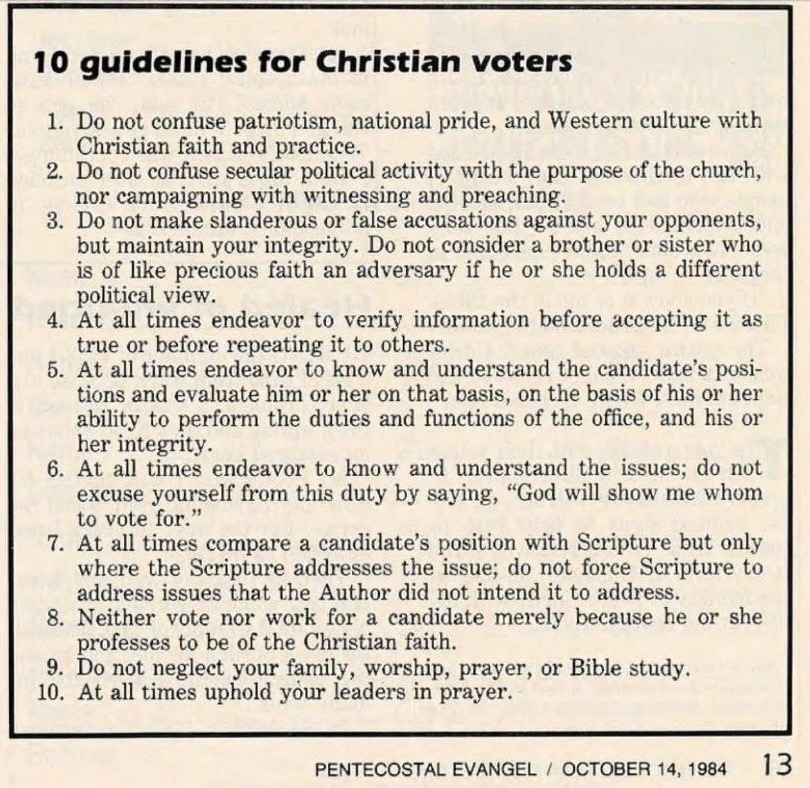
This past Sunday I spoke to my congregation about how Christians should behave biblically during an election season. Someone forwarded to me a related graphic from the Pentecostal Evangel magazine (a publication of the Assemblies of God) from 1984. I love these reminders for Christians!

Researchers unveiled the largest brain map ever completed. It was of a fruit fly, whose brain “includes nearly 140,000 neurons and captures more than 54.5 million synapses”! It took four years to complete this map. “All told, the researchers identified 8,453 types of neuron—much more than anyone had expected. Of these, 4,581 were newly discovered.” This level of complexity and order in a fruit fly is astounding to me. Can you imagine what it would take to map the much larger and more complex human brain?! Truly, David was right when he said that we are wonderfully made by our Creator!

“Freely, willingly and joyfully do good to everyone, serve everyone, suffer all kinds of things, love and praise the God who has shown such grace. Thus, it is just as impossible to separate faith and works as it is to separate heat and light from fire!” —Martin Luther

“Faith the mother of all good works justifieth us, before we can bring forth any good work: as the husband marryeth his wife before he can have any lawful children by her.” —William Tyndale

Unity Is Not Conformity

Listen to the podcast of this post by clicking on the player below, and you can also subscribe on AppleSpotify, or Audible.

Unity is not conformity nor is it mimicry. The Holy Spirit unites Christians in their message of hope to the world, but He does this by empowering each of our unique testimonies to our culture. 

This is a message I shared with the congregation at Country Chapel during their week-long revival meetings.

The Scriptures I reference in this message are—2 Chronicles 18:1-13; Romans 12:2; Mark 12:28-31; John 12:49-50; John 8:34-36; 2 Corinthians 3:16-18; Acts 15:1-35; Acts 1:8; Acts 2:1-11.

I have previously shared a whole series of messages about how the Holy Spirit empowers Christians for ministry:

►► Would you please prayerfully consider supporting this ministry? My Patreon supporters get behind-the-scenes access to exclusive materials. ◀︎◀︎

Determined And Empowered To Do God’s Will

The Sovereign Lord has given me His words of wisdom, so that I know how to comfort the weary. Morning by morning He wakens me and opens my understanding to His will. … Because the Sovereign Lord helps me, I will not be disgraced. Therefore, I have set my face like a stone, determined to do His will. And I know that I will not be put to shame. (Isaiah 50:4, 7 NLT)

God’s words give me wisdom and strength. It doesn’t matter what others say when I live and speak the way God wants me to because God sees my obedience and He will reward me in the end. I don’t live for the applause of men, but only for the applause from nail-scarred hands.

Check out two related blog posts: 

I also spend quite a bit of time unpacking this idea of what really matters to God in my book Shepherd Leadership: The Metrics That Really Matter.