Thursdays With Spurgeon—Church On Fire

This is a weekly series with things I’m reading and pondering from Charles Spurgeon. You can read the original seed thought here, or type “Thursdays With Spurgeon” in the search box to read more entries.

Church On Fire

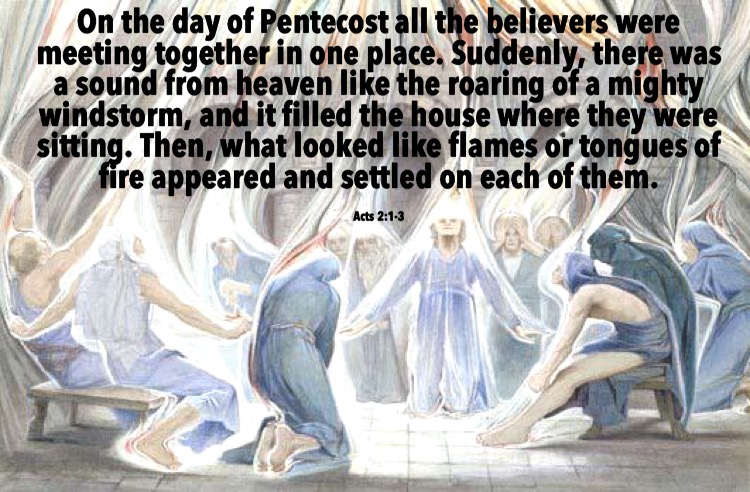
On the day of Pentecost all the believers were meeting together in one place. Suddenly, there was a sound from heaven like the roaring of a mighty windstorm, and it filled the house where they were sitting. Then, what looked like flames or tongues of fire appeared and settled on each of them. (Acts 2:1-3) 

     We are poor, empty things by nature, and useless while we remain so. We need to be filled with the Holy Spirit. Some people seem to believe in the Spirit of God giving utterance only, and they look upon instruction in divine things as of secondary importance. Dear, dear me! What trouble comes when we act upon that theory! How the empty vessels clatter, rattle, and sound! … Where the Spirit of God is truly at work, He first fills and then gives utterance—that is His way. …  

     Full! Then they were not cold, dead, and empty of life as we sometimes are. Full. Then there was no room for anything else in any one of them! They were too completely occupied by the heavenly power to have room for the desires of the flesh! Fear was banished; every minor motive was expelled! The Spirit of God, as it flooded their very beings, drove out of them everything that was extraneous. They had many faults and many infirmities before, but that day, when they were filled with the Spirit of God, faults and infirmities were no more perceptible! They became different men from what they had ever been before. Men full of God are the reverse of men full of self! …  

     The next Pentecostal symbol was utterance. … When the Spirit of God really comes upon a man, he does not wait till he has gathered an audience of the size that he desires, but he seizes the next opportunity! He speaks to one person. He speaks to two. He speaks to three—to anybody. …  

     When the Spirit of God fills a man, he speaks so as to be understood. … The crowd not only understood, they felt. There were lancets in this Pentecostal preaching, and the hearers ‘were pricked in their heart’ (Acts 2:37). … Those are the two effects of the Holy Spirit—a fullness of the Spirit in the ministry and the church, and next, a fire ministry and a church on fire, speaking so as to be felt and understood by those around!

From Pentecostal Wind And Fire

Oh, how I want this today! 

Let’s seek the fullness and the utterance that can only come through the baptism in the Holy Spirit! Let’s be set on fire so that we can impact the world around us! 
Book Reviews From 2020

Thursdays With Spurgeon—The Purpose Of The Baptism In The Holy Spirit

This is a weekly series with things I’m reading and pondering from Charles Spurgeon. You can read the original seed thought here, or type “Thursdays With Spurgeon” in the search box to read more entries.

The Purpose Of The Baptism In The Holy Spirit

On the day of Pentecost all the believers were meeting together in one place. Suddenly, there was a sound from heaven like the roaring of a mighty windstorm, and it filled the house where they were sitting. Then, what looked like flames or tongues of fire appeared and settled on each of them. (Acts 2:1-3) 

     Ordinary winds blow from this or that quarter of the skies, but this descended from heaven itself. It was distinctly like a downdraft from above. This sets forth the fact that the true Spirit, the Spirit of God, comes from neither this place nor that, neither can His power be controlled or directed by human authority. His working is always from above, from God Himself! The work of the Holy Spirit is, so to speak, the breath of God, and His power is always, in a special sense, the immediate power of God. …  

     Tongues of flame sitting on each man’s head symbolized a personal visitation to the mind and heart of each one of the chosen company. The fires came not to consume them, for the flaming tongue injured no one. To men whom the Lord has prepared for His approach, there is no danger in His visitations. They see God and their lives are preserved. They feel His fires and are not consumed. This is the privilege of only those who have been prepared and purified for such fellowship with God. The intention of the symbol was to show them that the Holy Spirit would illuminate them as fire gives light. ‘He will guide you into all truth’ (John 16:13). … 

     But the fire does more than give light; it inflames, and the flames that sat upon each show them that they were to be ablaze with love, intense with zeal, burning with self-sacrifice, and that they were to go forth among men to speak not with the chill tone of deliberate logic, but with burning tongues of passionate pleading, persuading, and entreating men to come to Christ that they might live! The fire signified inspiration. God was about to make them speak under a divine influence, to speak as the Spirit of God should give them utterance. …  

     O You who are our God, answer us by fire, we pray! Answer us both by wind and fire and then we will see You to be God indeed. The kingdom comes not and the work is flagging. Oh, that You would send the wind and fire! You will do this when we are all of one accord: all believing, are expecting, and all prepared by prayer. Lord, bring us to this waiting state!

From Pentecostal Wind And Fire

As I said earlier, Pentecost is not the culmination of God’s power, it is the initiation of His power that is necessary to empower us to be witnesses for Jesus. 

If Jesus said that we needed this power to live and testify for Him, why would we ever want anything but the full outpouring of this Holy Spirit power?! Jesus Himself relied on the power of the Holy Spirit during His earthly ministry, so how much more so do we need this baptism into the fire and wind of the Spirit!

Thursdays With Spurgeon—The Initiation Of Power

This is a weekly series with things I’m reading and pondering from Charles Spurgeon. You can read the original seed thought here, or type “Thursdays With Spurgeon” in the search box to read more entries.

The Initiation Of Power 

     Whatever the Holy Spirit was at the first, He is that now, for as God, He remains forever the same. … We would greatly grieve the Holy Spirit if we supposed that His might was less today than in the beginning. …  

     If at the commencement of the gospel we behold the Holy Spirit working great signs and wonders, may we not expect a continuance of and, if anything, increased displays of His power as the ages roll on? … 

     It ought not to be forgotten that Pentecost was the feast of firstfruits. It was the time when the first ears of ripe corn were offered to God. If, then, at the commencement of the gospel harvest we see so plainly the power of the Holy Spirit, may we not most properly expect infinitely more as the harvest advances and, most of all, when the most numerous sheaves will be gathered? May we not conclude that if the Pentecost was thus marvelous, the actual harvest will be still more wonderful?

From Pentecostal Wind And Fire

When Jesus was approaching the Cross, He gathered His disciples together to tell them what was coming. One of the assurances He gave His followers was this: “I assure you, most solemnly I tell you, if anyone steadfastly believes in Me, he will himself be able to do the things that I do; and he will do even greater things than these, because I go to the Father” (John 14:12). 

The empowering force for these “greater things” would be the Holy Spirit indwelling the Christian (Matthew 3:11; Luke 24:49; Acts 1:8, 2:1-4). 

Pentecost wasn’t the culmination, it was the initiation. 

Pentecost was the launching point for followers of Jesus to be filled with dunamis power that would enable them to go into all the world and preach the gospel, and to have signs and wonders follow to confirm the preaching of the Word. 

As Spurgeon said, we greatly grieve the Holy Spirit when we attempt to put Him in a box as to what He can or can’t do today, or if we try to limit Him to one era of long-past history. The Holy Spirit is as vital for a Christian today as He was on that Pentecost Sunday described in Acts 2! 

What Does The Bible Say About Church Leaders?

God’s plan has always been for His leaders to organize and oversee His ministry.

The important thing for us to distinguish is “His.” It’s not a man or woman saying, “I will be a leader,” or even a God-appointed leader saying, “I am going to build up my ministry.”

The New Testament gives us a fourfold purpose for the Body of Christ:

  1. Mobilizing for evangelism
  2. Organizing for more meaningful ministry
  3. Making disciple-makers
  4. Caring for one another

We see God’s leaders involved in all of these aspects—

Mobilizing for evangelism—Peter pointed out the need for an apostle to be appointed to replace Judas, thus returning their ranks to the 12 apostles just as Jesus had originally said (Acts 1:15-22).

Organizing for more meaningful ministry—Everywhere Paul founded a church, he also appointed leaders to oversee and shepherd that church.

Making disciple-makers—Paul tells us that God appointed five offices of leaders in the church who had the specific task of preparing church members to do the ministry of building maturity in the church (Ephesians 4:11-16).

Caring for one another—The First Church set the pace for providing care for all who were in need, including organizing leaders to oversee specific care ministries (Acts 6:1-5).

What about a church congregation’s responsibility to their leaders? I see five areas:

  1. Hold them accountable to the Word (Acts 17:11). The Bible has to be THE standard to which leaders are held.
  2. Give them your confidence and submission after they have shown accountability to their biblical mandate (Hebrews 13:17).
  3. Pray for them (Ephesians 6:19).
  4. Pay them (1 Timothy 5:17).
  5. Be very careful about accusing them (1 Timothy 5:19).

A church and its leaders following this biblical pattern is a church that can effectively fulfill the Great Commission which Jesus gave us.

What Is The Church Supposed To Be Doing?

Listen to the podcast of this post by clicking on the player below, and you can also subscribe on AppleSpotify, or Audible.

Before ascending back to Heaven, Jesus commissioned His followers. He gave them a mission that Christians often refer to as The Great Commission.

Jesus said, “All authority in heaven and on earth has been given to Me. Therefore go and make disciples of all nations, baptizing them in the name of the Father and of the Son and of the Holy Spirit, and teaching them to obey everything I have commanded you. And surely I am with you always to the very end of the age.”

There are several pictures in the New Testament of how the Church could live out this Great Commission, but one of the pictures that I find the most helpful is that of a Body.

The human body is an amazing creation! Just to accomplish the simple task of picking up something between our thumb and forefinger is a miracle in itself. The structure of bones and ligaments and tendons, the interaction of nerves in the fingers coordinating with the optical nerve, not to mention the enzymes and blood vessels that are all doing their part.

Yet if any part is not functioning properly, that simple action becomes more difficult. Maybe it even becomes impossible.

The Church is the same way. Every part of the Church Body has to be functioning in healthy order for the whole Body to be effective.

Here are four aspects of a healthy Church Body that the Apostle Paul lists in Ephesians 4:

  1. Caring for one another
  2. Mobilizing for evangelism
  3. Making disciple-makers
  4. Helping organize for more meaningful ministry

If every part of the Body is doing its part, we’re Living out the Great Commission.

If some parts are missing or unhealthy, we’re Wallowing in the Great Omission.

It’s not about your church (small “c”) or my church. It’s about all Christian disciples being a part of one Church—one Body—going into all the world and making disciples of all peoples. That’s what the Church is supposed to be doing!

►► Would you please prayerfully consider supporting this ministry? My Patreon supporters get behind-the-scenes access to exclusive materials. ◀︎◀︎

Where Preachers Are Powerless

To my dear pastor friends, please ponder carefully these wise words from Oswald Chambers:

“As preachers and teachers we are powerless to make saints. Our duty is to put the seed into the right place and leave the rest to God. …

“Modern evangelism makes the mistake of thinking that a worker must plough his field, sow the seed, and reap the harvest in half-an-hour. Our Lord was never in a hurry with the disciples, He kept on sowing the seed and paid no attention to whether they understood Him or not. He spoke the truth of God, and by His own life produced the right atmosphere for it to grow, and then left it alone, because He knew well that the seed had in it all the germinating power of God and would bring forth fruit after its kind once it was put in the right soil. …

“Sow the Word of God, and as sure as God is God, it will bring forth fruit. …

“Sow emotions, and the human heart will not get beyond you. There are men and women at work for God who steal hearts from God, not intentionally, but because they do not preach the Word of God. They say, ‘I don’t want anyone to think about me’; that should never need to be said. If the thought of ourselves is lurking anywhere as we preach, we are traitors to Jesus Christ. Our duty is to get people through to God. … See that you sow the real seed of the Word of God, and then leave it alone.” —Oswald Chambers, in The Servant As His Lord

These words prompt me to take a close look into God’s mirror to see if I’m preaching in a way that God can bless. How about you?

Book Reviews From 2015

Links & Quotes

link quote

“What takes away the compulsion of revenge is our deep confidence that this world is not our home, and that God is our utterly sure and all-satisfying reward.” —John Piper

“Though it is clear as noonday in Scripture and in experience that stability is not to be found beneath the moon, yet men are for ever building upon earth’s quicksand as if it were substantial rock, and heaping up its dust, as though it would not all be blown away.” —Charles Spurgeon

[PHOTOS] 50 photos of Moms loving their kids in very trying times.

This post from a Live Dead team member—The Risk Of Security—reminds me to (1) pray for our front-line missionaries, and (2) pray that God will move on people’s hearts to raise up more missionaries!

How to poison your marriage in 3 easy steps: blame, compare, withdraw. Married couple should definitely read this post.

I love the leadership insights from Tim Elmore. He’s got a thoughtful post today on 2 temptations leaders face in turbulent times.

[VIDEO] Frank Turek and Boby Conway discuss the question: Can Science Disprove God?

12 Quotes From “Rise”

RiseTrip Lee has given parents, teachers and anyone who mentors teens and 20-somethings an excellent resource in his book Rise. I read this book for myself, and now I’m reading it and discussing it with my teenage son. You can read my full book review by clicking here. Below are just a few of the quotes I especially appreciated in Rise.

“There are great benefits to living for Jesus in the present. Now is the time when we have the most strength. Now is the time when we have the most energy. Now is the time when we can give it everything we have. Now is the time to get up and live.”

“Every decision we make is a small piece of a larger puzzle. And without looking at the big picture for reference, we’ll place the pieces incorrectly every time. It’s tragic to treasure a moment in time more than an entire lifetime.”

“It’s loving of me to stop my son when he tries to put his finger in a socket or put a penny in his mouth. It’s loving of Jesus to tell me to say no to myself when I’m doing the wrong thing. … Let’s be clear, though. He’s not saying you can’t be yourself. He’s not calling you to ignore your personality and abandon your interests. Instead, He’s saying, ‘Submit all those things to Me.’ Your personality and your interests are His, and following Him shapes those things to bring you joy and bring God glory.” 

“One of our problems is that we think we belong to ourselves. Our assumption is that we are the masters of our lives and we get to make all the big decisions. That’s a myth. I belong to God. First, because He created me (Psalm 139:13), and second, because He purchased me (1 Corinthians 6:19-20). And that has serious implications for how I invest each hour of my day. I don’t have the right to rob God of time.”

“We allow our desire for approval to push us in directions we wouldn’t go otherwise. The answer is to be more content with the acceptance of Jesus, while praying that God would make us more passionate about pleasing Him than pleasing other people. … One of the quickest ways to ensure compromise is to obsess over what other people think of you.”

“Confession of sin can only be perceived as your enemy if you have a goal other than God’s glory. If your goal is your glory, then confessing your sin works against that goal and therefore should be avoided. But if you’re living for the glory of God, confessing your sin to the right people will only help.”

“With Christians or non-Christians, when we pretend, we are using them instead of loving them. Instead of saying or doing what would be most beneficial for them, we say or do what makes us look good. We’re using them to get to that end goal, the magical feeling of acceptance and approval, that sweet ego stroke. And that will eventually crush us and crush them.”

“The mature Christian doesn’t just ask, ‘What can I do?’ but ‘What can I do to glorify God?’”

“A Christian’s job is to live in such a way that shows off the real Jesus, the all-powerful, Almighty, sinner-loving King of the universe.”

“One of the reasons we struggle is because we forget that Jesus is the Lord of all. When I say Lord of all, I don’t just mean Lord of all people; I mean Lord of all things and spheres of life. It’s easy for us to section off our lives into little quadrants. There’s the fun stuff, the family stuff, the boring stuff, and the spiritual stuff. But the Bible doesn’t recognize any area of our lives that’s not spiritual. God made every sphere of life, He rules over every sphere of life, and He can be glorified in every sphere of life. This means everything is sacred.”

“The symptom of an encounter with the compassion of Jesus is compassion for others.”

“People go to hell because they haven’t seen the glory of God in the Gospel and trusted in Christ. Seeing the glory of God matters, and we want them to see it. Where the glorious light of Christ is not seen, sins are not forgiven and souls are not saved. This is why we share the Good News. The end goal of evangelism is that people would see the glory of God and worship Him forever.”