


Listen to the podcast of this post by clicking on the player below, and you can also subscribe on Apple, Spotify, or Audible. Check out the video content in this post by clicking here.
 I’m not sure that any other aspect of the Christian faith generates as much discussion as the role of the Person of the Holy Spirit. Specifically, I would say “nuanced discussion.” By that I mean, people carefully choosing their words to remain biblically accurate but not sound weird. “After all,” they might say, “we don’t want people looking at us strangely because we’re talking about signs, wonders, and speaking in unknown languages. Yet at the same time, we don’t want to grieve the Holy Spirit.”
I believe there is a better way to handle this: Let Scripture speak for itself.
Let me share one recent example with you that will address this point. A rather well-known Christian apologist, who happens to be quite skilled in ancient biblical languages, was recently asked in an interview, “Can you explain the gift of speaking in tongues?”
Here are some of the main things he said in reply: “I think there is something going on in the New Testament that is different. … There is a uniqueness to that time period. It’s normative in a way that it is not now” because, he says, we don’t see today what we see in the New Testament, “because the disciples are building the foundation of the Church. … Now we have the books of Scripture where God speaks to us in a different way. … Speaking in tongues, prophesying happen; I just don’t think they’re normative in the way we see them happening in the New Testament.”
There’s a lot to unpack here, but I want to focus on a word he repeated: normative.
The dictionary defines that word: implying, creating, or prescribing a norm or standard; especially an assumed norm regarded as the standard of correctness in behavior, speech, writing, etc.
So I guess we need to ask, “What is normal?”
Let’s begin with this question: What did the pre-Ascension followers of Jesus consider normal?
First, Jesus was with them bodily form, and He regularly explained Scripture to them. Jesus healed people and so did His followers. Jesus told them He was leaving in bodily form, but that He would send the Holy Spirit to be with them (John 14:16-17).
(Check out all of the Scriptures in this sermon here.)
The next question is: What did the post-Ascension followers of Jesus consider normal?
There was a joy of anticipating the Holy Spirit’s outpouring (Luke 24:50-53). Jesus was no longer with them bodily, but they still operated in His name and authority. They understood Scripture without Jesus in bodily form explaining it to them. They wrote the books of the New Testament, which are really a commentary on Scripture (the Old Testament) in light of the life, death, and resurrection of Jesus. They healed people.
Our final question should be: What should we consider normal?
Let’s go back to John 14:16-17 where Jesus promised the arrival of the Counselor. The baptism in the Holy Spirit is empowerment in a wholly different level. At salvation, He is “with” us; at baptism, He is “in” us. Jesus is still not with us in bodily form, but we can still operate in His name, we understand Scripture without Jesus in bodily form explaining it to us, and we can operate in a realm of power that seems extra-ordinary to others!
Listen to a couple of key phrases from Peter’s Pentecost Sunday sermon. He says this outpouring of the Holy Spirit is the fulfillment of a promise made by Jesus, and it is proof of the resurrection and ascension of Jesus (Acts 2:33, 38-39).
Nowhere is this implied that this is a one-time empowerment, nor an exclusive empowerment for those living in that time, nor is it exclusively for those called apostles. The saints lived this out as their normal daily life. See just a few examples in Acts 4:20, 30-31; 6:3, 8-10; 8:4-8, 14-17.
“The secret of our strength is the living testimony that Jesus Christ is every moment with us, inspiring, directing and strengthening us. This is what made the disciples so bold in preaching Him as the Crucified One in the midst of His enemies. They never for a moment regretted His bodily absence, for they had Him with them, and in them, in the divine power of the Holy Spirit.” —Andrew Murray
I think we have accepted sub-normal as normative for so long, that we now call that normal. Instead our normal should be a lifestyle, a language, a power that is called extraordinary by others.
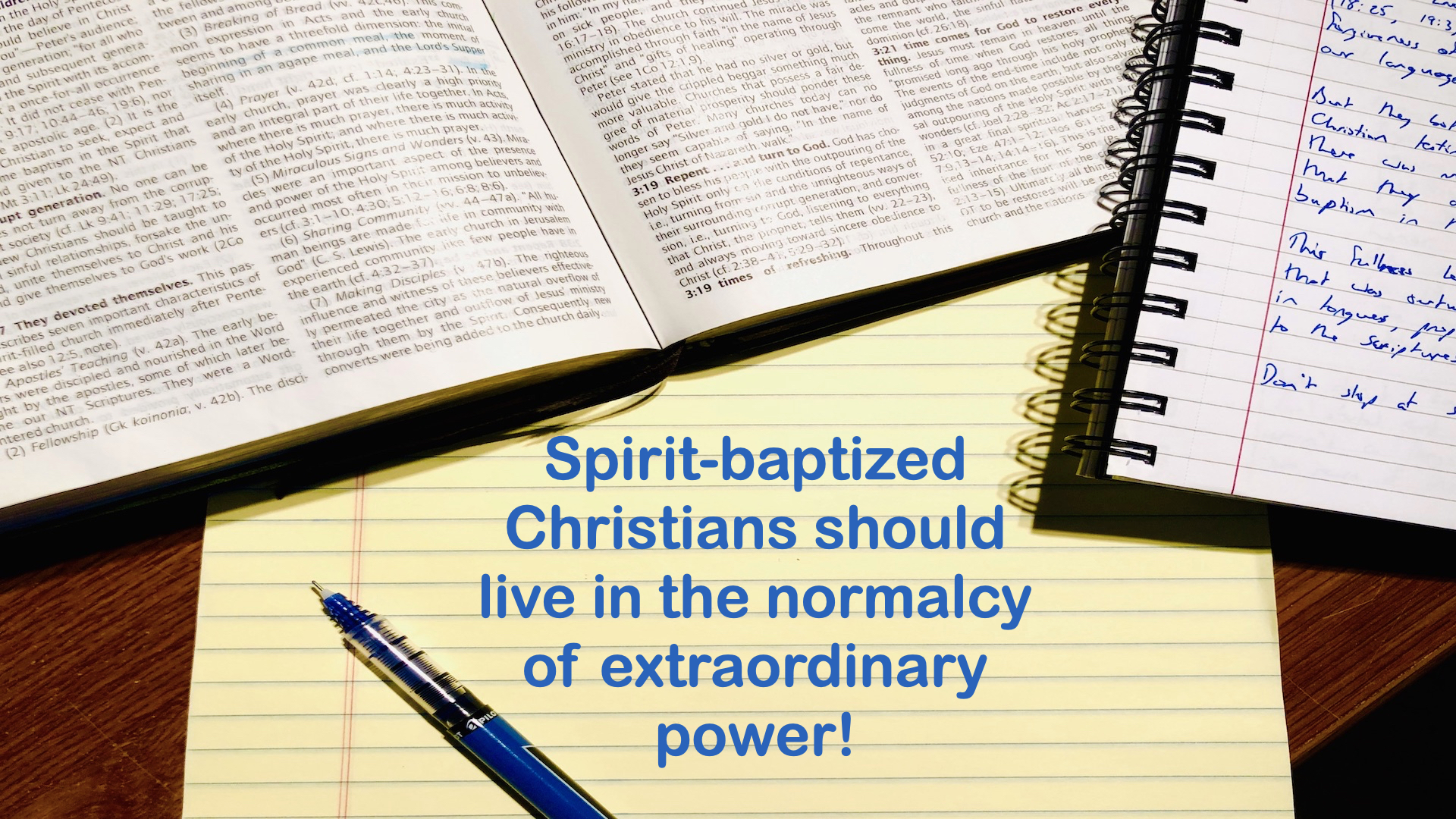
Spirit-baptized Christians should live in the normalcy of extraordinary power!
Please check out the other messages we have covered in this series called We Are: Pentecostal by clicking here.
►► Would you please prayerfully consider supporting this ministry? My Patreon supporters get behind-the-scenes access to exclusive materials. ◀︎◀︎


 Craig T. Owens
May 18, 2026 at 5:11 am
[…] The normalcy of extraordinary power […]
LikeLike