9 Quotes From “Seeing Jesus”

Nancy Guthrie marvelously shows us how Jesus links the Old Testament prophesies with His New Testament activities. This book makes the Old Testament come alive! Check out my full book review by clicking here, and then enjoy a few quotes from this book.

“satan’s power is wielded in the world in the form of death. What gives him that power is sin and the estrangement from God it brings. But on the Cross, Jesus did what was necessary for sinners to be reconciled with God. The devil thought he was defeating Christ, but in reality Christ was reconciling us to God, defeating the devil, and delivering us out of his clutches.”

“It has always been God’s way to use the weak, the foolish, the imperfect—even the shamefully sinful but ultimately repentant—in His redemptive plan. It is His glory to do so, and will be into eternity.”

“God has always wanted His people to know Him—not in a generic or shallow way, but personally, as He truly is. So He revealed Himself in a progressive way, not only through His name, but also through His glorious presence that dwelt in the Temple, through the Law, and through His mighty deeds on behalf of His people. But these revelations all led up to a definitive revelation in the Person of Jesus.”

“Our security in Christ frees us to enjoy His Sabbath rest. Christ fills our hearts with the same love He has for His Father so that we can honor our parents. Christ fills us with His very own faithfulness so that we can live in sexual purity. He convinces us of all that is ours in Him eternally so that we can stop coveting the things other people have that will not last beyond this life. As we refuse to allow anything else to be a god to us; we honor His name, His day, and our parents; as we value life; as we live in sexual purity and fidelity; as we nurture contentment and integrity, we’re not being merely legalistic. The grace of God is at work in our lives, making us holy and happy in God.”

“Jesus was less interested in explaining Himself to Nicodemus than in offering Himself to Nicodemus. … Jesus wanted Nicodemus to understand that we, too, have been bitten—not by a poisonous snake, but by the poison of sin. We, too, need a cure or we face certain death. And just as God provided the cure to His people in the desert, so has He provided a cure to us. But to experience healing requires something of us. We have to look to Jesus.”

“Jesus came into the world to make God knowable so that we can truly love Him with all our hearts, souls, and minds.”

“Jesus came the first time to offer forgiveness rather than bring down fire. He came down the first time to experience the fiery judgment of God in the place of guilty sinners. But the day is coming when Jesus will ‘come with His mighty angels, in flaming fire, bringing judgment on those who don’t know God and those who refuse to obey the Good News of our Lord Jesus’ (2 Thessalonians 1:7-8).”

“Whereas Proverbs describes a way of wisdom that leads to life and to God, Jesus defined that way in much more personal terms. He said, ‘I am the way, the truth, and the life. No one can come to the Father except through Me’ (John 14:6). The decision, as Jesus made clear, is not merely a matter of behavior or companions, but a choice about how we respond to Him, whether or not we will choose Him as our path, our life.”

“The people of Israel had the law; they knew what God wanted from them and for them. But they didn’t have the power or strength to obey. They knew what to do, but they didn’t have the ‘want-to’ to live as God commanded and to love Him as He desired. God’s commands in the covenant of the law were just a list of external rules. …

“In the new covenant, God’s law would be written on the hearts of His people rather than on stone tablets. He would put His Spirit inside His people. In this way, He would give them a love for His will and His ways, and a hatred of sin. His people would finally be able to love His will and walk in His ways because they would want to.”

Seeing Jesus (book review)

seeing-jesusB.B. Warfield once commented that the Old Testament is like a beautiful mansion, but the lights are turned off; with the Advent of Jesus, the lights have come on and we can now appreciate the beauty that was always there. In Seeing Jesus, Nancy Guthrie shows us the beauty of Jesus that is on full display from the opening words of the Bible, shining a bright light on passages that many may have previously missed.

Sadly, a lot people mistakenly believe that Jesus first shows up at His birth in Bethlehem, forgetting that Jesus Himself said that all the Scriptures point to Him. Nancy does just what Jesus said: She links together passages from both Testaments to show how all the Scripture finds its fulfillment in Jesus Christ.

Each chapter opens with a passage from the Old Testament and a passage from the New Testament. Then Nancy masterfully shows how Jesus links the two Testaments by the work He completed at Calvary. I appreciate how there is a satisfying conclusion to each chapter, but also how there is an open door to explore each particular topic more in my own Bible study time.

Especially for those who have thought the Old Testament is confusing, or outdated, or even boring, Seeing Jesus will bring a whole new excitement and insight into your Bible study time.

I am a Tyndale book reviewer.

Book Reviews From 2016

8 Quotes From “More Than A Carpenter”

more-than-a-carpenterMore Than A Carpenter by Josh & Sean McDowell is a wonderful resource to prepare you to share the uniqueness of Jesus Christ. Check out my book review by clicking here, and then enjoy these quotes that I especially found interesting.

“Why don’t the names of Buddha, Mohammed, or Confucius offend people the way the name of Jesus does? I think the reason is that these other religious leaders didn’t claim to be God.” —Josh McDowell

“It was reserved for Christianity to present to the world an ideal which through all the changes of eighteen centuries has inspired the hearts of men with an impassioned love; has shown itself capable of acting on an all ages, nations, temperaments, and conditions; has been not only the highest pattern of virtue, but the strongest incentive to its practice. … The simple record of these three short years of active fife has done more to regenerate and soften mankind than all the disquisitions of philosophers and all the expectations of moralists.” —William Lecky, one of Great Britain’s most noted historians and a fierce opponent of organized Christianity

“This testimony [that Jesus was God], if not true, must be downright blasphemy or madness. … Self-deception in a matter so momentous, and with an intellect in all respects so clear and so sound, is equally out of the question. How could He be an enthusiast or a mad man who never lost the even balance of His mind, who sailed serenely over all the troubles and persecutions, as the sun above the clouds, who always returned the wisest answer to tempting questions, who calmly and deliberately predicted His death on the Cross, His resurrection on the third day, the outpouring of the Holy Spirit, the founding of His church, the distraction of Jerusalem—predictions which have been literally fulfilled? A character so original, so complete, so uniformly consistent, so perfect, so human and set so high above all human greatness, can be neither a fraud nor a fiction. The poet, as has been well said, would in this case be greater than the hero. It would take more than a Jesus to invent a Jesus.” —Philip Schaff

“There exists no document from the ancient world witnessed by so excellent a set of textual and historical testimonies, and offering so superb an array of historical data on which an intelligent decision may be made. An honest [person] cannot dismiss a source of this kind. Skepticism regarding the historical credentials of Christianity is based on an irrational bias.” —Clark H. Pinnock

“The Gospels tell us Jesus’ family, including James, were embarrassed by what He was claiming to be. They didn’t believe in Him; they confronted Him. In ancient Judaism it was highly embarrassing for a rabbi’s family not to accept him. Therefore, the Gospel writers would have no motive for fabricating this skepticism if it weren’t true. Later the historian Josephus tells us that James, the brother of Jesus, who was the leader of the Jerusalem church, was stoned to death because of his belief in his brother. Why did James’ life change? Paul tells us: the resurrected Jesus appeared to him. There’s no other explanation.” —J. P. Moreland

“The resurrection takes the question ‘Is Christianity valid?’ out of the realm of philosophy and makes it a question of history.”

“I believe in the resurrection, partly because a series of facts are unaccountable without it.” —Michael Ramsey, former Archbishop of Canterbury

“The Old Testament contains sixty major messianic prophecies and approximately 270 ramifications that were fulfilled in one Person, Jesus Christ. … We find the chances of just forty-eight of these prophecies being fulfilled in one person to be only 1 in 10157. … All of the prophecies about the Messiah were made at least four hundred years before He was to appear. … This description of the manner of [Christ’s] death was written eight hundred years before the Romans used crucifixion as a method of execution.” —Josh McDowell

I am always sharing quotes from More Than A Carpenter and other interesting authors regularly on both Twitter and Tumblr. Please make sure you are following me there as well to see these quotes as soon as they are posted.

9 More Quotes From “Today’s Moment Of Truth”

Today's Moment Of TruthToday’s Moment Of Truth by Lee Strobel and Mark Mittelberg is so chockfull of helpful truths that I couldn’t possibly have shared all of the passages I highlighted. Here are a few more quotes I wanted to share with you:

“Jesus said, ‘Do not believe Me unless I do the works of My father. But if I do them, even though you do not believe Me, believe the works, that you may know and understand that the Father is in Me, and I in the Father’ (John 10:37-38). And Jesus did the miraculous works He referred to. Even the Pharisee Nicodemus conceded, ‘Rabbi, we know that You are a teacher who has come from God. For no one could perform the signs You are doing if God were not with Him’ (John 3:2).

“We can see such confirmation repeatedly in the lives of Jesus and the biblical prophets. But it never happened in the life of Mohammad, the founder of Islam. Mohammad believed Jesus was a prophet who performed miracles, including raising the dead. Muslims also believe Moses and Elijah performed miracles.

“However, according to the Qur’an, when unbelievers challenged Mohammad to perform a miracle, he refused. He merely said they should read a chapter in the Qur’an (Surah 2:118; 3:181-184; 4:153; 6:8, nine, 37).

“So, unlike Jesus, Mohammad never did miracles. It wasn’t until approximately 150 to 200 years after Mohammad’s death that some of his followers begin to come up with stories of miracles and ascribe them to him.” —Lee Strobel & Mark Mittelberg 

“There are two major competing worldviews to Christian theism—atheism and pantheism…. The problem with atheism is that, with its denial of God’s existence, there’s a loss of any ultimate moral basis by which to declare something good or evil. So atheists are left without any objective standard by which to judge something as being right or wrong. Instead, they’re left with mere preferences. I have mine. You have yours. Rape and murder may not be my cup of tea, but they maybe somebody else’s. And who are we to say that what others choose to do is wrong? [We are] not saying an atheist cannot live a moral life; we are saying that an atheist cannot define what morality is. ….

“If everything is part of god [as in pantheism], then what we call evil is actually part of that god as well. … This is the very god, or ultimate reality, that Eastern philosophy says we’re supposed to strive to become more like and eventually to become one with. This presents a tremendous problem: we’re supposed to join with the very entity that contains evil within itself!” —Lee Strobel & Mark Mittelberg

“Revering Christ as Lord and being prepared to defend our faith are ongoing processes in the Christian life. … It’s interesting that in the original Greek, the word Peter used for answer is apologia [1 Peter 3:15], from which we get our word apologetics. It literally means we are to be ready to give a speech of defense—a well-thought-out account of why our faith in Christ makes sense. … With God’s help we can present information that will remove intellectual barriers, helping people move one step closer to faith in Christ.” —Lee Strobel & Mark Mittelberg

“In 2 Chronicles 7, God says if Israel’s sin reaches a certain level, He’ll destroy the temple, exile the people, and leave them in a state of judgment. Sure enough, this comes to pass. The prophet Daniel prays in Daniel 9 that God would have mercy. God gives him a revelation about the temple being rebuilt. Before this new temple is destroyed, Daniel is told, several things are going to take place, including the bringing of everlasting atonement—the final dealing with sin.

“The prophet Haggai says the glory of the second temple will be greater than the glory of the first temple. God will fill the second temple with His glory. Then the prophet Malachi says the Lord will come to His temple. He uses a Hebrew term that always refers to God Himself: the Lord—He will come to that temple.

“Keep in mind the second temple was destroyed in AD 70. Atonement for sin had to be made and the divine visitation had to take place before the second temple was destroyed.

“So … if it’s not Yeshua, the Jewish name for Jesus, then throw out the Bible, because nobody except Him accomplished what needed to be done prior to AD 70. What divine visitation did take place if not for Yeshua? When else did God visit the second temple in a personal way? How else was the glory of the second temple greater than the first?

“Either the Messiah came two thousand years ago, or the prophets were wrong and we can discard the Bible. But they weren’t wrong. Yeshua is the Messiah—or nobody is.” —Michael Brown, a messianic Jew

“Even nonreligious people live in the trust that their nonreligious beliefs are accurate and that they won’t someday face a thoroughly religious Maker who actually did issue a list of guidelines and requirements that they failed to pay attention to.” —Mark Mittelberg 

“There can be no doubt that archaeology has confirmed the substantial historicity of Old Testament tradition.” —William F. Albright

“The noted Roman historian Collin J. Hemer, in The Book Of Acts In The Setting Of Hellenistic History, shows how archaeology has confirmed not dozens, but hundreds and hundreds of details from the biblical account of the early church. Even small details have been corroborated, like which way the wind blows, how deep the water is a certain distance from the shore, what kind of disease a particular island had, the names of local officials, and so forth.

“Now, Acts was authored by the historian Luke. Hemer gives more than a dozen reasons why Acts had to have been written before AD 62, or about thirty years after Jesus’ crucifixion. Even earlier, Luke wrote the Gospel of Luke, which is substantially the same as the other biblical accounts of Jesus’ life.

“So here you have an impeccable historian, who has been proven right in hundreds of details and never proven wrong, and it’s written within one generation while eyewitnesses were still alive and could have disputed it if it were exaggerated or false.” —Norman Geisler 

“No Book of Mormon cities have ever been located, no Book of Mormon person, place, nation, or name has ever been found, no Book of Mormon artifacts, no Book of Mormon scriptures, no Book of Mormon inscriptions,…nothing which demonstrates the Book of Mormon is anything other than myth or invention has ever been found.” —John Ankernerg and John Weldon

“Jesus did exist, whether we like it or not.” —Bart Ehrman, an agnostic

If you would like to read the first set or quotes from this book, please click here.

You can check out my review of Today’s Moment Of Truth here.

And to read some of the other quotes I’ll be sharing from this book, be sure to follow me on Tumblr and Twitter.

6 Quotes From “Light & Truth—The Lesser Epistles”

Light & Truth The Lesser EpistlesHoratius Bonar’s insights on the Scriptures are amazing! So far I’ve read and reviewed three of the four commentaries he has prepared on the New Testament (you can read those reviews here, here and here). These are a few quotes from the third book on the epistles Galatians through Jude. Any reference in brackets is the passage from the Bible on which Bonar is commenting.

“It is a busy, lighthearted, laughing, pleasure-seeking world. But sin is here, and pain is here, and broken hearts are here, and weeping is here, and death is here, and the grave is here. Oh! in spite of all its laughter and vanity, it is an evil world. And the great proof of its evil is, that it cost the death of the Son of God to deliver you from it. … Give yourselves to Him Who came to deliver you from it, and Who stretches out His hands to you all day long, asking you to allow Him to deliver you. He yearns over you; and with sincere earnestness proffers to you His love, His friendship, His great salvation. Consent, O man, consent! His desire is to bless, and not to curse; to save, and not to destroy.” [Galatians 1:4]

“There never have been two gospels. There is not an Old Testament gospel and a New Testament Gospel. There is not one gospel for the Jew, and another for the Gentile, one gospel for the first century, and another for the nineteenth. It is but one gospel, as there is but one Cross and one Savior. Many ages, but one gospel; many sinners, but one gospel; many prophets and apostles, but one gospel. As our earth has had but one sun, so it has had but one gospel. Nor does it need more; that one is sufficient.” [Galatians 1:6-9]

“As the earth without rain or sunshine turns to barrenness, so is it with the Church or soul without the Spirit. … The age thinks it can do without the Spirit. Let the Church watch against this blasphemy. Let her keep hold of the Lord’s promise, the promise of the Father. Let her prize the gift; long for more of it. Let every saint seek more of it. Let our cry be continually: More of the Holy Spirit; more of His fullness; more of His gifts and graces!”

“Strength for the race is needed, hourly strength, superhuman strength; for it is no earthly race, but something lofty, supernatural, divine. Forgetting the supernatural source of strength, we betake ourselves to the internal or the simply external. And so we weary. For only God can supply the power which keeps us running. By Him only shall we run, and not be weary.” [Galatians 5:7]

“‘To Him who is able’—He is the Mighty One, the mighty God, the Lord God Almighty. Hear how this word ‘able’ is used. ‘He is able to subdue all things unto Himself’ (Philippians 3:21). ‘He is able to help them that are tempted’ (Hebrews 2:18). ‘He is able to save to the uttermost’ (Hebrews 7: 25). ‘He is able to keep us from falling’ (Jude 24). It is with the mighty God that we have to do; mightier than ourselves or our foes; mightier than earth or hell; omnipotent.” [Ephesians 3:20]

“Are you expecting the Lord? Are you living in this expectation? Is it a deep-seated, abiding, cherished hope? Is it a hope that tells upon your character, your life, your daily actings in public or private, your opinions, your whole man? Does it quicken you? Does it purify you? Does it keep you separate from the world? Does it keep you calm in the midst of earth’s most exciting events, or most untoward changes? Does it give you a new view of history as well as prophecy? … Let your expectation of the Lord’s coming be a calm and healthy one; not one that excites, but one that tranquilizes; not one that unfits for duty, but one that nerves you more firmly for it; not one that paralyzes exertion, but one that invigorates you for it; not one that makes you indifferent to present duty, but one that makes you doubly in earnest about everything that your hand findeth to do; not one that stops liberality, and prayer, and work, but one that increases all these a hundred fold; not one that dwells exclusively on the future’s dark side—the judgments that are at hand—but one that realizes the glory and the joy of Messiah’s approaching victory and triumphant reign.” [Philippians 3:20]

10 Quotes On The Difference Between Christianity And Islam

Nabeel Qureshi wrote a couple of outstanding books to help those in the West better understand Islam (Seeking Allah, Finding Jesus and Answering Jihad).

Answering JihadIn Answering Jihad, Nabeel invests several chapters in looking at the differences between Christianity as displayed in the Bible and Islam as displayed in the Quran. Here are some of the more noteworthy quotes I pulled from this book. The references in parenthesis in these quotes are references to a chapter and verse in the Quran.

“Christians believe Jesus is God, but the Quran is so opposed to this belief that it condemns Jesus worshipers to hell (5:72).”

“According to Jesus, God is our Father, yet the Quran very specifically denies that God is a father (112:1-4).”

“Islam roundly condemns worship of the Trinity (5:73), establishing in contrast its own core principle of Tawhid, the absolute oneness of God. Tawhid emphatically denies the Trinity, so much so that it is safe to say the doctrine of God in Islam is antithetical to the doctrine of God and Christianity. … The Trinity teaches that God is not a person, but three Persons: Father, Son, and Spirit. To assert that the God of Islam is the same person as the God of Christianity becomes almost nonsensical at this point, as the Christian God is tripersonal, two persons of Islam specifically denies in the Quran.”

“The Trinity is an elaboration of Jewish theology, not a rejection. By contrast, Tawhid is a categorical rejection of the Trinity, Jesus’ deity, and the Fatherhood of God, doctrines that are grounded in the pages of the New Testament and firmly established centuries before the advent of Islam. The earliest Christians were all Jews, incorporating their encounter with Jesus into their Jewish theology. Nothing of the sort is true of Muhammad, who was neither a Jew nor a Christian. Islam did not elaborate on the Trinity but rejected and replaced it.”

“Christians worship the triune God: a Father Who loves unconditionally, a Son Who incarnates and Who is willing to die for us so that we may be forgiven, and an immanent Holy Spirit Who lives in us. This is not who the Muslim God is, and it is not what the Muslim God does. Truly, Tawhid is antithetical to the Trinity, fundamentally incompatible and only similar superficially and semantically. Muslims and Christians do not worship the same God.”

“The warfare the Quran commands is not due to any evil action, but rather due to the beliefs of non-Muslims, such as the Christian belief that Jesus is the Son of God (9:29, 30).”

“Warfare in the Old Testament is not about subjugating inferior peoples. Yahweh does not promise the Jews that they are the best of people and that their enemies are less than they are. He makes this quite clear in Deuteronomy 9:4-6. … The Quran, by contrast, envisions Muslims as the best people: ‘You are the best of all people, evolved for mankind’ (3:110). It teaches that Jews and Christians who do not convert to Islam are the worst of all creation: ‘Those who do not believe [in Islam] from among the Jews and Christians and the idolaters will go to hell. They are the worst of creatures’ (98:6; see 98:1-5 for context). This is why the Quran in 9:33 commands Muslims to fight Jews and Christians, so that Allah may cause Islam ‘to prevail over all religions.’”

“Muhammad’s life moved from peaceful to violent in a crescendo, reflecting the trajectory of the Quran, and he died just after conquering the Arabian Peninsula. His words in the canonical collections were, ‘I have been ordered by Allah to fight against the people until they testify that none has the right to be worshiped but Allah and that Muhammad is Allah’s messenger. … [O]nly then will they save their lives and property from me’ (Sahih Bukhara 1.2.25). Muslims are commanded to follow Muhammad’s example, and his example was jihad.

“By contrast, the stories in the Old Testament do not enjoin Jews or Christians to fight today. Though commands to fight are recorded in the text, no Jew or Christian is commanded to memorialize these battles as ongoing conduct. They were a part of the history of Israel, certainly, not a mandate or continuing command going forward.”

“Violence has a very different place in Islam and Christianity’s theological frameworks. The final marching order of Islam is jihad. The final marching orders of Christians are grace and love.”

But I especially love this thought from Nabeel: “One can both love Muslims and insist that the God they worship is not the same as the Christian God.” Amen!

Other quotes from Answering Jihad are here and here.

Additional quotes from Seeking Allah, Finding Jesus are here.

11 Quotes From “The Duty Of Pastors”

The Duty Of PastorsJohn Owen has some fascinating insights on pastors and ministers (hint: they’re not the same thing) in his book The Duty Of Pastors. Here are some of the quotes I liked from this book. Remember this book was written in the 17th-century, so don’t let the Old English keep you from discovering the rich truths in these passages.

“Why should any speak where the Holy Ghost is silent? … Where things are obscured, it is a safer way to prove the practice of men by God’s precept, charitably supposing them to have been obedient, than to wrest the divine rule to their observation, knowing how prone men are to deify themselves by mixing their inventions with the worship of God.”

“The lights which God maketh are sufficient to rule the seasons for which they are ordained. As, in creating of the world, God ‘made two great lights, the greater light to rule the day, and the lesser light to rule the night;’ so, in the erection of the new world of His church, He set up two great lights, the lesser light of the Old Testament to guide the night, the dark space of time under the law, and the greater light of the New Testament to rule the glorious day of the gospel. And these two lights do sufficiently enlighten every man that cometh into this new world. There is no need of the false fire of tradition where God sets up such glorious lights.”

“All faithful ministers of the gospel, inasmuch as they are ingrafted into Christ and are true believers, may, as all other true Christians, be called priests; but this inasmuch as they are members of Christ, not ministers of the gospel. It respecteth their persons, not their function, or not them as such.”

“Thus, this metaphorical appellation of priests is, in the first place an intimation of that transcendent privilege of grace and favour which Jesus Christ hath purchased for everyone that is sanctified with the blood of the covenant.”

“Not to lose myself and reader in this digression, the sum is, the unspeakable blessings which the priesthood of Christ hath obtained for us are a strong obligation for the duty of praise and thanksgiving; of which that in some measure we may discharge ourselves, He hath furnished us with sacrifices of that kind to be offered unto God.” 

“That the name of priests is nowhere in the Scripture attributed peculiarly and distinctively to the ministers of the gospel as such. … And yet, when Christ ascended on high, He gave some to be prophets, for the edification of His body, Eph. iv. 11; none, as we find, to be priests. Priests, then (like prelates), are a sort of church-officers whom Christ never appointed.”

“Never fear the equity of what God sets thee upon. No excuses of disability or any other impediment ought to take place; the Lord can and will supply all such defects.”

“God never sendeth any but whom He doth so extraordinarily and immediately call and ordain for that purpose; and that this may be manifested unto others, He always accompanieth them with His own almighty power, in the working of such miracles as may make them be believed, for the very works’ sake which God by them doth effect.”

“We do not read of any such miracles wrought by the prophet Amos, and yet he stands upon his extraordinary immediate vocation, ‘I was no prophet, neither was I a prophet’s son, but the Lord took me,’ etc. It sufficeth, then, that they be furnished with a supernatural power, either in, 1. Discerning; 2. Speaking; or 3. Working. … The sum is, that seeing such men pretend that their revelations and miracles are from heaven, let us search whether the doctrine they seek to confirm by them be from heaven or no.”

“There is a general obligation on all Christians to promote the conversion and instruction of sinners, and men erring from the right way.”

“For a public, formal, ministerial teaching, two things are required in the teacher: first, Gifts from God; secondly, Authority from the church (I speak now of ordinary cases). He that wants either is no true pastor.”

Be sure to check out my review of The Duty Of Pastors by clicking here.

4 Ways To Evaluate Biblical Evidence

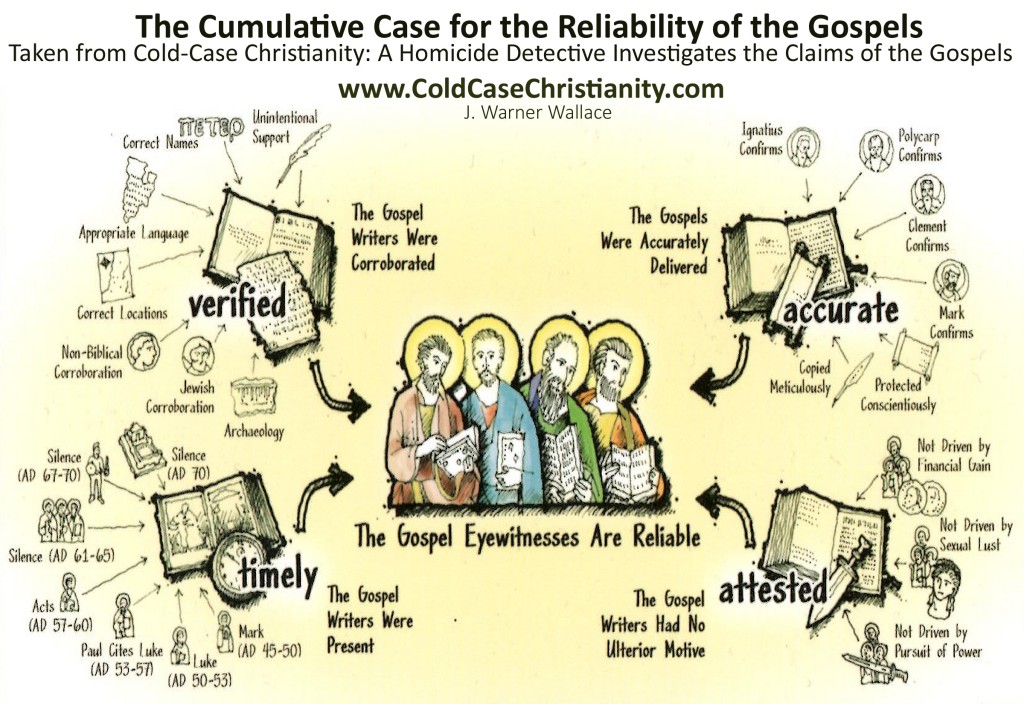
Reliability of the GospelsTo be honest, if someone hasn’t heard the biblical account of the life of Jesus Christ before, it can sound quite fantastic! Jesus was born of a virgin, lived a sinless life, performed miracles no one had seen before, died a horrific martyr’s death, was raised back to life three days later, and then ascended back into heaven until He returns to Earth again.

But as fantastic as this sounds, there is still enough evidence to reasonably believe it’s all true. An unreasonable faith believes in something in spite of the evidence; a blind faith believes in something without any evidence; and reasonable faith believes in something because of the evidence.

The Bible gives us eyewitness testimony about the life of Jesus which we can matter-of-factly evaluate. 

In a modern-day court of law, eyewitness testimony is evaluated on…

  • …the determination that the witnesses were actually present.
  • …the ability to corroborate their testimony.
  • …the consistency of their testimony over time.
  • …any biases they have that would cause them to exaggerate or misrepresent their testimony.

Let’s consider the testimony of the four Gospel writers: Matthew, Mark, Luke and John.

(1) Were The Eyewitnesses Present?

  • Luke is considered a credible historian, even by modern standards. He wrote the book of Acts following the ascension of Jesus into Heaven. Because he did not mention three major events in Jewish history (the Jewish uprising, the Roman siege of Jerusalem in response to that uprising, and the Roman destruction of the temple), we can determine that Acts was written before 61 AD.
  • Luke wrote the Gospel that bears his name before he wrote Acts. The Apostle Paul referenced portions of Luke’s Gospel in letters we can date by Paul’s Roman imprisonment, which means Luke was written prior to 53-57 AD.
  • Luke uses the Gospel of Mark as one of his references, which means Mark was probably written in 45-50 AD, just 10-15 years after the events of Christ’s life.
  • Mark was closely associated with the Apostle Peter, who was most assuredly Mark’s “source” in writing his Gospel, and Peter was one of the original twelve apostles called by Jesus.
  • Matthew and John were both apostles of Jesus, living and working closely with Jesus for over three years.

(2) Is Their Testimony Corroborated?

  • Archeological finds continually demonstrate the accuracy of the people, titles, places and details the Gospel writers mention.
  • Outside—or extra-biblical—sources like Josephus (a Jewish historian who wanted to preserve the purity of Judaism), Tacitus (a Roman historian), and Mara Bar-Serapion (a Syrian historian)—all who wrote between 40-70 AD—affirm things like where Jesus lived, the miracles He performed, the manner of His death, His resurrection, and the changed lives of people who believed in Jesus Christ.
  • In addition, Paul wrote of the “five hundred of the brothers” who were also eyewitnesses to the resurrected Christ (1 Corinthians 15:3-8).

(3) Has Their Testimony Remain Unchanged Over Time?

  • The history and accuracy of the scribes had already been demonstrated in the preservation and transmission of the Old Testament over a period of 1400 years.
  • These same scribal techniques were not only used in the transmission of the New Testament, but in subsequent years the Masoretic scribes became even more meticulous in the techniques they used.
  • The “chain of custody” of evidence can be absolutely traced from the Gospel authors, to their students, and to the writings of the Church Fathers.
  • In fact into the third-century AD, the writings of the Church Fathers contain so many direct quotations from the New Testament, that we can almost completely reconstruct the New Testament from their writings.

(4) Is Their Testimony Unbiased?

  • These eyewitnesses didn’t gain anything financially by their testimony. In fact, many of them lost or gave up all their possessions to tell others about Jesus.
  • They didn’t gain political power or influence that could save their own lives. All of the original apostles (except John) died a gruesome martyrs’ death.
  • In short, they had nothing to gain by making up and reporting a false story about Jesus.

All of these points make it reasonable to believe the evidence presented in the Bible about Jesus Christ is true. Check out this video where I elaborate a little more on each of these points—

If you live in the Cedar Springs area and don’t have a home church, I would love for you to visit with us Easter Sunday morning at 10:30am. We’ll be examining the evidence for Christ’s resurrection from the dead. Click here to get more details.

8 Quotes From “Light & Truth—Acts and the Larger Epistles”

Light & Truth [Acts]Horatius Bonar had great insight into the application of Scriptures. Check out my review of this commentary from Dr. Bonar by clicking here. Below are a few quotes that caught my attention. The reference in brackets after the quote is the biblical passage on which Bonar is commenting.

“Our Bible is of God; yet it is also of man. It is both divine and human. It comes to us from God’s Spirit; it comes also from man’s spirit. It is written in the language of the earth, yet its words are the words of him ‘Who speaketh it from heaven.’ Natural, yet supernatural; simple, yet profound; undogmatical, yet authoritative; very like a common book, yet very unlike also; dealing often with seeming incredibilities and contradictions, yet never assuming any need for apology, or explanation, or retraction; a book for humanity at large, yet minutely special in its fitnesses for every case of every soul; throughout its pages, from first to last, one unchanging estimate of sin as an infinite evil, get always bringing out God’s gracious mind toward the sinner, even in his condemnation of the guilt; such is the great Book with which man has to do, which man has to study, out of which man has to gather wisdom for eternity.” [Acts 1:1

“One of the great characteristics of the whole interval between Christ’s first and second coming is the world’s rage, secret and open, against the Father and the Son. … It is very useless anger. It accomplishes nothing. It is like an angry child striking a huge rock with its fist. It is the mere display of impotent hatred, or the temporary gratification of their dislike of God, and their rejection of His purpose regarding His Son. … It calls light darkness, and darkness light; good evil, and evil good; but the light and the darkness, the good and evil, still remain as they were. All the enlightenment of the age, all the appliances of modern progress, are impotent against God and His Christ, against His truth, and His church, and His Word.” [Acts 4:25]

“This is one of the many repetitions of the Pentecostal scene which occurred in early days. Most unscriptural is the statement of some that the giving of the Spirit at Pentecost was a thing done once for all, not to be repeated, and that we are not to pray for or expect such things again. The whole of the ‘Acts of the Apostles’ is a direct refutation of this piece of human fancy. Wherever the apostles went there was a repetition of Pentecost, whether at Jerusalem, or Samaria, or Antioch, or Corinth. Every conversion is the repetition of Pentecost; it is doing the same thing for an individual soul as was done for three thousand then, by a similar process, and by the same power—the power of the Holy Spirit. The Holy Ghost is the heritage of the church. The Old Testament saints possessed Him; and still more the New. This is our heritage, the heritage of every believing man.” [Acts 11:15

“Beware of seeking anything less than the baptism of the Holy Ghost. Our whole life is to be a reception of the Spirit. He is to be continually coming down on us, and filling us. Let us open our mouth wide that He may fill it. Let us beware of anything that would present itself as a substitute for the living Spirit. Many such things may we expect in these last days from satan as an angel of light.” [Acts 11:15]

“We are tempted in our day to be ashamed of the gospel. It is thought to be bare, unintellectual, almost childish by many. Hence, they would overlay it with argument and eloquence, to make it more respectable and more attractive. Every such attempt to add to it is being ashamed of it.” [Romans 1:16

“We must have a righteousness, else we cannot stand before God; we cannot have merely a religion.” [Romans 4:6-8]

“The prodigal did not work for the ‘best robe,’ but got it all ready-made from his father’s hands; Joseph did not work for his coat of many colors, but received it as the gift of his father’s love; Adam did not work for the skins with which the Lord God clothed him: so it is with the sinner in his approach to God, and in God’s approaches to him. ‘Righteousness without works’ is given him; nay, put upon him as a raiment, a divine raiment, to fit him for drawing near to God.” [Romans 4:6-8

“When the night is darkest, and the stars are hidden, and the clouds are black, then we think most of the clear fair day, and long for its dawn. When the storm is roughest, with the waves and wind roaring around the laboring vessel, then we are troubled, and look eagerly out for the glad and sunny calm. When winter binds the earth in its chain of frost, and wraps it in snow and ice, then we begin to ask for spring, with its flowers, and songs, and verdure. So with the saint, as represented by the apostle here. This is night, and storm, and winter to him; he is ever thinking of the day, and the calm, and the spring.” [Romans 8:19-23]

More quotes are here.