Abiding In Worship

Listen to the podcast of this post by clicking on the player below, and you can also subscribe on Apple, Spotify, or Audible. Check out the video content in this post by clicking here. 

Peter is giving us an important progression of virtues that supercharge our Christian testimony in the world and our ability to encourage fellow saints. We’ve looked at the first four (faith, goodness, knowledge, self-control) and now I see a place for a warning. 

A saint that is growing in their faith, in their goodness that shows itself as a Christian gentleman or gentlewomen, increasing in their knowledge of the things of God, and staying within the guardrails of self-control is probably starting to get noticed. They are seeing their own growth in maturity, and their old friends are also seeing it. This is a place to be on guard! 

I think this is what Jesus described in Mark 4:3-7, 14-19. 

  • A little knowledge can make us proud of what we’ve accomplished and tempt us to run too far ahead before we’re ready. This is the people with shallow roots. 
  • The worries of life can be giving too much attention to what others say or think about us, or how they begin to treat us. We become unfruitful when we pay attention to those things. 

(See all of the Scriptures in this post by clicking here.) 

Look at our progression in 2 Peter 1:2-6. The Holy Spirit inspired Peter to list perseverance in the perfect place in this progression! 

This is called patient endurance in the NLT and steadfastness in the AMPC, but I like to call it stick-to-it-iveness. The Greek word is interesting: hypomone = by (hypo-) + abiding (-meno). 

This word for remain or abide appears 11x in John 15:4-11! 

  • Scripture teaches us, but hypomone turns truth into hope (Romans 15:4) 
  • Hypomone keeps me living obediently to God’s Word (Hebrews 10:36; Revelation 14:12) 
  • Hypomone turns the seed of God’s Word into a bountiful harvest (Mark 4:8, 20) 
  • Hypomone keeps me peaceful—and therefore focused on God—during trials (Luke 21:19 AMPC) 

When Peter and John stood before the Sanhedrin, those leaders could tell they had been with Jesus (Acts 4:13b), so too with Stephen (6:15). The virtue that follows perseverance is godliness. Peter has already used this word to describe Jesus (2 Peter 1:3) and so does the Septuagint in Isaiah 11:2. 

The Greek word literally means “good worship” because godliness is a lifestyle—a lifestyle of worshipping God and magnifying the immeasurable worth of our Savior! 

To fully describe this word, godliness in the NT is typically linked with another attribute: 

  • godliness + power (Acts 3:12) 
  • godliness + reverence [righteousness, faith, love, endurance, gentleness] (1 Timothy 6:11) 
  • godliness + knowledge of the truth (Titus 1:1) 
  • godliness + zoe life (2 Peter 1:3) 
  • godliness + holiness (3:11) 

Remember that make every effort is not my ability to supply myself, but my choice to ask, receive, and apply. 

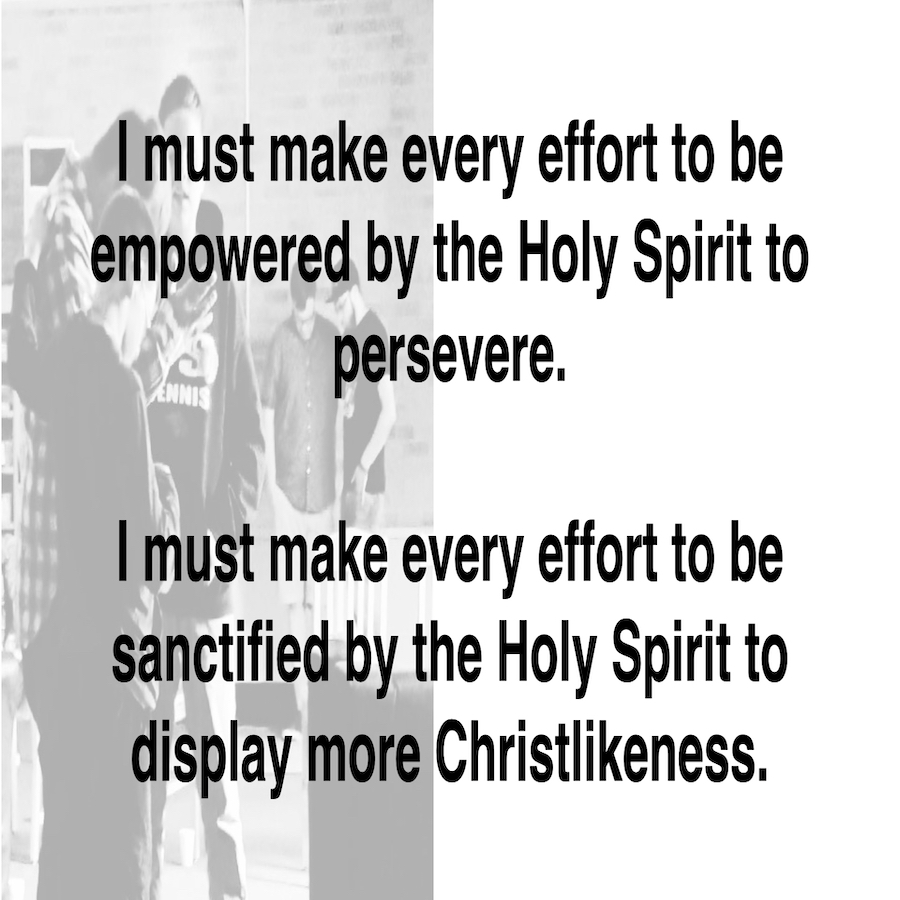
I must make every effort to be empowered by the Holy Spirit to persevere. I must make every effort to be sanctified by the Holy Spirit to display more Christlikeness. 

As I add goodness to my faith, and add knowledge to my goodness, and add self-control to my knowledge, and add perseverance to my self-control, and add godliness to my perseverance, people should see in me what John the Baptists desired: He must increase, but I must decrease. 

My growth in godliness is best seen by an attitude to persevere to see even more godliness in me. 

Check out all of the other messages in this series from 2 Peter called Friends of the Faith. 

►► Would you please prayerfully consider supporting this ministry? My Patreon supporters get behind-the-scenes access to exclusive materials. ◀︎◀︎

Divine Partnership

Listen to the podcast of this post by clicking on the player below, and you can also subscribe on Apple, Spotify, or Audible. Check out the video content in this post by clicking here. 

Having worked in and consulted with various businesses, I know there are a variety of configurations of businesses that people will choose for different reasons—there are S-corps and LLCs, and there are several types of partnerships. 

The two most basic partnership arrangements are a general partnership and a limited partnership. In a general partnership, all of the partners share equally in the risk and the reward, and all partners have a say in how the business is run. Typically, partners with more shares of stock have more “voting power” in making decisions, and they will usually benefit more if the company is successful. 

In a limited partnership, one general partner manages all the decisions, with the limited partners being merely passive investors. The limited partners can invest as much or as little as they feel comfortable doing, but they don’t have a say on how the business is run. If the general partner is a savvy operator, everyone will be rewarded handsomely; if the general partner isn’t quite as successful as others had hoped, the limited partners’ losses are limited to only as much as they invested. 

Although these types of business relationships didn’t have these names in the time Peter was writing, he used language that would be very familiar with today’s business attorneys when he wrote that we “may participate in the divine nature.” Participate literally means partnership—it’s the same word Peter knew for his partners in his fishing business (Luke 5:9-10).

(Check out all of the Scriptures in this post by clicking here.)

I believe Peter would call our partnership with Jesus a spiritual limited partnership, with Jesus as the General Partner. He is the One who makes the decisions and calls the shots. 

But what about us as “limited partners”? What investment can we make to this partnership? Only what Jesus has already given us. We saw this last week—HIS divine power has GIVEN US everything we need for life and godliness (see 2 Peter 1:3-4).

This is unheard of in today’s partnerships! The General Partner is giving the limited partners everything they need to invest in the partnership, and then He is allowing the limited partners to reap all of the rewards of His work (see Matthew 19:29)! 

Last week we said Jesus did the work so that we could do the work. We could modify this to say, Jesus gave us everything we need to reap the rewards of this partnership. 

The amazing benefit of this partnership is stated in the next verse: He has given us His very great and precious promises, so that through them you may participate in the divine nature (v. 4). 

Look at some blessings…  

  • recipients of the Holy Spirit—Galatians 3:14; Ephesians 1:13 
  • heirs of His Kingdom—Galatians 3:29 
  • eternal life—Titus 1:2; 1 John 2:25 
  • a perfect Mediator—Hebrews 9:15 AMPC 
  • power to access every single promise in His Word—2 Corinthians 1:20 

Peter says we are participating in His divine nature. Literally, Theios physis. The NLT says, “the promises that enable you to participate in the divine nature.” 

In his first letter, Peter quoted Leviticus, when God said, “Be holy, because I am holy” (see Leviticus 11:44-45; 1 Peter 1:15-16). Investing in this divine partnership releases to us the promises that empower us to participate—to be a partner in—God’s perfect holiness! 

Our participation in this divine partnership allows us to “escape the corruption in the world caused by evil desires” (v. 4b). The word participate or partnership can be used negatively (1 Corinthians 10:18-21). But Peter uses it positively. Prior to salvation our desires aligned with demonic desires, but now a new and infinitely superior power is at work in us. This power changes our desires from temporal things to eternal things (Galatians 5:17 NLT). 

Jesus told a story of a master who gave money to his to invest. The ones called wise were also welcomed into the master’s presence forever. They realized that their best investment was to use what their master had given them in partnership with their master, so they went all in. They invested everything their master had given them. 

Peter tells us essentially the same thing: Be all in with the investment Jesus has given you! Don’t hold anything back—make every effort. Don’t let Jesus be merely your Savior, but let Him be your Lord. Trust Him as the General Partner to do what is best. Give Him complete control of all the great and precious promises He has given you, and then allow the Holy Spirit to make you holy inside and out! 

Check out all of the other messages in our series based on 2 Peter called Friends of the Faith. 

►► Would you please prayerfully consider supporting this ministry? My Patreon supporters get behind-the-scenes access to exclusive materials. ◀︎◀︎

Links & Quotes

If leaders want to get the best ideas and implement the best strategies, they must invite everyone on their team to share from their unique perspective. This is the only way to get the whole picture. Check out this full conversation from The Craig and Greg Show.

I have a lot of new video content on my YouTube channel every week. Please check it out and subscribe so you don’t miss anything.

T.M. Moore writes, “We can know that we love our neighbors when, like Jesus, we go seeking them, in order to touch them with His love.”

This last week marked the 187th anniversary of the first time “O.K.” was first published as an abbreviation. The word’s origin is an interesting story, with some calling it “one of the most ubiquitous terms in the world, and certainly one of America’s greatest lingual exports.”

“Meekness and gentleness are two of the ornaments of our faith. I would that some professed Christians would understand that unholy contentiousness is not after the mind of Christ, it is not according to that gracious command, ‘Take My yoke upon you, and learn of Me; for I am meek and lowly in heart and ye shall find rest unto your souls.’ No, the Christian must be willing to suffer wrongfully, and to bear it in patience; he is never to be one who renders evil for evil, or railing for railing.” —Charles Spurgeon, commenting on Titus 3:2

“Then, since according to the Lord’s warnings the blood of so many will be sought for at the hands of their shepherds, careful watch must be kept, that is, the Word of the Lord must be often preached, and preached by the shepherds, by the Church’s bishops and teachers, that none may perish through ignorance; for he perishes through lack of heed, his blood will be on his own head.” —Columbanus, Letter to Pope Boniface 

“Knowledge will forever govern ignorance.” —James Madison 

“A good friend is like a four-leaf clover, hard to find and lucky to have.” —Irish proverb 

“When a man is getting better he understands more and more clearly the evil that is still left in him. When a man is getting worse he understands his own badness less and less. A moderately bad man knows he is not very good: a thoroughly bad man thinks he is all right. This is common sense, really. You understand sleep when you are awake, not while you are sleeping. You can see mistakes in arithmetic when your mind is working properly: while you are making them you cannot see them. You can understand the nature of drunkenness when you are sober, not when you are drunk. Good people know about both good and evil: bad people do not know about either.” —C.S. Lewis, Mere Christianity 

“If you want to win the day, you’ve got to flip the script. How? The Bible is a good starting point. Scripture is more than our script; it’s our script-cure. And that’s more than a play on words. Scripture confronts the false identities and false narratives perpetrated by the Father of Lies. It reveals the heavenly Father’s metanarrative and the unique role that each one of us plays in it.” —Mark Batterson, Win The Day 

Serving Through Preaching

Listen to the podcast of this post by clicking on the player below, and you can also subscribe on Apple, Spotify, or Audible. 

I’ve got something to share with pastors, but for the rest of you—who love your pastors—I hope you will listen in! 

The Scriptures I reference in this video are—Titus 1:1-3; Romans 1:1; 2 Peter 1:1. 

My definition of servant leadership:

I serve God, Who called me to leadership, so that I could serve people by calling them to serve God. 

A couple of other blog posts that may help you on this topic of servant leadership are:

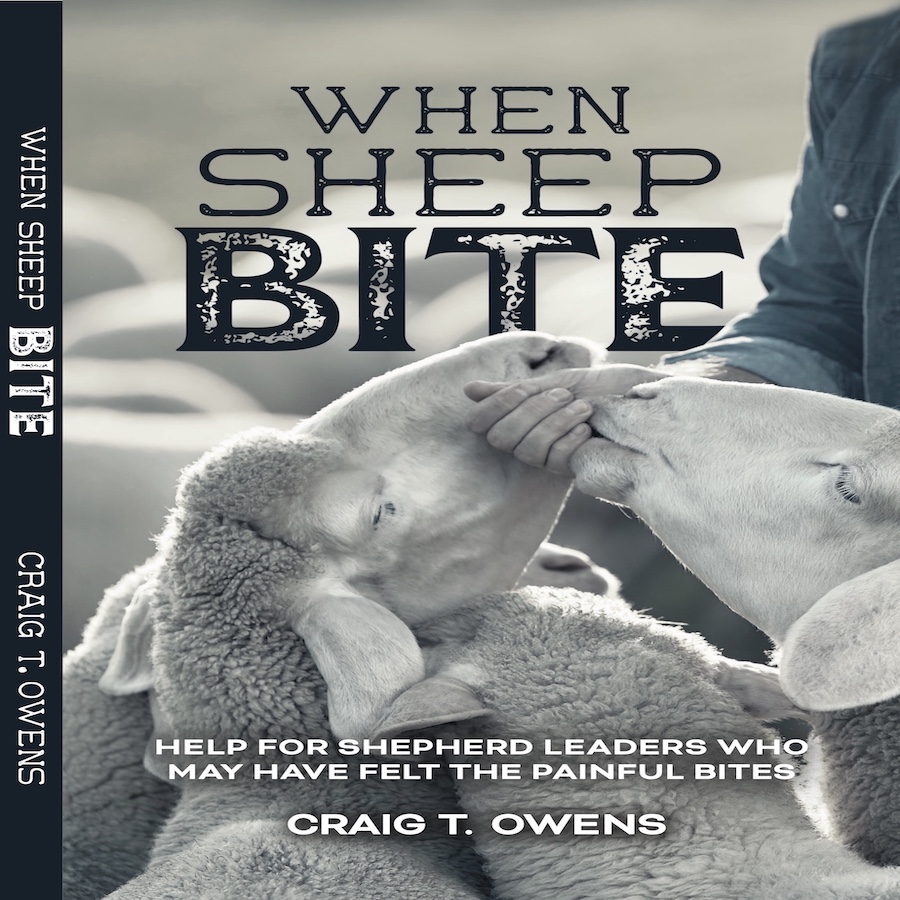
My books are for my fellow pastors. Shepherd Leadership will help us keep the biblical metrics in mind when we are thinking about our leadership roles. When Sheep Bite is an invaluable resource to help pastors continue to serve their flock, even after being painfully attacked. And Amen Indeed is a book of prayers for pastoral effectiveness. 

If you are a pastor—or if you love your pastor—please pick up copies of these books today! 

►► Would you please prayerfully consider supporting this ministry? My Patreon supporters get behind-the-scenes access to exclusive materials. ◀︎◀︎

The Vital Leadership Need For Mercy

Listen to the podcast of this post by clicking on the player below, and you can also subscribe on Apple, Spotify, or Audible. 

Paul salutes his friend Titus, “Grace, mercy, and peace from God the Father and the Lord Jesus Christ our Savior” (Titus 1:4). 

I’m not sure why several English translations of the Bible leave the word mercy out of this verse, because the Greek clearly says charis, eleos, eirene. Especially when we consider that this was an intentional word Paul was inspired to pen to a specific person. 

In every letter Paul writes to a church (plus in his personal letter to his friend Philemon), he greets the saints with “grace and peace” (Romans 1:7; 1 Corinthians 1:3; 2 Corinthians 1:2; Galatians 1:3; Ephesians 1:2; Philippians 1:2; Colossians 1:2; 1 Thessalonians 1:1; 2 Thessalonians 1:2; Philemon 3). This is also the greeting of Peter and John to the churches (1 Peter 1:2; 2 Peter 1:2; Revelation 1:4). 

(Check out all of the Scriptures in this post here.)

But in Paul’s three pastoral letters, he says, “Grace, mercy, and peace” (1 Timothy 1:2; 2 Timothy 1:2; Titus 1:4). Only John in the New Testament uses this salutation in a personal correspondence to another church leader (2 John 3). 

From this, I think we would be wise to note that Paul feels his pastoral proteges need to keep mercy in the forefront of their minds. Not that pastors—and the “dear lady” in John’s second letter—don’t know that God has been merciful to them, but as a reminder of just how important mercy truly is to both pastors and to the saints under their care. 

Charles Spurgeon wrote that pastors need to be reminded of mercy “as if the higher the office, the greater the liability to sin.” I think one of the biggest temptations for leaders is to believe their elevated title means they are to be served by others, rather than to continually take the role of a servant serving others. 

Pastoral leaders will also do well to recall that “all we like sheep have gone astray” (Isaiah 53:6; 1 Peter 2:25), and that “all” includes both pastors and saints. Pastors need to quickly recognize anytime they may be straying from their servant’s role, repent, and receive God’s mercy. 

Shepherd leaders also need to guard against the frustration that can creep into their heart when they see the sheep in their flock going astray. Paul and John are reminding these pastors to keep in mind how merciful the Chief Shepherd has been to them, and how this should stir up their mercy toward the flock around them. 

Shepherd leaders have a vital need to keep mercy always in mind. 

I think a good prayer for pastors might be—

     Holy Spirit, in my moments of frustration, remind me of the “grace, mercy, and peace from God the Father and the Lord Jesus Christ [my] Savior” which has been extended to me innumerable times. May that recollection awaken in me increased depths of mercy toward the flock around me, despite how frequently they may stray. In Jesus’ name. Amen! 

P.S. If you are interested in going deeper on the topic of pastors as leaders, please check out my book Shepherd Leadership. 

►► Would you please prayerfully consider supporting this ministry? My Patreon supporters get behind-the-scenes access to exclusive materials. ◀︎◀︎
God-ability

Listen to the podcast of this post by clicking on the player below, and you can also subscribe on Apple, Spotify, or Audible. 

The last time we were together, Pastor Caleb mentioned that I was the only one he knew that put hot sauce on my eggs. But then several of you let him know that you do that too. After the service, someone told me that they like Tabasco sauce on their pizza, which isn’t something I enjoy. 

We all have different tastes. Our tastebuds are just one of the things that makes us unique creations. Unique means one-of-kind, no one else like me. We don’t need to add something like “very unique” because just by itself the word means that God made a once-in-eternity masterpiece when He made you and me. 

It’s a good thing that we are unique. I see what you don’t see, and you see what I don’t see. There are some things I know how to do well, but perhaps you struggle doing them. That’s okay because there are things you can do that I won’t have the opportunity to do. Combined together we saints make an amazing team! 

The apostle Paul understood the value of unique individuals. 

(Check out all of the Scriptures in this post by clicking here.) 

Titus was probably the one who carried Paul’s letter to the Corinthians and then had the responsibility to teach those saints how to carry out what was in the letter (2 Corinthians 2:12-13; 7:6-7, 13-15; 8:6, 16-17). Titus was the pastor that Paul sent to Crete. Paul quoted a poet who said, “Cretans are always liars, evil brutes, lazy gluttons” (Titus 1:12). Titus was confident and bold to stand his ground for what he believed (Galatians 2:1-3). 

Timothy was more soft-spoken and tenderhearted, so Paul had to encourage him more (1 Timothy 4:7, 12), but he was the one who could soothe troubled spots. Timothy stepped in to help behind the scenes (Acts 18:1-5) and he was the one Paul reached out to with his last letter form prison, asking Timothy to come to him (2 Timothy 4:12). 

What a great thing it is to have unique saints in our lives! 

One person—not matter how gifted—cannot do it all. Look at Moses in Exodus 18:13-18. Even an anointed team like the 12 apostles cannot to it all. Look at Acts 6:1-2. 

These leaders recognized the need to other uniquely gifted people to come alongside them. Moses was advised to choose capable men. In other words, those with the ability to judge disputes wisely (Exodus 18:19-25). The apostles chose those who were full of the Holy Spirit and wisdom (Acts 6:3-6). The Greek word for wisdom (sophia) means someone with heaven-sent wisdom that also has the ability to apply that wisdom effectively. 

Israel in the Old Testament and the Church in the New Testament would have been constricted if those other people hadn’t agreed to let their God-given abilities be used. 

God’s talent + My ability = God-ability

In 2 Corinthians 8-9, Paul is specifically talking about the ability of people to give their offerings to help the growing church, but there is a phrase that I think is appropriate for any application of our gifts: They gave themselves first of all to the Lord (2 Corinthians 8:5). 

When what we do is a cheerful “get to” and not an obligatory “got to” it is noticed by everyone. Those two chapters in 2 Corinthians are filled with words like cheerful, eagerness, and enthusiasm. 

In our Hand2Hand food ministry, some people have…

  • Give-ability to give financially 
  • Shop-ability to find deals
  • Organize-ability to make all the parts work
  • Strength-ability to lift and move 
  • Deliver-ability to get the needed items to those who need them

But none of these work without availability. This is the attitude that makes our God-ability a blessing and not a chore. 

There is a place in ministry for every Christian. When you are available, God will allow the talent that He has given you to be a blessing to the Church. You benefit, the other saints benefit, and the watching world sees a living witness that will draw them to Jesus. 

►► Would you please prayerfully consider supporting this ministry? My Patreon supporters get behind-the-scenes access to exclusive materials. ◀︎◀︎

How Are Godly Leaders To Use Their Authority?

Listen to the podcast of this post by clicking on the player below, and you can also subscribe on Apple, Spotify, or Audible. 

Have you ever heard a parent say to their child, “Because I’m the parent and I say so”? 

Have you ever heard a pastor say that to a sheep in his flock? 

There is a certain authority that comes with God’s calling on a shepherd leader, but how exactly are pastors to use that authority? Or asked another way, how are shepherds to use their shepherding staff? 

When Paul is writing to his friend Titus some instructions for pastors, he uses a Greek word for “authority” three times. 

First, in regard to his own calling he says, “Paul, a bond-servant of God and an apostle of Jesus Christ, for the faith of those chosen of God and the knowledge of the truth which is according to godliness … but at the proper time revealed His word in the proclamation with which I was entrusted according to the commandment of God our Savior” (Titus 1:1, 3 NASB). 

The phrase “chosen of God” in verse 1 literally means the same thing he says in verse 3: “according to the commandment of God.” 

The third usage of this word is when Paul tells Titus that he has this same authority: “These things speak and exhort, and rebuke with all authority. No one is to disregard you” (Titus 2:15). 

Interestingly, Paul uses this Greek word a total of seven times in his letters, with three of those times being in this short letter to Titus. 

Paul also uses this word three times in his two letters to the saints in Corinth (1 Corinthians 7:6, 25; 2 Corinthians 8:8). But in all of three of these instances, Paul says, “I choose not to use my God-given authority on this, but I’m asking you to make a good choice.” 

The only other time Paul uses this word in a letter is found in his closing remarks to the saints in Rome, with the emphasis there on the authority of the Word of God which he preaches—

     Now to Him who is able to establish you according to my gospel and the preaching of Jesus Christ, according to the revelation of the mystery which has been kept secret for long ages past, but now has been disclosed, and through the Scriptures of the prophets, in accordance with the commandment of the eternal God, has been made known to all the nations, leading to obedience of faith. (Romans 16:25-26 NASB) 

Questioning of our pastoral authority is one of the sheep bites I discuss in my book When Sheep Bite. Here is one passage from that chapter—

     When our conversation with criticizing sheep hasn’t gone well, and when those unhealthy sheep begin to gossip and then slander, it’s inevitable that they will eventually began to question your authority as a shepherd. Perhaps they think you’re too young and naive, or too old and out of touch. They may question your motives, or the vision you’ve imparted for the church, or your ability to follow through on what you have already shared. Whatever the case, these biting sheep seem to be implying that they know better than you do how this pasture should be run. 

     During times like these, it is tempting to want to “prove” that we are qualified, that we do know what we’re doing, and that we can indeed successfully pursue the vision we’ve articulated for them. Once again, it’s natural to want to say, “I’ll show you just how qualified I am!” 

     Before we respond, we need to recognize the source of our authority. There is a certain authority that comes with a position or an office. For instance, a parent can say to a child who is questioning a rule, “Because I’m the parent and I say this is how it is going to be.” We see similar positional authority for CEOs, police officers, school teachers, and pastors. But like the little boy we met at the beginning of this book, people may say to a positional leader, “I may be obeying you on the outside, but on the inside I’m questioning everything you’re saying!” 

     Far greater than positional authority is moral authority. This is authority that comes not merely from a title or position, but from who conferred that title or position on the leader. If God has called us and appointed us to this pasture, that is all the authority we need.

Let me wrap up with four takeaways for shepherd leaders:

  1. A godly leader’s authority is imparted by God. Keep in mind these three powerful words, “God chose me.” That means you have nothing to prove. 
  2. As a godly leader, you are “entrusted” with your authority and that means you have to give an account to God for its application. Don’t let the pain of the moment tempt you to react in a shortsighted way. 
  3. There are times to use God’s authority to hold the line; specifically when addressing issues which are biblical or unbiblical (Titus 1:9-14, 3:1-8). 
  4. There are also times for us to sheath this authority; like when addressing a non-biblical issue (Titus 3:9). 

Being a godly shepherd leader is not for the faint of heart! But God has called YOU which means He has also equipped YOU to respond appropriately in each situation. 

My book When Sheep Bite is packed with biblical examples, personal experiences, practical applications, and prayers for each of these biting problems you will face. I hope you will pick up a copy today.

►► Would you please prayerfully consider supporting this ministry? My Patreon supporters get behind-the-scenes access to exclusive materials. ◀︎◀︎
Our Blessed Hope

Listen to the podcast of this post by clicking on the player below, and you can also subscribe on Apple, Spotify, or Audible. 

As we wrap up our series looking at our foundational belief statements, I want to combine the last four statements together, not only because they all cover the same theme of end-times events, but also because these statements should give every Christian hope! 

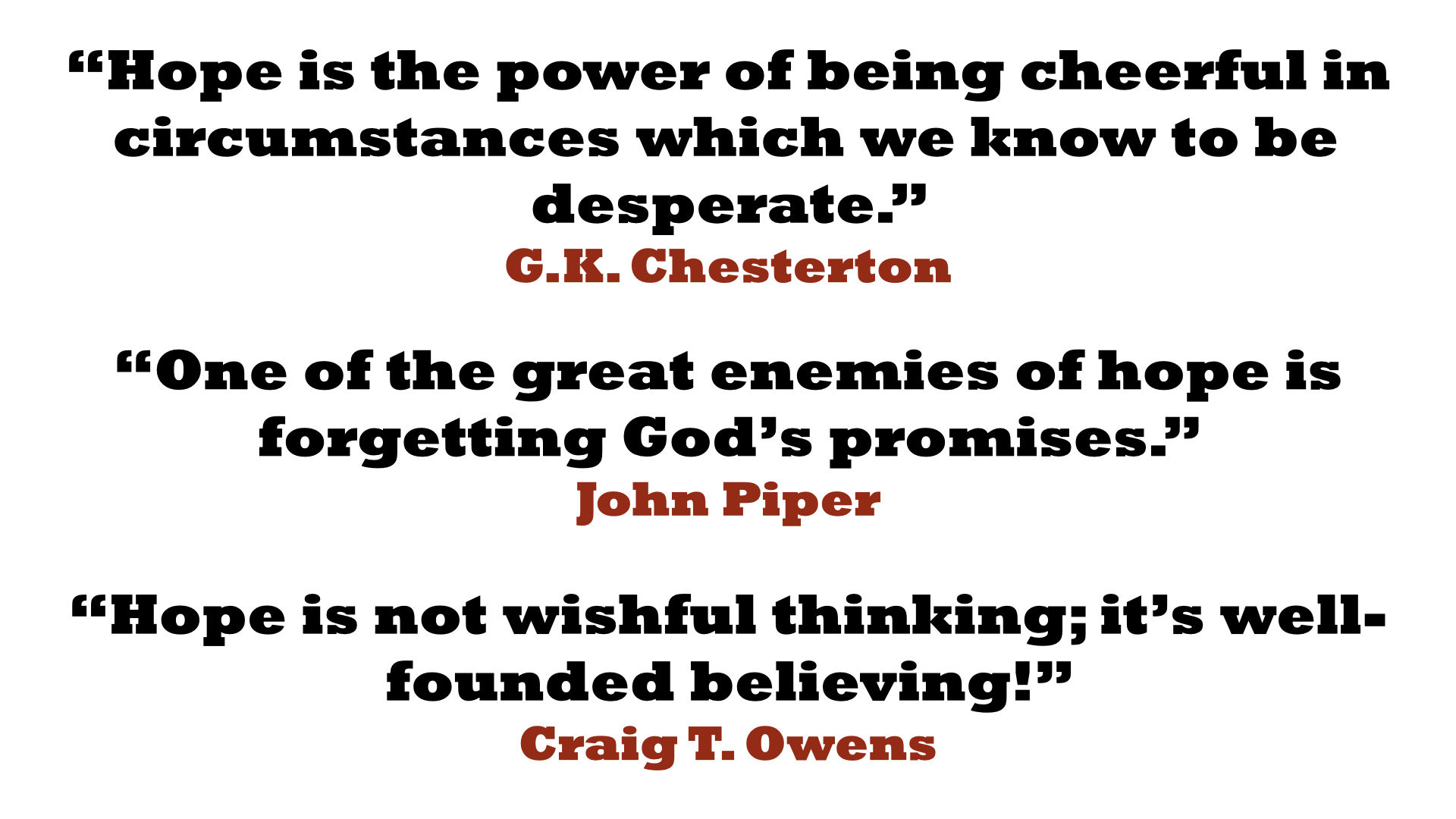
  • “Hope is the power of being cheerful in circumstances which we know to be desperate.” —G.K. Chesterton 
  • “One of the great enemies of hope is forgetting God’s promises.” —John Piper 
  • “Hope is not wishful thinking; it’s well-founded believing!” —Craig T. Owens 

Christians have a fantastic, unshakable, blessed hope on which we can stand not only secure but joyful! 

Foundational truth #13: “The resurrection of those who have fallen asleep in Christ and their translation together with those who are alive and remain unto the coming of the Lord is the imminent and blessed hope of the church.” 

This blessed hope in the future helps us live with joy today! Knowing that death has been defeated and Jesus will come back to take us home with Him should fuel us to say “no” to the temporary pleasures of sin, and live such godly lives that it turns others’ eyes to Jesus (Titus 2:11-14; 1 Corinthians 15:51-52; 1 Thessalonians 4:16-17). 

Foundational truth #14: “The second coming of Christ includes the rapture of the saints, which is our blessed hope, followed by the visible return of Christ with His saints to reign on earth for one thousand years.” 

Sometimes you will hear Christians talk about the “rapture” of the Church. Although this word itself isn’t in the Bible, the Greek word harpazo in 1 Thessalonians 4:17 means “catching up.” It also means “to eagerly claim for one’s self,” which reminds me that Jesus is thrilled to bring His Bride home to be with Him forever! After the Church has been caught up to Heaven, a period of tribulation will plague the earth, followed by Christ’s Second Coming and His millennial reign (Zechariah 14:4-5; Revelation 19:11-15; 20:1-10). 

Foundational truth #15: “There will be a final judgment in which the wicked dead will be raised and judged according to their works. Whosoever is not found written in the Book of Life, together with the devil and his angels, the beast and the false prophet, will be consigned to the everlasting punishment in the lake which burns with fire and brimstone, which is the second death.” 

Christians have no fear of the second (or final) death because our names are written in the Book of Life (Luke 12:4-6; Revelation 20:11-15). Not only is there judgment for the wicked, but there will be rewards for the righteous. 

Foundational truth #16: “In keeping with His promise we are looking forward to a new heaven and a new earth, where righteousness dwells” (2 Peter 3:13). Revelation 21-22 give us a small glimpse of our eternal home. 

In light of these truths, how should Christians live while still on earth? I think there are three ways we should live: 

  1. Live circumspectly
  2. Live on-mission
  3. Live unafraid

(see Ephesians 5:15; Matthew 28:18-20; Proverbs 24:11-12; Jude 1:20-25) 

With this blessed hope of the Second Coming of Jesus and our security in knowing we will remain with Him forever, let’s tell everyone we can how they too can know what it is to live with this hope in their heart. 

If you’ve missed any of the messages in our series exploring our foundational beliefs, you can access the full list by clicking here. 

►► Would you please prayerfully consider supporting this ministry? ◀︎◀︎

Soul Watchers

I share T.M. Moore’s heartbeat for the role of shepherd leaders in the Church today. I highly recommend that every pastor subscribe to the newsletters that are available through the Fellowship of Ailbe. 

A recent article called “Soul Watchers” really caught my attention. Here are a few excerpts to whet your appetite… 

Elders are called “overseers” and “shepherds” in their relationship to the congregations of the Lord (1 Peter 5:1-3). … Elders were charged with the responsibility of watching over the flocks of the Lord (Acts 20:28), preserving sound doctrine and right practice in the churches (Acts 15:1-6; Titus 1), and, in particular, keeping watch over the souls of God’s people (2 Corinthians 12:15; Hebrews 13:17). … 

The elders appointed to serve the churches of the New Testament were called to be shepherds, leading the Lord’s flocks into fuller realization of His Kingdom and promises. In fact, so vital were elders to the churches of the New Testament that Paul insisted that any church that didn’t have elders was to that extent not “in order” (Titus 1:3).

(Check out the bible verses T.M. references in this piece by clicking here.)

T.M. Moore wrote one of the endorsements for my book Shepherd Leadership: The Metrics That Really Matter, and I recently appeared as a guest on his Ailbe Podcast.

Thursdays With Spurgeon—An Assured Eternity

This is a weekly series with things I’m reading and pondering from Charles Spurgeon. You can read the original seed thought here, or type “Thursdays With Spurgeon” in the search box to read more entries.

Listen to the podcast of this post by clicking on the player below, and you can also subscribe on iTunes or Spotify.

An Assured Eternity 

     The life of God in the soul is not transient but abiding. Not temporary but eternal. Some think that the life of God in the believer’s soul may die out. But how then could it be eternal? If it dies, it is not eternal life. If it is eternal life, it cannot die. … We are said to have been made ‘partakers of the divine nature’ (2 Peter 1:4). Surely this means, among other things, that we receive an undying life. …  

     If our life is Christ’s life, we will not die until Christ dies. … 

     This is John’s desire for you: that you would believe with all your heart and soul and strength. He would have you believe more constantly, so that you may say, ‘My heart is steadfast, O God, my heart is steadfast; I will sing and give praise’ (Psalm 57:7). It is not always so with us. We are at times chicken-hearted. We play the man today and the mouse tomorrow. Lord, have mercy upon us. We are an inconsistent people, fickle as the wind. The Lord would have us abide always in Him with strong and mighty confidence, being rooted and built up in Him. He would have us trust courageously.

From The Blessing Of Full Assurance 

John the Beloved wrapped up his Gospel with this statement: “But these are written that you may believe that Jesus is the Messiah, the Son of God, and that by believing you may have life in His name” (John 20:31). The word John uses for “life” is the Greek word zoe. This is how zoe is defined—

Life real and genuine, a life active and vigorous, devoted to God, blessed, in the portion even in this world of those who put their trust in Christ, but after the resurrection to be consummated by new accessions…and to last for ever. (Strong’s Greek dictionary) 

Do you believe Jesus died and rose again? Based on that faith, have you asked the Father to forgive you of your sins? If so, then listen for the voice of the Holy Spirit in your heart that is giving you full assurance of promises like these: 

  • Everyone who believes may have eternal life in [Jesus] (John 3:15) 
  • Whoever believes in [Jesus] shall not perish but have eternal life (John 3:16) 
  • Now this is eternal life: that they know You, the only true God, and Jesus Christ, whom You have sent (John 17:3) 
  • Whoever believes in the Son has eternal life (John 3:36) 
  • Whoever drinks the water I give them will never thirst. Indeed, the water I give them will become in them a spring of water welling up to eternal life (John 4:14) 
  • Because I live, you also will live (John 14:9) 
  • Whoever hears My word and believes Him who sent Me has eternal life and will not be judged but has crossed over from death to life (John 5:24) 
  • My Father’s will is that everyone who looks to the Son and believes in Him shall have eternal life, and I will raise them up at the last day (John 6:40) 
  • When Christ, who is your life, appears, then you also will appear with Him in glory (Colossians 3:4) 
  • Resting in the hope of eternal life, life which the ever truthful God Who cannot deceive promised before the world or the ages of time began (Titus 1:2) 
  • I write these things to you who believe in the name of the Son of God so that you may know that you have eternal life (1 John 5:13) 

[Check out all of these verses by clicking here.]

Friend, this is why it’s so important for us to regularly read the Bible. We need to have our faith bolstered by hearing these rock-solid, unchanging, eternal words of God so that we can live each day in full assurance of our salvation and eternal life.

►► Would you please prayerfully consider supporting this ministry? ◀︎◀︎