Thursdays With Oswald—How God Prepares Us For His Service

Oswald ChambersThis is a weekly series with things I’m reading and pondering from Oswald Chambers. You can read the original seed thought here, or type “Thursdays With Oswald” in the search box to read more entries.

How God Prepares Us For His Service 

     Preparation is not something suddenly accomplished, but a process steadily maintained. It is easy to imagine that we get to a settled state of experience where we are complete and ready; but in work for God it is always preparation and preparation. … 

     In writing to the Philippians Paul mentions two “perfections”: “not as though I…were already perfect” (3:12); “Let us therefore, as many be perfect…” (3:15). The first refers to the perfection of attainment; the second to the perfection of adjustment to God. … When we are sanctified, we are perfectly adjusted to God, but we have done nothing yet, we are simply perfectly fit to begin. … Think of Christ’s eyes fastening on us and pointing us out before God as He says—“Father, that is My work; that is the meaning of Gethsemane, that is the meaning of Calvary. I did all that man’s work in him, all that woman’s work in her; now You can use them.” … 

     When we are first put right with God, it is the great general principles that are at work, then God begins to make the conscience sensitive here and there. Don’t quench the Spirit. His checks are so tiny that common sense cannot detect them. … When He checks, never debate, but obey at once. … He does not come with a voice like thunder, with strong emphatic utterance—that may come ultimately; but at the beginning His voice is as gentle as a zephyr. At the same time it carries an imperative compulsion—we know the voice must be obeyed. The “go” of preparation is to let the Word of God scrutinize.

From So Send I You

When we invited Jesus into our lives to be our Lord and Savior, we are perfectly ready to be used in service for God.

Now begins the saint-ifying process. The Holy Spirit will gently, but insistently, point out what we need to address. The more sensitive we are to those “checks,” and the quicker we are to obey the Spirit’s prompting, the better prepared we are to answer God’s call to “go.”

Are you letting the Voice of God scrutinize you, so that you can be prepared to be used in service for Him?

No Room For God?

My friend Scott delivered a right-between-the-eyes message yesterday. Here are my takeaways.

Quite possibly the deadliest of the relationship killers is pride.

Think of all the ugly things surrounding Pride:

  • Always fault-finding
  • Always defensive
  • Constantly craving attention
  • Disregarding advice
  • Saying “I’m better than you!”
  • Saying “I don’t need your help!”
  • Quick to tell others “Here’s how you should do that”
  • Can’t handle any constructive criticism
  • But always critical of others

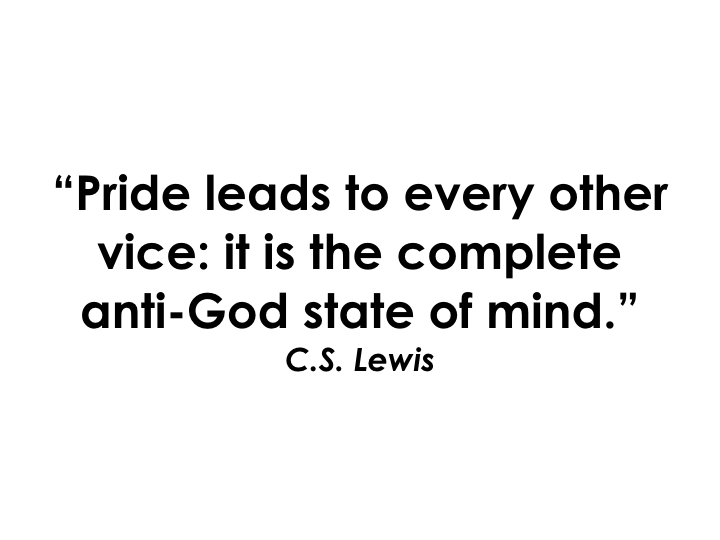
In fact, C.S. Lewis said, “Pride leads to every other vice: it is the complete anti-God state of mind.”

One psalmist got right to the root of the problem of pride when he wrote—

In his pride the wicked does not seek Him; in all his thoughts there is no room for God. (Psalm 10:4)

No room for God?!

The Bible is all about relationships. Adam was first created to be in a relationship with God, and then Eve was created so she and Adam could be in a relationship with each other. Jesus reiterated this when He was asked what the greatest commandment was, and He said, “Love God with all your heart, mind and soul.”

But if Pride rules in my heart, and there is no room for God, how can I love Him with all I’ve got? The simple answer is: I can’t.

Jesus quickly added that the next greatest commandment also revolved around relationships when He said, “And love your neighbor as yourself.”

If my proud heart is filled with prideful love, it cannot be filled with God’s love.

If my pride-filled heart has no room for God’s love, then it has no room to love anyone else.

Pride kills every relationship.

Jesus had absolutely no trace of pride when He set aside all His heavenly privileges and came to earth as a Human (Philippians 2:6-8). The Apostle Paul then tells us that our attitude should be the same as Christ’s attitude.

Humility kills pride!

Are you filled with pride? Ask yourself some of these questions:

  • Do I have a problem submitting to authority?
  • When I get into an argument, do I always have to have the last word?
  • Am I willing to accept blame?
  • Can I ask for forgiveness, or am I always right?
  • Do I sometimes cheat at a game just so I can win?
  • If I lose, is it someone else’s fault?
  • If I win, do I brag about how good I am?
  • Do I think I’m the only one who can solve all my own issues?
  • Do I think I can solve everyone else’s issues too?

If you found yourself saying “yes” to these questions it’s probably time to ask the Holy Spirit to do a heart-check on your level of pride. Make sure that in your heart there is increasingly more room for God.

Jesus—100% God And 100% Human

Listen to the podcast of this post by clicking on the player below, and you can also subscribe on AppleSpotify, or Audible.

On paper, it seems so simple: “We believe in the Deity of the Lord Jesus Christ. As God’s Son, Jesus was both human and divine.” But trying to wrap our finite human minds around the concept of the full humanity and the full deity of Jesus is challenging!

First off, Jesus was fully human. Both Matthew and Luke record details about Christ’s physical birth, and the writer of Hebrews says that Jesus was made every bit as human as us (Hebrews 2:17).

But Jesus was also fully God. John records how God became flesh in the Person of Jesus (John 1:1-2, 14), and Paul tells us how Jesus chose not to use His deity when He came to earth as a human (Philippians 2:6-8).

I know that anytime we say, “God is like…” we’ve already sold ourselves short, but I’d like to try one analogy that’s been helpful for me.

Imagine a coin that has two distinct sides. While we are looking at one side (heads), we cannot see the other side (tails) but that doesn’t mean the other side has ceased to exist. In fact, if we were able to split that coin in half, so that there was only a heads and a tails, we haven’t cut the value of the coin in half, but we’ve made the coin of no value at all! 

In the Greek language of the New Testament, there are a couple of words for “knowing”: one is gnosis and the other oido. Together these words combine head knowledge and heart knowledge, or knowledge by study and knowledge by experience.

C.S. Lewis captures the idea this way: “It is Christ Himself, not the Bible, who is the true Word of God. The Bible, read in the right spirit and with the guidance of good teachers, will bring us to Him.”

Just as Jesus was both God and Man, we are to use both our mind and our heart to know Him.

To focus on the “heads” side—the deity of Jesus—is to pervert gnosis into gnosticism, and deny the humanity of Jesus. To focus on the “tails” side—the humanity of Jesus—is to pervert gnosis into agnosticism, and deny the deity of Jesus. True gnosis keeps both sides in mind: Deity and humanity.

To truly know THE Word of God (Jesus) in all His humanity and in all His deity, we need to study the Word of God. We also need the help of the Holy Spirit. I like the Old English wording of this verse—Ye have an unction [charisma] from the Holy One, and ye know [gnosis] all things (1 John 2:20).

So read your Bible, but not just to read your Bible. Ask the Holy Spirit to make THE Word known to you. Live in the balance of gnosis as you get to know Jesus more deeply and personally.

(When Jesus proclaimed His “I Am” statements in the New Testament, He was tying Himself to all of the “Jehovah” titles of the Old Testament. Check out I Am Jehovah.)

This post is a part of our series studying our foundational beliefs. If you would like to read more about the first foundational beliefs we have discussed, check out this post on the inspiration of Scripture, and this post on the Trinity.

►► Would you please prayerfully consider supporting this ministry? My Patreon supporters get behind-the-scenes access to exclusive materials. ◀︎◀︎

Horatius Bonar On Spiritual Warfare

Horatius Bonar“The devil’s object in the present day is to persuade us that he does not exist, that we have to fight no such battle, that we need no sword nor shield, that we can do without anything beyond our own human power and skill.” [Ephesians 6:12]

“We must fight. There is no choice here. Whether we will or not, we must fight; for we are thrown upon a battlefield, and if we fight not, we perish. Woe be to the man who thinks there is no need of fighting now; that there is no danger and no enemy. Fight the good fight of faith.”

“satan persuades us that we can combat evil by the appliances of modern intellect and science and civilization. Let us beware. To try to suit religion to the spirit of the age, is to play into satan’s hands. Only divine weapons will avail in a battle with the powers of darkness.”

“Is the Christianity of our day of the lofty kind of which apostolic men have left us so bright an example? Is it not feeble, indolent, self-indulgent, second-rate? Is there in it anything of the presentation of ‘living sacrifices’ to God, which is our acceptable and reasonable service? Are we not seeking our own, not the things which are Jesus Christ’s? Are we not feasting when the world is starving? Are we not at ease in Zion? Are we not sitting still and in luxurious comfort, when many noble and self-sacrificing ones amongst us are rushing into the toil or the war, and, for want of being supported by their fellow Christians, are sinking under the burden and heat of the day?” [Philippians 4:19]

“It is inner warfare. The 7th of the Romans is the description of this, the battle between faith and unbelief, between the spirit and the flesh. This war is private, solitary, with no eye upon the warrior; fought in the closet, on the knees, with the Bible as his weapon. …

“It is outer warfare. The enemies are legion; the world, with all its enmities, snares, pomps, pleasures; satan, with his principalities and powers; both of these in combination hating, persecuting, attacking. This is ‘the great fight of afflictions’ (Hebrews 10:32). Thus it is so far public, before men; ‘we are made a spectacle to the world, and to angels, and to men.’ …

“It is daily warfare. It is not one great battle, but a multitude of battles, constant warring: there is no intermission and no discharge in this war. The enemy wearies not, ceases not; nor must we. We wake to warfare each morning, and go out to warfare each day. Everywhere we find the enemy posted, sometimes openly, sometimes in ambush. The conflict is life-long, and it is daily. …

“It is warfare not fought with human arms. The weapons of our warfare are not carnal. We do not war after the flesh. It is in divine strength; with the sword of the Spirit; clothed in the whole armor of God. …

“It is warfare in which we are sharers with Christ. He first fought the good fight, as the Captain of our salvation, the Lord strong and mighty; the Lord mighty in battle. The inner warfare indeed was not His, but all the rest was. He fought, when here, the same battles as we; and it is into His warfare that we are called to enter.”

All quotes from Horatius Bonar’s book Light And Truth.

6 Quotes From “Light & Truth—The Lesser Epistles”

Light & Truth The Lesser EpistlesHoratius Bonar’s insights on the Scriptures are amazing! So far I’ve read and reviewed three of the four commentaries he has prepared on the New Testament (you can read those reviews here, here and here). These are a few quotes from the third book on the epistles Galatians through Jude. Any reference in brackets is the passage from the Bible on which Bonar is commenting.

“It is a busy, lighthearted, laughing, pleasure-seeking world. But sin is here, and pain is here, and broken hearts are here, and weeping is here, and death is here, and the grave is here. Oh! in spite of all its laughter and vanity, it is an evil world. And the great proof of its evil is, that it cost the death of the Son of God to deliver you from it. … Give yourselves to Him Who came to deliver you from it, and Who stretches out His hands to you all day long, asking you to allow Him to deliver you. He yearns over you; and with sincere earnestness proffers to you His love, His friendship, His great salvation. Consent, O man, consent! His desire is to bless, and not to curse; to save, and not to destroy.” [Galatians 1:4]

“There never have been two gospels. There is not an Old Testament gospel and a New Testament Gospel. There is not one gospel for the Jew, and another for the Gentile, one gospel for the first century, and another for the nineteenth. It is but one gospel, as there is but one Cross and one Savior. Many ages, but one gospel; many sinners, but one gospel; many prophets and apostles, but one gospel. As our earth has had but one sun, so it has had but one gospel. Nor does it need more; that one is sufficient.” [Galatians 1:6-9]

“As the earth without rain or sunshine turns to barrenness, so is it with the Church or soul without the Spirit. … The age thinks it can do without the Spirit. Let the Church watch against this blasphemy. Let her keep hold of the Lord’s promise, the promise of the Father. Let her prize the gift; long for more of it. Let every saint seek more of it. Let our cry be continually: More of the Holy Spirit; more of His fullness; more of His gifts and graces!”

“Strength for the race is needed, hourly strength, superhuman strength; for it is no earthly race, but something lofty, supernatural, divine. Forgetting the supernatural source of strength, we betake ourselves to the internal or the simply external. And so we weary. For only God can supply the power which keeps us running. By Him only shall we run, and not be weary.” [Galatians 5:7]

“‘To Him who is able’—He is the Mighty One, the mighty God, the Lord God Almighty. Hear how this word ‘able’ is used. ‘He is able to subdue all things unto Himself’ (Philippians 3:21). ‘He is able to help them that are tempted’ (Hebrews 2:18). ‘He is able to save to the uttermost’ (Hebrews 7: 25). ‘He is able to keep us from falling’ (Jude 24). It is with the mighty God that we have to do; mightier than ourselves or our foes; mightier than earth or hell; omnipotent.” [Ephesians 3:20]

“Are you expecting the Lord? Are you living in this expectation? Is it a deep-seated, abiding, cherished hope? Is it a hope that tells upon your character, your life, your daily actings in public or private, your opinions, your whole man? Does it quicken you? Does it purify you? Does it keep you separate from the world? Does it keep you calm in the midst of earth’s most exciting events, or most untoward changes? Does it give you a new view of history as well as prophecy? … Let your expectation of the Lord’s coming be a calm and healthy one; not one that excites, but one that tranquilizes; not one that unfits for duty, but one that nerves you more firmly for it; not one that paralyzes exertion, but one that invigorates you for it; not one that makes you indifferent to present duty, but one that makes you doubly in earnest about everything that your hand findeth to do; not one that stops liberality, and prayer, and work, but one that increases all these a hundred fold; not one that dwells exclusively on the future’s dark side—the judgments that are at hand—but one that realizes the glory and the joy of Messiah’s approaching victory and triumphant reign.” [Philippians 3:20]

Overcoming Anxiety

God's answersI remember visiting Denver, Colorado. The scenery was so breathtaking, so I decided to go for an early morning hike. Quickly I discovered that my hike became breathtaking in more than one way! Even though I was in good shape, I had a hard time getting my breath because of the mile-high atmosphere.

I learned later that this is why many top athletes train in high elevation: it increases their lung capacity and endurance so that they now have an advantage when they compete against others.

God trains us on His mountains, but He made us to live and minister in the valleys. Our ascent into God’s mountaintop presence is so important for godly maturity!

In the first song of ascent, I noticed something unusual in the very first verse. Some Bibles translate the verbs in the present tense (I call on the Lord and He answers me), but some translations use the past tense (I called on the Lord and He answered me). Which is correct? Actually both of them are correct!

The verbs are written in the perfect tense—something done at a specific point in the past, but still relevant and powerful in the present. In other words, we can say it like this, “I called on the Lord in the past and He most definitely answered me. That gives me confidence to call on the Lord today, knowing that He will answer me again.”

Past answers lead to present power and future hope.

But—oh wow!!—check out how God answers us! The word literally means that God answers us in song. God so loves it when you trust Him enough to bring all your cares to Him, that He sings His answer to you. For the Lord your God is living among you. He is a mighty Savior. He will take delight in you with gladness. With His love, He will calm all your fears. He will rejoice over you with joyful songs (Zephaniah 3:17).

If we don’t continue to recall how God has answered us in the past, we’re missing out on the blessing of hearing Him sing His answers over us again today. As a result, we begin to live in the world’s valley-level turmoil and anxiety.

Peace is longed for in verses 6 and 7. The Christian wants to live in peace, but the world loves turmoil. Want proof? Just look at what makes the headlines today! The solution is to keep going back to God again and again and again—

Do not be anxious about anything, but in everything, by prayer and petition, with thanksgiving, present your requests to God. And the peace of God, which transcends understanding, will guard your hearts and minds in Christ Jesus. (Philippians 4:6-7)

Check out the full message to find the peace you are longing for!

If you don’t have a home church, please join us this Sunday as we continue our look at the psalms of ascent, or you can tune in to our live Periscope broadcast from wherever you are.

If you’ve missed any of the messages in this series, you can access the complete list by clicking here.

Praying For Your Congregation

I heart my churchPastors often ask for their congregation to pray for them. This is a good thing! But the Apostle Paul gives pastors a model for praying for their congregation.

In his letter to the Church at Philippi, Paul says, “And this is my prayer…” (Philippians 1:9).

First, notice the motivation for Paul’s prayer: thankfulness. He’s not skeptical nor cynical. He doesn’t browbeat them for any shortcomings. He doesn’t think, “Ministry would be great if it weren’t for these people.” No! He was full of thanks that bubbled up in joyful prayer for these precious people (vv. 3, 4).

Paul also had an attitude of confidence for this congregation. He believed they could carry out ministry responsibilities, and that in the process they could continue to mature in Christ (vv. 5, 6).

Paul had affection for this church: he really liked these people! It’s one thing to love someone (after all, Jesus commanded us to do that), but something entirely different when we like being around people. The King James Version says Paul greatly longed after these folks. The Greek is even better—it says he doted on them (v. 8).

With this in mind, look how Paul prayed for these precious folks on whom he doted. He prayed that…

  • …their love might abound
  • …they would increase in knowledge and insight
  • …their level of spiritual discernment would help them always see the best
  • …their purity and blamelessness would remain intact all the days of their life
  • …they would be filled with God’s righteousness
  • …they would bring glory to God

Pastor, this is a great prayer to pray over the precious people on whom you dote!

Don’t Try To Change Your Bad Behavior

Thoughts to beahviorsAs I wrote previously, I believe Christians should be the best at getting along with others. First of all, Christians have been empowered by the Holy Spirit with the skills necessary to live at peace with everyone, IF we will only allow the Spirit to do the necessary work in us. And second, the way Christians treat others goes a long way toward either attracting or repelling others from a relationship with Jesus.

But here’s an important thing: If you don’t get along well with others now, don’t try to change your behavior!

Stephen Covey wrote, “To try to change outward behaviors does very little good in the long run if I fail to examine the basic paradigms from which those attitudes and behaviors flow.”

You see, behavior is the fruit. If we want to change the fruit, we need to back up a few steps.

The Apostle Paul used the life of Jesus as an example for Christians on how we can get along with others. But notice this: most of what Paul discusses is the “inside stuff.”

The progression goes like this (see Philippians 2:1-13)—

Thoughts → Values → Attitudes → Behaviors

(1) Thoughts—These need to be humble thoughts about God’s love toward us (v. 1).

(2) Values—Paul tells us to be “one in spirit and purpose” with others (v. 2). The definition of the Greek words here mean valuing the well-being of everyone. Paul then explains how our humility can lead to these win-win relationships (vv. 3, 4).

(3) Attitudes—“Your attitude should be the same as Christ Jesus” (v. 5). Jesus showed us what it was to have an attitude related toward obedience to God’s will.

(4) Behavior—If our thoughts, values and attitudes are rightly aligned to God, then our behavior will naturally be Christ-like as well. We see the example of Jesus in verses 6-8, and God’s reward for that behavior in verses 9-11. Then Paul calls on Christians to follow that pattern in our own lives (vv. 12, 13).

Most decent, reasonably-thinking human beings share the same values. Harry Truman said, “When we understand the other fellow’s viewpoint—understand what he is trying to do—nine times out of ten he is trying to do right.”

The problem is this: When the other person behaves differently from me, my natural tendency is to assume he doesn’t value what I value. In other words, I’m judging his value system on the way I normally behave.

The break-down is in my attitude. That’s the area I need to address. That’s the attribute of Jesus that Paul told us to copy.

So if I want to get along better with others, I shouldn’t try to change my behavior, but my attitude. My prayer should be: “I want this same attitude to be in me which was also in Christ Jesus. He served God and others, so I too want to follow His example of obedience, and I want to demonstrate my appreciation for all that Jesus has done for me by working hard to better get along with others. Help me change my attitude!”

Check out this video of the full message…

I hope you can join us next Sunday as we continue learning how to get along with others. Please join us in person or on Periscope.

Thursdays With Oswald—Work Out What God Has Worked In

Oswald ChambersThis is a weekly series with things I’m reading and pondering from Oswald Chambers. You can read the original seed thought here, or type “Thursdays With Oswald” in the search box to read more entries.

Work Out What God Has Worked In

     If we have experienced regeneration, we must not only talk about the experience, we must exercise it and work out what God has worked in (Philippians 2:12-13). We have to show it in our finger-tips, in our tongue, and in our bodily contact with other people, and as we obey God we find we have a wealth of power on the inside. … 

     The practicing is ours, not God’s. God regenerates us and puts us in contact with all His divine resources, but He cannot make us walk according to His will. If we will obey the Spirit of God and practice through our physical life all that God has put in our hearts by His Spirit, then when the crisis comes we shall find that we have not only God’s grace to stand by us but our own nature also, and the crisis is passed without any disaster, but exactly the opposite happens, the soul is build up into a stronger attitude towards God.

From The Psychology Of Redemption

God doesn’t make us a new person, but He gives us the power to become a new person. The key is our obedience to what the Holy Spirit reveals to us from the Bible. Will we obey what He shows us? If we do, we can expect “a wealth of power on the inside.” If we don’t, people will probably call us hypocrites.

Will you obey? Will you work out what God has worked in?


This Is My Doing

This is My doing“My child, I have a message for you today. Let me whisper it in your ear so any storm clouds that may arise will shine with glory, and the rough places you may have to walk will be made smooth. It is only four words, but let them sink into your inner being, and use them as a pillow to rest your weary head: this is My doing [1 Kings 12:24].

Have you ever realized that whatever concerns you concerns Me too? For whoever touches you touches the apple of My eye [Zechariah 2:8]. You are precious and honored in My sight [Isaiah 43:4]. Therefore it is My special delight to teach you. I want you to learn when temptations attack you, and the enemy comes in like a pent-up flood [Isaiah 59:15], that this is My doing and that your weakness needs My strength, and your safety lies in letting Me fight for you.

Are you in difficult circumstances, surrounded by people who do not understand you, never ask your opinion, and always push you aside? This is my doing. I am the God of circumstances. You did not come to this place by accident—you are exactly where I meant for you to be. Have you not asked Me to make you humble? Then see that I have placed you in the perfect school where this lesson is taught. Your circumstances and the people around you are only being used to accomplish My will.

Are you having problems with money, finding it hard to make ends meet? This is My doing, for I am the one who keeps your finances, and I want you to learn to depend upon Me. My supply is limitless and I will meet all your needs [Philippians 4:19]. I want you to prove My promises so that no one may say you did not trust the Lord your God [Deuteronomy 1:32].

Are you experiencing a time of sorrow? This is my doing. I am a Man of sorrows, and familiar with suffering [Isaiah 53:3]. I have allowed your earthly comforters to fail you, so that by turning to Me you may receive eternal encouragement and good hope [2 Thessalonians 2:16].

Have you longed to do some great work for Me but instead have been set aside on a bed of sickness and pain? This is my doing. You were so busy I could not get your attention, and I wanted to teach you some of My deepest truths. They also serve who only stand and wait. In fact, some of My greatest workers are those physically unable to serve, but who have learned to wield the powerful weapon of prayer.” —Your loving Heavenly Father (as recorded by Laura A. Barter Snow)