Expectation Or Superstition?

Safe placeWhat good is it to pray if we don’t expect to receive anything from God? Isn’t that just making “prayer” a superstition? Instead, the Bible tells us that we can have “a remarkable degree of confidence” that when we take something to God in prayer, we can expect something great (1 John 5:14-15)!

Our prayer closet should be the safest place for us to express ourselves. You might have a close friend with whom you can “be yourself.” You can pour everything out to your friend, knowing that they will still love you. And yet, even with that really close, true-blue friend there are still times you hold back.

God doesn’t want that from us.

Check out David’s prayer closet. He had no problems telling God how he felt about the bad guys who were after him (Psalm 56:5-7; 57:3; 58:6-8; 59:13). Here’s the important thing to note: David poured out these words only in God’s presence. We don’t read anywhere in the Bible where David yelled these words at his enemies, or even shared these thoughts with his close friends.

Instead David said, “Trust in Him at all times, O people; pour out your hearts to Him, for God is our refuge” (Psalm 62:8). Pouring out your heart to anyone else can sound like gossiping, picking a fight, or whining!

When David got it all out in God’s presence, he experienced two really cool things:

  1. His swirling, angry thoughts were quietedfor God alone my soul waits in silence.
  2. He came away with an expectation of God’s helpmy soul, wait thou only upon God; for my expectation is from Him.

What about you? Are you being honest in prayer? Are you pouring out all of your hurts and doubts and frustrations to your Heavenly Father? Do you expect Him to answer you?

Here’s how you can tell if you aren’t praying with total honesty … you will walk out of your prayer closet still in turmoil. When you truly unload your heart in God’s presence, He will give you a peace that is so beyond anything you could have worked up yourself (Philippians 4:6-7).

Check this out…

Join me next Sunday as we continue our look at Practical Prayer.

Week Of Prayer—Friday

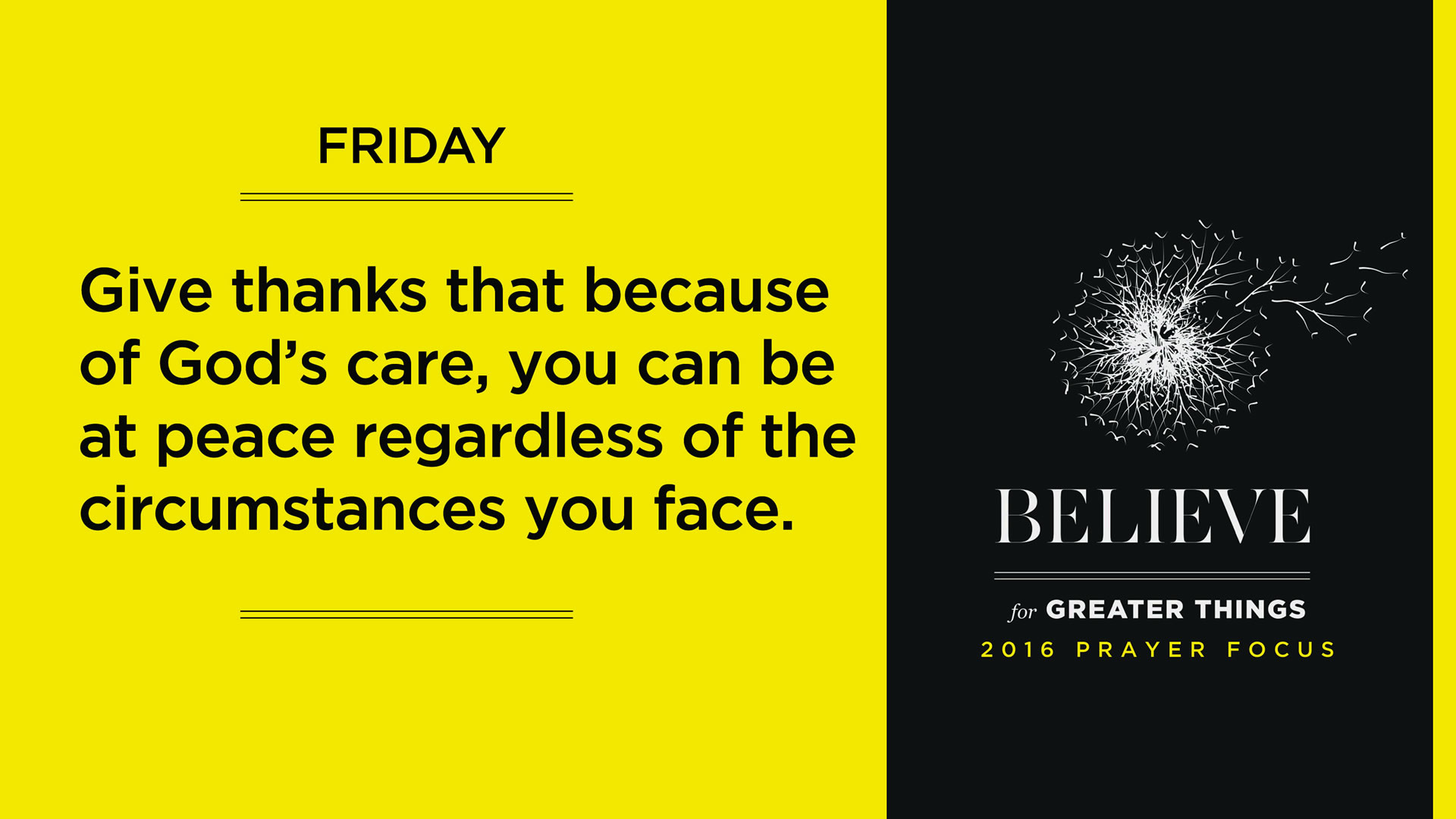
WOP_2016_Slide_FriOur week of prayer continues on Friday with this prayer focus—

Give thanks that because of God’s care, you can be at peace regardless of the circumstances you face.

I love to pray the Scriptures during my times of prayer. Perhaps today you could pray something like this:

Heavenly Father, I am learning not to be anxious about anything, but to turn every stressful situation over to You in prayer, and to be thankful for what You’re going to do. I am also learning to turn everything that bothers me into a prayer request to You. When I do this, Your peace, which transcends my human understanding, guards my heart and mind in Christ Jesus. 

I am also learning to be content whatever my circumstances are. I certainly know what it is to be in need, and I know what it is to have enough. I am learning the secret of being content in any and every situation, whether well fed or hungry, whether living in plenty or in want. I can do all this through You, Jesus, because You give me strength. I know that You will meet all my needs according to the riches in Christ Jesus [Philippians 4:6-7, 11-13, 19]. I know that when I pray this in Your name, Jesus, I can say a confident “amen!”

Links & Quotes

link quote

“Build God-centered anticipation and expectancy and excitement into your home—especially for the children. If you are excited about Christ, they will be too. If you can only make Christmas exciting with material things, how will the children get a thirst for God? Bend the efforts of your imagination to make the wonder of the King’s arrival visible for the children.” —John Piper

“The only people whose soul can truly magnify the Lord are people like Elizabeth and Mary—people who acknowledge their lowly estate [Luke 1:43, 48] and are overwhelmed by the condescension of the magnificent God.” —John Piper

“I try to read every book—Christian and secular—touted as ground-breaking. None of them are. We are driven by a reality placed in us by the Creator God with legitimate ways, context, and relationship to express our sexuality. If we don’t find those legitimate outlets, we will spend our lives searching for fulfillment in self-destructive ways to fill that God-given need for community, intimacy, relationship, and meaning. We cannot live without intimacy, and here I don’t mean sex. Sex is simply one of the most powerful forms of intimacy. We are not asexual beings. Being Christ-followers, striving for integrity in all things, doesn’t neuter us.” —Becky McDonald, founder and president of Women At Risk (WAR) International

“We must discipline our minds in all things to submit to the Word of God. We have the mind of Christ (1 Corinthians 2:16), and we are commanded to let His mind hold sway in all our thinking (Philippians 2:5). What the Scripture teaches concerning the disciplined life may not always seem the reasonable thing to do—because we cannot square its teaching with our experience or logic—but it is always the Word of God. Our duty is to get behind it and order all our steps accordingly.” —T.M. Moore

“Life is better when we act like we might see someone again soon, isn’t it?” —Seth Godin

This is scary (but typical of how abortion providers operate): a 911 call reveals that a teenager is held against her will and is being forced to have an abortion!

BREAKING NEWS: The US Senate has voted to repeal Obamacare, and defund Planned Parenthood!

Guillaume Bignon, a former atheist, has become a Christian. Here is Sean McDowell’s interview with him.

Archeologists in Israel have found a seal purported to belong to King Hezekiah. You can read about other verified archeological finds every day in the Archeological Study Bible.

[VIDEO] John Maxwell on the value of imagination—

6 Ways To Make Sure Everything You Do Is Sacred

It's all sacredAround 1300 AD, the Church began propagating a myth. It showed up in two words that were created around that time: clergy and laity.

Simply stated, clergy is from a root word that means “the learned men … the ones enlighten for ministry.” And laity is anyone not in that inner circle.

Insecure leaders did this to maintain control. They continued to read the Scriptures in Latin, which few could read, so they made sure that the clergy alone had a Bible, and they alone became the expounders of how the Bible told us to live.

In the clergy-laity divide, they also created a sacred-secular divide.

When Paul addresses the Colossians he does so with anything but a clergy-laity divide in mind. He calls them the holy and faithful brothers in Christ (Colossians 1:2). The KJV translates holy as saints, for that’s how Paul indeed sees them. And he sees them as his very own faith-filled brothers.

Paul also has anything but a sacred-secular divide in mind as he instructs then—whatever you do, whether in word or deed.

He makes it clear that everything we do as faith-filled, holy saints is to be sacred and God-honoring.

How do we do whatever we do in a sacred, God-honoring way? We ask these six questions:

[1] Can it be done with a clear conscience? (Acts 23:1; 24:16)

  • “It is not WHAT a man does that determines whether his work is sacred or secular, it is WHY he does it.” —A.W. Tozer

[2] Will it promote the Gospel? (Philippians 1:27)

[3] Is it a good deed? (Acts 10:38; James 3:13)

[4] Does it point people to God? (1 Peter 2:12; 1 Corinthians 10:31)

[5] Can I do it in the name of Jesus? (Colossians 3:17do it ALL in the name of Jesus)

[6] Does it cause others to be thank-full? (Colossians 3:17giving THANKS to God the Father).

Live according to your high calling, for all you do is sacred!

(To check out more thoughts on Colossians 3:15-17, click here and here.)

Links & Quotes

link quote

 [VIDEO] John Maxwell has a special message for veterans as he talks about heroism—

“God never says ‘no’ to us unless ‘no’ will make us ultimately happier.” —Jon Bloom

“You may remember the Old Testament story of the Israelite spies sent to scout out the Promised Land. They came back saying, ‘Yes, it’s a land flowing with milk and honey. But it’s also full of giants and walled-up cities. We’re not able to go up against these people. Compared to them, we’re mere grasshoppers’ (see Numbers 13). Now, these men didn’t accuse God. They never said, ‘God isn’t able. He isn’t strong enough.’ They dared not voice such unbelief. Instead, they focused on themselves, saying, ‘We’re not able. We’re like little bugs in our enemies’ sight.’ Yet that is not humility. And it isn’t innocent, harmless talk. Rather, it’s an affront to the One who is the Light of the world, who commands us to believe, ‘I can do all things through Christ which strengtheneth me’ (Philippians 4:13).” —David Wilkerson

“The voice of God indeed daily calls to us; calls to the world to abandon sins and seek the Kingdom of God wholeheartedly.” —C.S. Lewis

J. Warner Wallace uses his skill as a cold-case detective to examine the testimony of the New Testament Gospel writers. Here is his case for why the Gospels were written fairly soon after Christ’s ascension.

Unfortunately, this is true: The First Amendment Is Dying.

[VIDEO] Was Jesus a myth?—

Authority Comes From Submission

Authority comes from submissionOut of all the unlikely places, I never would have expected that guy to be a theologian! After all, the ones with the amazing insight into how God works are supposed to be deep into Scripture, know the ancient biblical languages, and be able to preach profound sermons. This guy had none of that.

He was simply an officer in the military who had an aide-de-camp who was sick. He had enough basic knowledge to see that Jesus could do something for his faithful assistant, but—strangely enough—he didn’t think he was worthy of having Jesus come into his home.

He said something that caused Jesus to be amazed. When Jesus is amazed by something a man does, that gets my attention!

This military officer said, “Although I’m an officer who can tell people what to do—when I say, ‘Jump!’ they say, “How high, sir?’ When I say, ‘Go!’ they say. ‘Yes, sir!’—I’m also a man under authority. I recognize that you too, Jesus, are a Man of authority. So if You simply say, ‘Go!’ to this disease, it will go.”

Jesus was amazed!

What theology came from that guy—a Roman centurion! This military officer saw that authority came from being under authority. Jesus had authority because He remained under the authority of His Heavenly Father (see John 12:49-50; Philippians 2:5-11).

We can learn a valuable lesson from this unlikely theologian. Authority comes NOT from trying to get our way, but from doing things God’s way … from staying under His authority. All the authority you will ever need is found in the Word of God (see Matthew 9:6-8; 10:1; 16:19).

This is a great story. Check it out for yourself here.

5 Ways To Live As A Free Servant

Peculiar not popularWe Americans love our freedom! But “freedom” is often misused and even abused—

  • We have sexual freedom … but not the “freedom” to say no.
  • We have freedom of expression … unless it’s “offensive” to me.
  • We have freedom of speech … unless I think it’s “hate speech.”

Freedom usually means: I am free to do what I want when I want to do it, but you are free to only do what I agree to. In other words, “freedom” has become subjective and selfish. For Christians, citizens of Heaven who are passing through Earth, the Bible calls us to use our freedom in a different way.

[1] Make sure your freedom is based in reverence for God (1 Peter 1:17). God is the One who will judge our actions. The Amplified Bible adds, “conduct yourselves in reverent fear of Him and with profound respect for God.”

[2] Live good lives, shown by your good deeds (1 Peter 2:12). The word good here means beautiful, useful, beneficial. In other words, the emphasis is more on action than on talk. George MacDonald wrote, “The time for speaking seldom arrives, the time for being never departs.”

[3] Do good to silence foolish talk (1 Peter 2:15). Notice the contrast between doing (the citizens of Heaven) and merely talking (the citizens of Earth). Good doing always trumps good talking.

[4] Live as free servants (1 Peter 2:16). That sounds like an oxymoron, doesn’t it? A free servant?! But this is the same word used to describe Jesus in Philippians 2:7. It’s also how Jesus lived. In fact, the only time Jesus said, “I have set you an example” is when He was being the lowest of servants.

[5] Never forget the Cross (1 Peter 2:21-24; 4:1-6). Because of what Jesus did on the Cross for us, we die to sins and live for righteousness. Because of the Cross, we are to live differently from Earthlings.

When we live in this peculiar way, it gets noticed:

Simple question: If you are a Christian, are you living the way Peter instructs you to live?

If you’ve missed any messages in this series, you may find the complete list by clicking here.

Links & Quotes

link quote

“People most affected by fear are those who hang around negative people. If you’re going to control the negative thoughts in your life, you’ve got to get away from negative people as much as you can.” —Rick Warren

“Liberty cannot be established without morality, nor morality without faith.” —Horace Greeley

“It’s natural enough in our species, as in others, that the young birds should show off their plumage—in the mating season. But the trouble in the modern world is that there’s a tendency to rush all the birds on to that age as soon as possible and then keep them there as late as possible, thus losing all the real value of the other parts of life in a senseless, pitiful attempt to prolong what, after all, is neither its wisest, its happiest, or most innocent period. I suspect merely commercial motives are behind it all: for it is at the showing-off age that birds of both sexes have least sales resistance!” —C.S. Lewis

“Don’t make a decision, large or small, without sitting before God with an open Bible, an open heart, and open ears. Philippians 2:13 says, ‘God is working in you to help you want to do and be able to do what pleases Him.’” —Max Lucado

“Strange as it may seem, one of the primary purposes of being shaken by suffering is to make our faith more unshakable. Faith is like muscle tissue: if you stress it to the limit, it gets stronger, not weaker. That’s what James means here [James 1:2-3]. When your faith is threatened and tested and stretched to the breaking point, the result is greater capacity to endure. … If you think your suffering is pointless, or that God is not in control, or that He is whimsical or cruel, then your suffering will drive you from God, instead of driving you from everything but God—as it should. So it is crucial that faith in God’s grace includes the faith that He gives grace through suffering.” —John Piper

“The promise, made when I am in love and because I am in love, to be true to the beloved as long as I live, commits me to being true even if I cease to be in love. A promise must be about things that I can do, about actions: no one can promise to go on feeling in a certain way. He might as well promise never to have a headache or always to feel hungry.” —C.S. Lewis

“It’s the lives of the saints, not the arguments of the theologians and philosophers, that covert people.” — Pope Benedict XVI

Rewards For Faithfulness

NunI unabashedly tell anyone who asks me what my favorite book is … It’s the Bible. I have yet to find such a collection of writings that work every single time they’re applied.

Two summers ago we began a series of messages on the 119th Psalm. It appears that the psalmist shares my passion for God’s Word, as he writes time and time again the difference Scripture makes in his life.

The other thing that makes this psalm so cool to me is the organization of the 176 verses into twenty-two 8-verse segments, with each verse in a segment beginning with the the same Hebrew letter as its title. In the Hebrew language, the letters in the alphabet had their own meaning. In English an “n” is simply spelled “n.” It has no other definition or meaning. But in Hebrew the letter nun has both a spelling and a meaning. Nun is spelled nun-vav-nun (final), and it means both faithfulness and the reward for faithfulness.

Look at the three Hebrew characters that spell nun. Reading right to left it tells a story and gives the meaning of the letter/word—the one who is humbled in faithfulness will be the one who stands in righteousness. The perfect example of this is Jesus, Who humbled Himself when He came to earth and to the Cross, and then was exalted by the Heavenly Father to wear the crown of righteousness (see Philippians 2:5-11 and Revelation 14:14). Paul starts this passage by calling on us to “have the same attitude as that of Jesus” (v. 5), and concludes with the call to stick with it all the way to the end (see vv. 12-13).

RewardsThe psalmist calls us to this same thing in nun (Psalm 119:105-112). The “bookend” verses say, “Your Word is a lamp for me… so my heart is set on keeping Your Word” (vv. 105 and 112). In between the psalmist commits himself to a life of humbly persevering to God’s ways, and reaps the rewards of a changed heart, the joy of the Lord, and a heritage to pass on to others.

I have fought the good fight, I have finished the race, I have kept the faith. Now there is in store for me the crown of righteousness, which the Lord, the righteous Judge, will award me on that day—and not only to me, but also TO ALL who have longed for His appearing (2 Timothy 4:7-8).

Humble yourself before the Lord, and He will lift you up (James 4:10).

My heart is set on keeping Your decrees to the very end (Psalm 119:112).

Rewards here (new heart, joy, heritage) AND rewards in Heaven (a crown of righteousness). How awesome is that!!

If you have missed any of the messages in our P119 series, you can access them all by clicking here.

Myth Buster

Dick BrogdenGuest Blogger: Dick Brogden

Currently there is an inordinate emphasis on size and speed when it comes to the development of the church. Church history soberly shows that orthodoxy tends not to spread as swiftly as heresy and that bad teaching outpaces good. It is the slow, steady repeated truth of God that builds the enduring church. The largest church at the end of the first century was found in Rome, thought by most scholars to be around two hundred members. The churches in Ephesus, Corinth, Philippi, Colosse, and Thessalonica (among others) were most probably between fifteen and fifty. The record of Acts takes place over about fifty years. Biblical precedent indicates that it takes about a generation to get a few churches to what we now consider modest size. One myth is that the church has to grow quickly; another that a strong church is a big church. The best churches tend to grow slowly and steadily, and the normal first century church comprised less than fifty people.

Disciples, too, are forged over time. If a church is but a collection of disciples, then it makes sense that strong churches require time to become solid. Another common myth today in mission is that all new disciples need is the Bible and the Holy Spirit. As appealing as this sounds, it has never been true in history, and if we are honest, it has not been true for any of us experientially. Consider how many books, sermons, mentors, friends, and external inputs help shape and form our spirituality over time. None of us grew to where we are without multiple sources of input over disparate seasons, all the input submitted to the authority of Holy Spirit and the Word. Biblically there always remains the need for an outside catalyst to help correct our biases and heresies. A group of people studying the Scriptures can just as easily end up pooling ignorance as illumining one another. Acts 15 is a classic example of ongoing external input necessary for the formation of strong disciples and churches. The negative example of external input (requiring circumcision) does not negate the massive, ongoing positive external input.

Paul and Barnabas report the wonderful turning of the Gentiles to Jesus. They also report the negative external pressure. James and the counsel respond by correcting the error and reinforcing what is necessary. In Acts 15:20, James delineates what they should not do–former religious forms and rituals. Paul reminds the council that coming to Jesus demands conversion (v. 3) and James cites Peter that the Gentiles must come out of false religion (v. 14). In Acts 15:32, Judas and Silas “exhort and strengthen the brethren with many words.” In verse 35, Paul and Barnabas teach and preach to the Gentiles and in verse 36, Paul and Barnabas commit to revisit their converts to ensure they are walking correctly. Disciples and churches are forged over time. Let us continue to believe that God will do great things and bring millions into His church. Let us continue to understand that it is slow, steady, life-on-life work to make disciples and build churches.