Links & Quotes

Christians need to be very cautious about not quarreling in a way that pushes people away from the love of God.

I have a lot of new video content on my YouTube channel every week. Please check it out and subscribe so you don’t miss anything.

In discussing how Thomas Huxley coined the term agnostic, John Stonestreet and Dr. Glenn Sunshine note, “If God is rational and created an orderly universe and human beings in His image, we can study the universe. Without these assumptions, there is no reason to assume the world is knowable or that humans are able to know. It is the theistic assumption, not the agnostic assumption, that grounds science. By rejecting God, scientists undercut the foundations for their work.”

“There will come a time when every culture, every institution, every nation, the human race, all biological life is extinct and every one of us is still alive. Immortality is promised to us, not to these generalities. It was not for societies or states that Christ died, but for men.” —C.S. Lewis, in The Weight of Glory 

“If Patrick Henry could arise from the dead and revisit the land of the living, and see the vast system and social organization and social science which now controls, he would probably simplify his observation and say, ‘Give me death.’” —G.K. Chesterton, speaking in New York City’s Time Square Theatre in 1921 

T.M. Moore has an excellent series of posts about God and reason. In the post Since God is Reasonable, he writes, “If we are sluggish in reason, so that we do not like to have to think hard and long about matters; or if our skills in reasoning are inadequate, poorly honed, or rusty from disuse, then we should make it our business to overcome our laziness and improve our use of reason, since the great prize of reasoning with and knowing God lies open to us.”

We all experience conflicts with other people, but this post—8 signs you’re the problem in your arguments—is quite insightful.

Stanley Horton’s influence on the Assemblies of God—and wider Pentecostal circles too—cannot be understated. This is a great mini-biography of his life. 

I’m always impressed by the historicity of the Bible. “Archaeology has demonstrated that numerous people, places, and events within the books [of Ezra and Nehemiah] are historically accurate,” says this post.

“The Jewish high priests went once a year into the Holy of Holies. Each year as it came round demanded that they should go again. Their work was never done; but ‘He entered in once,’ and only once, ‘into the holy place, having obtained eternal redemption for us.’ I love that expression, ‘eternal redemption’—a redemption which really does redeem, and redeems forever and ever. If you are redeemed by it, you cannot be lost; if this redemption be yours, it is not for a time, or for a season, but it is ‘eternal redemption.’ Oh, how you ought to rejoice in the one entrance within the veil by our great High Priest who has obtained eternal redemption for us!” —Charles Spurgeon 
Jesus—100% God And 100% Human

Listen to the podcast of this post by clicking on the player below, and you can also subscribe on AppleSpotify, or Audible.

On paper, it seems so simple: “We believe in the Deity of the Lord Jesus Christ. As God’s Son, Jesus was both human and divine.” But trying to wrap our finite human minds around the concept of the full humanity and the full deity of Jesus is challenging!

First off, Jesus was fully human. Both Matthew and Luke record details about Christ’s physical birth, and the writer of Hebrews says that Jesus was made every bit as human as us (Hebrews 2:17).

But Jesus was also fully God. John records how God became flesh in the Person of Jesus (John 1:1-2, 14), and Paul tells us how Jesus chose not to use His deity when He came to earth as a human (Philippians 2:6-8).

I know that anytime we say, “God is like…” we’ve already sold ourselves short, but I’d like to try one analogy that’s been helpful for me.

Imagine a coin that has two distinct sides. While we are looking at one side (heads), we cannot see the other side (tails) but that doesn’t mean the other side has ceased to exist. In fact, if we were able to split that coin in half, so that there was only a heads and a tails, we haven’t cut the value of the coin in half, but we’ve made the coin of no value at all! 

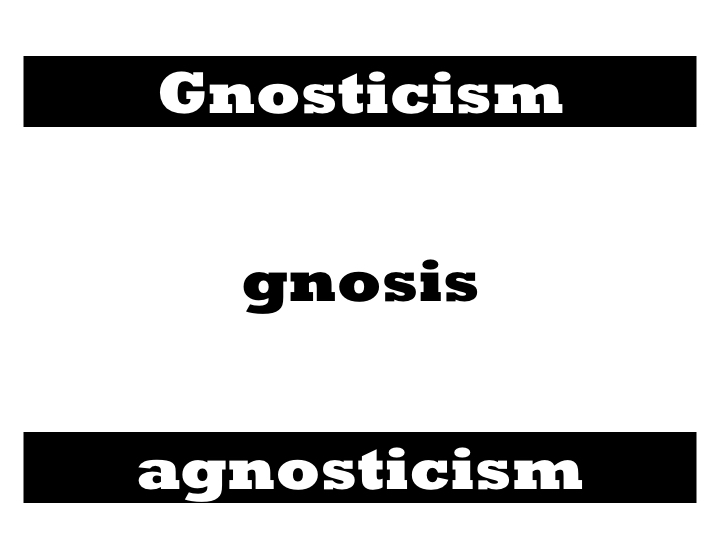
In the Greek language of the New Testament, there are a couple of words for “knowing”: one is gnosis and the other oido. Together these words combine head knowledge and heart knowledge, or knowledge by study and knowledge by experience.

C.S. Lewis captures the idea this way: “It is Christ Himself, not the Bible, who is the true Word of God. The Bible, read in the right spirit and with the guidance of good teachers, will bring us to Him.”

Just as Jesus was both God and Man, we are to use both our mind and our heart to know Him.

To focus on the “heads” side—the deity of Jesus—is to pervert gnosis into gnosticism, and deny the humanity of Jesus. To focus on the “tails” side—the humanity of Jesus—is to pervert gnosis into agnosticism, and deny the deity of Jesus. True gnosis keeps both sides in mind: Deity and humanity.

To truly know THE Word of God (Jesus) in all His humanity and in all His deity, we need to study the Word of God. We also need the help of the Holy Spirit. I like the Old English wording of this verse—Ye have an unction [charisma] from the Holy One, and ye know [gnosis] all things (1 John 2:20).

So read your Bible, but not just to read your Bible. Ask the Holy Spirit to make THE Word known to you. Live in the balance of gnosis as you get to know Jesus more deeply and personally.

(When Jesus proclaimed His “I Am” statements in the New Testament, He was tying Himself to all of the “Jehovah” titles of the Old Testament. Check out I Am Jehovah.)

This post is a part of our series studying our foundational beliefs. If you would like to read more about the first foundational beliefs we have discussed, check out this post on the inspiration of Scripture, and this post on the Trinity.

►► Would you please prayerfully consider supporting this ministry? My Patreon supporters get behind-the-scenes access to exclusive materials. ◀︎◀︎

7 Quotes From “The Greatest Words Ever Spoken”

The Grestest Words Ever SpokenObviously the best quotes from The Greatest Words Ever Spoken are from Jesus Himself. But Steven K. Scott, who complied the words of Christ into this unique format (you may read my book review by clicking here) had some good things to say too.

“No occurrence in history or physical science has been verified with a higher degree of statistical certainty than the fact that Jesus is exactly who He claimed to be—the Messiah, the Son of the living God.” 

“We cannot worship the Father in spirit or in truth unless we see Him for who He really is and understand His relationship with the Son.”

“Agnostics hold the position that they simply do not know if God exists. Atheists, on the other hand, claim intellectual superiority over all others, saying they know there is no God.”

“If you want to know what God thinks and feels, how He acts and works, what grieves Him and what pleases Him, all you have to do is read the words and observe the behavior of Jesus Christ.”

“Several years ago a string of four letters took the Christian community by storm. It seemed like WWJD, which stands for ‘What would Jesus do?’ was everywhere—and why not? When a choice has to be made, is any other question more important to ask? The answer is ‘Yes, one question is more important. One question Christians should ask before choosing any course of action, making any spiritual decision, or adopting any value or belief.’ That question is ‘WDJS: what did Jesus say?’ This is the question Christians need to ask because in many situations we simply can’t know for sure what Jesus would do, so we are left to figure it out for ourselves. And figuring it out may require more wisdom, revelation, insight, and spiritual maturity than we possess at the time. … Jesus made more statements about how His followers should live and what they should believe than about any other group of topics.”

“By nature, we evaluate nearly every situation according to its immediate impact on our desires, and we make our choices accordingly. Consequently, we often sacrifice that which would bring infinite eternal benefit in exchange for temporary gratification.”

“Jesus shows us that blaming others for our failures is not only offensive to God; it is detrimental to our relationships. While we all want healthier relationships, most of us have a hard time breaking free from our natural inclinations. The words of Christ… can bring about extraordinary change in every relationship in your life, for the rest of your life. … We can have better relationships with anyone who crosses our path, but it doesn’t happen naturally. Jesus provides both the revelation and the power that frees us from our human nature.”