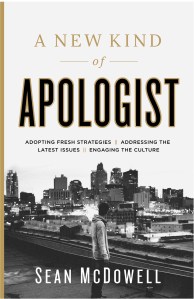
 A New Kind Of Apologist is edited by Sean McDowell and contains a collection of fabulous essays to prepare Christian apologists to be effective in this current generation. You can read my full book review by clicking here. These quotes mainly deal with the attitude that a Christian apologist should adopt.
“Truth must be wedded to grace, and what we say is important…but how we say it is equally critical.” —Sean McDowell
“To listen to a person will require that we temporarily set aside our objections to what a person is saying and allow him or her to speak openly without fear of being challenged.” —Tim Muelhoff
“Our character and relationships with others have a greater capacity for attracting those around us to the Christian message than do our arguments or rhetoric.” —Ken Wytsma & Rick Gerhart
“If our beliefs are not expressed in love and by example, we miss the greatest command of all, which is loving God and loving others.” —Dan Kimball
“The Barna Research Group found that twentysomethings who stay in church were twice as likely to have a close personal friendship with an adult inside the church. Those who had an adult mentor at church, aside from the pastor, were almost three times as likely to stay as those who did not.” —Jeff Myers
“Any fully-orbed presentation of the truth about ourselves and God’s plan for us cannot be a disembodied, purely intellectual truth; it must truthfully reflect our nature as created beings.
“Part of being incarnate means that it is good and right for us to have emotions and express them—as our Lord did, for example, by weeping at the tomb of Lazarus and getting angry with the money changers in the temple. The fact that little children wanted to come to Him suggests that He had a welcoming physicality and a warm personality that they instinctively trusted and found attractive. He wasn’t just a walking dictionary of Christian theology.” —Holly Ordway
“At its core, apologetics is the art and science of defending the faith. However, practically understood, the work of the apologist is simply to answer with integrity, clarity, and compassion the questions critics are asking about the gospel (1 Peter 3:15). The context of this passage implies a lifestyle on the part of the apologist that engenders and welcomes questions from their audience. The encouragement of Peter seems to be that we avoid the telemarketer approach of simply enduring questions solely for the sake of closing the deal. Rather, Peter calls us to anticipate and patiently answer the questions of our unbelieving friends, family members, and neighbors in an uncompromising and yet humble manner.” —Christopher Brooks
“We must be Christians first and apologists second, which means our intellectual lives must be primarily shaped by seeking to understand the faith we live within rather than debating, disputing, or even persuading those who do not believe it.” —Matthew Anderson
“It is our responsibility to share the message of hope through Christ ‘with gentleness and respect’ and ‘with grace,’ as Peter and Paul taught. The gospel message is already offensive to some. We need not make it more offensive by presenting it in a manner that lacks gentleness, respect, and grace.” —Mike Licona
“Truth without grace is abusive and arrogant. Grace without truth is mushy sentimentalism. … As much as possible, always deal with the person in grace and the issue itself in truth.” —Glenn T. Stanton
“Paul doesn’t say that we ought to know how to answer each question [see Colossians 4:5-6]. He specifically teaches us to answer each person. … Paul tells us that we aren’t in the question-answering business. We are in the people-answering business. Today’s apologist must understand that questions don’t need answers; people need answers. … I am convinced that the key to apologetics today is to identify what non-Christians thirst for most and show how the Christian faith alone can slake that thirst.” —Abdu Murray
“The manner in which we communicate the gospel is not a minor add-on to the gospel itself [see 1 Peter 3:15-16]. Very often it is the nature of the communication that determines whether the gospel gets a hearing at all. …
“It remains true that it is not arrogant to make truth claims, it is not arrogant to pursue a knowledge of that truth, and to argue that we’ve found it. It is important that the content of our message is a genuine reflection of the gospel, and that the manner in which we communicate it doesn’t become a stumbling block.” —Tanya Walker
More quotes from A New Kind Of Apologist will be coming soon. You can also follow me on Tumblr and Twitter to read great quotes every single day.



 This is a weekly series with things I’m reading and pondering from Charles Spurgeon. You can read the original seed thought here, or type “Thursdays With Spurgeon” in the search box to read more entries.









 Craig T. Owens
6 Quotes From “Light & Truth—The Lesser Epistles”
July 13, 2016 — Craig T. Owens“It is a busy, lighthearted, laughing, pleasure-seeking world. But sin is here, and pain is here, and broken hearts are here, and weeping is here, and death is here, and the grave is here. Oh! in spite of all its laughter and vanity, it is an evil world. And the great proof of its evil is, that it cost the death of the Son of God to deliver you from it. … Give yourselves to Him Who came to deliver you from it, and Who stretches out His hands to you all day long, asking you to allow Him to deliver you. He yearns over you; and with sincere earnestness proffers to you His love, His friendship, His great salvation. Consent, O man, consent! His desire is to bless, and not to curse; to save, and not to destroy.” [Galatians 1:4]
“There never have been two gospels. There is not an Old Testament gospel and a New Testament Gospel. There is not one gospel for the Jew, and another for the Gentile, one gospel for the first century, and another for the nineteenth. It is but one gospel, as there is but one Cross and one Savior. Many ages, but one gospel; many sinners, but one gospel; many prophets and apostles, but one gospel. As our earth has had but one sun, so it has had but one gospel. Nor does it need more; that one is sufficient.” [Galatians 1:6-9]
“As the earth without rain or sunshine turns to barrenness, so is it with the Church or soul without the Spirit. … The age thinks it can do without the Spirit. Let the Church watch against this blasphemy. Let her keep hold of the Lord’s promise, the promise of the Father. Let her prize the gift; long for more of it. Let every saint seek more of it. Let our cry be continually: More of the Holy Spirit; more of His fullness; more of His gifts and graces!”
“Strength for the race is needed, hourly strength, superhuman strength; for it is no earthly race, but something lofty, supernatural, divine. Forgetting the supernatural source of strength, we betake ourselves to the internal or the simply external. And so we weary. For only God can supply the power which keeps us running. By Him only shall we run, and not be weary.” [Galatians 5:7]
“‘To Him who is able’—He is the Mighty One, the mighty God, the Lord God Almighty. Hear how this word ‘able’ is used. ‘He is able to subdue all things unto Himself’ (Philippians 3:21). ‘He is able to help them that are tempted’ (Hebrews 2:18). ‘He is able to save to the uttermost’ (Hebrews 7: 25). ‘He is able to keep us from falling’ (Jude 24). It is with the mighty God that we have to do; mightier than ourselves or our foes; mightier than earth or hell; omnipotent.” [Ephesians 3:20]
“Are you expecting the Lord? Are you living in this expectation? Is it a deep-seated, abiding, cherished hope? Is it a hope that tells upon your character, your life, your daily actings in public or private, your opinions, your whole man? Does it quicken you? Does it purify you? Does it keep you separate from the world? Does it keep you calm in the midst of earth’s most exciting events, or most untoward changes? Does it give you a new view of history as well as prophecy? … Let your expectation of the Lord’s coming be a calm and healthy one; not one that excites, but one that tranquilizes; not one that unfits for duty, but one that nerves you more firmly for it; not one that paralyzes exertion, but one that invigorates you for it; not one that makes you indifferent to present duty, but one that makes you doubly in earnest about everything that your hand findeth to do; not one that stops liberality, and prayer, and work, but one that increases all these a hundred fold; not one that dwells exclusively on the future’s dark side—the judgments that are at hand—but one that realizes the glory and the joy of Messiah’s approaching victory and triumphant reign.” [Philippians 3:20]
Share this: