Thinking Christianly

“If you read history you will find that the Christians who did most for the present world were just those who thought most of the next. The Apostles themselves, who set on foot the conversion of the Roman Empire, the great men who built up the Middle Ages, the English Evangelicals who abolished the Slave Trade, all left their mark on Earth, precisely because their minds were occupied with heaven. It is since Christians have largely ceased to think of the other world that they have become so ineffective in this.” —C.S. Lewis

“To think secularly is to think within a frame of reference bounded by the limits of our life on earth: it is to keep one’s calculations within this-worldly criteria. To think christianly is to accept all things with the mind as related, directly or indirectly, to man’s eternal destiny as the redeemed and chosen child of God…. There is nothing in our experience, however trivial, worldly, or even evil, which cannot be thought about christianly.” —Harry Blamires

Most of us do not think; we live healthy ordinary lives and don’t bother about thinking at all; but when an upheaval comes from underneath proving that the basis of things is not rational, we find the value of the Bible attitude, which is that the basis of things is tragic and not rational…. We have to live based on our relationship to God in the actual condition of things as they are.” —Oswald Chambers

God wants a child’s heart, but a grownup’s head. He wants us to be simple, single-minded, affectionate, and teachable, as a good children are; but He also wants every bit of intelligence we have to be alert at its job, and in first-class fighting trim.” —C.S. Lewis

“Don’t let anyone capture you with empty philosophies and high-sounding nonsense that come from human thinking and from the spiritual powers of this world, rather than from Christ.” —Apostle Paul (Colossians 2:8)

“We do not think on the basis of Christianity at all. We are taught to think like pagans for six days a week and to reverse the order for one day, consequently in critical moments we think as pagans and our religion is left in the limbo of the inarticulate.” —Oswald Chambers

[Emphasis in these quotes added by me]

To read thought-provoking quotes like this every day, please follow me on Twitter and Tumblr.
Jesus—100% God And 100% Human

Listen to the podcast of this post by clicking on the player below, and you can also subscribe on AppleSpotify, or Audible.

On paper, it seems so simple: “We believe in the Deity of the Lord Jesus Christ. As God’s Son, Jesus was both human and divine.” But trying to wrap our finite human minds around the concept of the full humanity and the full deity of Jesus is challenging!

First off, Jesus was fully human. Both Matthew and Luke record details about Christ’s physical birth, and the writer of Hebrews says that Jesus was made every bit as human as us (Hebrews 2:17).

But Jesus was also fully God. John records how God became flesh in the Person of Jesus (John 1:1-2, 14), and Paul tells us how Jesus chose not to use His deity when He came to earth as a human (Philippians 2:6-8).

I know that anytime we say, “God is like…” we’ve already sold ourselves short, but I’d like to try one analogy that’s been helpful for me.

Imagine a coin that has two distinct sides. While we are looking at one side (heads), we cannot see the other side (tails) but that doesn’t mean the other side has ceased to exist. In fact, if we were able to split that coin in half, so that there was only a heads and a tails, we haven’t cut the value of the coin in half, but we’ve made the coin of no value at all! 

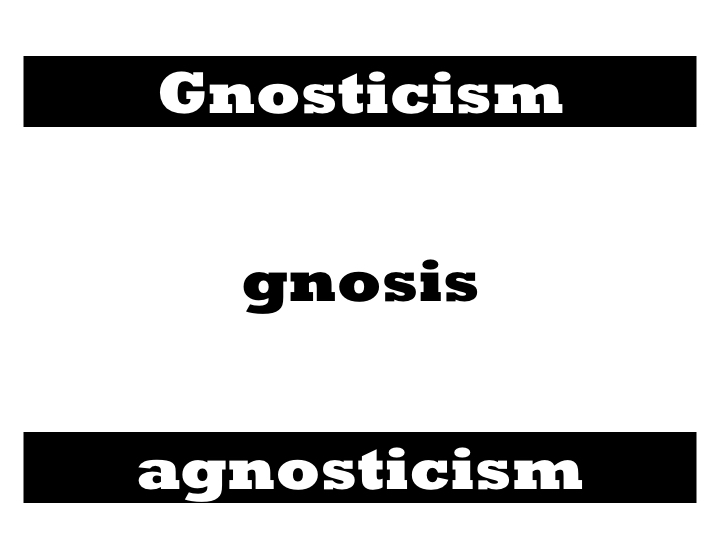
In the Greek language of the New Testament, there are a couple of words for “knowing”: one is gnosis and the other oido. Together these words combine head knowledge and heart knowledge, or knowledge by study and knowledge by experience.

C.S. Lewis captures the idea this way: “It is Christ Himself, not the Bible, who is the true Word of God. The Bible, read in the right spirit and with the guidance of good teachers, will bring us to Him.”

Just as Jesus was both God and Man, we are to use both our mind and our heart to know Him.

To focus on the “heads” side—the deity of Jesus—is to pervert gnosis into gnosticism, and deny the humanity of Jesus. To focus on the “tails” side—the humanity of Jesus—is to pervert gnosis into agnosticism, and deny the deity of Jesus. True gnosis keeps both sides in mind: Deity and humanity.

To truly know THE Word of God (Jesus) in all His humanity and in all His deity, we need to study the Word of God. We also need the help of the Holy Spirit. I like the Old English wording of this verse—Ye have an unction [charisma] from the Holy One, and ye know [gnosis] all things (1 John 2:20).

So read your Bible, but not just to read your Bible. Ask the Holy Spirit to make THE Word known to you. Live in the balance of gnosis as you get to know Jesus more deeply and personally.

(When Jesus proclaimed His “I Am” statements in the New Testament, He was tying Himself to all of the “Jehovah” titles of the Old Testament. Check out I Am Jehovah.)

This post is a part of our series studying our foundational beliefs. If you would like to read more about the first foundational beliefs we have discussed, check out this post on the inspiration of Scripture, and this post on the Trinity.

►► Would you please prayerfully consider supporting this ministry? My Patreon supporters get behind-the-scenes access to exclusive materials. ◀︎◀︎

The Delight Of Praise

C.S. Lewis at his desk“Just as men spontaneously praise whatever they value, so they spontaneously urge us to join them in praising it. ‘Isn’t she lovely? Wasn’t it glorious? Don’t you think that magnificent?’ The Psalmists in telling everyone to praise God are doing what all men do when they speak of what they care about.

“My whole, more general, difficulty about the praise of God depended on my absurdly denying to us, as regards the supremely Valuable, what we delight to do, what indeed we can’t help doing, about everything else we value. I think we delight to praise what we enjoy because the praise not merely expresses but completes the enjoyment; it is its appointed consummation. It is not out of compliment that lovers keep on telling one another how beautiful they are; the delight is incomplete till it is expressed. … This is so even when our expressions are inadequate, as of course they usually are. But how if one could really and fully praise even such things to perfection—utterly ‘get out’ in poetry or music or pain the upsurge of appreciation which almost bursts you? Then indeed the object would be fully appreciated and our delight would have attained perfect development. The worthier the object, the more intense this delight would be.” —C.S. Lewis, in Reflections On The Psalms

10 Quotes From C.S. Lewis

C.S. Lewis(When is it ever not a good day to share C.S. Lewis quotes?!)

“There is either a warning or an encouragement here for every one of us. If you are a nice person—if virtue comes easily to you—beware! Much is expected from those to whom much is given. If you mistake for your own merits what are really God’s gifts to you through nature, and if you are contented with simply being nice, you are still a rebel: and all those gifts will only make your fall more terrible, your corruption more complicated, your bad example more disastrous. The devil was an archangel once; his natural gifts were as far above yours as yours are above those of a chimpanzee.” —C.S. Lewis 

“The monstrosity of sexual intercourse outside marriage is that those who indulge in it are trying to isolate one kind of union (the sexual) from all the other kinds of union which were intended to go along with it and make up the total union. …You must not isolate that pleasure and try to get it by itself, any more than you ought to try to get the pleasures of taste without swallowing and digesting, by chewing things and spitting them out again.” —C.S. Lewis

“On the contrary, those who are seriously attempting chastity are more conscious, and soon know a great deal more about their own sexuality than anyone else. They come to know their desires as Wellington knew Napoleon, or as Sherlock Holmes knew Moriarty; as a rat-catcher knows rats or a plumber knows about leaky pipes. Virtue—even attempted virtue—brings light; indulgence brings fog.” —C.S. Lewis

“For there are two things inside me, competing with the human self which I must try to become. They are the Animal self, and the Diabolical self. The Diabolical self is the worse of the two. That is why a cold, self-righteous prig who goes regularly to church may be far nearer to hell than a prostitute. But, of  course, it is better to be neither.” —C.S. Lewis

 “A great deal of our anxiety to make excuses comes from not really believing in it, from thinking that God will not take us to Himself again unless he is satisfied that some sort of case can be made out in our favor. But that would not be forgiveness at all. Real forgiveness means looking steadily at the sin, the sin that is left over without any excuse, after all allowances have been made, and seeing it in all its horror, dirt, meanness, and malice, and nevertheless being wholly reconciled to the man who has done it. That, and only that, is forgiveness, and that we can always have from God if we ask for it.” —C.S. Lewis 

“To be a Christian means to forgive the inexcusable, because God has forgiven the inexcusable in you.” —C.S. Lewis

“The human lives in time but our enemy destines them to eternity. He therefore, I believe, wants them to attend chiefly to two things, to eternity itself, and to that point of time which they call the Present. For the Present is the point at which time touches eternity. Of the present moment, and of it only, humans have an experience analogous to the experience which our Enemy has of reality as a whole; in it alone freedom and actuality are offered them. He would therefore have them continually concerned either with eternity (which means being concerned with Him) or with the Present—either meditating on their eternal union with, or separation from, Himself, or else obeying the present voice of conscience, bearing the present cross, receiving the present grace, giving thanks for the present pleasure.” —C.S. Lewis

“War creates no absolutely new situation; it simply aggravates the permanent human situation so that we can no longer ignore it.” —C.S. Lewis

“The rescue of drowning men is, then, a duty worth dying for, but not worth living for.” —C.S. Lewis

“Christianity does not simply replace our natural life and substitute a new one; it is rather a new organization which exploits, to its own supernatural ends, these natural materials.” —C.S. Lewis

“The Thing Really Happened”

I shared this quote from C.S. Lewis this morning in my message…

C.S. Lewis at his desk“Now, as a literary historian, I am perfectly convinced that whatever else the Gospels are they are not legends. I have read a great deal of legend and I am quite clear that they are not the same sort of thing. They are not artistic enough to be legends. From an imaginative point of view they are clumsy, they don’t work up to things properly. Most of the life of Jesus is totally unknown to us, as is the life of anyone else who lived at that time, and no people building up a legend would allow that to be so. Apart from bits of the Platonic dialogues, there are no conversations that I know of in ancient literature like the Fourth Gospel. There is nothing, even in modern literature, until about a hundred years ago when the realistic novel came into existence. In the story of the woman taken in adultery we are told Christ bent down and scribbled in the dust with His finger. Nothing comes of this. No one has ever based any doctrine on it. And the art of inventing little irrelevant details to make an imaginary scene more convincing is a purely modern art. Surely the only explanation of this passage is that the thing really happened. The author put it in simply because he had seen it.” ―C.S. Lewis (emphasis added)

Poetry Saturday—On A Theme From Nicholas Of Cusa

C.S. Lewis at his deskWhen soul and body feed, one sees
Their differing physiologies.
Firmness of apple, fluted shape
Of celery, or tight-skinned grape
I grind and mangle when I eat,
Then in dark, salt, internal heat,
Annihilate their natures by
The very act that makes them I.

But when the soul partakes of good
Or truth, which are her savoury food,
By some far subtler chemistry
It is not they that change, but she,
Who feels them enter with the state
Of conquerors her opened gate,
Or, mirror-like, digests their ray
By turning luminous as they. —C.S. Lewis

Book Reviews From 2015

9 Quotes From C.S. Lewis

C.S. Lewis at his deskYesterday I posted a review on an innovative book The Surprising Imagination Of C.S. Lewis. Truly this man’s literary output during his lifetime, and his works’ staying power after his lifetime, is amazing. Here are a few quotes from this prolific author.

“We may ignore, but we can nowhere evade, the presence of God. The world is crowded with Him. He walks everywhere incognito. And the incognito is not always hard to penetrate. The real labor is to remember, to attend. In fact, to come awake. Still more, to remain awake.” —C.S. Lewis

“Humanity does not pass through phases as a train passes through stations: being alive, it has the privilege of always moving yet never leaving anything behind. Whatever we have been, In some sort we are still.” —C.S. Lewis

“God saw the Cross in the creation of the first nebulae.” —C.S. Lewis 

“Nothing can deceive unless it bears a plausible resemblance to reality.” —C.S. Lewis

“The real way of mending a man’s taste is not to denigrate his present favorites, but to teach him how to enjoy something better.” —C.S. Lewis 

“Coming to understand anything we must reject the facts as they are for us in favor of the facts as they are.” —C.S. Lewis

“The terrible thing, the almost impossible thing, is to hand over your whole self—all your wishes and precautions—to Christ. But it is far easier than what we are all trying to do instead. For what we are trying to do is to remain what we call ‘ourselves,’ to keep personal happiness as our great aim in life, and yet at the same time be ‘good.’ We are all trying to let our mind and heart go their own way—centered on money or pleasure or ambition—and hoping, in spite of this, to behave honestly and chastely and humbly. And that is exactly what Christ warned us you could not do.” —C.S. Lewis 

“The real problem of the Christian life comes where people do not usually look for it. It comes the very moment you wake up each morning. All your wishes and hopes for the day rush at you like wild animals. And the first job each morning consists simply in shoving them all back; in listening to that other Voice, taking that other point of view, letting that other larger, stronger, quieter life come flowing in. And so on, all day.” —C.S. Lewis

“‘Be ye perfect.’ I think He meant ‘The only help I will give is help to become perfect. You may want something less: but I will give you nothing less.’” —C.S. Lewis 

“That is why we must not be surprised if we are in for a rough time. When a man turns to Christ and seems to be getting on pretty well (in the sense that some of his bad habits are now corrected) he often feels that it would now be natural if things went fairly smoothly. When trouble comes along—illnesses, money troubles, new kinds of temptation—he is disappointed. These things, he feels, might have been necessary to rouse him and make him repent in his bad old days; but why now? Because God is forcing him on, or up, to a higher level: putting him into situations where he will have to be very much braver, or more patient, or more loving, than he ever dreamed of being before. It seems to us all unnecessary: but that is because we have not yet had the slightest notion of the tremendous thing He means to make of us.” —C.S. Lewis

I previously posted quotes from C.S. Lewis here, here, and here.

The Surprising Imagination Of C.S. Lewis (book review)

The Surprising Imagination Of C.S. LewisC.S. Lewis wrote the first books I fell in love with as a kid, and he continues to be my “go to” author as an adult. One of the things which makes Lewis so widely read and appreciated is the variety of genres in which he wrote. This is the subject of an insightful book by Jerry Root and Mark Neal—The Surprising Imagination Of C.S. Lewis.

Lewis wrote satire, poetry, literary criticism, autobiography, apologetic, children’s literature, and science fiction, to name just a few of the genres. Scholars who study his works point to seventeen literary genres in which he was adept. The fact that he could write so eloquently in this many genres is amazing, but what’s even more amazing, say Root and Neal, is that he could stick to one genre, even when it would be so tempting to shift to another mid-book.

Lewis was fond of talking about the time he felt his imagination had been “baptized.” That is to say, when he was aware of the power of using imagination to open others’ minds to new worlds and ideas. Those who have read the Narnia books or the space trilogy books know how imaginative Lewis’ writing can be. But what Root and Neal point out is that this amazing imagination was on full display in all of the different genres in which Lewis wrote.

The Surprising Imagination Of C.S. Lewis would be a great pre-read the next time you are going to read something from C.S. Lewis. Each chapter in this book zeros-in on a particular Lewis book, so reading that chapter prior to reading the corresponding C.S. Lewis book will prime your mind to spot the brilliant imagination that was on display in every book he wrote.

I am an Abingdon Press book reviewer.

Links & Quotes

link quote

“One of the greatest mercies God bestows upon us is His not permitting our inclinations and opportunities to meet. Have you not sometimes noticed that when you had the inclination to a sin there has been no opportunity, and when the opportunity has presented itself you have had no inclination towards it? satan’s principal aim with believers is to bring their appetites and his temptations together….” —Charles Spurgeon

“In a very real sense, we are what we love. … What we treasure in our heart will be what we seek in life and what we become in fact. … What we most love, therefore, tells us something about the condition of our hearts. If the best part of our spiritual and physical energies are invested in making a good living—if being materially well-off is the treasure we seek—then this will be evidence of a heart which believes it can only be satisfied by the enjoyment of things and the realization of every whim.” —T.M. Moore

“Let us make war, not with other people, but with our own unbelief. It is the root of anxiety, which, in turn, is the root of so many other sins. So let us turn our eyes fixed on the precious and very great promises of God. Take up the Bible, ask the Holy Spirit for help, lay the promises up in your heart, and fight the good fight—to live by faith in future grace.” —John Piper

“This third Person is called, in technical language, the Holy Ghost or the ‘spirit’ of God. Do not be worried or surprised if you find it (or Him) rather vaguer or more shadowy in your mind than the other two [Father and Son]. I think there is a reason why that must be so. In the Christian life you are not usually looking at Him: He is always acting through you. If you think of the Father as something ‘out there,’ in front of you, and of the Son as someone standing at your side, helping you to pray, trying to turn you into another son, then you have to think of the third Person as something inside you, or behind you. Perhaps some people might find it easier to begin with the third Person and work backwards. God is love, and that love works through men—especially through the whole community of Christians. But this spirit of love is, from all eternity, a love going on between the Father and Son.” —C.S. Lewis, Mere Christianity

Max Lucado reminds us of the original terrorist.

Lenny Esposito shares 3 problems for atheism.

Good reminders: 5 things married couples should do every day.

[VIDEO] George Will explains campaign finance “reform” in a way I haven’t heard anyone else say it—