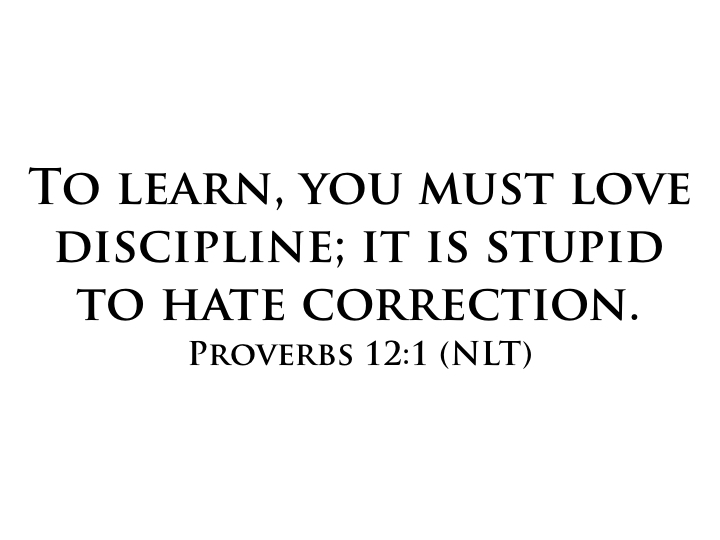
Pastor Josh Schram shared with us the lessons he’s appreciated about receiving wise counsel from those around him. One of Josh’s opening remarks really hit home with me, because it’s something I still struggle with at times: I have to get beyond thinking that those who are trying to speak into my life are somehow trying to meddle in my life!
A couple of other thoughts that really made me pause and reflect were—
“Ignorance may be bliss, but it won’t last.” How true! I may cover my eyes and ears to the truth, but my ignorance will ultimately lead to my downfall.
“People who will speak truth into my life care more about me than about my feelings.” As Proverbs says, “Wounds from a friend can be trusted, but an enemy multiplies kisses” (27:6).
Josh closed with these challenging questions:
Am I open to correction from wise counsel?
When I am corrected, do I feel like I must defend myself?
There is perhaps nothing more heart-wrenching for a Christian parent than to see their son or daughter living a life differently than how they were raised.
One biblical promise these parents can claim in prayer is—Train up a child in the way he should go: and when he is old, he will not depart from it (Proverbs 22:6).
He was born in 354 in a North African town set among the woods near the Mediterranean. His father was a pagan, but his mother, Monica, was of devout Christian stock.
Augustine was an undisciplined child, idle and truant despite frequent beatings. He loved sports and pranks and soon discovered a host of adolescent pleasures. … Augustine was also brilliant, and he soon moved to Carthage to further both his studies and his fun. Monica warned him against fornication, but ‘I ran headlong with blindness.’
At about 18 he found himself the father of a son. At the same time he joined a cult. Years passed, and Monica, praying ceaselessly, heard that Augustine was planning to leave Africa for Rome. She begged him not to go. When he refused, she determined to go with him. Using deception, he left her praying in a chapel and sailed without her; but she took a later boat and intercepted him. They traveled to Milan where she persuaded him to listen to the great Bishop Ambrose. The bishop’s razor-sharp sermons penetrated Augustine’s head, if not yet his heart. Monica continued praying, confiding her struggles to Ambrose. He told her not to worry: ‘It isn’t possible for the son of such prayers to be lost.’
One day as Augustine sat in a friend’s garden he heard a child singing, ‘Take up and read!’ He opened the Bible near him and read from Romans 13: ‘Don’t go to wild parties or get drunk or be vulgar or indecent.… Let the Lord Jesus Christ be as near to you as the clothes you wear.’ By the time he finished the sentence, he later said, he was converted. On the eve of Easter, April 24, 387, Augustine and his son Adeodatus were baptized by Ambrose as Monica watched. Her lifetime of prayer was answered, and a church father was born.
Years later as Augustine shared about his conversion in his book Confessions, he wrote out this prayer to God: “My mother, Your faithful servant, wept to You for me, shedding more tears for my spiritual death than others shed for the bodily death of a son. You heard her.”
The Apostle Peter uses an appropriate term for Christians living on Earth: “Aliens and strangers.” This means that those who call Jesus their Lord are to live a counter-cultural lifestyle. Not a lifestyle that changes with the popular culture, but one that stays true to God’s Word.
There probably has never been a more controversial subject in any day or culture than marriage and the relationship between the sexes. Why are these terms “controversial”? I suspect it is because we are naturally bent toward being pragmatic people.
In pragmatism, the outcome determines meaning. If I find something easy to do, convenient for me, and I seem to get applause from those around me, then what I did must be right. However, if it’s challenging to stick with something, and seemingly only a few people approve of how I do it, then it must be wrong. That is letting culture determine morality, instead of letting God determine it.
As Peter begins to address the topic of marriage, and the interaction between spouses, he uses two similar phrases—“Wives, in the same way … Husbands, in the same way (vv. 1, 7).”
In the same way as what? Actually, if you look at the five verses that come before this you will see that it’s not what but Whom. Those verses are talking about our example in Jesus. Peter points out that Jesus showed:
submission to God’s purpose—His prayer was, “Not My will, but Yours be done.”
longsuffering—He did not retaliate nor threaten His persecutors, but for the joy set before Him, He endured the shame of the Cross.
servant-leadership—At the last meal He had with His followers before being crucified, He washed their feet, and told them He had given them an example of how they were to serve others.
respectful behavior—Jesus willingly suffered the penalty for the world’s sin. He fulfilled the prophecy of Isaiah which said He remained silent before His accusers.
mercy—This always means not getting the penalty we deserve. Jesus came to save us when we were the least worthy of His love.
forgiveness—As the spikes were being driven through His wrists, Jesus said, “Father, forgive them for they don’t know what they’re doing.”
Pragmatism looks at God’s design and says, “Yes, I understand that, but….” Pragmatism tries to find an “out” or a “loophole” that let’s someone change a definition or skip out on doing something God’s way.
If anyone ever had the authority to say, “Yes, Father, I know what You want Me to do, but look how they’re treating Me” it was Jesus.
A wife with a difficult husband may want to say, “Yes, I know I’m supposed to submit to my husband, but….” A husband with a nagging wife may say, “Yes, I know I’m supposed to treat my wife with consideration and respect, but….”
But Peter says, “Wives and husbands, exhibit the same submission, longsuffering, servant-leadership, respectful behavior, mercy and forgiveness toward your spouse as Jesus exhibited toward you!”
So the question we need to ask is: Am I thinking about marriage—a husband’s role, a wife’s role—in counter-cultural biblical terms or in popular cultural terms?
If I find I am thinking culture’s thoughts, am I willing to try God’s way?
It’s no secret that being tired can lead to a lot of not-so-nice consequences. Everything from automobile crashes, to poor work performance, to foot-in-mouth statements, to giving in to temptations, to health issues are all traced back to not getting enough peaceful sleep.
But did you know that sweet sleep is something God wants to give you?
Psalm 127 says, “God grants sleep to those He loves.” Guess what? God loves you, and wants you to have a peaceful night’s sleep!
Here are some benefits to getting solid sack time:
Muscles are repaired—the body “turns off” muscles during sleep so they can repair themselves.
The hormone leptin, that regulates your appetite, is adjusted.
Your blood pressure is lowered.
Your heart rate is lowered.
The energy-producing cells we all need are restocked.
Your immune system is re-energized.
Memories are consolidated from short-term memory banks to long-term memories.
The hormones that allow you to concentrate are replenished.
Your “database” of decision-making options is re-calibrated.
Bottom line—you get healthier physically, mentally, emotionally, relationally, and spiritually.
All of this God wants to give to those He loves. “God loves me, so I’m going to sleep peacefully tonight!”
The problem is we often sabotage God’s blessing of sweet sleep by our own poor decisions during the day. So here are seven things you can do to cooperate with God’s blessing of sleep:
Reduce stress. Stress causes your body to release cortisol, which prepares your body for fight-or-flight. This means when you’re trying to quiet down for the night, your body is still screaming, “Go, go go!” Stress is mainly triggered by worrying over things outside of our control, so check out what Jesus said to us about not worrying—Matthew 6:25-34.
Reduce late-day caffeine. Caffeine has a half-life of six hours, so if you are pouring it into your body late in the date, you might fall into bed exhausted but the caffeine is keeping your brain buzzing. As a result, you don’t have the normal deep sleep patterns.
Eliminate emotional caffeine. Arguments with other people release cortisol and adrenaline in your bloodstream. If these disagreements are happening later in the day, your body is fighting against God’s plan for your tranquil sleep. So take care of any disagreements quickly (Ephesians 4:26).
Exercise. Getting some movement into your daily routine flushes cortisol and adrenaline from your bloodstream.
Go to bed and get up at the same time. There’s a reason God made the sun to rise and set at predictable times. Your body also functions best on a predictable schedule.
Reduce “blue lights” close to bed time. The blue light waves of dawn tell our bodies to stop releasing melatonin, the sleepy hormone. The red light waves of dusk tell our bodies to increase melatonin so we can go to sleep. But when we’re staring into the blue light of our phones and tablets, our body is being sent a conflicting signal.
Pray. Two great passages you can pray before bedtime are Psalm 4:8 and Proverbs 3:24. Claim those promises of sweet sleep!
God loves you. He wants to give you the blessing of peaceful sleep. If you’re going to sleep peacefully tonight, make sure you are not sabotaging what God wants to give you.
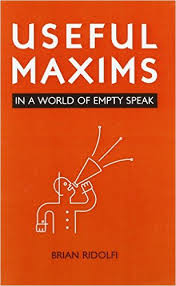
I thoroughly enjoyed reading Useful Maxims by Brian Ridolfi (check out my review of his book by clicking here). Here are 20 of Brian’s useful maxims that caught my highlighter.
Going to church is good; going to God is better.
Progress is not good if you are progressing in the wrong direction.
Good demeanor does not validate bad behavior.
Broken commandments break down integrity.
The Bible’s meaning is not hidden from men; men hide from its meaning.
Actions are better indicators of character than rhetoric.
The indifferent make no difference.
Remaining weak takes strength. It takes power not to use power.
Great men step in when everyone else steps out.
Moral arguments which are entirely material are entirely immaterial.
Peacemakers and saltshakers dispense enrichment.
A grudge will keep you deep in sludge. Points of contention are points of retention.
Revenge is hard to reverse.
Never put faith in people who have no faith.
Everything goes when anything goes.
Your sin is not just your problem.
Parental neglect prompts government parenting.
Where no one fears God, everyone fears man.
The right battle is lost with the wrong weapon.
Insecurity secures instability.
Watch for more maxims soon. Or follow me on Twitter and Tumblr to read some of Brian Ridolfi’s maxims.
One day a little girl was sitting and watching her mother do the dishes at the kitchen sink. She suddenly noticed that her mother has several strands of white hair sticking out in contrast on her brunette head. She looked at her mother and inquisitively asked, “Momma, why are some of your hairs white?” Spotting a teachable moment, her mother replied, “Well, every time that you do something wrong and make me cry or unhappy, one of my hairs turns white.” The little girl thought about this revelation for while and then asked, “Momma, how come all of grandma’s hairs are white?”
Mom, you have earned every one of those gray hairs or wrinkles through your loving care for us!
Gray hair is a mark of distinction, the award for a God-loyal life. (Proverbs 16:3)
The glory of the young is their strength; the gray hair of experience is the splendor of the old. (Proverbs 20:29)
Mom, your love for us can be summed up in one verse—Love always protects, always trusts, always hopes, always perseveres. (1 Corinthians 13:7)
And the Apostle Paul’s words to a young preacher are just as true for Moms as they were for Timothy: Keep a close watch on how you live and on your teaching. Stay true to what is right for the sake of your own salvation and the salvation of those who hear you. (1 Timothy 4:16)
Don’t give up, Mom! You need to persevere so that when you have done the will of God, you will receive what He has promised. (Hebrews 10:36)
What has God promised you about your family? Has He said your whole family will call on Jesus as their Savior? Then persevere in that. Has He said that your prodigal child will come home? Then persevere in that. Despite the odds, despite the obstacles, despite the setbacks, keep on loving them and praying for them. It IS making a difference!
Here’s an encouraging biblical example of a little-known Mom’s prayerful influence on a son that is listed in the genealogy of Jesus Christ…
This is a weekly series with things I’m reading and pondering from Oswald Chambers. You can read the original seed thought here, or type “Thursdays With Oswald” in the search box to read more entries.
The Power Of Your “Say So”
Many of us are on the verge of a spiritual vision the realization of which never becomes ours because we will not open our mouths to “say so.” We have to “say so” before we “feel so.” … If I will not confess with my mouth what I believe in my heart, that particular phase of believing will never be mine actually. Assurance of faith is never gained by reserve but only by abandonment.
If you want to encourage your own life in spiritual things, talk about them. … If you have not received, ask; if you have not found, seek; if the door is shut, knock. When you are up against the barriers, the way out is to “say so,” then you will be emancipated, and your “say so” will not only be an emancipation for yourself, but someone else will enter into the light.
From The Place Of Help
Oswald Chambers is urging Christians to not just believe what they believe, but saywhat they believe. Say it out loud!
For the accuser of our brothers and sisters, who accuses them before our God day and night, has been hurled down. They triumphed over him by the blood of the Lamb and by the word of their testimony… (Revelation 12:10-11).
O give thanks to the Lord, for He is good; for His compassion and lovingkindness endure forever! Let the redeemed of the Lord say so… (Psalm 107:1-2).
You need to hear your “say so” in your own ears to energize your faith. The enemy needs to hear your “say so” to defeat him. Others in need around you need to hear your “say so” to encourage them.
Don’t keep quiet! “Assurance of faith is never gained by reserve but only by abandonment.” Abandon your reserve and “say so” for all to hear!
Last week I spoke and wrote about some tools you might use to study your Bible. Now I’d like to share some Bible study projects you might try with those new tools. As always, I recommend that beginning Bible studies go verse by verse through the Bible. I believe you will lay a strong foundation for your faith when you systematically put God’s Word into your heart.
Book By Book
I’ll use the book of Ephesians as an example. Using my Bible atlas I find that the city of Ephesus is located along an important trade route, and it is the Roman capital of the province of Asia. My Full Life Study Bible tells me that because so much trade passed through this city, this letter was probably intended to be a circular letter for all of the communities near Ephesus. As a result, Paul is not addressing any specific problems in this church, but writes theological ideas for a broad spectrum of people.
As I begin reading, I paused in the first verse when I came to the phrase “the faithful in Christ.” I asked myself, “What does it mean to be faithful IN Christ? Can I be faithful outside of Him?” By the time I got to verse 3, I saw a similar phrase: “every spiritual blessing in Christ.” Now I went back and used a blue highlighter (there’s nothing special about blue, it just happened to be the first highlighter I grabbed), and marked those two “in Christ” phrases. I see two more in verse 4: “He chose us in Him” and “holy and blameless in His sight.” Going through the whole book I discovered 36 times the phrases “in Christ” or “in Him.” This is helpful to me to know the kind of security I have in Jesus.
Another thing that stood out to me were Paul’s prayers for the church. I see His very moving prayers in passages like 1:15-19 and in 3:14-21. I also see in 6:18 that he tells us to pray all kinds of prayers for ourselves and for others. And I see in 6:19 that Paul asked the church to pray for him too.
And always look for “therefore” phrases. For example in 4:24-25 or 4:32-5:1. The “therefore” phrases tell us how to live or think in light of the ideas that were just shared.
Chapter By Chapter
A good place to do this is in the Psalms or Proverbs. These are usually stand-alone chapters. When reading the chapters in these two books, I love reading them in parallel with other translations. For example, check out this from Psalm 1.
In Psalm 59, notice the superscript (or introduction). This gives us some background information to the psalm. Using my concordance, I found that this psalm was written this time in David’s life.
There is usually a theme to each chapter of the Proverbs, so try to discover that. In Proverbs 2, I noticed the “if … then” statements. In the first four verses I see things like “IF you will seek wisdom like this,” and then in verses 5-22 I see a whole bunch of blessings that follow the “then” that starts verse 5.
Word By Word
Sometimes I like to go really deep in a passage, so I slow down and look at it word by word. Here you need to use a Strong’s Concordance of the Bible. I like the one available on Blue Letter Bible. For example, next to 2 Peter 1:5, you can hover over the word “Tools” and select “Interlinear.” Clicking on “Interlinear” you will see all of the Greek words that make up this verse. By clicking on the Strong’s number, you can see the definition of that Greek word. Scrolling down a bit, you can see all of the other verses where that Greek word is used in the New Testament.
In this video I go into more detail on how I undertake all of these Bible studies. And be sure to join us next week as we take another look at different types of Bible studies.
I love technology! I love how social media and my iPhone can keep me in touch with family and friends. But one of the dark sides to this easy access to technology is the ease with which people can gossip—or even slander!—people publicly online. In his book #struggles, Craig Groeschel has some good counsel for avoiding gossip.
“God is crystal clear on how He feels about gossip. Solomon said, ‘There are six things the Lord hates, seven that are detestable to Him…a false witness who pours out lies and a person who stirs up conflict in the community’ (Proverbs 6:16, 19). What a perfect way to describe a gossip: ‘A false witness who pours out lies,’ and someone who ‘stirs up conflict in the community.’ God hates that.”
“The people being gossiped about hate it, and God hates it. So before you post, comment, or link, consider three sets of questions to keep yourself gossip-free online.
Is what I’m about to say helpful or hurtful? Will this build others up or tear them down? What’s my intention behind what I’m about to type? [Ephesians 4:29]
Am I making private matters public? Am I about to share something that would be better handled privately? [Proverbs 11:12-13]
Am I permitting—maybe even encouraging—others to gossip? It’s not only wrong to dish it out; it’s also wrong to eat it up. Notice that this verse [Proverbs 17:4] doesn’t say that only gossipers are wrongdoers. No, it says wrongdoers are also those who ‘listen to gossip.’ It’s not just wrong to spread gossip; it’s wrong to consume it. Why? Because what you permit, you promote.”
You can read my review of #struggles by clicking here. I have also posted other quotes from this book here and here.