Listen to the podcast of this post by clicking on the player below, and you can also subscribe on Apple, Spotify, or Audible. Check out the video content in this post by clicking here.
This may be the single most well-known word in the world!
Listen to the podcast of this post by clicking on the player below, and you can also subscribe on Apple, Spotify, or Audible.
Discussions about end times events and thoughts about the Second Coming of Jesus are sure to make some people uneasy. Even Christians can feel a little uncertain over the details of this topic.
This isn’t anything new. In the first century, the apostle Paul was already writing about this to the saints, particularly in his two letters to the church at Thessalonica. Paul wants to bring us reassurance about God’s resolute plan, and he also wants to reassure any fearful hearts.
In 2 Thessalonians, I see two little words that Paul uses to give us both certainty and security—those words are “the” and “our.” Paul especially uses these words when he mentions the Father, the Son, and the Spirit.
The definite article “the” distinguishes the True and the Authentic from the deception that the antichrist will bring. The “the” tells us that there is only One that is certain.
Think of it this way: If I tell you that some supplies I brought for you are in my car, I can give you the one and only car to go to. You don’t have to check just any car in the parking lot, but you have one certain car—the car—that can supply your needs. This is what we have in our Savior Jesus.
I shared more details about this in an exclusive 5-minute video for my Patreon supporters. You can become a supporter and get access to all of my exclusive content by clicking here.
The pronoun “our” then assures us of the security we have in our relationship with God. Much like Jesus taught us to pray “Our Father” we can feel comforted in knowing the assurance the Holy Spirit gives us that the Savior has opened the way for us to come to the Father—to our Heavenly Father!
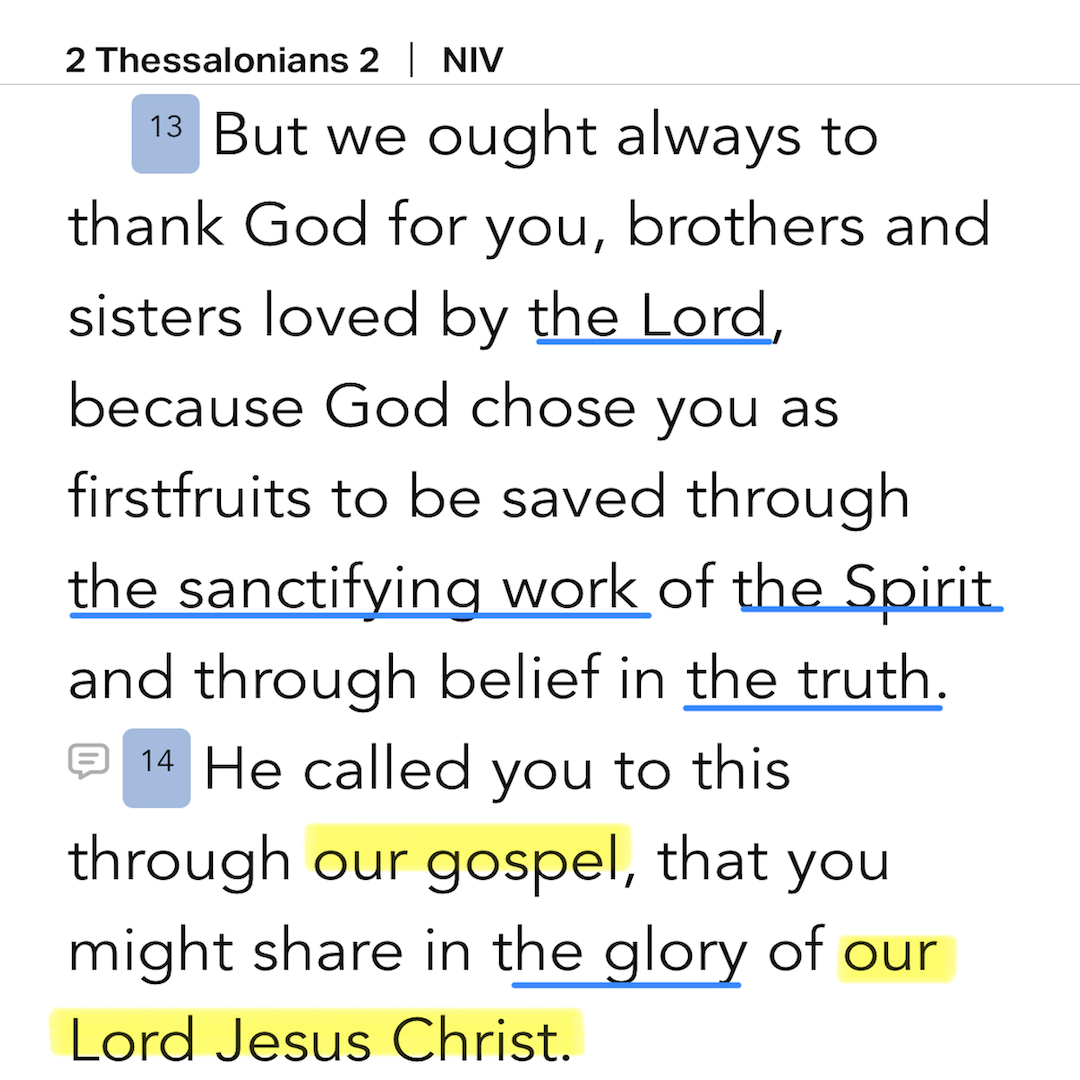
Check out both of these powerful little words in this passage—
But we ought always to thank God for you, brothers and sisters loved bytheLord, because God chose you as firstfruits to be saved throughthesanctifying work oftheSpirit and through belief in thetruth. He called you to this through ourgospel, that you might share in theglory of ourLord Jesus Christ. (2 Thessalonians 2:13-14)
“The” gives us certainty and “our” gives us security to know that we are lovingly held in God’s hands—held securely for all of eternity.
Listen to the podcast of this post by clicking on the player below, and you can also subscribe on Apple, Spotify, or Audible.
Esther was unsure if Xerxes would extend favor to her, but God is already extending His favor to you even before you approach Him. He wants to turn your grief into joy.
Let your grief be a time you press into God’s presence. Like Esther taking her grief and her petition into the king’s presence, take your grief into the presence of King of kings.
It is His word: “No word from God will ever fail.” It is not the way I desire it to be, or the way culture wants it to be, but it is the way the All-Loving, All-Powerful One has already determined it is going to be.
God’s words never fail, but they always prevail. It doesn’t matter how dark, hopeless, or even impossible it may seem, His plan always triumphs!
When I have God’s word on it, I can confidently say, “Worry, be gone! Striving, cease! Doubt, you are a liar! I belong to the One who has spoken His word. I will rest assured in Him until His word prevails. I say as Mary replied to Gabriel, ‘May it be to me as you have said’” (Luke 1:38).
Listen to the podcast of this post by clicking on the player below, and you can also subscribe on Apple, Spotify, or Audible.
When Luke says first that “Jesus grew in wisdom,” that is our indication that a healthy mind is at the foundation for every other aspect of health (Luke 2:52). We don’t see Jesus anxious or worried, we don’t see Him confused in His thinking, or even indecisive of what to say or do. So by studying the life of Jesus—and the Scriptures on which He relied—we, too, can improve our mental health.
This may sound unbelievable when you first read this, but I believe that at their foundation, anxiety and assurance are remarkably similar. The similarity is that they both have faith.
The dictionary defines faith as a strong or unshakeable belief in something. The biblical definition of faith is remarkably similar: “Faith is confidence in what we hope for and assurance about what we do not see” (Hebrews 11:1).
Using those definitions of faith, let me point out the similarity and the difference between the anxious mind and the assured mind:
Anxiety is faith or expectation that something bad is going to happen.
Assurance is faith or expectation that something good is going to happen.
But the biggest difference of all is seen in the mental health of the one worried and anxious about the bad things that are coming versus the one who is confidently assured of the good things that are coming.
If we are going to be mentally healthy people, we need to shift our faith from anxiety to assurance every single time we feel the worry building in our hearts. This isn’t just changing our mindset but knowing what we believe and why we believe it.
Assurance and anxiety both believe in the unseen. The assured person believes in God’s promises to provide all that we need, while the anxious person doubts their own abilities and resources will be able to sustain them.
As a result, the assured person has an abundance mindset, while the anxious person has a scarcity mindset.
These feelings can be traced back to our faith about the origins of the universe. The assured person believes that God transcends this universe—that He existed before time began and spoke all created things into existence (Hebrews 11:3). But the anxious person is still trying to find answers in constantly-changing theories about the universe’s beginning.
Finally, the person who sees the universe and their own life as accidental becomes quite anxious and uneasy when they think about death, and what may or may not come on the other side. But the one who trusts God as their Creator is confident that God is their eternal reward (Hebrews 11:6).
Hebrews 11 is filled with the accounts of assured people who shifted their faith away from anxiety—believing something bad was going to happen—to the assurance that God was bringing about something incredibly good! Hebrews 12 then invites Christians today to remember that cloud of witnesses and keep our eyes on Jesus, who is described as the Author and Perfecter of our faith, so that we don’t lose hope (Hebrews 12:1-3).
I’ve previously shared seven strategies for a Christian to maintain a strong mental health. Our eighth strategy is a constant shifting of our faith away from anxiety to assurance. Every single time an anxious thought tempts us to believe something bad is coming, we need to make a shift toward the assurance of God’s goodness.
Really quickly, here is how we can use the first seven strategies to help us make that shift:
Pray for the Holy Spirit to help you make a new path.
Notice your fearful or anxious words and pull them out by the root.
Confront the thought patterns that are causing fear or anxiety.
Talk back to those fearful thoughts with the truth from God’s Word.
Check the inputs that may be causing fear (poor diet, not taking time for solitude, anxious friends, etc.).
Focus on today—I like the words of the song “strength for today and bright hope for tomorrow!”
Don’t look to escape, but take time to de-escalate.
Listen to the podcast of this post by clicking on the player below, and you can also subscribe on Apple, Spotify, or Audible.
When we hear the word “if” we hear something that is uncertain: “If only I get that job” or “If I have enough money at the end of the month” or “If we get there in enough time.”
The dictionary tells us “if” has an element of uncertainty. Like when King George III said of George Washington’s decision to step down as the president, “If he does that, he will be the greatest man in the world.”
Sometimes we think of “if” as a condition to receive some sort of award or recognition. Like Rudyard Kipling’s famous poem If—
If you can keep your head when all about you are losing theirs and blaming it on you … [then] Yours is the Earth and everything that’s in it, and—which is more—you’ll be a Man, my son!
We need to be careful of those paradigms when we come to the next song of ascent in Psalm 124, since the word “if” appears twice in the opening two verses.
David is not saying, “Weren’t we lucky that God was there for us” or “I wonder if He will be for us again in the future.” I like how the New Living Translation renders this verse: “What if the Lord had not been on our side?” In other words, He was on our side, therefore look what we avoided!
Far from being a statement of uncertainty, this is a statement of total assurance: It’s saying, “I’m confident of what would have happened if God wasn’t there, and I’m assured of what will happen in the future.” This is why in the next verses David calls on us to praise God in the present tense.
Every one of these songs of ascent can be sung as stand-alone songs, but the Jewish sages believed that these 15 songs are like the 15 steps that go up to the center of the courtyard. No one climbs the steps from their basement, stops after three or four steps, and says, “I was lucky that the first steps held me! Now I’m wondering if the next step is going to fail me or not.” No, the fact that we have already climbed some steps gives us assurance of the stability of the next step.
Look at a quick review of the previous steps:
in Psalm 120 pilgrims climb away from the pull of the dark valleys
in Psalm 121 we read the phrase, “I lift my eyes up to the One who is watching over me”
in Psalm 122 we climb the steps knowing that we aren’t climbing to a throne of judgment but a throne of shalom because of the peace Jesus purchased for us
in Psalm 123 we are called to only have eyes for our Savior who has lavished His grace on us, and who continues to lavish His grace on us
now in Psalm 124 we continue to climb up in growing assurance
The devil loves to use “if” as a weapon to keep us from this confidence. Perhaps the doubt comes like this, “This song was written by David. If I’m not King David—or even a part of the Jewish nation—can I be assured that God is on my side?”
Or perhaps the devil’s doubt comes like this, “If I sin, will God no longer be on my side?”
No, neither our efforts nor our shortcomings increase nor decrease God’s love for us. He loved us before we even knew we needed Him, and our sin cannot diminish His love one iota (Romans 5:20-21; 2 Corinthians 5:21; Ephesians 2:4-5).
When the devil confronted Jesus, he used that little weapon “if” with all three of his temptations. Jesus dismantled those temptations to doubt God by quoting Scripture. So too with Joshua. As he contemplated leading the Israelites into the Promised Land, he may have felt a bit insecure. God told Joshua to continue to meditate on His Word and as a result, Joshua would be strong and courageous.
David’s closing words in Psalm 124:8 is the Source of our doubt-destroying confidence: “Our help is in the name of the Lord, the Maker of heaven and earth!”
Whenever the devil plagues you with doubts, keep your eyes on your Maker, keep His Word in your mouth, and then feel His confidence grow in your heart.
Listen to the podcast of this post by clicking on the player below, and you can also subscribe on Apple, Spotify, or Audible.
As Jesus headed towards Jerusalem, Mark records, “with Jesus leading the way” (Mark 10:32).
The Greek word for “lead” is proago. The prefix pro- means before or in front, and the root word -ago means to lead oneself, to lead by accompanying, or to lead by taking hold. This means that Jesus never sends us off by ourselves. He goes before us, with us, alongside us.
One would think that this would give the disciples great comfort. But Mark also records two unexpected responses from these men: “astonished” and “afraid.”
The words “astonished” or “amazed” are both the same word in Greek and are used both here and just a couple of verses earlier (verse 24), when Jesus said how hard it was for a rich person to enter into the kingdom of God. That statement amazed the disciples. Now they are astonished that Jesus is going to Jerusalem. “After all,” they might be thinking, “That’s where His main antagonists are headquartered! Why would He go there?”
It appears that the father they went on their journey, the more their astonishment morphed into fear. The Greek word here is the one for which we get the word “phobia”—the kind of fear that can paralyze us or tempt us to run away.
There are two things that Jesus does here to help His fearful friends:
(1) He gives them the unvarnished facts: “We are going up to Jerusalem…and the Son of Man will be delivered over to the chief priests and the teachers of the law. They will condemn Him to death and will hand Him over to the Gentiles, who will mock Him and spit on Him, flog Him and kill Him….”
Leaders who want to honor Jesus in their leadership would do well to follow this example—Give your fearful friends both the facts (no matter how painful they might seem) and the unshakable hope that God is sovereignly in control.
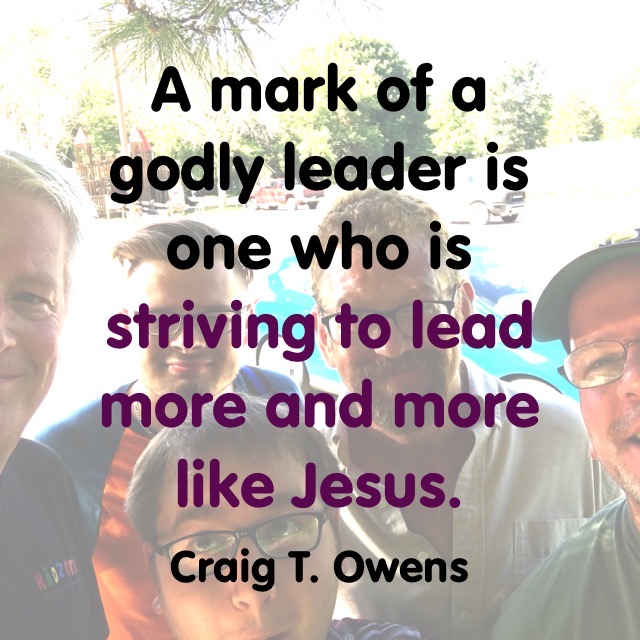
A mark of a godly leader is one who is striving to lead more and more like Jesus.
Let’s keep studying His life and allowing the Holy Spirit to teach us the lessons we can apply in our leadership roles.
This is part 70 in my series on godly leadership. You can check out all of my posts in this series by clicking here.
This is a weekly series with things I’m reading and pondering from Charles Spurgeon. You can read the original seed thought here, or type “Thursdays With Spurgeon” in the search box to read more entries.
Listen to the podcast of this post by clicking on the player below, and you can also subscribe on iTunes or Spotify.
The Assurance Of God’s Love
Tell me, O you whom I love, where you feed your flock, where you make it rest at noon. For why should I be as one who veils herself by the flocks of your companions? (Song of Solomon 1:7)
It is well to be able to call the Lord Jesus Christ by this name without an ‘if’ or a ‘but.’ A very large proportion of Christian people can only say of Christ that they hope they love Him. They trust they love Him, but this is a very poor and shallow experience to be content to stay here. It seems to me that no one ought to give any rest to his spirit till he feels quite sure about a matter of such a vital importance. We are not content to have a hope of the love of our parents, or of our spouse, or of our children! We feel we must be certain there. And we are not to be satisfied with a hope that Christ loves us and with a bare trust that we love Him. …
‘I know whom I have believed,’ says Paul (2 Timothy 1:12). ‘I know that my Redeemer lives,’ says Job (Job 19:25). ‘You whom I love,’ says Solomon in the Song as we have it here. Learn, dear friends, to get that positive knowledge of your love to Jesus, and be not satisfied till you can talk about your interest in Him as a reality that you have made infallibly sure by having received the witness of the Holy Spirit and His seal upon your soul by faith that you are born of God and belong to Christ. …
Why do we love Jesus? We have the best of answers: because He first loved us! … Why do we love Him? Because before this round earth was fashioned between the palms of the great Creator, before He had painted the rainbow or hung out the lights of the sun and moon, Christ’s delights were with us. He foresaw us through the glass of His prescience. He knew what we should be….
From The Church’s Love To Her Loving Lord
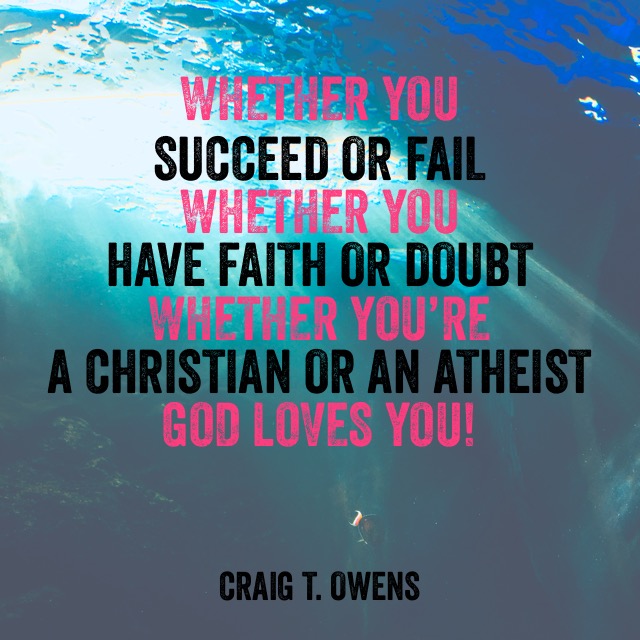
God wants you to know how much He loves you. He went first because we didn’t have any way to approach Him. But Jesus made it possible for us to come close to God through His substitutionary death on the Cross for our sins. And now the Holy Spirit is speaking clearly to your heart to trust that this is absolutely, irrevocably true: GOD LOVES YOU!
As Spurgeon said, don’t be content with merely thinking this is true, but ask the Holy Spirit to help you know this is true!
Listen to these words—This is how God showed His love among us: He sent His one and only Son into the world that we might live through Him. … This is how we know that we live in Him and He in us: He has given us of His Spirit. And we have seen and testify that the Father has sent His Son to be the Savior of the world. … We love because He first loved us. (1 John 4:9, 13-14, 19)
Listen to the podcast of this post by clicking on the player below, and you can also subscribe on Apple, Spotify, or Audible.
How many are Your works, O Lord! In wisdom You made them all; the earth is full of Your creatures. There is the sea, vast and spacious, teeming with creatures beyond number—living things both large and small. (Psalm 104:24-25)
This psalm makes me want to go on a nature walk!
The psalmist is in awe of the Creator’s handiwork—from the majestic sun and moon, to the smallest of creatures, God created them and sustains them all.
God set the earth on its foundations; it can never be moved.… He makes springs pour water into the ravines; it flows between the mountains. They give water to all the beasts of the field; the wild donkeys quench their thirst. The birds of the air nest by the waters; they sing among the branches. He waters the mountains from His upper chambers; the earth is satisfied by the fruit of His work. He makes grass grow for the cattle, and plants for man to cultivate—bringing forth food from the earth. … The moon marks off the seasons, and the sun knows when to go down. … The lions roar for their prey and seek their food from God. … These all look to You to give them their food at the proper time. When You give it to them, they gather it up; when You open Your hand, they are satisfied with good things.
Take a walk. See God’s beauty.
Listen to the wind, the birds, the lions.
Taste the food from the soil and the trees.
Feel the coolness of the water, the warmth of the sun, the invigoration of the breeze.
Smell the flowers, the soil, the sea air.
And then as you take all of these in, remind yourself: “If God cares for the fields, if He sees the smallest sparrow, how much more does He care for me!”
Jesus told us much the same thing—
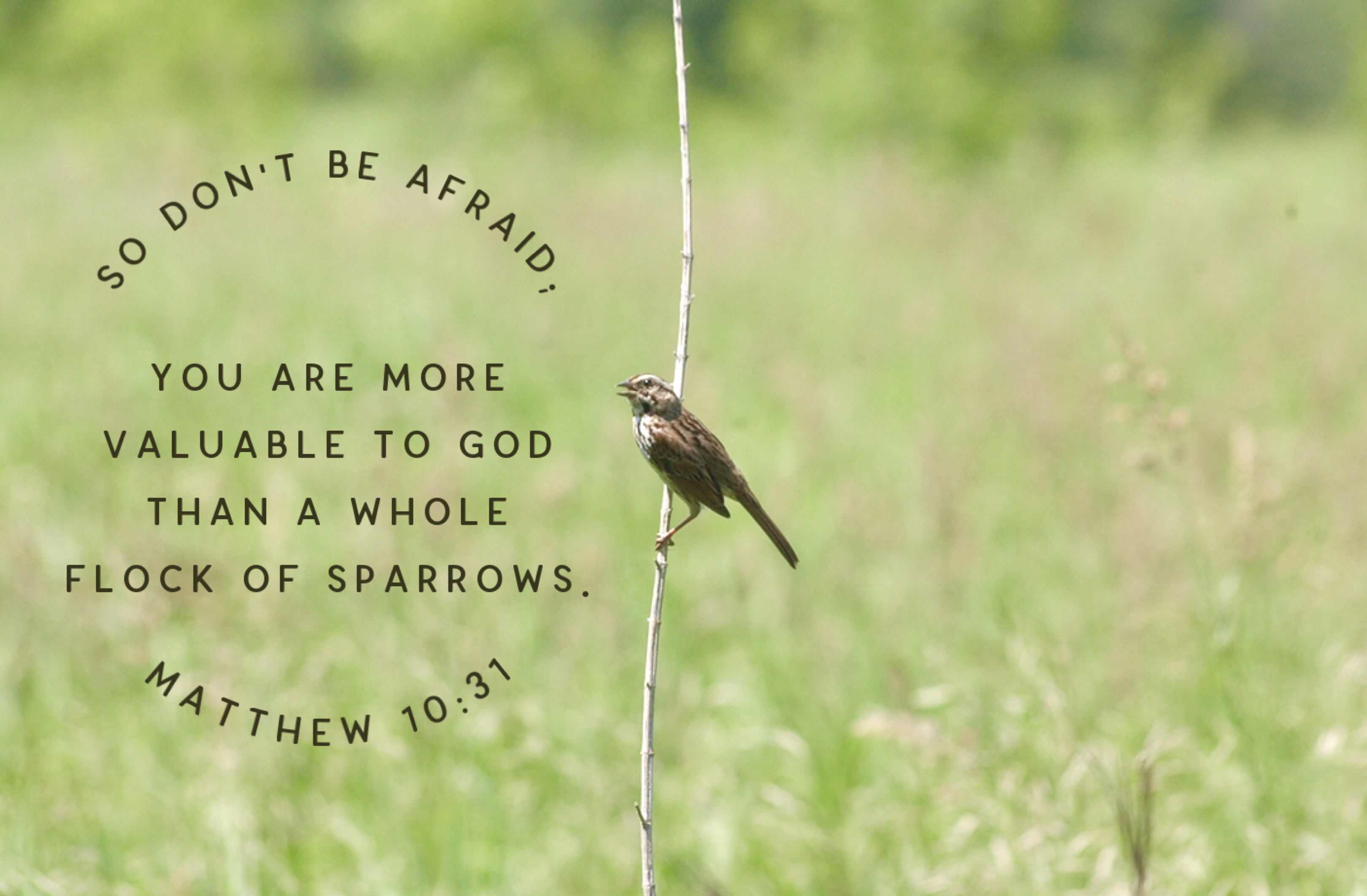
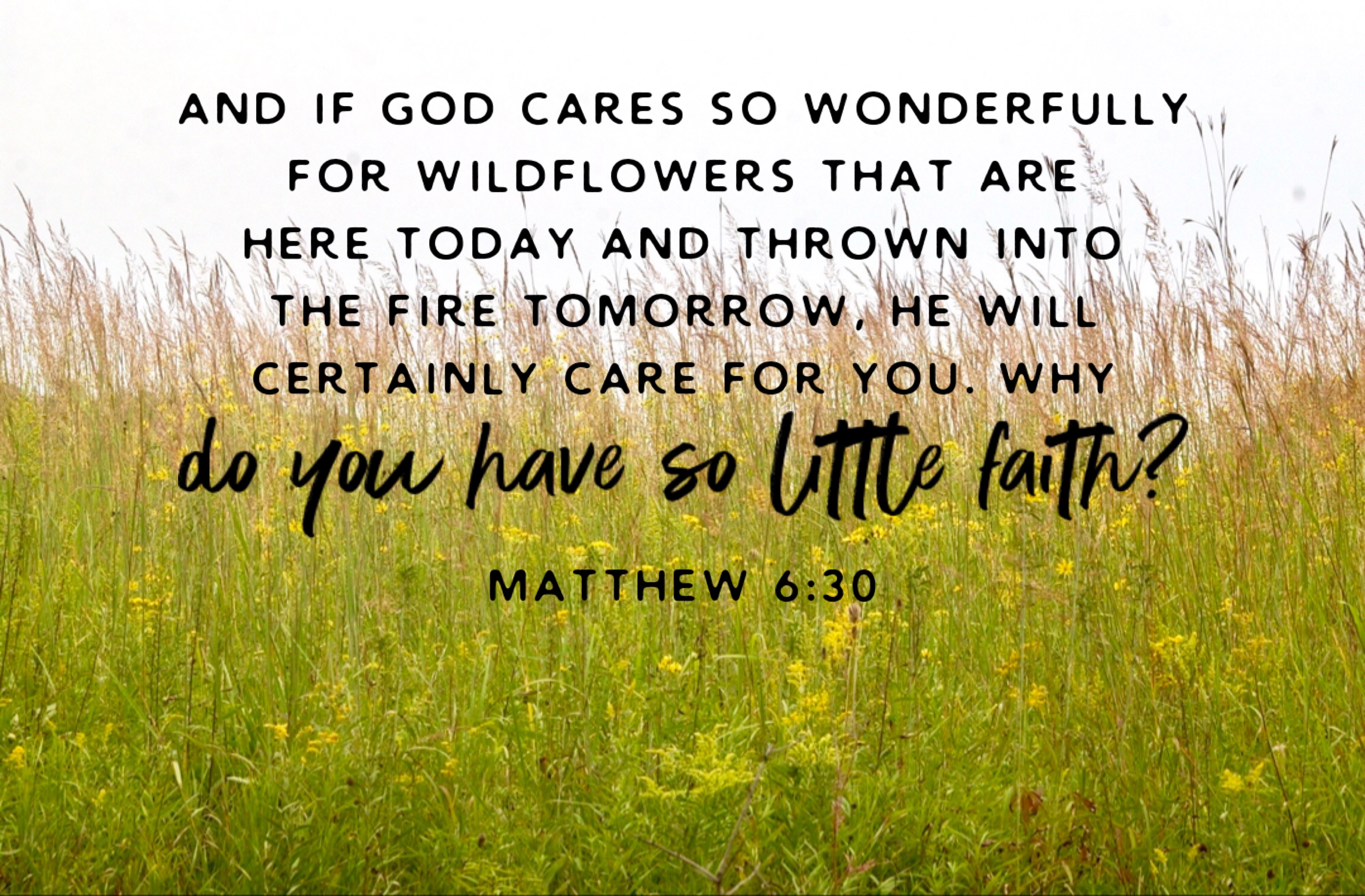
Look at the birds of the air; they do not sow or reap or store away in barns, and yet your Heavenly Father feeds them. Are you not much more valuable than they? … See how the lilies of the field grow. They do not labor or spin. Yet I tell you that not even Solomon in all his splendor was dressed like one of these. If that is how God clothes the grass of the field, which is here today and tomorrow is thrown into the fire, will He not much more clothe you? … Are not two sparrows sold for a penny? Yet not one of them will fall to the ground apart from the will of your Father. And even the very hairs of your head are all numbered. So don’t be afraid; you are worth more than many sparrows. … Your Father knows what you need before you ask Him. (Matthew 6:8, 26, 28-30; 10:29-31)
My friend, the next time you need reassurance of God’s love for you, I invite you to take a nature walk and let the beauty of the Creator fill you with confidence of His love for you and His power to care for your every need!



 Amen means: God’s Word is true, so we can stand on God’s Word; we can live in God’s Word; we can expect God’s promises!