11 More Quotes From “Cherish”

Gary Thomas calls on husbands to not just love their wives, but to cherish them. It’s an admirable goal for all married men! Please check out my review of Cherish by clicking here. Below are a few more quotes I especially liked.

“Never forget: You married a spouse with natural weaknesses. You married a spouse with a history of hurt. We can be agents of healing redemption and acceptance in our marriage, or we can do further harm, perhaps unintentionally.”

“Of course, there’s no promise that if you persevere, you’ll get just what you’re hoping for. But the one certainty is that if you give up, you definitely won’t get it.”

“Every conversation—every one!—takes you closer to or farther away from a cherishing marriage. The Bible declares this truth: ‘The tongue has the power of life and death’ (Proverbs 18:21).”

“If we want our spouses to feel cherished, we may have to work at a few things we’re not so good at by nature.”

“Pam Farrel writes in several of her books that a wife often feels most loved when her husband is simply more curious about her. … It’s not enough to simply listen. We have to take the next step, engage, and go even further to say, ‘I want more. Tell me more.’ We have to maintain our curiosity. … Husbands, cherishing often isn’t about what your wife is saying; it’s about who is saying it.”

“Silence is often unintentionally malicious, so try to verbalize every positive thing you can think of.”

“A joyful person walking in grace and hope can cherish much more than one who is tangled up in the guilt that Christ died to remove. Our guilt serves no one. In Christ, our self-condemnation offends God; it doesn’t please Him. To walk in condemnation is to call God a liar and Christ’s work insufficient. One of the worst sins you can commit as a Christian is to define yourself by your sin. In the same way, one of the worst sins you can commit against your spouse is to always define them by their sin. Biblical marriage is about defining each other as Christ defines us—saved.”

“Your spouse has a unique history, so cherish your spouse by treating them according to their reality: They are living a life that has never been lived before. They have a personality that has never existed before. They have a unique blend of strengths and weaknesses, temptations and gifts, as well as a once-in-the-universe calling. Your role is to help them complete their one-of-a-kind story.”

“Never, ever, get to the point that you expect your spouse to never stumble. Otherwise, you won’t cherish them; you’ll resent them.”

“Stop comparing your spiritual maturity with your spouse’s; instead, start comparing your spiritual maturity with Ephesians 4:1–3. If you do that, you will change the climate of your marriage.”

“When someone pledges to be your spouse, that commitment alone should earn him or her the benefit of the doubt. Even when things may not look the best, seek understanding before you even think about censure. Cherishing our spouses doesn’t mean living in Fantasyland, but it does mean giving our spouses the benefit of the doubt instead of jumping immediately to accusation.”

To read the first set of quotes I shared from Cherish, click here.

How Guys Unintentionally Sabotage Their Relationships

There is a relationship killer that seems to be particularly hard for men. It’s hard because men’s brains are designed in a way that sometimes prohibits them from even seeing this issue.

Bill & Pam Farrel wrote a book called Men Are Like Waffles, Women Are Like Spaghetti. The Farrels identify how men tend to compartmentalize their lives. That is, guys can be so absorbed in one “box” in their life that they are completely oblivious to the other boxes. For instance, when a man is at work he seldom thinks about the other areas of his life (his wife, his kids, the bills that need to be paid, what he’s going to have for lunch).

In addition, men’s brains are also designed to stay in those boxes where things can be quickly fixed. A guy likes fixing things, so the boxes where he can do something and see an immediate result is a box he’s going to keep going back to again and again.

Here’s the trouble… Relationships don’t fit in nice, neat boxes. Neither are relationships something that can be “fixed.” And relationships are never, ever fixed or improved quickly.

So if a guy isn’t aware of these things, he can be unintentionally sabotaging the relationships around him.

King David illustrated this in his unintentional lack of involvement in three of his sons’ lives—

  • Amnon pursued an unhealthy relationship with his step-sister. David got mad but never did anything about it (2 Samuel 13:21).
  • Absalom got revenge for what Amnon did and then fled the country. When David finally allowed him to return to Israel, they never met to resolve what went wrong (2 Samuel 14:28).
  • Adonijah wanted to be king after David, but the Bible says, “His father had never interfered with him by asking, ‘Why do you behave as you do?’” (1 Kings 1:6).

Dave Wills wrote, “We all tend to craft a self-focused view of the world where we emerge as either a hero or a victim in every scene. We’re never the villains in the story. The truth is, though, that we’ve all been the bad guy more often than we’d like to admit. A life of love requires that we look in the mirror and give an honest and humble self-assessment.”

The way to defeat this relationship killer is to become aware of it through humble self-assessment. David learned this truth and shared his prayer with us: “Search me, O God. Show me any areas in my life where I am off-track” (Psalm 139:23-24).

In response to this prayer, the Holy Spirit must have showed David how he had unintentionally starved his relationships with Amnon, Absalom, and Adonijah, because he became highly involved in his son Solomon’s life.

So much so that as Solomon talked to his children about how they should live, he also told them where he had learned how to do this—his father taught him (Proverbs 4:1-4).

Guys, it doesn’t matter how long you’ve been unintentionally in another box. It doesn’t matter how strained the relationship may have become. If you will humbly ask God to search you, reveal to you where you’ve messed up, and ask Him to help you get better … your relationships WILL begin to improve!

Don’t wait another day to pray that “Search me” prayer!

The Power Of Laughter

“Laughter increases the number and activity of some white blood cells called ‘T’ and ‘B’ cells, natural killers that fight viral infections and some types of cancer cells. It multiplies the antibody IgA, which fights upper respiratory tract infections. A hearty chuckle builds up gamma interferon, which stimulates the various components of the immune system.

“Laughing speeds up our heart rate, and some have likened this to ‘internal jogging.’ It’s an aerobic activity that works the diaphragm and increases the body’s ability to use oxygen. That’s why after a big laugh you often feel the need to sigh and take a big breath of air. It sure beats thirty minutes on the treadmill.

“As we laughed, our blood pressure temporarily is elevated; however, that is followed by a prolonged, mild decrease in blood pressure. Laughter also lowers various hormone levels—the kind associated with the fight-or-flight response—and makes us feel less stressed, more relaxed. That’s why people say things like ‘I laughed so hard I couldn’t get up’ or ‘I laughed so hard I fell over.’

“Science is figuring out that laughter is good for the body, something the Bible told us long ago—Proverbs 15:30; Proverbs 17:22.” —Lynn Eib, in Peace In The Face Of Cancer

To read other quotes from this exceptional book, click here and here.

12 Quotes For Mother’s Day

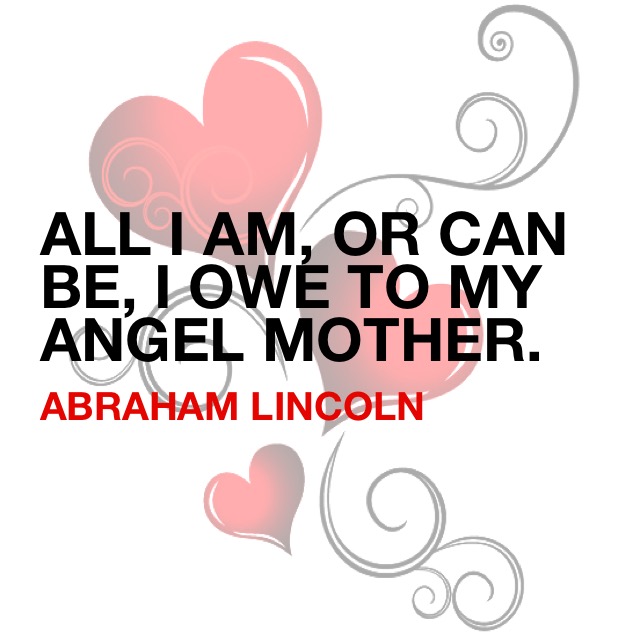
“All I am, or can be, I owe to my angel mother.” —Abraham Lincoln

“My mother was the most beautiful woman I ever saw. All I am I owe to my mother. I attribute all my success in life to the moral, intellectual and physical education I received from her.” —George Washington

“I remember my mother’s prayers and they have always followed me. They have clung to me all my life.” —Abraham Lincoln

“The foundations of national morality must be laid in private families. In vain are schools, academies, and universities, instituted, if loose principles and licentious habits are impressed upon children in their earliest years. The mothers are the earliest and most important instructors of youth.” —John Adams

“The fundamental truths reported in the four gospels as from the lips of Jesus Christ, and that I first heard from the lips of my mother, are settled and fixed moral precepts with me.” —Abraham Lincoln

“The devil never reckons a man to be lost so long as he has a good mother alive. O woman, great is thy power!” ―Charles Spurgeon

“I learned more about Christianity from my mother than from all the theologians in England.” ―John Wesley

“Your motherhood is in God’s sight holier and more blessed than you realize.” —Andrew Murray

“God could not be everywhere, and therefore He made mothers.” —Jewish Proverb

“An ounce of mother is worth a ton of priest.” —Spanish Proverb

“To be a mother is the greatest vocation in the world. No being has a position of such great power and influence. She holds in her hands the destiny of nations, for to her is necessarily committed the making of the nation’s citizens.” —Hannah Whitall Smith

“Youth fades, love droops, the leaves of friendship fall; a mother’s secret hope outlives them all.” —Oliver Wendell Holmes

11 Quotes From “Peace In The Face Of Cancer”

This book is a MUST READ for anyone who has been diagnosed with cancer, or is a caregiver to someone with cancer. Lynn Eib’s Peace In The Face Of Cancer will give you insight and encouragement for your journey. Check out my book review by clicking here, and then enjoy a few quotes below.

“We always want people to give us the benefit of the doubt or cut us some slack, but we have to admit, it’s not always easy to do the same for others—especially when our world as been rocked by something as life-threatening as cancer. Our emotions are fragile, our bodies are hurting, and our spirits can be wounded easily. … Nevertheless, if we want to find peace in the face of cancer, sometimes we will have to hear people’s hearts and ignore their words (and perhaps their actions, too).”

“There is a much more reliable source of truth and good news no matter what you’re facing. I guarantee it has the kinds of hopeful words you will want to reverberate through your brain. That source is the Word of God. (For example: Psalm 119:28; Proverbs 1:33)

“God designed us to need each other and to be able to offer one another our talents, our gifts, our insights, and our special brand of encouragement. Please don’t let those differences become a wedge in your relationships. One of the primary ways satan discourages families and friends facing cancer is to get us at odds with one another. Don’t let that deceiver win.”

“Be a friend. Be a shoulder. Be a hugger. Be an asset. Please just be there and God will be there.

If you do this you will be the giver of the greatest gift a suffering friend needs—presence without fixing; love without an agenda.”

“The most loving thing you may do for your loved one today is to be good to yourself. … Do something to lift your spirits so afterward you can once again lift someone else’s.”

“Please don’t surrender to cancer. Even if it ultimately takes your life or your loved one’s life, you never have to become submissive to it. Cancer is not in charge. Those errant cells are not calling the shots. This disease is not in control. God is.”

“Quit searching for life’s Ctrl+Z button and stop pretending you could be in charge of it all. Go ahead and give up the control stick and declare with the psalmist, ‘My future is in Your hands’ (Psalm 31:15). Trust the only One who is all-knowing, all-seeing, and all-powerful. He will lead you into all your tomorrows.”

“No matter what havoc cancer wreaks on your body, it does not have the final say. Those who have everlasting life never lose their battle with cancer because if God doesn’t take the cancer out of them on earth, He takes them out of the cancer and home to Heaven.” 

“Don’t fix your eyes on what is seen. Don’t fix them on pathology reports or CT scans or bloodwork or insurance bills or cancer statistics or anything else you can see. No matter what this life brings, fix your eyes on what is unseen.”

“Your purpose in life never changes. It is the same whether you or your loved one has a lot of cancer, a little cancer, or even no cancer. Your purpose in life—and mine—is to know God and love Him more, and to help others know God and love Him more.” 

I will be sharing more content from this phenomenal book soon. Stay tuned…

Thursdays With Oswald—Teach Them While They’re Young

Oswald ChambersThis is a weekly series with things I’m reading and pondering from Oswald Chambers. You can read the original seed thought here, or type “Thursdays With Oswald” in the search box to read more entries.

Teach Them While They’re Young

      We need a personal knowledge of God through all our life. The time to discover Him for ourselves is in life’s earliest morning—“that from a child thou hast known the holy Scriptures, which are able to make thee wise unto salvation,” wrote Paul to Timothy (2 Timothy 3:15). “And ye fathers, provoke not your children to wrath: but nurture them in the chastening and admonition of the Lord” (Ephesians 6:4).

     We are so built that in childhood we can more easily come to a knowledge of God in simplicity than in later years. And in those formative years the personal life can be shaped and fitted to God’s standard more surely than later on.

From Shade Of His Hand

At the end of Ecclesiastes, Solomon wrote, “Remember your Creator in the days of your youth, before the days of trouble come” (Ecclesiastes 12:1).

Oswald Chambers notes that parents lay a much stronger foundation for their children’s future spiritual attainment by talking often of the love of God while those children are still young.

Parents—start early, keep at it often, and don’t ever quit telling your children about God’s love. 

These commandments that I give you today are to be on your hearts. Impress them on your children. Talk about them when you sit at home and when you walk along the road, when you lie down and when you get up. Tie them as symbols on your hands and bind them on your foreheads. Write them on the doorframes of your houses and on your gates. (Deuteronomy 6:6-9)

Train up a child in the way he should go: and when he is old, he will not depart from it. (Proverbs 22:6)

[Mom and Dad, be sure to check out Andrew Murray’s exceptional book Raising Your Child To Love God. You can read some quotes from Murray’s book here, and some of his prayers for children here.]

9 Quotes From “Seeing Jesus”

Nancy Guthrie marvelously shows us how Jesus links the Old Testament prophesies with His New Testament activities. This book makes the Old Testament come alive! Check out my full book review by clicking here, and then enjoy a few quotes from this book.

“satan’s power is wielded in the world in the form of death. What gives him that power is sin and the estrangement from God it brings. But on the Cross, Jesus did what was necessary for sinners to be reconciled with God. The devil thought he was defeating Christ, but in reality Christ was reconciling us to God, defeating the devil, and delivering us out of his clutches.”

“It has always been God’s way to use the weak, the foolish, the imperfect—even the shamefully sinful but ultimately repentant—in His redemptive plan. It is His glory to do so, and will be into eternity.”

“God has always wanted His people to know Him—not in a generic or shallow way, but personally, as He truly is. So He revealed Himself in a progressive way, not only through His name, but also through His glorious presence that dwelt in the Temple, through the Law, and through His mighty deeds on behalf of His people. But these revelations all led up to a definitive revelation in the Person of Jesus.”

“Our security in Christ frees us to enjoy His Sabbath rest. Christ fills our hearts with the same love He has for His Father so that we can honor our parents. Christ fills us with His very own faithfulness so that we can live in sexual purity. He convinces us of all that is ours in Him eternally so that we can stop coveting the things other people have that will not last beyond this life. As we refuse to allow anything else to be a god to us; we honor His name, His day, and our parents; as we value life; as we live in sexual purity and fidelity; as we nurture contentment and integrity, we’re not being merely legalistic. The grace of God is at work in our lives, making us holy and happy in God.”

“Jesus was less interested in explaining Himself to Nicodemus than in offering Himself to Nicodemus. … Jesus wanted Nicodemus to understand that we, too, have been bitten—not by a poisonous snake, but by the poison of sin. We, too, need a cure or we face certain death. And just as God provided the cure to His people in the desert, so has He provided a cure to us. But to experience healing requires something of us. We have to look to Jesus.”

“Jesus came into the world to make God knowable so that we can truly love Him with all our hearts, souls, and minds.”

“Jesus came the first time to offer forgiveness rather than bring down fire. He came down the first time to experience the fiery judgment of God in the place of guilty sinners. But the day is coming when Jesus will ‘come with His mighty angels, in flaming fire, bringing judgment on those who don’t know God and those who refuse to obey the Good News of our Lord Jesus’ (2 Thessalonians 1:7-8).”

“Whereas Proverbs describes a way of wisdom that leads to life and to God, Jesus defined that way in much more personal terms. He said, ‘I am the way, the truth, and the life. No one can come to the Father except through Me’ (John 14:6). The decision, as Jesus made clear, is not merely a matter of behavior or companions, but a choice about how we respond to Him, whether or not we will choose Him as our path, our life.”

“The people of Israel had the law; they knew what God wanted from them and for them. But they didn’t have the power or strength to obey. They knew what to do, but they didn’t have the ‘want-to’ to live as God commanded and to love Him as He desired. God’s commands in the covenant of the law were just a list of external rules. …

“In the new covenant, God’s law would be written on the hearts of His people rather than on stone tablets. He would put His Spirit inside His people. In this way, He would give them a love for His will and His ways, and a hatred of sin. His people would finally be able to love His will and walk in His ways because they would want to.”

How To Grow Your Wisdom

wisdom-brings-harmonyDr. Luke is a great “noticer.” Twice he notices and records something about the early life of Jesus that gives us great insight for growing in a wholly healthy way.

First of all, Luke tells us how Jesus grows (check out my thoughts on this by clicking here), and then he begins to zero-in on the four areas in which Jesus grew. The first thing Dr. Luke notes is Christ growing in wisdom (see Luke 2:40 & 52).

Knowledge is not the same thing as wisdom. In fact, lots of people have knowledge without ever having wisdom. But we have to remember that you cannot get wisdom without getting knowledge.

The Greek language as a couple of different words for knowledge:

  • ginosko = head knowledge; information; belief that something is true
  • oida = experiential knowledge; belief in the knowledge you have

Let me give you a quick example. One time my facilities team was overseeing the reinstallation of our zip line from our 30-foot-high ropes course. This zip line stretched some 500 feet from the platform on top of the ropes course all the way down a big hill. After the zip line was replaced, our facilities guys believed that they had successfully connected the zip line. But only Phil believed in their work enough to put on a harness, connect to the zip line, and jump off the platform!

In order to grow in wisdom, we have to have good information (ginosko) to work with. Then we have to test this knowledge in our personal lives (oida). Only this will help us develop wisdom that can be applied to our every-day lives.

Otherwise, Oswald Chambers notes this: “We do not think on the basis of Christianity at all. We are taught to think like pagans for six days a week and to reverse the order for one day, consequently in critical moments we think as pagans and our religion is left in the limbo of the inarticulate.”

Often times the Holy Spirit will use the Bible, or a sermon, or the advice from a friend, or even a “slip of the tongue” to alert us to thoughts that aren’t healthy. Jesus tells us that the so-called “slip of the tongue” is actually a tip off to what’s really in our hearts (see Matthew 12:34). Solomon counsels us to guard our hearts and minds (Proverbs 4:23), and then Paul builds on the guarding theme to tell us to capture our thoughts and make sure they line-up with God’s Word (2 Corinthians 10:5).

This is what develops God-pleasing wisdom. If we don’t constantly grow in this area, we will hold back growth in every other area of our life—physical health, spiritual health, and emotional health, but growing in wisdom brings harmony to all of these areas.

So ask yourself:

  • Am I getting good information?
  • Am I capturing my thoughts to make sure they are healthy?
  • Am I applying what I am learning?

God wants to grow wisdom in you! May He equip you with all you need for doing His will. May He produce in you, through the power of Jesus Christ, every good thing that is pleasing to Him (Hebrews 13:21).

Book Reviews From 2016

Thursdays With Oswald—A New Look At Some Old Bible Studies

This is a weekly series with things I’m reading and pondering from Oswald Chambers. You can read the original seed thought here, or type “Thursdays With Oswald” in the search box to read more entries.

A New Look At Some Old Bible Studies

     It is important to notice the difference between the Wisdom of the Hebrews and the Wisdom of the Greeks. The Wisdom of the Hebrews is based on an accepted belief in God; that is, it does not try to find out whether or not God exists, all its beliefs are based on God, and in the actual world of things as they are, all its mental energy is bent on practical living. The Wisdom of the Greeks, which is the wisdom of our day, is speculative; that is, it is concerned with the origin of things, with the riddle of the universe, etc., consequently the best of our wits is not given it to practical living.

     The value of the Book of Job is not in what it teaches, but that it expresses suffering, and the inscrutability of suffering. In the Book of Psalms, Wisdom is applied to things as they are and to prayer. The Book of Proverbs applies Wisdom to the practical relationships of life, and Ecclesiastes applies Wisdom to the enjoyment of things as they actually are; there is no phase of life missed out, and it is shown that enjoyment is only possible by being related to God. 

     The record of the whirl of things as they are is marvelously stated in these books of Wisdom: Job—how to suffer; Psalms—how to pray; Proverbs—how to act; Ecclesiastes—how to enjoy; Song of Solomon—how to love. … 

     Solomon sums up the whole thing as follows: If you try to find enjoyment in this order of things, you will end in vexation and disaster. If you try to find enjoyment in knowledge, you only increase your capacity for sorrow and agony and distress. The only way you can find relief and the right interpretation of things as they are it is by basing your faith in God, and by remembering that man’s chief end is to glorify God and enjoy Him forever. Jesus Christ is the One Who can transmute everything we come across.

From Shade Of His Hand

Sometimes the “wisdom” books of the Bible can be difficult to understand in our modern day, Western culture. But perhaps you may be able to read them differently with these insights that Oswald Chambers shares.

Why not try giving a new look at some old Bible studies, and then comment below on how it worked for you.