Notes From The Global Leadership Summit

I had an amazing time last week at the Willow Creek Global Leadership Summit. Every year I came away with some many thoughts, and a brand new passion for the various leadership roles in which I get to serve.

Below are just a few of my notes that I jotted down during an intense two days.
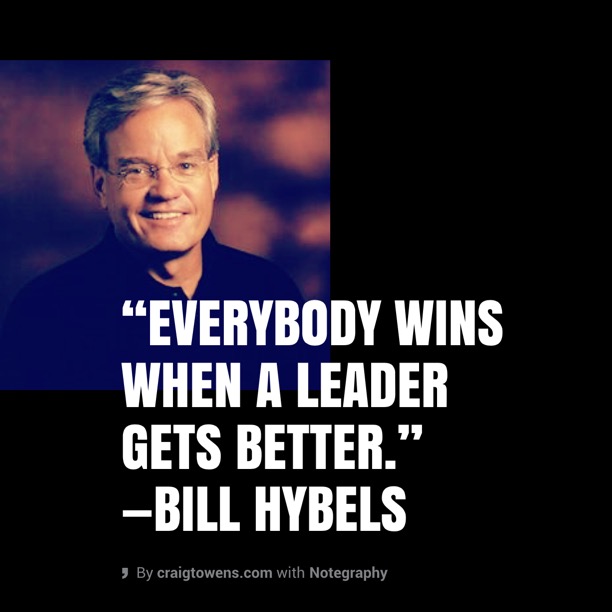
Hybels - everybody winsBill Hybels—The Lens Of Leadership

“Everybody wins when a leader gets better.”

“Armed with enough humility, leaders can learn from anyone.”

Hybels discussed four leadership lenses:

1.   Passionate leader (depicted by vibrant bright red frames)

  • They understand unbridled passion in leadership.
  • “Passion is like protein for the team.”
  • A motivated worked will outperform an unmotivated worker by 40%.
  • People are more motivated by working for a passion-filled leader than they are by compensation or perks.
  • Passion comes from a mountain-top dream, or a valley-deep frustration of current settings.

2.   People leader (cool frames, but cracked lenses)

  • An organization will only be as healthy as the top leader wants it to be.
  • This world needs more pastors of businesses, factories, medical offices, military units, etc.

3.   Performance leader (self-adjusting glasses)

  • Leaders ask: what progress should be made? how do we measure this? what doesn’t need to be measured?
  • Every worker wants to know how they are doing. For the leader, it’s cruel to hire someone and never let them know how they’re doing. Every staff member should get an update at least every six months.

4.   Legacy leader (sunglasses with a rearview mirror [cyclist])

  • Every once in awhile we need to look behind to see what legacy we’re leaving behind.
  • Leaders should reflect on this annually.
  • If my leadership assignment were to end today, what legacy would I leave?
Mulally - overcommunicateAlan Mulally—CEO Boeing and Ford Motor Company

An average commercial airline has 4 million parts!

  • People first
  • Include everyone
  • Create a compelling vision
  • Present a workable strategy
  • Set clear performance goals
  • Relentless implementation
  • Share lots of data
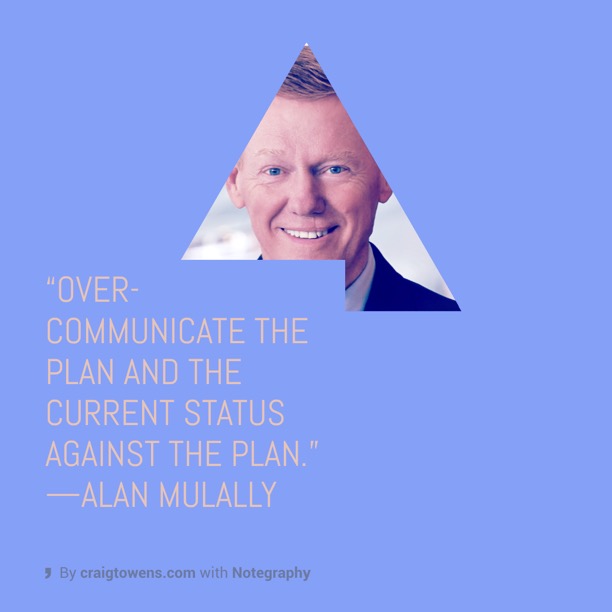
  • “Over-communicate the plan and the current status against the plan.”
  • Instill a positive can-do attitude
  • Keep your emotional resilience
  • Have fun


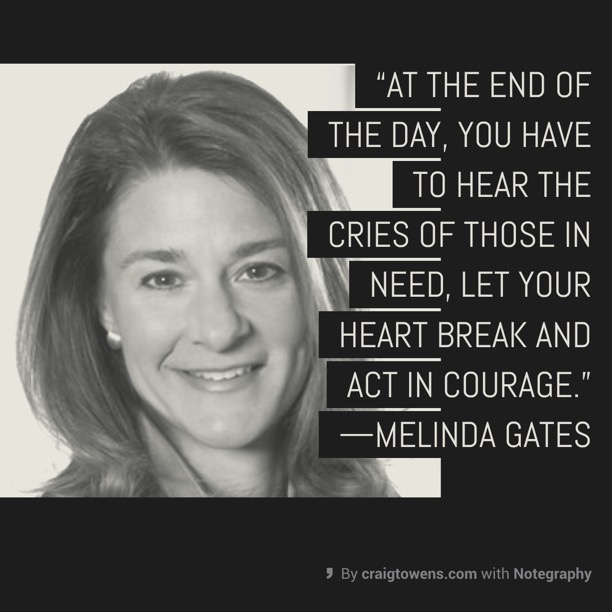
Melinda Gates - hear the criesMelinda Gates—Gates Foundation

Melinda says of herself, “I am an impatient optimist. We are changing the world, but we need to change it faster.”


“At the end of the day, you have to hear the cries of those in need, let your heart break and act in courage.”

Jossy Chacko—Empart

“All of us have been entrusted with something. What are we doing to leverage it?”

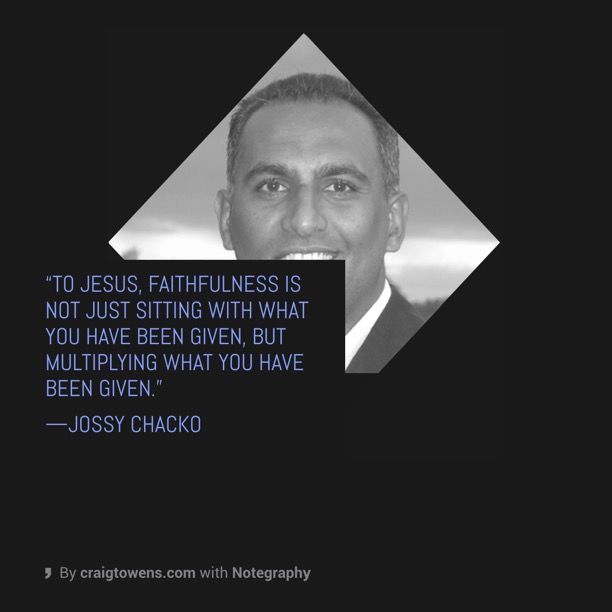
In thinking about the parable of the talents … “To Jesus, faithfulness is not just sitting with what you have been given, but multiplying what you have been given. God’s mission is not maintaining.”

“Playing it safe is not enough for a follower of Jesus Christ.”

Three principles for expanding our leadership reach:
Jossy Chacko - faithfulness1. Enlarge your vision

  • “When people hear my vision, they should know the size of my God.”
  • “An enlarged vision should keep us driven.”
  • “Do not be confused about what people say about your vision; trust what God has said to you.”

2. Empower your people

  • “Leadership is about taking wise chances and giving people opportunities.”
  • “Your leadership reach will be determined by your empowerment choices.”
  • Three things to keep in mind: (1) Focus on building their character before empowering them; (2) Empowerment has to be through relationship; and (3) Make sure we have agreed on the right outcomes, and have the right way to measure them.

3. Embrace risk

  • Faith = risk. Without faith it is impossible to please God = without taking risks it is impossible to please God.
  • Paradigms to be changed: (1) See risk as your friend to love, not as your enemy to be feared; (2) See comfort and safety as your enemies; and (3) Increase your pain threshold.
  • “Your leadership capacity is in direct relationship to your pain threshold.”
  • “Don’t allow the fear of losing what we have to lose what God has in store for you.”
  • “By me not taking risks, who is missing out?”
Bradberry - EQDr. Travis Bradberry—TalentSmart

All inputs into the brain travel through the limbic system first (emotional center) before the inputs travel to the frontal cortex. The EI (emotional intelligence) center is in the front of the brain, just above the left eye.

Only 36% of people are able to accurately identify their emotions as they happen.

EQ (the Emotional Quotient that measures emotional intelligence) is not IQ.

EQ can be improved all throughout life.

Four components of emotional intelligence:

 1. Self-awareness: knowing my emotions, and knowing my tendencies. I need to lean into my discomfort if I want to improve.

   2. Self-management: what I do with this increased self-awareness. This is not “stuffing” my feelings. The biggest mistake is only trying to manage negative emotions; positive emotions need to be managed too.

   3. Social awareness: focusing more on others than on myself.

   4. Relationship management: using the first three skills in concert. Seeing how my behavior is affecting the other person, and then adjusting accordingly.


How to increase my EQ:

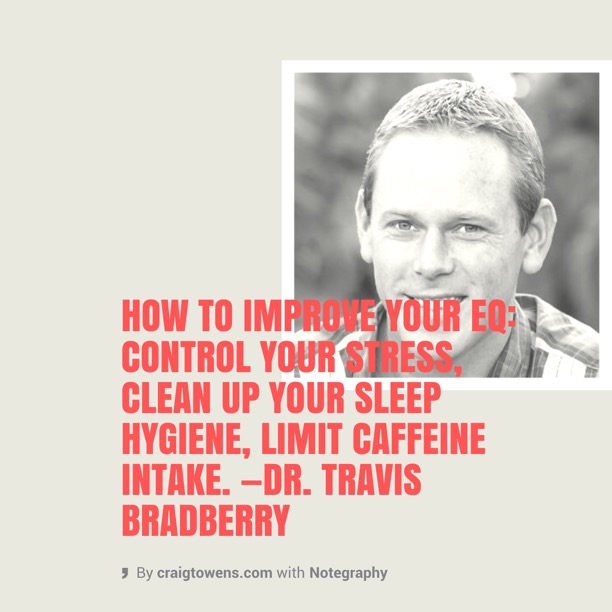
  1. Control stress—stress under control is healthy; chronic stress is unhealthy. Gratitude reduces the stress hormone cortisol.
  2. Clean up my sleep hygiene—sleep cleans up toxic hormones in the brain. To get better sleep: (1) Don’t take any kind of sleeping pill; and (2) Reduce “blue lights” in the evening.
  3. Reduce my caffeine input—especially after noon.
Ideal team playerPatrick Lencioni—Author

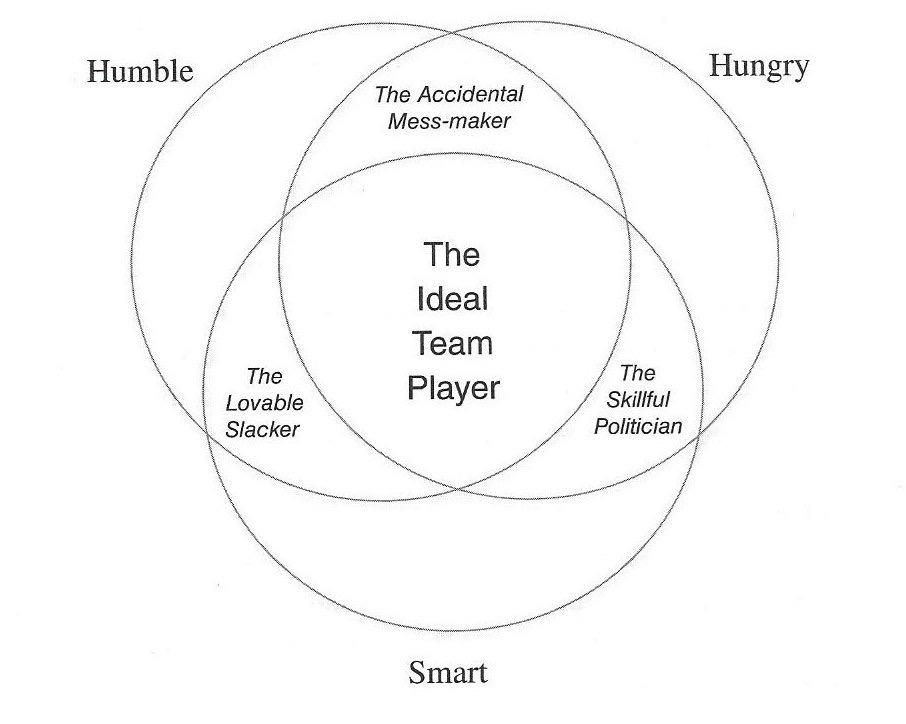
Three qualities of an ideal team player:

1.   Humble

  • Lacking self-confidence is not humility.
  • “Denying skills and downplaying abilities is not humility.”

2.   Hungry

  • Strong work ethic
  • Driving hard

3.   Smart

  • Not intellectual smarts, but people smarts = EQ

“To develop people, we have to have the courage to humbly and constantly talk to people about their ‘stuff.’”
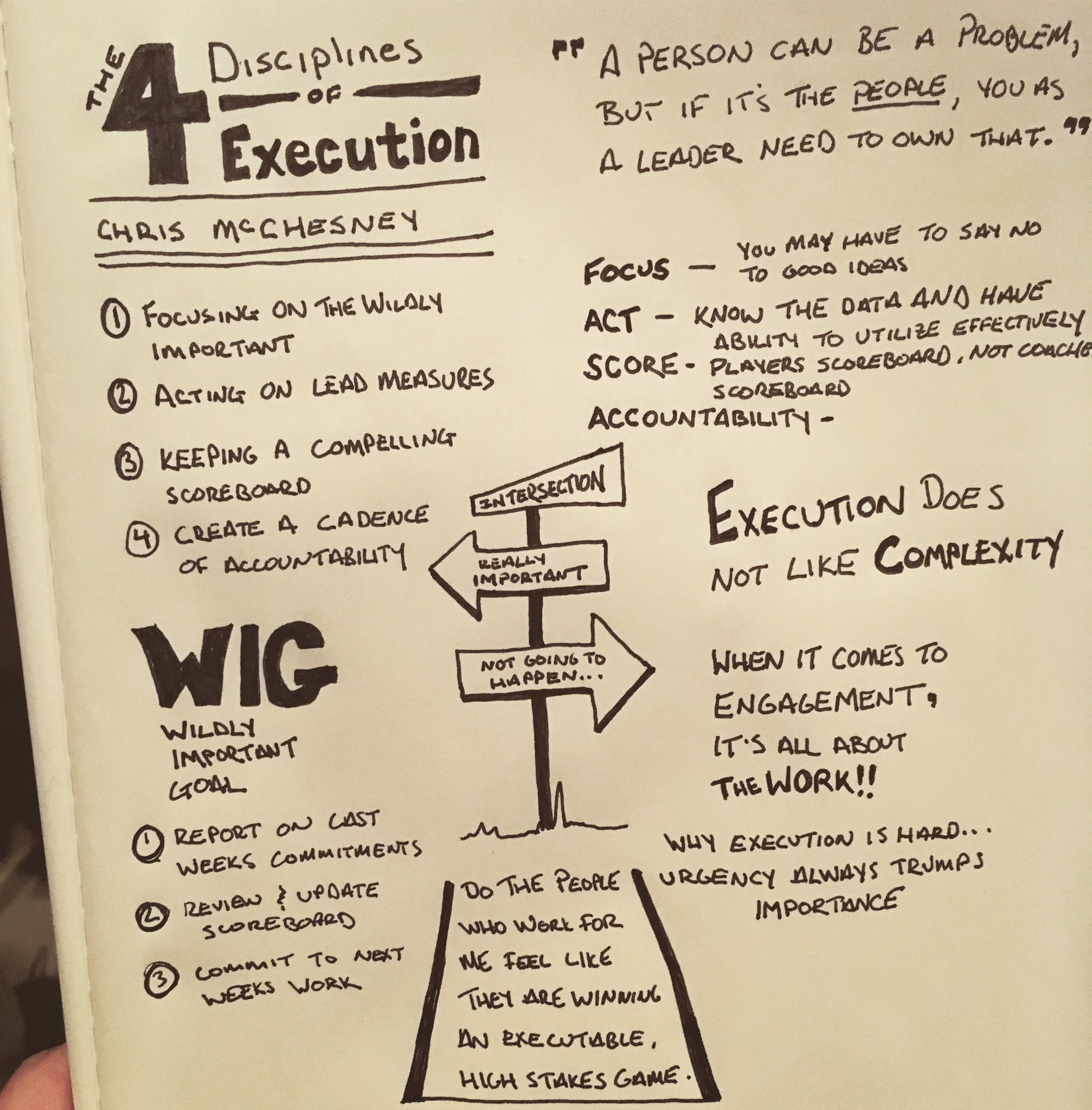
McChesney - execution disciplinesChris McChesney—Franklin Covey

Rahm Charan asked:

  • Q: Do leaders struggle more with strategy or execution? A: Execution.
  • Q: Are leaders more educated in strategy or execution? A. Strategy.

“The hardest thing a leader will ever do is drive a strategy that changes someone’s behavior.”

There are four disciplines for making changes in human behavior:

1.  Focus

  • “Focus on the wildly important.”
  • If a team focuses on 2-3 goals, they are likely to get them done. But if there are 4-10 goals, momentum is killed. At 11+ goals, the team is going backward.
  • We narrow the focus by coming up with a WIG: wildly important goal (this lives at the intersection of ‘really important’ and ‘not going to happen’).

2.  Leverage

  • “What are the fewest number of battles necessary to win the war?”
  • “When you want to go big, don’t think big, think narrow.”
  • One WIG per team at the same time. Everything else is in sustainment mode.
  • Make goals like this—“From x to y by when.”

3.  Engagement

  • “The biggest driver of engagement is when people feel like they’re winning.”
  • “Do the people who work for me feel like they’re playing a winnable game?”

4.  Accountability

  • Everyone needs to answer: “What are the things I do that have the biggest impact on the WIG?”
  • After sharing the scoreboard, allow people to determine what they need to do next. The people need to determine their own next moves, not the leader. The leader pulls this out of people.
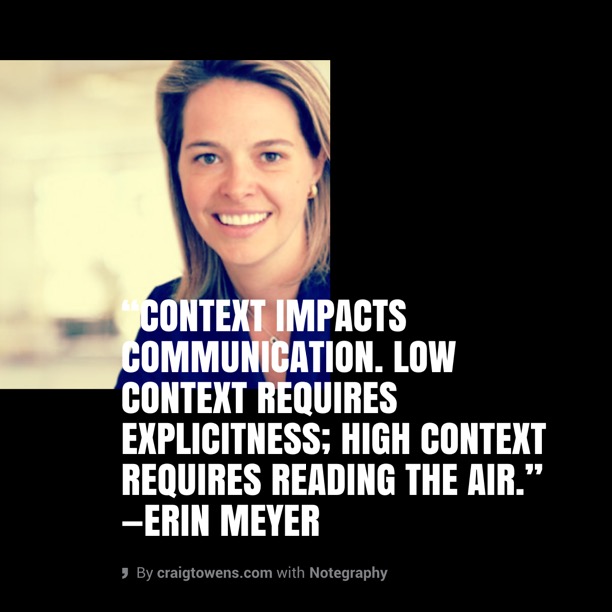
Erin Meyer - contextErin Meyer—INSEAD

On The Culture Map communication is divided into Low vs. High Context:

  • Low = feel we don’t have the same context or relationship. We feel we need to explain things very simply and explicitly.
  • High = we assume we have a larger body of shared reference points. We feel communication is more implicit or nuanced.

Anglo-Saxon countries are typically low context.

Latin American are mid-low.

Asian countries are usually high context.

In low context we tend to nail things down in writing, where in high context we leave things more open to later interpretation.

“Context impacts communication. … We need to read both the messages ‘in the air’ as well as the explicitly stately messages.”

“In a high context culture, repeat things less, ask more questions, learn to ‘read the air.’”
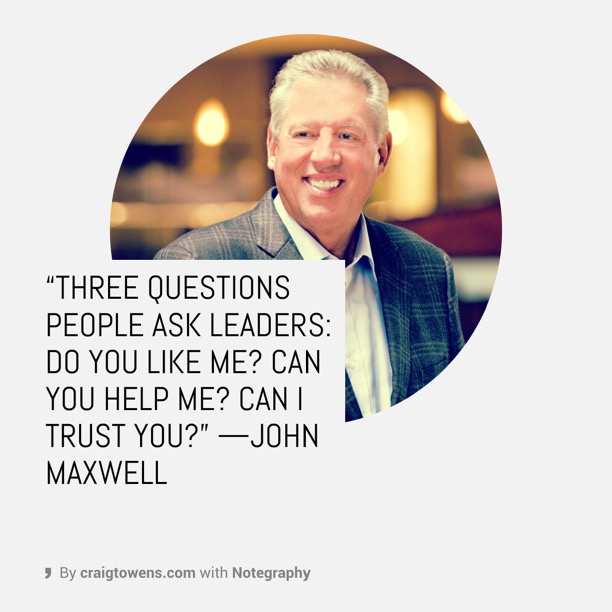
 

Maxwell - 3 questionsJohn Maxwell—Author 

“Good leaders lift.”

“You have to find the people before you lead the people.”

“The one thing leaders have to get right—they must intentionally add value to people every day.”


Five things that intentionally adds value to people:

  1. Value people—“God values people I don’t know; He even value people I don’t like.” “Are we going to spend our lives connecting with people, or correcting them?”
  2. Think of ways to add value to people—“Intentional living is thinking upfront on how to help people.”
  3. Look for ways to add value to people.
  4. Do things that add value to people.
  5. Encourage others to add value to people.

If you attended the GLS, please share in the comments below something amazing / challenging / paradigm-busting that you learned. Let’s all keep on learning!

Poetry Saturday—Pressed

Annie Johnson FlintPressed beyond measure ; yes, pressed to great length.
Pressed so intensely, beyond my own strength;
Pressed in the body and pressed in the soul,
Pressed in the mind till the dark surges roll.
Pressure from foes, and pressures from dear friends.
Pressure on pressure, till life nearly ends.

Pressed into knowing no helper but God;
Pressed into loving His staff and His rod.
Pressed into liberty where nothing clings;
Pressed into faith for impossible things.
Pressed into living my life for the Lord,

Pressed into living a Christ-life outpoured. —Annie Johnson Flint

Thursdays With Oswald—6 Questions About Your Relationship With Jesus

Oswald ChambersThis is a weekly series with things I’m reading and pondering from Oswald Chambers. You can read the original seed thought here, or type “Thursdays With Oswald” in the search box to read more entries.

6 Questions About Your Relationship With Jesus

“How much more shall the blood of Christ, Who through the enteral Spirit offered Himself without blemish unto God, cleanse your conscience from dead works to serve the living God?” (Hebrews 9:14)

     Our right to ourselves in every shape and form was destroyed once and for ever by the death of Jesus, and we have to be educated into the realization of what this means in all its fullness. We have to come to a relationship to the Cross in thought as well as in life. … 

     We are here with no right to ourselves, for spiritual blessing for ourselves; we are here for one purpose only—to be made servants of God as Jesus was. …

   “How much more” does the death of Jesus mean to us today than it ever has before? Are we beginning to be lost in wonder, love and praise at the marvelous loosening from sin, and are we so assimilating the nature of Jesus that we bear a strong family likeness to Him?

     The most devout among us are too flippant about this great subject of the death of Jesus Christ. When we stand before the Cross, is our every common pious mood stripped off? … 

     How does all the profound thought underlying the death of Jesus touch us? The writer to the Hebrews instantly connect it with conscience—“How much more shall the blood of Christ,…cleanse your conscience from dead works to serve the living God?” Has conscience the place in our salvation and sanctification that it ought to have? … 

     Are you thankful to God for your salvation and sanctification, thankful He has purged your conscience from dead works? Then go a step further; let Jesus Christ take you straight through into identification with His death until there is nothing left but the light at the foot of the Cross, and the whole sphere of the life is hid with Christ in God. 

From The Philosophy Of Sin

I challenge you: take some time to thoughtfully answer these questions.

Thursdays With Oswald—Is Jesus Worth It?

Oswald ChambersThis is a weekly series with things I’m reading and pondering from Oswald Chambers. You can read the original seed thought here, or type “Thursdays With Oswald” in the search box to read more entries.

Is Jesus Worth It? 

     With regard to all the pleasures and sciences and interests of this life, push this simple consideration, “Is this the kind of thing the Son of God is doing in the world, or is it what the prince of this world is doing?” Not, “Is it right?” but “Is it the kind of thing the Son of God would be doing in the world?” If it is not, then don’t touch it. 

     If you only give up wrong things for Jesus Christ, don’t talk any more about being in love with Him. If you want to do a thing all the time, it is no virtue not to do it! Jesus Christ takes the “want to” out of us and enables us to do in this world the things He would be doing if He were here. 

     We say, “Why shouldn’t I? It isn’t wrong!” What a sordid thing to say! When we love a person, do we only give up what is wrong for him? Love is not measured by what it gets, but by what it costs, and our relationship to Jesus Christ can never be on the line of, “Why shouldn’t I do this?” Our Lord simply says, “If any man will be My disciple, those are the conditions” (see Luke 14:26-27 and 33). Is He worth it?

From The Psychology Of Redemption

What do you think: Is Jesus worth it?

Poetry Saturday—Abandoned

DSC_0004Utterly abandoned to the will of God;
Seeking for no other path than my Master trod;
Leaving ease and pleasure, making Him my choice,
Waiting for His guidance, listening for His voice.

Utterly abandoned! No will of my own;
For time and for eternity, His, and His alone;
All my plans and purposes lost in His sweet will,
Having nothing, yet in Him all things possessing still.

Utterly abandoned! It’s so sweet to be
Captive in His bonds of love, yet wondrously free;
Free from sin’s entanglements, free from doubt and fear,
Free from every worry, burden, grief, or care.

Lo! He comes and fills me, Holy Spirit sweet!
I, in Him, am satisfied! I, in Him, complete!
And the light within my soul will never more grow dim
While I keep my covenant—abandoned unto Him! —Anonymous

Book Reviews From 2015

Is “Christian” Just A Label?

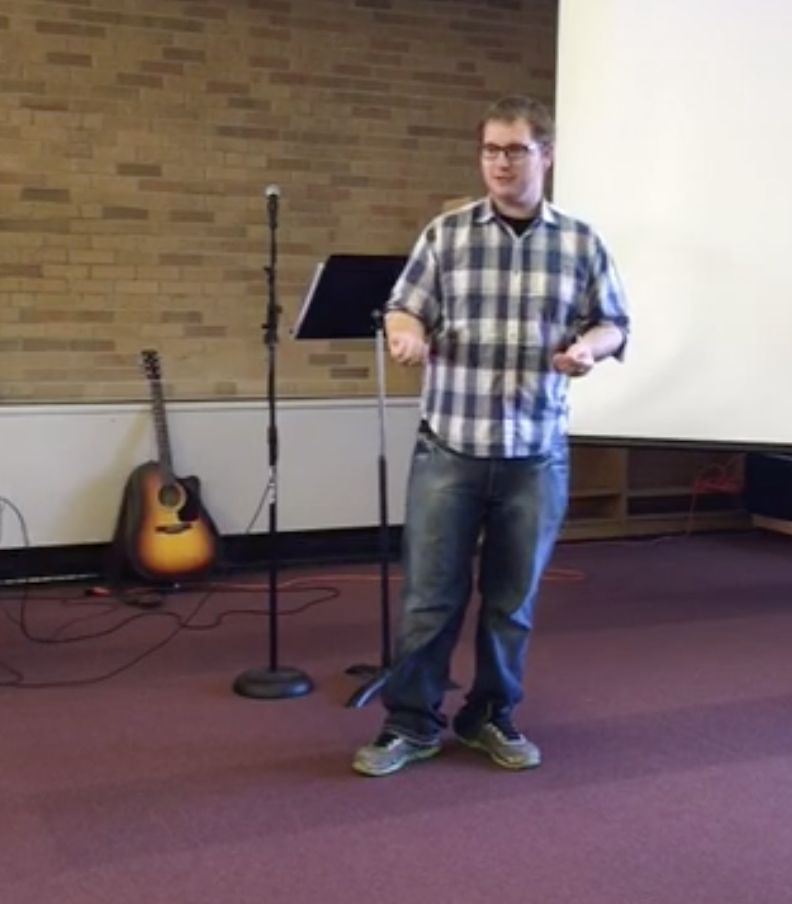
Josh SchramOur youth pastor, Josh Schram, shared a message yesterday which really convicted me. Here are my notes just as I took them Sunday morning.

Some stereotypes of Christians aren’t very flattering. If we ask someone to think of a farmer or a plumber, we probably all get the same sorts of images in our minds. But when we say “Christian,” there are a lot of images that come to mind. And many of them aren’t very flattering.

The word Christian only appears three times in New Testament (in the NIV)—Acts 11:26; Acts 26:28; 1 Peter 4:16.

The followers of Jesus preferred to call themselves disciples (see Acts 26:11). That signals a lifestyle, not just a label.

Does my lifestyle reflect the fact that I’m a follower of Jesus, or am I just happy with the title “Christian”? Am I trying to justify not doing the discipleship work that Jesus commanded me to do, namely loving God and loving others (Luke 10:25-37)? Notice especially this verse: But he wanted to justify himself, so he asked Jesus, “And who is my neighbor?” (Luke 10:29).

Why don’t Christians want to put their love into action? They say they’re busy, or don’t have enough resources, or don’t want to get involved, or they think helping may be a trap. But the priest and Levite who didn’t stop to help may have saved the injured man’s life! How much so the Christian of today!

Does my faith in Jesus change the way I live, or is “Christian” just a title I’m happy to live with?

As kids, when we play “follower the leader” we follow all the actions of the leader. But Christians seem to change the rules: “I just need to believe what He says, but I don’t have to do what He says.”

To truly be called a “Christian”—a disciple of Jesus—my LOVE should be in action, just like Jesus (Luke 10:27-28; c.f. Acts 10:38).

If you’re ready to be challenged, check out Josh’s message for yourself—

The Tweetable Billy Graham

BillyGrahamAlthough The Quotable Billy Graham was compiled nearly 50 years ago, all of this godly man’s wisdom still rings true today. Here are some of his quotes that fit nicely into Twitter—15 tweetable quotes from Billy Graham…

“Our faith grows by expression. If we want to keep our faith, we must share it. We must act.”

“The neglect of older people is becoming an increasing sin in America.”

“The ethical and moral concepts of Christianity are found all the way through the Declaration of Independence.”

“Anxiety is the natural result when our hopes are centered in anything short of God and His will for us.”

“The world has never seen such a manifestation of selfless love as was demonstrated upon Calvary.”

“We have not practiced applied Christianity. We have restricted it to a Sunday affair.”

“Many persons today insist on coming into the church head first rather than heart first.”

“Hot heads and cold hearts never solved anything.”

“Those who stand by the Cross are those who changed the course of history.”

“Salvation is free, but discipleship costs everything we have.”

“The further we get from the fact of the Resurrection, the closer we get to the reality of distraction.”

“It is very strange that the world accepts enthusiasm in every realm but the spiritual.”

“Faith is not anti-intellectual. It is an act of man that reaches beyond the limits of our five senses.”

“Once man denies the existence of God, he can stoop to anything.”

“If you gossip in front of your children, they are going to grow up to be gossipers.”

Previously I shared some of Billy Graham’s quotes on faith and on the church.

If you would like to check out my review of The Quotable Billy Graham, please click here.

Links & Quotes

link quote

“You have no idea the number of people that God may want to influence through you.” —Andy Stanley

“Proclaiming the gospel to a lost world cannot be just another activity to add to the church’s crowded agenda. It must be central to who we are. It forms our identity.” —Francis Chan

If you are job hunting, here is something to consider: Job recruiters don’t care about your GPA.

Ever wonder why politicians continue to fund the murderous practices of Planned Parenthood? Just follow the money. Look how much money Planned Parenthood gives to these politicians.

Max Lucado asks, “Does one prevailing problem stalk your life? Where does satan have a hook in you?” Read more in Max’s post Strongholds.

Thursdays With Oswald—Quick Snippets

Oswald ChambersThis is a periodic series with things I’m reading and pondering from Oswald Chambers. You can read the original seed thought here, or type “Thursdays With Oswald” in the search box to read more entries.

Quick Snippets 

(Normally I share a longer passage from Oswald Chambers, but his book Disciples Indeed contains so many short, power-packed statements, that I wanted to share a few of those with you.) 

  • “If we understood what happens when we use the Word of God, we would use it oftener.” 
  • “Everything the devil does, God over-reaches to serve His own purpose.”
  • “There is nothing so still and gentle as the checks of the Holy Spirit if they are yielded to, emancipation is the result; but let them be trifled with, and there will come a hardening of the life away from God.”
  • “My conscience makes me know what I ought to do, but it does not empower me to do it.”
  • “In the moral realm if you don’t do things quickly you will never do them.”
  • “Second thoughts on moral matters are always the deflections.”
  • “The greatest test of Christianity is the wear and tear of daily life, it is like the shining of silver, the more it is rubbed the brighter it grows.”
  • “We have to do more than we are built to do naturally; we have to do all the Almighty builds us to do.”
  • “When I began to be satisfied with where I am spiritually, instantly I begin to degenerate.

Which of these is your favorite?