Don’t Try To Change Your Bad Behavior

Thoughts to beahviorsAs I wrote previously, I believe Christians should be the best at getting along with others. First of all, Christians have been empowered by the Holy Spirit with the skills necessary to live at peace with everyone, IF we will only allow the Spirit to do the necessary work in us. And second, the way Christians treat others goes a long way toward either attracting or repelling others from a relationship with Jesus.

But here’s an important thing: If you don’t get along well with others now, don’t try to change your behavior!

Stephen Covey wrote, “To try to change outward behaviors does very little good in the long run if I fail to examine the basic paradigms from which those attitudes and behaviors flow.”

You see, behavior is the fruit. If we want to change the fruit, we need to back up a few steps.

The Apostle Paul used the life of Jesus as an example for Christians on how we can get along with others. But notice this: most of what Paul discusses is the “inside stuff.”

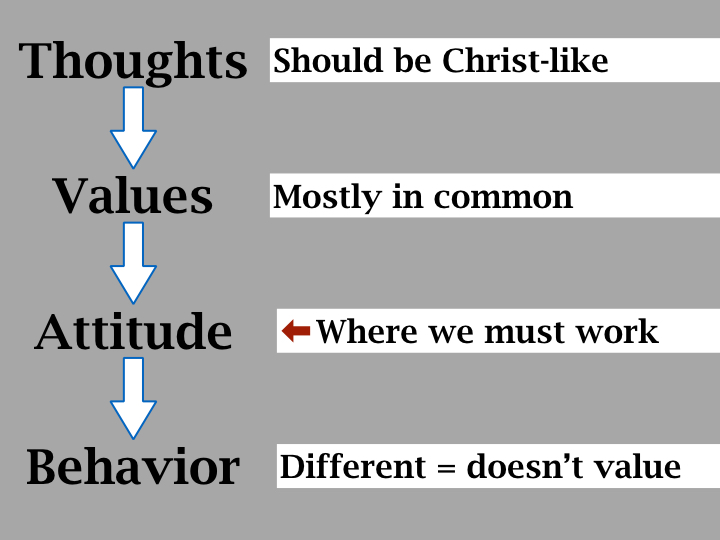
The progression goes like this (see Philippians 2:1-13)—

Thoughts → Values → Attitudes → Behaviors

(1) Thoughts—These need to be humble thoughts about God’s love toward us (v. 1).

(2) Values—Paul tells us to be “one in spirit and purpose” with others (v. 2). The definition of the Greek words here mean valuing the well-being of everyone. Paul then explains how our humility can lead to these win-win relationships (vv. 3, 4).

(3) Attitudes—“Your attitude should be the same as Christ Jesus” (v. 5). Jesus showed us what it was to have an attitude related toward obedience to God’s will.

(4) Behavior—If our thoughts, values and attitudes are rightly aligned to God, then our behavior will naturally be Christ-like as well. We see the example of Jesus in verses 6-8, and God’s reward for that behavior in verses 9-11. Then Paul calls on Christians to follow that pattern in our own lives (vv. 12, 13).

Most decent, reasonably-thinking human beings share the same values. Harry Truman said, “When we understand the other fellow’s viewpoint—understand what he is trying to do—nine times out of ten he is trying to do right.”

The problem is this: When the other person behaves differently from me, my natural tendency is to assume he doesn’t value what I value. In other words, I’m judging his value system on the way I normally behave.

The break-down is in my attitude. That’s the area I need to address. That’s the attribute of Jesus that Paul told us to copy.

So if I want to get along better with others, I shouldn’t try to change my behavior, but my attitude. My prayer should be: “I want this same attitude to be in me which was also in Christ Jesus. He served God and others, so I too want to follow His example of obedience, and I want to demonstrate my appreciation for all that Jesus has done for me by working hard to better get along with others. Help me change my attitude!”

Check out this video of the full message…

I hope you can join us next Sunday as we continue learning how to get along with others. Please join us in person or on Periscope.

12 More Quotes From “The Place Of Help”

The Place Of HelpAs always, there are more quotes from Oswald Chambers’ books than I have space to share them. So here are a few more from The Place Of Help.

“If we are going to be used by God, He will take us through a multitude of experiences that are not meant for us at all, but meant to make us useful in His hands. There are things we go through which are unexplainable on any other line, and the nearer we get to God the more inexplicable the way seems. It is only on looking back and by getting an explanation from God’s Word that we understand His dealings with us.”

“The essence of Christianity is that we give the Son of God a chance to live and move and have His being in us, and the meaning of all spiritual growth is that He has an increasing opportunity to manifest Himself in our mortal flesh.”

“Temptation is a short cut to what is good, not to what is bad. satan came to our Lord as an angel of light, and all his temptations center around this point—‘You are the Son of God, then do God’s work in Your own way; put men’s needs first, feed them, heal their sicknesses, and they will crown You King.’ Our Lord would not become King on that line; He deliberately rejected the suggested short cut, and choose the long trail, evading none of the suffering involved (cf. John 6:15).”

“God expects His children to be so confident in Him that in a crisis they are the ones upon whom He can rely. … God expects of us the one thing that glorifies Him—and that is to remain absolutely confident in Him, remembering what He has said beforehand, and sure that His purposes will be fulfilled.”

“God has never promised to keep us immune from trouble; He says ‘I will be with him in trouble,’ which is a very different thing.”

“The Bible characters never fell under weak points but on their strong ones; unguarded strength is double weakness.”

“Do we trust in our wits or do we worship God? If we trust in our wits, God will have to repeat the same lesson until we learn it.”

“The coming of Jesus Christ is not a peaceful thing, it is a disturbing thing, because it means the destruction of every peace that is not based on a personal relationship to Himself.” [Matthew 10:34]

“The peace that Jesus gives is never engineered by circumstances on the outside; it is a peace based on a personal relationship that holds all through. ‘In the world ye shall have tribulation: … in Me … peace.’”

“God is a holy God, and the marvel of the Redemption is that God the Holy One puts into me, the unholy one, a new disposition, the disposition of His Son.”

“In the Sermon on the Mount our Lord teaches us not to look for justice, but never to cease to give it. That is not commonsense, it is either madness or Christianity.”

“When the love of God is in me I must learn how to let it express itself; I must educate myself in the matter; it takes time. Acquire your soul with patients, says Jesus [Luke 21:19]. Never give way to this spirit—‘Oh well, I have fallen again, I will stay down now.’ Have patience with yourself, and remember that this is salvation not for the hereafter, but for the here and now.”

You can read the first set of quotes from The Place Of Help by clicking here.

My review of The Place Of Help is here.

And be sure to look for “Thursdays With Oswald” to read quotes and thoughts from the current Chambers’ book I am reading.

Is Christ Real To Me?

John WesleyJohn Wesley was deeply introspective about his faith in Jesus Christ. He once wrote—

“I did go thus far for many years…using diligence to eschew all evil, and to have a conscience void of offense; redeeming the time; buying up every opportunity of doing all good to all men; constantly and carefully using all the public and all the private means of grace; endeavoring after a steady seriousness of behavior, at all times, and in all places; and, God is my record, before Whom I stand, doing all this in sincerity; having a real design to serve God; a hearty desire to do His will in all things; to please Him who had called me to ‘fight the good fight,’ and to ‘lay hold of eternal life.’ Yet my own conscience beareth me witness in the Holy Ghost, that all this time I was but almost a Christian.”

To help keep himself on the right path, Wesley came up with this list of questions he regularly asked himself. This is a list any Christian would do well to read through regularly—

  1. Am I consciously or unconsciously creating the impression that I am better than I am? In other words, am I a hypocrite?
  2. Am I honest in all my acts and words, or do I exaggerate?
  3. Do I confidentially pass onto another what was told me in confidence?
  4. Am I a slave to dress, friends, work, or habits?
  5. Am I self-conscious, self-pitying, or self-justifying?
  6. Did the Bible live in me today?
  7. Do I give it time to speak to me everyday?
  8. Am I enjoying prayer?
  9. When did I last speak to someone about my faith?
  10. Do I pray about the money I spend?
  11. Do I get to bed on time and get up on time?
  12. Do I disobey God in anything?
  13. Do I insist upon doing something about which my conscience is uneasy?
  14. Am I defeated in any part of my life?
  15. Am I jealous, impure, critical, irritable, touchy or distrustful?
  16. How do I spend my spare time?
  17. Am I proud?
  18. Do I thank God that I am not as other people, especially as the Pharisee who despised the publican?
  19. Is there anyone whom I fear, dislike, disown, criticize, hold resentment toward or disregard? If so, what am I going to do about it?
  20. Do I grumble and complain constantly?
  21. Is Christ real to me?

Thursdays With Oswald—What Does Your Religion Mean?

Oswald ChambersThis is a weekly series with things I’m reading and pondering from Oswald Chambers. You can read the original seed thought here, or type “Thursdays With Oswald” in the search box to read more entries.

What Does Your Religion Mean? 

     To believe is literally to commit. Belief is a moral act, and Jesus makes an enormous demand of a man when He asks him to believe in Him. To be “a believer in Jesus” means to bank our confidence in Him, to stake our soul upon His honor. …

     Many of us use religious jargon, we talk about believing in God, but our actual life proves that we do not really believe one tithe of what we profess. … “The unsearchable riches of Christ”—yet we often live as if our Heavenly Father had cut us off with a shilling! We think it is a sign of real modesty to say at the end of a day—“Oh well, I have just got through, but it has been a severe tussle.” We carry our religion as if it were a headache, there is neither joy nor power nor inspiration in it, none of the grandeur of the unsearchable riches of Christ about it, none of the passion of hilarious confidence in God. …

     Christianity is the vital realization of the unsearchable riches of Christ. …

     We have made Christianity to mean the saving of our skins. Christianity means staking ourselves on the honor of Jesus; His honor means that He will see us through time, death and eternity. … 

     Why do you pray? Why are you religious? Because of a consuming passion for a particular set of your beliefs to be enthroned and proved right, or because of a consuming passion for Jesus Christ? 

From The Place Of Help

Wow, those are excellent questions to consider—What do I think Christianity really is? Do I really believe what Jesus did for me, or is it just jargon I use? Am I consumed in my passion for Christ, or is it only something I profess when things are going my way?

Alive (book review)

AliveI love the detective-like approach that cold-case detective J. Warner Wallace brings to Christian apologetics! Wallace presents reasonable evidence to lead to a reasonable faith in the biblical claims about Jesus. A quick read to prepare you for Good Friday and Resurrection Sunday is Alive

The material in this short 48-page booklet is taken from Wallace’s book Cold-Case Christianity, and is a just-the-facts look at the resurrection account of Jesus Christ. This booklet will prepare you to give a good answer to anyone who asks you about your faith.

These booklets are sold in a 10-pack, so buy a pack and pass them out to your friends who want to learn how to defend their Christian faith, or give one to a friend or coworker who is still skeptical about the accounts in the Bible surrounding Christ’s death and resurrection. All who read Alive will learn something they didn’t know before.

A great read!

8 Quotes From “Light & Truth—Acts and the Larger Epistles”

Light & Truth [Acts]Horatius Bonar had great insight into the application of Scriptures. Check out my review of this commentary from Dr. Bonar by clicking here. Below are a few quotes that caught my attention. The reference in brackets after the quote is the biblical passage on which Bonar is commenting.

“Our Bible is of God; yet it is also of man. It is both divine and human. It comes to us from God’s Spirit; it comes also from man’s spirit. It is written in the language of the earth, yet its words are the words of him ‘Who speaketh it from heaven.’ Natural, yet supernatural; simple, yet profound; undogmatical, yet authoritative; very like a common book, yet very unlike also; dealing often with seeming incredibilities and contradictions, yet never assuming any need for apology, or explanation, or retraction; a book for humanity at large, yet minutely special in its fitnesses for every case of every soul; throughout its pages, from first to last, one unchanging estimate of sin as an infinite evil, get always bringing out God’s gracious mind toward the sinner, even in his condemnation of the guilt; such is the great Book with which man has to do, which man has to study, out of which man has to gather wisdom for eternity.” [Acts 1:1

“One of the great characteristics of the whole interval between Christ’s first and second coming is the world’s rage, secret and open, against the Father and the Son. … It is very useless anger. It accomplishes nothing. It is like an angry child striking a huge rock with its fist. It is the mere display of impotent hatred, or the temporary gratification of their dislike of God, and their rejection of His purpose regarding His Son. … It calls light darkness, and darkness light; good evil, and evil good; but the light and the darkness, the good and evil, still remain as they were. All the enlightenment of the age, all the appliances of modern progress, are impotent against God and His Christ, against His truth, and His church, and His Word.” [Acts 4:25]

“This is one of the many repetitions of the Pentecostal scene which occurred in early days. Most unscriptural is the statement of some that the giving of the Spirit at Pentecost was a thing done once for all, not to be repeated, and that we are not to pray for or expect such things again. The whole of the ‘Acts of the Apostles’ is a direct refutation of this piece of human fancy. Wherever the apostles went there was a repetition of Pentecost, whether at Jerusalem, or Samaria, or Antioch, or Corinth. Every conversion is the repetition of Pentecost; it is doing the same thing for an individual soul as was done for three thousand then, by a similar process, and by the same power—the power of the Holy Spirit. The Holy Ghost is the heritage of the church. The Old Testament saints possessed Him; and still more the New. This is our heritage, the heritage of every believing man.” [Acts 11:15

“Beware of seeking anything less than the baptism of the Holy Ghost. Our whole life is to be a reception of the Spirit. He is to be continually coming down on us, and filling us. Let us open our mouth wide that He may fill it. Let us beware of anything that would present itself as a substitute for the living Spirit. Many such things may we expect in these last days from satan as an angel of light.” [Acts 11:15]

“We are tempted in our day to be ashamed of the gospel. It is thought to be bare, unintellectual, almost childish by many. Hence, they would overlay it with argument and eloquence, to make it more respectable and more attractive. Every such attempt to add to it is being ashamed of it.” [Romans 1:16

“We must have a righteousness, else we cannot stand before God; we cannot have merely a religion.” [Romans 4:6-8]

“The prodigal did not work for the ‘best robe,’ but got it all ready-made from his father’s hands; Joseph did not work for his coat of many colors, but received it as the gift of his father’s love; Adam did not work for the skins with which the Lord God clothed him: so it is with the sinner in his approach to God, and in God’s approaches to him. ‘Righteousness without works’ is given him; nay, put upon him as a raiment, a divine raiment, to fit him for drawing near to God.” [Romans 4:6-8

“When the night is darkest, and the stars are hidden, and the clouds are black, then we think most of the clear fair day, and long for its dawn. When the storm is roughest, with the waves and wind roaring around the laboring vessel, then we are troubled, and look eagerly out for the glad and sunny calm. When winter binds the earth in its chain of frost, and wraps it in snow and ice, then we begin to ask for spring, with its flowers, and songs, and verdure. So with the saint, as represented by the apostle here. This is night, and storm, and winter to him; he is ever thinking of the day, and the calm, and the spring.” [Romans 8:19-23]

More quotes are here.

10 More Quotes From “Christian Behavior”

Christian BehaviorAlthough written 300+ years ago, John Bunyan has some timeless wisdom for Christians in his book Christian Behavior. You can check out my book review by clicking here, and the first set of quotes I shared from this book are here. Below are some other quotes I really liked.

In a section to parents about children—

“See if fair words will win them from evil. This is God’s way with His children (Jeremiah 25:4-5).” 

“Take heed that the misdeeds for which thou correctest thy children be not learned them by thee.”

“How a Christian wife should live with her unbelieving husband:

  1. Let thy words be few.
  2. And none of them savoring of a lording over him; but speak thou still as to thy head and lord, by way of entreaty and beseeching.
  3. And in such a spirit of sympathy, that the manner of thy speech and behavior in speaking may be to him an argument that thou speakest in love, as being sensible of his misery, and inflamed in thy soul with desire after his conversion.
  4. And follow thy words and behavior with prayers to God for his soul.
  5. Still keeping thyself in a holy, chaste, and modest behavior before him.”

In a section written to employers—“In a word, learn of the Lord Jesus to carry yourselves well to your servants, that your servants also may learn something of the kindness of Christ by your deportment to them. Servants are goers as well as comers; take heed that thou give them no occasion to scandal the Gospel when they are going for what they observe thee unrighteously to do when they were with thee.”

“Pride, in general, is that which causeth a man to think of man and his things above what is written (1 Corinthians 4:6).”

“Pride is when you slight this or that person, though gracious—that is, look over them and shun them for their poverty in this world—and choose rather to have converse with others that possibly are less gracious because of their greatness in this world.”

“It argueth pride of heart when men will not deny themselves in things that may be for the good and profit of their neighbors.”

“It argueth pride of heart when a man that hath this or that in his heart to do in reference to God, but yet will slight a sober asking counsel and direction of God in this matter.”

“It argueth pride of heart when persons are tickled with thoughts of their own praise, that secretly lust after it.”

“It is an easier matter to begin to do good than it is to continue therein; and the reason is, there is not so much of a Christian’s cross in the beginning of a work as there is in a continual, hearty, conscientious practice thereof. Therefore Christians have need, as to be pressed to do good, so to continue the work.”

Book Reviews From 2015

Practical Prayer

Practical PrayerI remember when I was searching for my first job, and I kept getting turned down because I didn’t have any “experience.” And I kept thinking, “How am I supposed to get any experience if you won’t hire me?!” It’s frustrating being in a place where the only way you can get the job is to have experience, which you can’t get because you don’t have the job!

Sadly, I think this is how many people—even many Christians—feel about prayer.

Mature Christians say, “You need to pray.” But newer Christians keep thinking, “I don’t have the experience to allow me to come into God’s presence, because I haven’t been praying before. Does God even want to hear from me now?” It can be frustrating being in a place where you feel the only way you can get to God is to have advanced prayer experience, which you can’t get because you don’t know how to pray that way!

This Sunday I am beginning a new nuts-and-bolts series on how anyone can learn what prayer really is. We will be looking at some of the most basic things that anyone can do to get the prayer experience they need. The series will be called Practical Prayer, and I believe everyone is going to find it highly practical.

I hope you can join me at 10:30am this Sunday. If you cannot join us in person, be sure to check out our live broadcast on Periscope every week (search for @craigtowens).

9 Quotes From C.S. Lewis

C.S. Lewis at his deskYesterday I posted a review on an innovative book The Surprising Imagination Of C.S. Lewis. Truly this man’s literary output during his lifetime, and his works’ staying power after his lifetime, is amazing. Here are a few quotes from this prolific author.

“We may ignore, but we can nowhere evade, the presence of God. The world is crowded with Him. He walks everywhere incognito. And the incognito is not always hard to penetrate. The real labor is to remember, to attend. In fact, to come awake. Still more, to remain awake.” —C.S. Lewis

“Humanity does not pass through phases as a train passes through stations: being alive, it has the privilege of always moving yet never leaving anything behind. Whatever we have been, In some sort we are still.” —C.S. Lewis

“God saw the Cross in the creation of the first nebulae.” —C.S. Lewis 

“Nothing can deceive unless it bears a plausible resemblance to reality.” —C.S. Lewis

“The real way of mending a man’s taste is not to denigrate his present favorites, but to teach him how to enjoy something better.” —C.S. Lewis 

“Coming to understand anything we must reject the facts as they are for us in favor of the facts as they are.” —C.S. Lewis

“The terrible thing, the almost impossible thing, is to hand over your whole self—all your wishes and precautions—to Christ. But it is far easier than what we are all trying to do instead. For what we are trying to do is to remain what we call ‘ourselves,’ to keep personal happiness as our great aim in life, and yet at the same time be ‘good.’ We are all trying to let our mind and heart go their own way—centered on money or pleasure or ambition—and hoping, in spite of this, to behave honestly and chastely and humbly. And that is exactly what Christ warned us you could not do.” —C.S. Lewis 

“The real problem of the Christian life comes where people do not usually look for it. It comes the very moment you wake up each morning. All your wishes and hopes for the day rush at you like wild animals. And the first job each morning consists simply in shoving them all back; in listening to that other Voice, taking that other point of view, letting that other larger, stronger, quieter life come flowing in. And so on, all day.” —C.S. Lewis

“‘Be ye perfect.’ I think He meant ‘The only help I will give is help to become perfect. You may want something less: but I will give you nothing less.’” —C.S. Lewis 

“That is why we must not be surprised if we are in for a rough time. When a man turns to Christ and seems to be getting on pretty well (in the sense that some of his bad habits are now corrected) he often feels that it would now be natural if things went fairly smoothly. When trouble comes along—illnesses, money troubles, new kinds of temptation—he is disappointed. These things, he feels, might have been necessary to rouse him and make him repent in his bad old days; but why now? Because God is forcing him on, or up, to a higher level: putting him into situations where he will have to be very much braver, or more patient, or more loving, than he ever dreamed of being before. It seems to us all unnecessary: but that is because we have not yet had the slightest notion of the tremendous thing He means to make of us.” —C.S. Lewis

I previously posted quotes from C.S. Lewis here, here, and here.