My books are for my fellow pastors. Shepherd Leadership will help us keep the biblical metrics in mind when we are thinking about our leadership roles. When Sheep Bite is an invaluable resource to help pastors continue to serve their flock, even after being painfully attacked. And Amen Indeed is a book of prayers for pastoral effectiveness.
If you are a pastor—or if you love your pastor—please pick up copies of these books today!
Listen to the podcast of this post by clicking on the player below, and you can also subscribe on Apple, Spotify, or Audible.
Jude calls Christians to contend for the faith without contention and without compromise. Instead, we are to loving serve Jesus by engaging with others mercifully, peacefully, and lovingly. This means we have to contend without quarreling.
But that’s easier said than done because people love to pick fights, and we hate to lose an argument.
Look at the ministry of Jesus. His adversaries couldn’t get around the perfect logic that He used based on Scripture, so they came up with all sorts of controversies in the hope of tripping Him up and silencing Him. They posed seemingly unanswerable dilemmas like: In heaven, which one of the seven brothers will be married to the woman they all married on earth? Should we pay taxes to Caesar? Should we pay the temple tax? What’s the greatest commandment of all? They tried to get Him to take the bait about religious traditions, laws concerning the Sabbath, and the punishment for a woman caught in adultery.
Jesus never got fluster or frustrated—He never took the bait to quarrel with them, but He simply stood unwaveringly and lovingly on God’s Word. But once again, that’s easier said than done!
King Solomon pointed out the difficulty of this in Proverbs 26:4-5. Do we answer a fool or not? Yes, but we answer wisely not foolishly.
I believe Jude would agree with Solomon, Jesus, Paul, and Peter, but then he uses three examples that could spark a controversy:
the fate of fallen angels (Jude 6)
Michael and the devil arguing over the body of Moses (v. 9)
Enoch prophesying (v. 14)
But notice that how Jude uses these examples by not addressing any more than what we already know from Scripture. In this way, Jude keeps this from becoming a foolish, quarrelsome controversy (v. 10).
Notice the consistent instruction of the Bible on how to handle critics:
Michael the archangel: The Lord rebuke you! (also 2 Peter 2:11)
Jesus: Away from Me! (Matthew 4:10) and Get behind Me! (Mark 8:33)
James: Submit to God and then resist the devil (James 4:7)
Peter: speak gently, respectfully, and with a clear conscience (1 Peter 3:15-16)
Paul: warn people without becoming quarrelsome (2 Timothy 2:14, 16, 23-25)
In Luke 13:1-5, Jesus addresses two events that could have become quite controversial, but Jesus defused the controversy by simply saying, “No matter what, everyone needs to have their sins forgiven by God.” Paul continued this singleminded focus on Jesus. I love how the Amplified Bible captures his words in 1 Corinthians 2:2. And then Paul encourages his friend Timothy to operate the same way (1 Timothy 1:15-17).
Don’t let foolish controversies sidetrack you from the faith entrusted to us, but take everything back to Jesus as He is revealed in the Scripture.
If you’ve missed any of the other messages in our series called Earnestly Contending, you can find them all here.
Listen to the podcast of this post by clicking on the player below, and you can also subscribe on Apple, Spotify, or Audible.
David declared that the Holy Spirit inspired the words he penned. “The Spirit of the Lord spoke in and by me, and His word was upon my tongue” (2 Samuel 23:2).
Both Jesus and Peter affirm this in the New Testament as well when they make mention that David’s words were given to him by the Holy Spirit (Matthew 22:43; Mark 12:36; Acts 1:16, 4:25).
It’s not just the words of David, but all Scripture is God-breathed (2 Timothy 3:16; 2 Peter 1:21)! This is why we would be wise to pray before reading our Bibles to ask the One Who inspired the Scripture to illuminate our minds to understand it and guide us into its daily application (John 14:26, 16:13).
Jesus desired that we go even farther than this. His directive to His followers was for them to be baptized in the Holy Spirit. This initial baptism took place on the first Pentecost celebration after Jesus had ascended to Heaven. Luke records it this way—
And they were all filled (diffused throughout their souls) with the Holy Spirit and began to speak in other (different, foreign) languages (tongues), as the Spirit kept giving them clear and loud expression in each tongue in appropriate words. (Acts 2:4 AMPC)
And in the subsequent verses Luke makes it clear that these were intelligible languages and intelligent words that served as a testimony to the worldwide visitors that were in Jerusalem—
And when this sound was heard, the multitude came together and they were astonished and bewildered, because each one heard them—the apostles—speaking in his own particular dialect. And they were beside themselves with amazement, saying, “Are not all these who are talking Galileans? Then how is it that we hear, each of us, in our own (particular) dialect to which we were born? Parthians and Medes and Elamites and inhabitants of Mesopotamia, Judea and Cappadocia, Pontus and the province of Asia, Phrygia and Pamphylia, Egypt and the parts of Libya about Cyrene, and the transient residents from Rome, both Jews and the proselytes to Judaism from other religions, Cretans and Arabians too—we all hear them speaking in our own native tongues and telling of the mighty works of God!” (vv. 6-11 AMPC)
In his sermon that followed this event, Peter states that the baptism in the Holy Spirit—with the physical evidence of speaking in tongues—is an evidence of Christ’s resurrection. “Being therefore lifted high by and to the right hand of God, and having received from the Father the promised blessing which is the Holy Spirit, He has made this outpouring which you yourselves both see and hear” (v. 33).
God answers their prayer powerfully! “And when they had prayed, the place in which they were assembled was shaken; and they were all filled with the Holy Spirit, and they continued to speak the word of God with freedom and boldness and courage” (v. 31).
The Holy Spirit gave us the Scripture, and He illuminates the Scripture to us.
The Holy Spirit assures us of our salvation, and He empowers us to share this Good News with others.
The Holy Spirit gives us words to speak, and He gives us the boldness and courage to speak them.
He speaks, He illuminates, He empowers, He emboldens! If your theology limits the work of the Holy Spirit to some obscure corner of your world, you are robbing yourself of the power to live a God-glorifying, Jesus-promoting life.
You may be interested in some additional posts and sermons where I discuss more about the initial physical evidence of speaking in tongues as the Holy Spirit empowers Christians—
Listen to the podcast of this post by clicking on the player below, and you can also subscribe on Apple, Spotify, or Audible.
The Jordan River was a powerful border guard. For years it had served the Canaanites well, protecting their eastern border from large-scale attacks from their enemies. Now the Jordan was all that stood between the Israelites on the east side of the river and their promised land on the west side.
Joshua gave some unusual instructions to the priests that carried the ark of the covenant of the Lord. He told them to carry the ark while they walked into the middle of the flood-level river. He said they should trust that God would stop the flow of the river while they stood there (see Joshua 3:1—4:11).
I can imagine the two priests carrying the ark at the front stepping into the water, feeling the current rush around their ankles, and holding their breath as they took their next steps deeper into the river.
Step after step the two priests in front waded into the Jordan. Until finally they walked far enough that the priests carrying the ark from the back stepped into the Jordan.
And all of a sudden, the water levels begin to go down! Lower and lower until the priests were standing on a damp riverbed that had been completely covered by water just a few minutes earlier. To their left, as they looked downstream, no water was to be seen. To their right, as they looked upstream, they might have glimpsed the wall of water piled up as the invisible Hand of God held it back.
Only then did the Israelites began crossing the previously uncrossable river. Family after family, tribe after tribe began to march at long last into their promised land.
And while all Israel passed over on dry ground, the priests who bore the ark of the covenant of the Lord stood firm on dry ground in the midst of the Jordan, until all the nation finished passing over the Jordan. … For the priests who bore the ark stood in the midst of the Jordan until everything was finished that the Lord commanded Joshua to tell the people…. (Joshua 3:17, 4:10)
It was only after every Israelite had crossed the Jordan, and memorial stones had been gathered from the riverbed and carried to the shore, that the priests carrying the ark of the covenant of the Lord came across themselves. It was immediately after this that the mighty Jordan River began flowing again at full strength.
Second, godly leaders stand their ground until all the people enter into God’s blessing. Remember that God is patient, “not wanting anyone to perish, but everyone to come to repentance” (2 Peter 3:9).
So leaders, let me encourage you—
Keep going first in obeying God, keep standing firm in His promises, keep showing others the path they need to follow to step into God’s blessings, and keep encouraging people to walk into that blessing.
Don’t be slow in obeying. Don’t fear going first into the unknown. And don’t become weary or frustrated or nervous and walk away too soon.
Listen to the podcast of this post by clicking on the player below, and you can also subscribe on Apple, Spotify, or Audible.
Check out a couple of ways I could greet you in this post:
It’s great to see all of you today. I am really glad you stopped by my blog.
In fact, no one is as astute as you are. No one digs into the Scripture the way you do. There is no one else in the world that I would want visiting my blog today.
What did I just do? I went from genuinely complimenting you to flattering you. I bit you. Flattery is a sneaky bite that we need to be aware of.
A compliment is simply defined as an expression of praise or admiration.
Flattery, on the other hand, crosses the line. It’s defined as trying to please someone by excessive or insincere praise. The reason why I call flattery a bite is because the flatterer is only thinking about himself, not about you.
Flatterers are trying to get something for themselves. See how the rich young man tried to do this by flattering Jesus in Mark 10:17. The Amplified Bible brings out the man’s flattery more clearly: Teacher, You are essentially and perfectly morally good.
This man was looking for the secret formula that would get him into Heaven, so he wasn’t complimenting Jesus but flattering Him to get a favorable answer.
Jude described these pseudo-religious people as ones who “flatter others for their own advantage” (Jude 1:16). The NKJV says they use “great swelling words.” Peter describes these same kinds of people as speaking “great swelling words of emptiness” (2 Peter 2:18).
Flatterers are trying to trip you up so they are recognized as your superior. Once again, we can see how tricksters tried this tactic on Jesus in Mark 12:14. We know they are insincere because of the background information Mark gives us in vv. 12-13.
David described flatterers in Psalm 12:1-3. The AMPC says they talk “with flattering lips and double heart” and The Message paraphrases it, “Lies slide off their oily lips. They doubletalk with forked tongues” (v. 2).
Solomon warns us of the net they are setting for us: Those who flatter their neighbors are spreading nets for their feet (Proverbs 29:5).
Flatterers are trying to cover up their own sinfulness. David again diagnoses this in Psalm 36:1-4. This also means that sometimes we can flatter ourselves to avoid dealing with our own sin.
It’s natural to want to hear a compliment, but we need supernatural discernment to protect ourselves from the sneaky bite of flattery.
Look how Jesus did this in Mark 10:17-18. Remember the Amplified Bible that laid it on so thick? Jesus responded correctly: “There is no one essentially and perfectly morally good—except God alone” (v. 18). If we are going to do any comparing at all, let’s compare ourselves to our perfect God and Savior. Remember, we have done a self-check (Psalm 26:2) so we know what’s really there!
Swallowing this flattery only fuels the pride inside us. C.S. Lewis warned, “It was through Pride that the devil became the devil; it is the complete anti-God state of mind. … Pride is a spiritual cancer: it eats up the very possibility of love, or contentment, or even common sense.”
Look at the other example from Jesus in Mark 12:12-15. When Jesus sensed their flattery, He called it what it was: hypocrisy!
Flattery makes you feel like you’re on top of the world. Flattery makes you forget the things the Holy Spirit has revealed to you that needs work. But Jesus asked, “What do you benefit if you gain the whole world but lose your own soul?” (Mark 8:36 NLT).
The sincerest compliment we should all be living to hear is, “Well done, good and faithful servant! Enter into your Master’s happiness forever and ever!” No other voice matters!
Check out the other messages in this series called When Sheep Bite Sheep by clicking here. And if you are a pastor, check out my book When Sheep Bite.
Listen to the podcast of this post by clicking on the player below, and you can also subscribe on Apple, Spotify, or Audible.
Jesus said His Second Coming would occur at a time in history that was just like the behaviors during “the days of Noah” (Matthew 24:36-39; Luke 17:26-27).
What exactly did those days look like?
The earth was depraved and putrid in God’s sight, and the land was filled with violence (desecration, infringement, outrage, assault, and lust for power). And God looked upon the world and saw how degenerate, debased, and vicious it was, for all humanity had corrupted their way upon the earth and lost their true direction. (Genesis 6:11-12 AMPC)
Paul describes this same environment to his friend Timothy—
For people will be lovers of self and [utterly] self-centered, lovers of money and aroused by an inordinate [greedy] desire for wealth, proud and arrogant and contemptuous boasters. They will be abusive (blasphemous, scoffing), disobedient to parents, ungrateful, unholy and profane. [They will be] without natural [human] affection (callous and inhuman), relentless (admitting of no truce or appeasement); [they will be] slanderers (false accusers, troublemakers), intemperate and loose in morals and conduct, uncontrolled and fierce, haters of good. [They will be] treacherous [betrayers], rash, [and] inflated with self-conceit. [They will be] lovers of sensual pleasures and vain amusements more than and rather than lovers of God. (2 Timothy 3:2-4 AMPC)
It seems to me that we are now living in “the days of Noah” and “the last days.” For Christians, I think this means two things:
(1) Be diligent to keep yourself devoted to living for God.Noah stood out in stark contrast to everyone else because of his righteousness and blamelessness “in his evil generation” (Genesis 6:9). Peter wrote,
So, beloved, since you are expecting these things, be eager to be found by Him [at His coming] without spot or blemish and at peace [in serene confidence, free from fears and agitating passions and moral conflicts]. (2 Peter 3:14 AMPC)
(2) Be active in telling people about the Second Coming of Jesus and that the only door to salvation from God’s judgment is Jesus Christ. Jude wrote this—
Guard and keep yourselves in the love of God; expect and patiently wait for the mercy of our Lord Jesus Christ (the Messiah)–[which will bring you] unto life eternal. And refute [so as to] convict some who dispute with you, and on some have mercy who waver and doubt. [Strive to] save others, snatching [them] out of [the] fire; on others take pity [but] with fear, loathing even the garment spotted by the flesh and polluted by their sensuality. (Jude 1:21-23 AMPC)
The time is short. Let’s stay righteous and let’s stay active in proclaiming the Good News that Jesus is coming as the All-Righteous Judge, but He has already paid for our forgiveness so that we can “stand in the presence of His glory, blameless and with great joy” (Jude 1:24).
Listen to the podcast of this post by clicking on the player below, and you can also subscribe on Apple, Spotify, or Audible.
The lights of hope, peace, and joy burn brightly. They drive out the darkness in our own lives and in the lives of others with whom we come in contact. But you and I both know lots of people who are very positive people—always upbeat, seemingly peaceful and joyful. The real question is: What is the source of this light? Or more specifically, how do people know that you are hopeful, peaceful, and joyful because you know Jesus as your Savior and King?
Jesus said there were two proofs that we are His followers:
That we love others (John 13:35)
That we are producing God-honoring fruit (John 15:8)
God IS love—it’s His very nature. Just like an apple doesn’t have the capacity for apple-ness but is by its nature an apple, so God doesn’t have the capacity for love, or love more than others, but He is by His nature Love.
Any qualities of hope, peace, and joy in our lives have to originate from God’s love. We cannot manufacture these fruits, but they are a natural result of our being connected with Love Himself.
Love is what brought Jesus to earth at His First Advent (John 3:16-17; Romans 5:5-8). And we can only love others and produce the fruit of hope, peace, and joy because Jesus went first and became our Source (1 John 4:19; John 15:1).
Love brought Jesus to earth at His First Advent, and Love is what empowers us to be loving and fruitful between His Advents.
Love one another means that love serves (John 13:1-5, 15-17, 34-35)
Bear much fruit means that love grows (John 15:1-12)
We can only serve and be lovingly fruitful as we stay connected to Love (2 Peter 1:2-7; 1 John 2:28).
Love brought Jesus to earth at His First Advent, Love is what empowers us to be loving and fruitful between His Advents, and Love is what patiently waits for Christ’s Second Advent (2 Peter 3:3-4, 9).
We continue to grow in our love and produce fruit by being connected to the Vine of Love (1 Corinthians 13:11-12; 1 John 3:1-2 ; Hebrews 10:23-24).
This means we live every moment as though the Second Advent is imminent. Because it is!
We need to let our love be continually supplied by Love Himself so that our fruitfulness can shine as a bright testimony. Jesus said, He was the Light of the world, and then He called us to be the light to our part of the world where He has placed us (John 8:12; Matthew 5:14-16).
Always remember that we celebrate the First Advent and look forward to the Second Advent by staying connected to Jesus, growing in our love for Him and for others, and allowing the fruit of hope, peace, and joy to shine brightly for God’s glory.
Listen to the podcast of this post by clicking on the player below, and you can also subscribe on Apple, Spotify, or Audible.
We as a Church are underperforming. How do I know this? Look at the way the world treats Christians; specifically, look at what’s NOT happening.
“By this all will know that you are My disciples, if you have love for one another” (John 13:35). Jesus said this right after He served His disciples by washing their feet. Is this happening today: Do people know you are a Christian by the way you put your love into servant-hearted action, or do they just know what you are against?
“Be prepared to give an answer to everyone who asks you to give the reason for the hope that you have” (1 Peter 3:15). When was the last time someone saw your hope-filled life in such contrast to everyone else’s response that they said, “How can I have what you have?”
Peter said our adversary prowls like a lion. He is perfectly willing to bide his time, picking the strategy that works best. One of his favorite strategies is lies—sometimes half-truths or out-of-context truths.
…Woe to the earth and the sea, because the devil has gone down to you! He is filled with fury, because he knows that his time is short. … The dragon was enraged with the woman and went off to make war against the rest of her offspring—those who obey God’s commandments and hold to the testimony of Jesus (Revelation 12:12, 17).
Lies are his native tongue. He lied to Adam and Eve right in the beginning (Genesis 3:1, 4-5), and he still lies now (Revelation 12:10). Jesus contrasted this with the truth that He came to proclaim (John 8:42-45).
The devil has learned that with many people, outright attacks drive them TO God. We see this in the oldest book of the Bible (Job 1:6f, 20-22), and in modern times (churches were filled after the 9-11 terrorist attacks).
What the devil would rather do is lie to you to keep you comfortable. In The Screwtape Letters, Screwtape implores Wormwood to keep his patient indifferent and comfortable. Indeed, we all have a comfort zone and we love to stay in it.
King Saul went from 3000 men to 600 men, from a full armory to only two swords, from defeating the Ammonites to being hemmed in by the Philistines. King Saul was enjoying life as the king, hanging out with his friends, sitting under a pomegranate tree, far away from his enemies. Life was good for Saul, life was familiar and comfortable. Saul was living in his comfort zone. But the comfort zone is a lousy place to live.
In the comfort zone you only tell stories, but never live an adventure. In the comfort zone, you only hear about what God has done for others, but you never experience Him move in miraculous ways for yourself.
God has given us all gifts so that we can live as overcomers and bring Him glory, but we settle for living only in our comfort zone. Our comfort zones are always way smaller than our gift zones, and the devil is perfectly happy to see us stay there.
Moses was comfortable in the desert, but God sent him in His power (Exodus 3:11, 14).
David was comfortable in the pasture, but God equipped him to lead a whole nation (2 Samuel 7:18; Psalm 78:70-71).
Jeremiah was comfortable being an anonymous priest, but God gave him words to prophesy to a wayward nation (Jeremiah 1:4-8).
Saul was comfortable as a Pharisee, but God sent him to tell the world the Jesus is the Messiah (Acts 8:3; 1 Timothy 1:16).
What lies have kept you in your comfort zone?
Maybe a parent said, “You’ll never amount to anything.”
Maybe a teacher said, “You’re slow.”
Maybe a classmate said, “You’re weird.”
Maybe the devil said, “You cannot make a difference in the world.”
You need to silence those lies with God’s truth:
God created me on purpose and for a purpose—Psalm 139:13-17
He has given me all the gifts I need to soar—2 Peter 1:3-4
He wants to help me, if I will trust Him—Isaiah 41:10, 13-14
Charles Spurgeon said, “The extent of power God can infuse into a person is immeasurable; when divine strength is granted, human weakness ceases to be a hindrance.”
So, friends, it’s time to get uncomfortable with staying comfortable. It’s time to stretch and soar out of your comfort zone and into more of your gift zone!
Listen to the podcast of this post by clicking on the player below, and you can also subscribe on Apple, Spotify, or Audible.
I’ve noticed over the years that some people get quite nervous—even fearful—with the thought of God coming close to then. Some people have told me, “I can’t go to church—the roof will fall in on me!”
If I’m honest, I had a time in my life when I feared God’s approach. I didn’t want to pray, “God, use me however You want to” because I just knew He was going to send me somewhere I didn’t want to go, or ask me to give up something that was special to me.
But from the the birth of Jesus until His ascension, the consistent message is: Fear not! and Rejoice!
Matthew 21:4 says that Christ’s arrival on a donkey was “to fulfill” another one of the jots and tittles. And John adds, “Jesus found a young donkey and sat upon it, as it is written, ‘Do not be afraid, O Daughter of Zion; see, your King is coming, seated on a donkey’s colt’” (John 12:14-15).
Typically, conquerors came with a show of overwhelming force, not a show of humility. But Jesus came to Jerusalem with the same message repeated at His birth, “Fear not.”
This is elaborated on in the original prophecy found in Zechariah 9:9-14, where the opening word is, “Rejoice!” We rejoice because He is coming to take away the instruments of war that the occupying forces used to keep the citizens in bondage. He is coming to bring freedom He is coming to announce hope and restoration.
With all of these jot-and-tittle prophecies, we have been asking three questions.
(1) What did it mean then? Quite simply, on that first Palm Sunday it meant that this was not the time for judgment.
(2) What does it mean now? Since the final judgment has not taken place, it must mean it still is not a time of judgment, but a time of favor. God is still drawing people to Himself by His kindness (Romans 2:4).
Zechariah 9:14 makes it clear that there will be a day of judgment. And Peter says that God’s not being slow about this, but He is demonstrating His patience so that none will have to perish without Him (2 Peter 3:9-10).
(3) What does it mean for me? It means that I don’t have to fear the approach of God.
First, there is no fear when God calls me to stand before Him because my sins have been forgiven (Romans 8:1).
Second, there is no fear when God asks me to give something to Him because God has equipped me ahead of time to respond obediently. When Jesus sent His disciples ahead of Him to bring back the donkey that He would ride into Jerusalem, Jesus must have already informed the donkey’s owners that this would be coming. The disciples were simply to say, “The Master needs the donkey now.”
God has already prepared me to say, “Yes” to whatever He calls me to do (Psalm 139:16).
Finally, there is no fear when God asks me to give something to Him because I’m only giving back to Him what is already His. You and I are just stewards of what God has given us. When the disciples talked to the steward of the donkey, they assured him, “The Lord needs it and will send it back here shortly” (Mark 3:11). And the prophecy in Zechariah, God says, “Now I announce that I will restore twice as much to you” (Zechariah 9:12). Maybe not here on earth, but the rewards in Heaven will be incalculable for His faithful servants!
Those who know Jesus as their Master can live as fearless stewards.
We don’t fear the requests of our King, but we rejoice to allow Him access. We don’t fear the approach of our Judge, but we rejoice to stand before Him forgiven and rejoicing!
Listen to the podcast of this post by clicking on the player below, and you can also subscribe on Apple, Spotify, or Audible.
The apostle Peter said he wrote two letters to the church “as reminders to stimulate you to wholesome thinking” (2 Peter 3:1). And Paul reminded his young friend Timothy to “keep reminding [your congregation] of these things” (2 Timothy 2:14).
In the spirit of those great apostles, I have made it a practice to take time at the end of each year to look back on all that we have learned in the previous year, and then to look forward to where God may be leading Calvary Assembly of God in this upcoming year.
Clicking on each series title will take you to a list of all of the sermons in that series.
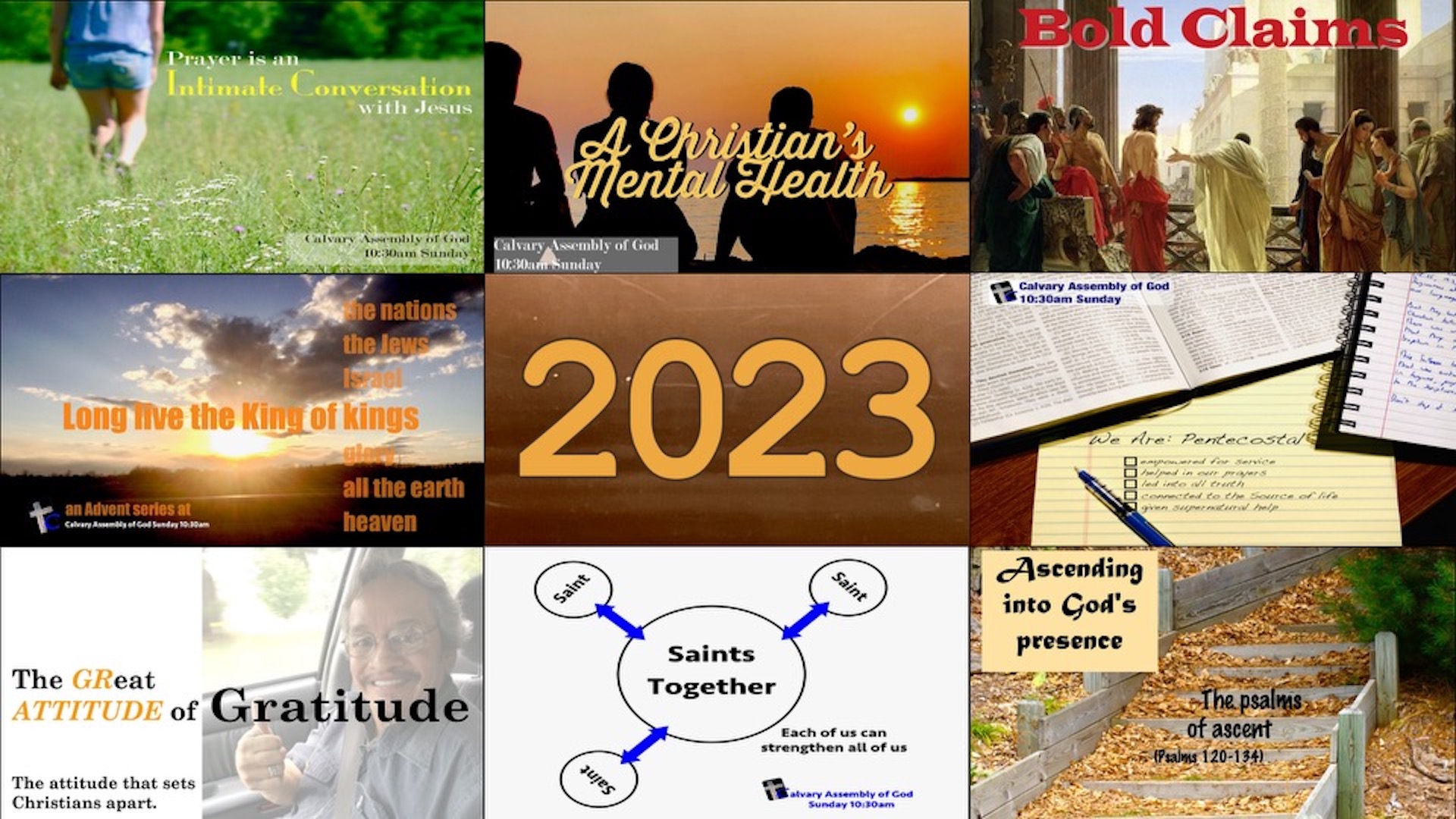
Intimate Conversation—The dictionary defines the word “intimate” with these phrases: associated in close personal relations, characterized by warm friendship, and closely personal. These words perfectly describe the relationship God wants to have with His children through prayer. Pete Briscoe said, “Prayer is an intimate conversation with the One who passionately loves you and lives in you.” The One who loves you so passionately desires to walk with you and share intimate knowledge with you. Prayer is not something formal, cold, or mechanical, but it is vibrant, warm, engaging, and life-changing.
A Christian’s Mental Health—I don’t think there is any arguing that Jesus was the healthiest individual who ever walked planet Earth. Some may want to push back with, “Of course He was because He didn’t have any problems to deal with!” But the writer of Hebrews tells us that Jesus experienced everything you and I will ever experience (Hebrews 2:17), so His deity didn’t exclude Him from the stressors that His humanity would have to face. And yet, He handled all of these things successfully. Luke the physician observed the growth of Jesus and tells us that it all began with Jesus having a robust mental health. From that foundation, everything else—physical, spiritual, relational—all could develop properly. We must learn from this example and pay careful attention to our own mental health.
Bold Claims—“That’s a pretty bold claim. Are you prepared to back that up?” I’ll bet you have heard something like that said to you, and maybe you have even said that yourself to someone else who made a big, audacious statement. After Jesus is arrested by the religious leaders—an arrest that will ultimately lead to Jesus being crucified on the Cross—there are some incredibly bold claims spoken by key people in this part of the Story. For the most part, these are claims that we don’t read earlier in any of the Gospels, but as this story is heading toward its most crucial moment, we have these audacious statements pronounced. But here’s the most important part: These bold claims weren’t just made, but they were backed up with proof as well.
We Are: Pentecostal—Pentecost for over 1500 years was a celebration in Jerusalem that brought in Jews from all over the world. But on the Day of Pentecost that came just ten days after Jesus ascended back into heaven, the meaning of Pentecost was forever changed! Followers of Jesus—now empowered by an infilling of the Holy Spirit—began to take the good news of Jesus all over the world. These Spirit-filled Christians preached the Gospel and won converts to Christ even among hostile crowds, performed miracles and wonders, stood up to pagan priests and persecuting governmental leaders, and established a whole new way of living as Christ-followers. We, too, can be Pentecostal followers of Jesus Christ today.
Ascending—Every year, Jews from around the world made four pilgrimages up to Jerusalem for various feasts and sacrifices. These journeys reminded them of God’s goodness as they went to the Temple to worship, and they helped refocus on God’s ways as they returned to their regular routines. Jerusalem is over 2500 feet above sea level, so the pilgrimage there was a physical workout as well as a spiritual workout. These workouts were beneficial for God’s people, preparing them to minister in their cities in the following months. The Book of Psalms contains 15 songs that these pilgrims would sing to and with each other as they traveled up to Jerusalem. These Psalms of Ascent are still instructive for Christians today.
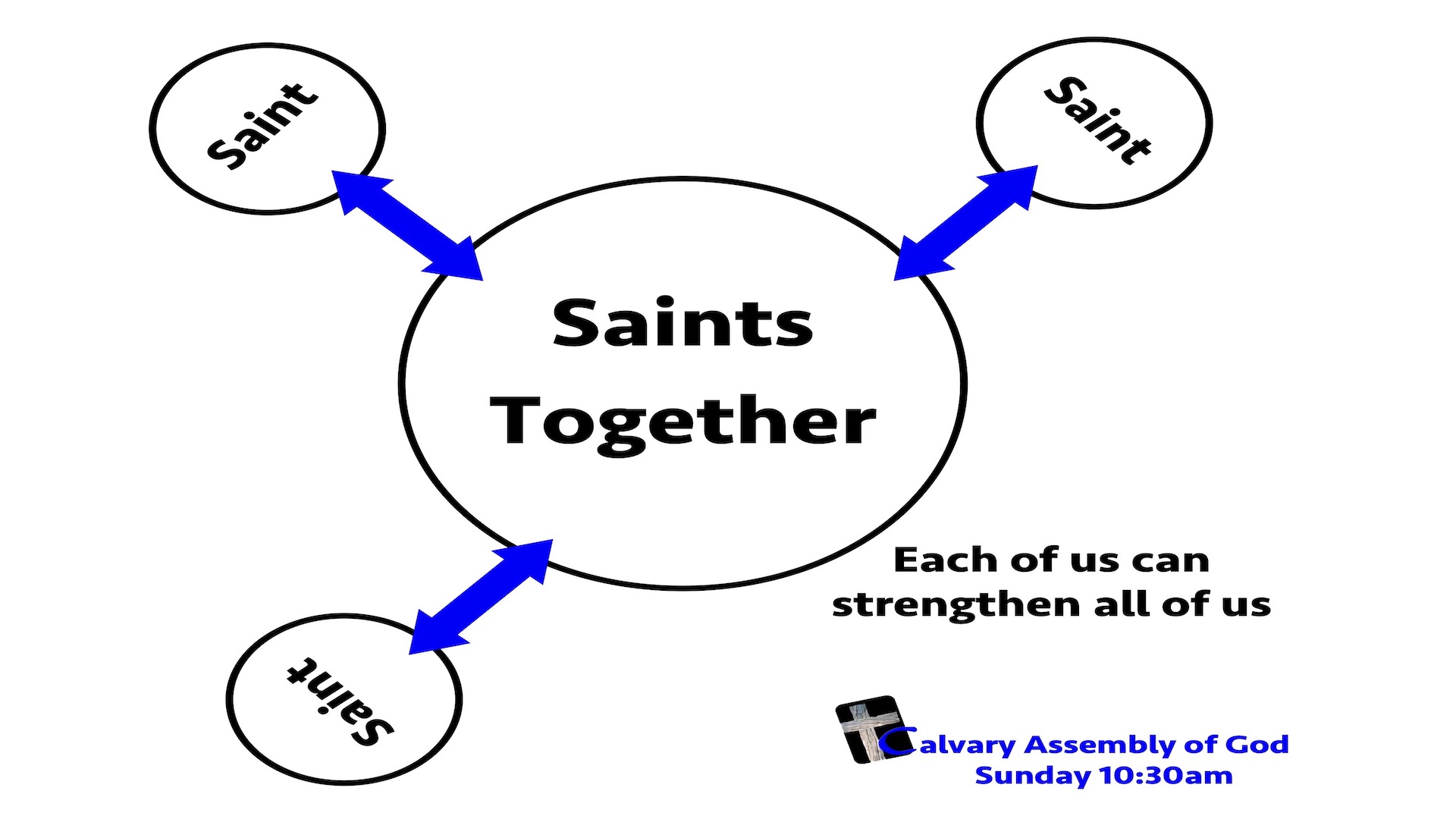
Saints Together—Throughout the New Testament the word “saints” is always in the plural form. This is a clear indication that none of us can develop into the full-fledged Christians we were meant to be on our own. We all need each other. More specifically, we all need the most mature version of each other. A key component of an individual saint’s development is the time spent alone being forged by the discipline of the Holy Spirit. Maturing saints then come together with each other to continue to strengthen and sharpen everyone in the church. Strong individual saints make a strong church, and a strong church makes strong individual saints! Let’s learn about six important spiritual disciplines that each individual saint must put into practice so that they can use their newly developed strengths to help other saints in their own development.
The Great Attitude Of Gratitude—There’s something about gratitude that distinguishes people. Think about it: would you rather hang around with grumblers or grateful people? The gratitude of Paul and Silas certainly made them stand out from the crowd when they were in Philippi. Wrongly accused, beaten, and thrown in prison, but instead of bellyaching, they were praising God. Later on, when Paul wrote his letter to the Christians in Philippi, the theme of gratefulness permeates his letter. The distinguishing mark is actually in the title: The GReat ATTITUDE spells out GRATITUDE!
Long Live The King Of Kings—Throughout human history, whenever a king died, the people would say something like, “The king is dead. Long live the king!” They would say this because the next king ascended to the throne immediately after his predecessor died. Except when a nation had been defeated, the cry, “The king is dead” was unanswered by, “Long live the king!” Israel must have felt like this. After being defeated by Nebuchadnezzar and spending 70 years in exile, it appeared to many that the line of kings was broken. Even after retuning to their homeland, Israel continued to live under the thumb of other powerful nations. And yet, some still clung to the glimmer of the promise God had made about an eternal King sitting on Jerusalem’s throne. The First Advent of Jesus revealed to us in the Gospels reassures us that the promise of an eternal King is true. Jesus came to earth to reveal His majesty to us. The First Advent is so important because it bolsters our faith for the imminent Second Advent when Jesus will return as the King of kings! Christmas is a great time to be reminded that even now we can confidently declare, “Long live the eternal King of kings!”
2024 promises to be an exciting year! If you don’t have a home church in the northern Kent County area, I would love to have you join us!



 A couple of other blog posts that may help you on this topic of servant leadership are:
















 Craig T. Owens