Altar To Alter

Listen to the podcast of this post by clicking on the player below, and you can also subscribe on AppleSpotify, or Audible.

The process of sanctification—or as I like remember the word: saint-ification—is the process whereby the Holy Spirit develops Christlike character in us. His process is immediate, personalized, and ongoing. In other words, the Spirit is intimately and immediately involved in every aspect of our lives.

Christlikeness in us is described in the Bible with phrases like…

  • Being made new in the attitude of your minds; and putting on the new self, created to be like God in true righteousness and holiness (Ephesians 4:23-24).
  • Conformed to the likeness of God’s Son (Romans 8:29).

The Holy Spirit is often portrayed as fire. In fact, the Bible says that Jesus will baptize you with the Holy Spirit and with fire (Matthew 3:11). This is because in order for Christlike character to be formed in us, that character will have to be forged in us. Forged in the Spirit’s fire.

Look at two examples:

  • Until the time came to fulfill his dreams, the Lord tested Joseph’s character (Psalm 105:19).
  • Even though Jesus was God’s Son, He learned obedience from the things He suffered (Hebrews 5:8).

Here’s what I’ve learned—

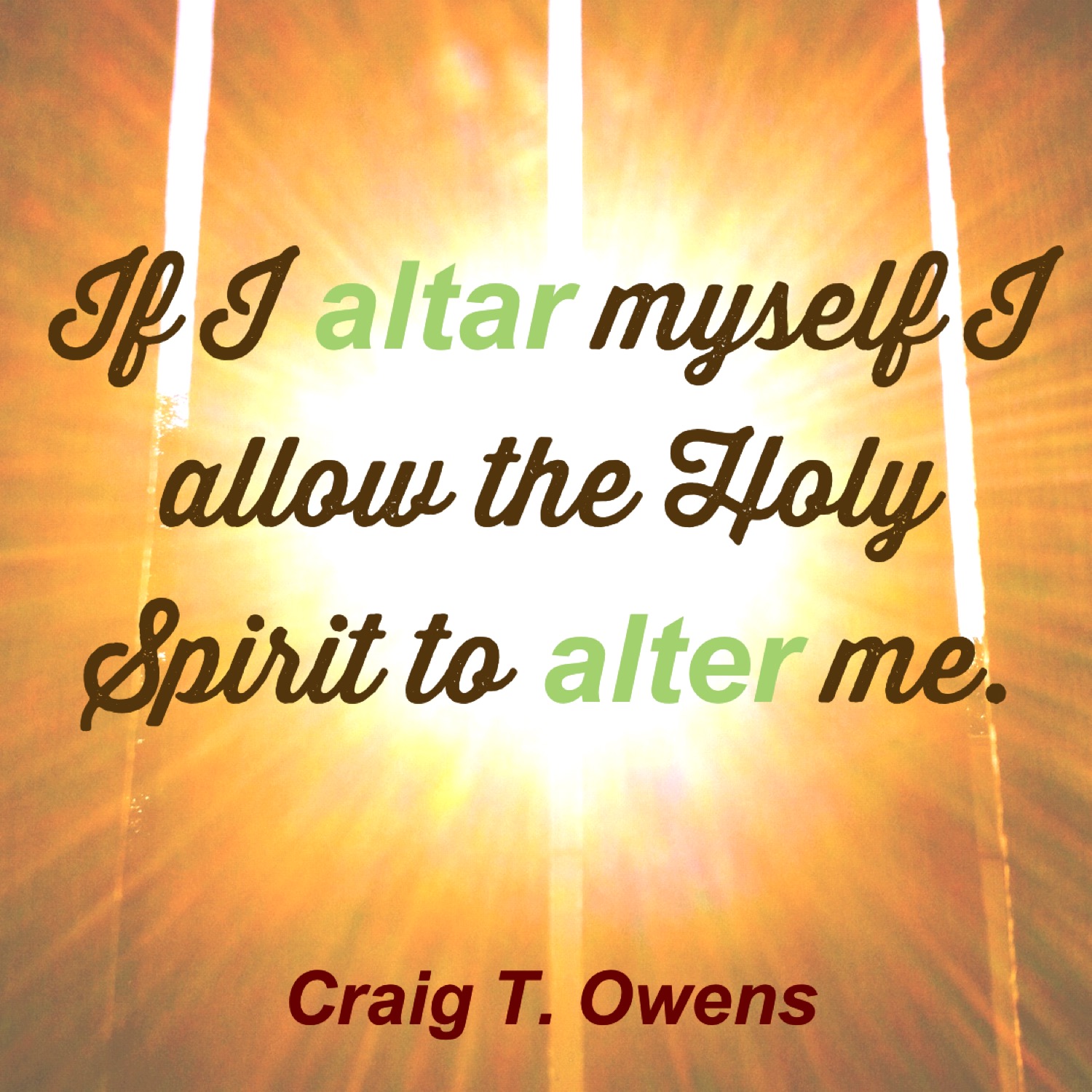
We must altar our lives so that the Holy Spirit can alter our lives.

Unless we yield to what the Holy Spirit wants to do with us, He cannot and will not bring about the changes that will lead to more Christlikeness being revealed in us.

It may be painful to altar our lives, but the apostle Paul says, “I consider that our present sufferings are not worth comparing with the glory that will be revealed in us” (Romans 8:18).

You altar, and then watch the Holy Spirit alter your life in a way that reveals God’s glory!

►► Would you please prayerfully consider supporting this ministry? ◀︎◀︎

Worship Where You Are

Worship everywhereO God, we meditate on Your unfailing love as we worship in Your Temple. (Psalm 48:9)

“We can go to church and worship. But if we go to church and worship one day, it is not true worship unless it is followed by continuing worship in the days that follow.” (A.W. Tozer)

It’s easy to say, “O God, I worship You in church on Sunday,” but can I also say…

…I worship You in my office on Monday.

…I worship You in my basketball game on Tuesday.

…I worship You in my commute on Wednesday.

…I worship You in my dinner preparations on Thursday.

…I worship You in my house cleaning on Friday.

…I worship You in my golf game on Saturday.

Worship means making sure what I’m doing is pleasing to God, and glorifying God. It means I am doing my utmost for His highest. It means I am doing what I’m doing so that others see God in it, and are prompted to worship Him too.

Worship wherever you are today, and not just in your church building on Sunday. Let TRUE worship be seen all day, everyday, in everything.

My Prayer

Right from my journal…

My prayerHeavenly Father,

May those who hope in You not be disgraced because of me, O Lord, the Lord Almighty; may those who seek You not be put to shame because of me, O God of Israel. Amen.


Great Is Your Renown

No Exceptions

Listen to the podcast of this post by clicking on the player below, and you can also subscribe on AppleSpotify, or Audible. 

King David wrote a coronation psalm for his son Solomon as he ascended the throne in Jerusalem. The opening words say, “Endow the king with Your justice, O God, the royal son with Your righteousness. He will judge Your people in righteousness, Your afflicted ones with justice” (Psalm 72:1-2).

David was calling on God’s blessing on his son, but He was also reminding Solomon that he couldn’t rule without God’s help. David’s singular focus was for God to receive all the glory. He closes the coronation psalm like this: “Praise be to the Lord, the God of Israel, Who alone does marvelous deeds. Praise be to His glorious name forever; may the whole earth be filled with His glory. Amen and Amen” (vv. 18-19).

Solomon started out well. “Solomon son of David established himself firmly over his kingdom, for the Lord his God was with him and made him exceedingly great” (2 Chronicles 1:1). Even when God gave Solomon the option to ask for anything, he choose wisdom “to govern this great people of Yours (1 Kings 3:7-9).

David strongly impressed on Solomon that obedience to God was the key to God’s blessing on Solomon and on the nation of Israel. “So be strong, act like a man, and observe what the Lord your God requires: Walk in obedience to Him, and keep His decrees and commands, His laws and regulations, as written in the Law of Moses. Do this so that you may prosper in all you do and wherever you go” (1 Kings 2:2-3).

But there is an ominous word that creeps in very early on in Solomon’s reign. Just one word that foreshadows the downfall that is to come—

Solomon showed his love for the Lord by walking according to the instructions given him by his father David, EXCEPT (1 Kings 3:3).

As you’ve probably heard, Solomon’s many foreign wives began to lead him astray from “observing what the Lord your God requires” and eventually became his downfall. But it began right here with the EXCEPT.

It’s all or nothing.

I cannot pick and choose which words from God I’m going to follow and which I’m going to “except.” If God says I must do it, then I must do it!

The EXCEPT will lead to my downfall just as surely as it did for Solomon.

Heavenly Father, may I be so sensitive to the prompting of Your Holy Spirit if I’ve let any EXCEPTs creep into my life. Reveal them to me so that I may repent, show myself a man, and follow You wholeheartedly.

►► Would you please prayerfully consider supporting this ministry? My Patreon supporters get behind-the-scenes access to exclusive materials. ◀︎◀︎

The Incense Of Prayer

E.M. Bounds has challenged and inspired my prayer life probably more than any other author. Check out these words from his book Purpose In Prayer

Purpose In Prayer“God shapes the world by prayer. Prayers are deathless. The lips that utter them may be closed in death, the heart that felt them may have ceased to beat, but the prayers live before God, and God’s heart is set on them and prayers outlive the lives of those who uttered them; outlive a generation, outlive an age, outlive a world.

“That man is the most immortal who has done the most and the best praying. They are God’s heroes, God’s saints, God’s servants, God’s deputies. A man can pray better because of the prayers of the past; a man can live holier because of the prayers of the past, the man of many and acceptable prayers has done the truest and greatest service to the incoming generation. The prayers of God’s saints strengthen the unborn generation against the desolating waves of sin and evil. Woe to the generation of sons who find their censors empty of the rich incense of prayer; whose fathers have been too busy or too unbelieving to pray, and perils inexpressible and consequences untold are their unhappy heritage. Fortunate are they whose fathers and mothers have left them a wealthy patrimony of prayer.” (emphasis added)

When God gave Moses instructions for building the tabernacle, the altar of incense was placed before the curtain that separated the Holy Place from the Holy of Holies. The Bible does not tell us how the high priest passed through or by the curtain, so many believe that as he worshiped God, his prayers mingled with the incense, and God translated him through the curtain and into His presence.

There are other verses to support this:

  • Let my prayer be set forth as incense before You, the lifting up of my hands as the evening sacrifice. (Psalm 141:2)
  • The book of Revelation gives us a glimpse into Heaven, and twice we see the prayers of the saints being linked with the incense of worship (see Revelation 5:8 and 8:3-4).

Notice what E.M. Bounds says … our prayers TODAY are providing the incense the NEXT GENERATION will need! If we fail to pray now, we’re not only hurting ourselves, but we’re putting our children and grandchildren on a path toward “perils inexpressible and consequences untold.”

Instead, let’s leave them “a wealthy patrimony of prayer”! Will you pray? Today?

Listen, O My Soul

Listen O my soulDavid wraps up the 35th Psalm with a thought that is familiar to him—

My tongue will speak of Your righteousness and of Your praises all day long. (Psalm 35:28)

Praise is good for the soul! But in the midst of enemies gloating over David, hating him without reason, devising false accusations against him, and making plans to do him in (see verses 19-21), where could David get the strength to sing about God’s goodness?

As I said, it’s the last verse where David declares his unending praise. This verse is the result of seeing God move. But much earlier in this psalm David says, “Say to my soul, ‘I am your salvation’” (v. 3).

Before David could speak it, he had to hear it! He had to quiet himself in the midst of all the assaults on him to hear God say, “I AM your salvation!”

Not “my ears,” but “my soul”: the very center of my being, my mind, my emotions. I need the I AM to reassure the soul He created that He is still there. Unless I hear that assurance at the core of my being, I can only go through the motions. True worship comes from a real, personal encounter with the I AM.

O, listen my soul! Hear your Savior speak the assurance of His salvation. Only then can I open my lips in endless praises all day long.

Forethought Or After-Thought?

What is man that You are mindful of him, the son of man that You care for him? You made him ruler over the works of Your hands; You put everything under his feet. (Psalm 8:4-5)

forethoughtafterIn mythology, humans are an after-thought, a nuisance, slaves and servants of the gods, and usually pawns in the gods’ scheming against each other.

But Jehovah God created man as a part of His creation. He created mankind in His own image and breathed His own life into him. After the first five days of creation, God said, “It is good.” But on the sixth day, after creating man, He said, “It is very good!”

Jehovah God has man at the forefront of His mind. He not only calls us into a relationship with Him, but the Trinity works in divine cooperation to make it possible for us to come to Him.

He doesn’t see a mass of humanity, but He sees each one of us individually and uniquely. And He is attentive to us—“For the Lord has heard my cry for mercy; the Lord accepts my prayer” (Psalm 6:9).

As David burst into praise with this realization of God’s forethought of us, let us echo this praise (Psalm 8:9)—

O Lord, our Lord, how majestic is Your name in all the earth!

The North Star

The North StarIn our series called The Star Of CHRISTmas, Pastor Josh reminded us that Jesus is the North Star.

The North Star never wavers, never moves; it’s always constant.

But as Josh reminded us, light pollution sometimes makes it hard to see the North Star. The bright lights of the city, airplane lights, and even street lights make it difficult to know for sure we are following the North Star.

Jesus is the North Star—“I am the way, the truth, and the light” (John 14:6). But there are so many things that bring light pollution to His bright, unwavering, unchanging light. Lights that say, “This is important,” or “This light will get you where you need to go,” or even “All lights are equal.”

In this busy time of year, it’s important for us to take the time to filter out light pollution, and make sure that we are truly following Jesus. David prayed a great prayer, “Search me, O God, see if there is any offensive ways in me” (Psalm 139:23-24). It’s a great prayer for us to pray too.

Check out the other ways Jesus shined brightly at His Advent in our series The Star Of CHRISTmas.

See God Bigger

See God BiggerGlorify the Lord with me; let us exalt His name together. (Psalm 34:3)

“I am positively sure after many years of observation and prayer that the basis of all of our trouble today, in religious circles, is that our God is too small. When David says magnify the Lord, he doesn’t mean that you are to make God big, but you are to see Him big. When we take a telescope and look at a star, we don’t make the star bigger, we only see it big. Likewise you cannot make God bigger, but you are only to see Him bigger. … My brethren, God calls us to magnify Him, to see Him big. A meeting is not big because a lot of people are present. A meeting is big because a number of people see a big God in the meeting. And the bigger God is seen, the greater the meeting. A friend of mine has a little saying, ‘I would rather have a big, little meeting than a little, big meeting.’ There are a lot of big meetings that are little because the God in them is a small God. And there are a lot of little meetings that are big because God is big in the midst of them. … That is the first thing—magnify God. Your ministry will be little, and you will live and die little unless you have a bigger God.” —A.W. Tozer