
8 Quotes Worth Studying From “Proverbs”

ProverbsIn my review of Proverbs by Charles Bridges (which you can read by clicking here), I noted how he weaved the principles in the biblical book of Proverbs into the teaching that occurs throughout the Scripture. In others words, he showed that the wisdom in Proverbs wasn’t just a “stand-alone” wisdom, but integrated into the whole.

In the quotes I’m sharing today, I trust you will get a glimpse of what I mean. The reference in brackets before the quote indicate the Proverb to which Bridges is commenting. I have also linked all of the Scripture references to my friends at Bible Gateway, so you can look them up easily (and I encourage you to do so!).

[Proverbs 1:10-16] “If the temptation prevail, charge it not on God; no—nor on the devil. As the worst he can do, he can only tempt, he cannot force us, to sin. When he has plied us with his utmost power, and most subtle artifice, it is at the choice of our own will, whether we yield or no (see James 1:13-15). The habitual resistance of the will clears us of responsibility (cp. Romans 7:14-17, 19-20, 23). The consent, even if it be not carried out into the act, lays the responsibility at our own door.”

[Proverbs 2:10-11] “The forsaken sin only makes way for some more plausible, but not less deadly passion. The heart, cast into the mold of the Gospel, is the only cover from those snares within and without (Romans 6:17, 18; 2 Corinthians 3:18), which so imperceptibly, yet so fatally, estrange us from God. Never, till the vital principle is implanted, is their mischief discerned. Never, till then, does the heart find its proper object, its true resting-place.”

[Proverbs 3:5-6] “Take one step at a time, every step under Divine warrant and direction (cp. Ezekiel 18:21-23; Nehemiah 1:11). Ever plan for yourself in simple dependence on God. It is nothing less than self-idolatry to conceive that we can carry on even the ordinary matters of the day without His counsel. He loves to be consulted. Therefore, take all thy difficulties to be resolved by Him. Be in the habit of going to Him in the first place—before self-will, self-pleasing, self-wisdom, human friends, convenience, expediency. Before any of these have been consulted, go to God at once. Consider no circumstances too clear to need His direction. In all thy ways, small as well as great; in all thy concerns, personal or relative, temporal or eternal, let Him be supreme.”

[Proverbs 3:11-12] “Faith understands the reasons of the discipline (1 Peter 1:6, 7); acknowledges it as a part of His gracious providence (Deuteronomy 8:2, 15, 16), and the provision of His everlasting covenant (Psalm 89:30-32); waits to see the end of the Lord (James 5:11); and meanwhile draws its main support from the seal of adoption.”

[Proverbs 4:14-17] “To pray not to be led into temptation; yet not to watch, that we enter not into it (Matthew 6:13; 26:41)—is practically to contradict our prayers; to mock our God, by asking for what we do not heartily wish.”

[Proverbs 11:18-19] “Righteousness is the seed; happiness is the harvest. The reward indeed is not from cause, but of consequence; not of debt, but of grace depending upon a free promise; mercifully yet surely linked with Christian perseverance (Ecclesiastes 11:6; Hosea 10:12; 1 Corinthians 15:58; Galatians 6:7, 8).”

[Proverbs 17:22] “If then, Christian, you believe the Gospel to be ‘glad tidings’ (Luke 1:19; 8:1), show that you believe it, by lighting up your face with a smile.”

[Proverbs 28:13] “The love of sin struggles with the power of conscience. The door of access to God is barred (Psalm 66:18). Christian confidence is clouded (Psalm 32:3, 4); and, unless Sovereign mercy interpose, it must end in the sting of ‘the never-dying worm’ (Isaiah 66:24; Mark 9:44-48). The covering of the disease precludes the possibility of the cure. Only the penitent confessor can be the pardoned sinner.”

“The best work on the Proverbs. While explaining the passage in hand, he sets other portions of the Word in new lights.” —C.H. Spurgeon, commenting on this book


11 More Quotes From “Our Portrait In Genesis”

The Complete Works Of Oswald ChambersOswald Chambers’ book Our Portrait In Genesis is an excellent companion book when you read the book of Genesis from the Bible. I’ve already shared a few quotes from this book here, and here. Below are a few more I found highlighter-worthy.

“Degeneration and backsliding are by no means one and the same. Degeneration begins in almost imperceptible ways; backsliding in the Scriptural use of the term is a distinct forsaking of what I know of God and a deliberate substitution of something other (cf. Jeremiah 2:13). … If I maintain my right to my natural self I will begin to degenerate and get out of God’s purpose. … If I refuse to sacrifice the natural, the God-life in me is killed.”

“To experience conviction of sin is not a cause for misgiving, but an occasion for understanding the impossible things God has done in the Redemption.”

“All through, a personal crisis ought to serve as an occasion for revealing the fact that God reigns, as well as compelling us to know our own character.”

“We have the notion that it is only when we are pure and holy that God will appear to us; that God’s blessing is a sign that we are right with Him. Neither notion is true. Our Lord took care to say that God makes His sun to rise on the evil and on the good, and sends His rain on the just and on the unjust. God’s blessings are not to be taken as an indication of the integrity of the character blessed, yet on the other hand the discernment of God’s character is determined entirely by the individual character of the person estimating God. ‘With the merciful You will show Yourself merciful’ (Psalm 18:25). The way I discern God’s character is determined by my own character. God remains true to His character, and as I grow in integrity I discern Him. Jacob’s undeservedness, and the fact that God continually blesses him, are brought out very clearly all through his life.”

“‘I can’t understand why I have no confidence in God’; the reason may be a matter of digestion, not enough fresh air, or sleep, too much tea—something slight. It is the shallow things that put us wrong much more quickly than the big things. The great object of the enemy of our souls is to make us fling away our confidence in God; to do this is nothing less than spiritual suicide. When we experience misgiving because we have sinned there is never any ambiguity as to its clause, the Holy Spirit brings conviction home like a lightning flash.”

“Prayer in distress dredges the soul (cf. Psalm 107). It is a good thing to keep note of the things you prayed about when you were in distress. We remain ignorant of ourselves because we do not keep a spiritual autobiography.”

“That is always the test of the reality of sanctification, not so much that I have received something, but that I have ceased to be my old self.”

“The warrior of God is not the man of muscle and a strong jaw, but the man of un-utterable weakness, the man who knows he has not any power; Jacob is no longer strong in himself, he is strong only in God, his life is no longer marked by striving, but by reliance on God. You cannot imitate reliance on God.”

“Authority never comes from you, but from God through you, therefore let God introduce or withhold as He chooses.”

“Beware of saying, ‘Oh well, it doesn’t matter much what I think about in secret’; it does, for the opportunity will come when what you think about in secret will find expression and spurt out in an act. The Bible always speaks of sin as it appears in its final analysis. Jesus does not say, ‘You must not covet because it will lead to stealing’; He says, ‘You must not covet because it is stealing.’ He does not say, ‘You must not be angry with your brother because it will lead to murder’; He says, ‘You must not be angry with your brother because it is murder.’”

“Four times over in this chapter [Genesis 39] is this statement made, ‘the Lord was with Joseph.’ It is the presence of God that is the secret of victory always. The fear of the Lord creates an atmosphere in which impure thoughts and unholy desires die a natural death.”

You can also read my review of this book by clicking here.

Try Reverse Thinking

Listen to the podcast of this post by clicking on the player below, and you can also subscribe on Apple or Spotify.

Today was the absolute worst day ever
And don’t try to convince me that
There’s something good in every day
Because, when you take a closer look,
This world is a pretty evil place.
Even if
Some goodness does shine through once in a while
Satisfaction and happiness don’t last.
And it’s not true that
It’s all in the mind and heart
Because
True happiness can be obtained
Only if one’s surroundings are good
It’s not true that good exists
I’m sure you can agree that
The reality
Creates
My attitude
It’s all beyond my control
And you’ll never in a million years hear me say that
Today was a good day
(now read from the bottom to the top)

Psychologists call it metacognition when we think about what we’re thinking about. The Bible calls it capturing every thought (2 Corinthians 10:5).

Sometimes it takes reversing our thinking.

The devil has a singular agenda: He wants to steal joy from your life, he wants to kill any hope you have for the future, and he wants your end to be utter destruction.

Jesus has a singular agenda for you too: I have come that you might have abundant life.

Try reversing your thinking. Try thinking about your thinking a different way.

The devil says, “Life has no purpose.” God says, “I created you on purpose.”

The devil says, “You’re nothing special.” God says, “You’re one-of-a-kind.”

The devil says, “God remembers you blew it.” God says, “I’ve forgotten everything I’ve forgiven.”

The devil says, “This life is all there is.” God says, “You can’t even imagine what’s coming next!”

The devil says, “You’ll never find true love.” God says, “I love you so much that I died for you.”

Reverse your thinking to listen to what God says. Then you will be able to reverse today was the absolute worst day ever to today was a good day!

►► Would you please prayerfully consider supporting this ministry? My Patreon supporters get behind-the-scenes access to exclusive materials. ◀︎◀︎

John Piper On Fear

I read this in a devotional from John Piper this morning, and wanted to pass it on.

John PiperOne possible response to the truth that our anxiety is rooted in unbelief goes like this: “I have to deal with feelings of anxiety almost every day; and so I feel like my faith in God’s grace must be totally inadequate. So I wonder if I can have any assurance of being saved at all.”

My response to this concern is: Suppose you are in a car race and your enemy, who doesn’t want you to finish the race, throws mud on your windshield. The fact that you temporarily lose sight of your goal and start to swerve does not mean that you are going to quit the race.

And it certainly doesn’t mean that you are on the wrong racetrack. Otherwise, the enemy wouldn’t bother you at all. What it means is that you should turn on your windshield wipers.

When anxiety strikes and blurs our vision of God’s glory and the greatness of the future that He plans for us, this does not mean that we are faithless, or that we will not make it to heaven. It means our faith is being attacked.

At first blow, our belief in God’s promises may sputter and swerve. But whether we stay on track and make it to the finish line depends on whether, by grace, we set in motion a process of resistance—whether we fight back against the unbelief of anxiety. Will we turn on the windshield wipers?

Psalm 56:3 says, “When I am afraid, I put my trust in You.”

Notice: it does not say, “I never struggle with fear.” Fear strikes, and the battle begins. So the Bible does not assume that true believers will have no anxieties. Instead, the Bible tells us how to fight when they strike. (emphasis mine)

Check out this and other great devotional resources through BibleGateway.com by clicking here.

Links & Quotes

link quote

“The Kingdom of God is Good News because it ushers all who receive it into God’s good plan for their lives, a plan which brings them, among other things, pleasures forevermore (Psalm 16:11).” —T.M. Moore

“Remember a little more the intimate connection between the body and the soul. Go to the poor man and tell him of the bread of heaven, but first give him the bread of earth, for how shall he hear you with a starving body?” —Charles Spurgeon

“We must open our Bibles every morning with this prayer—‘Give us this day our daily bread.’” —Charles Spurgeon

“The Lord rebukes his people for seeking ‘their own’ pleasure on His holy day [Isaiah 58:3-4]. But what does He mean? He means they are delighting in their business and not in the beauty of their God. He does not rebuke their hedonism. He rebukes the weakness of it. They have settled for secular interests and thus honor them above the Lord. Notice that calling the Sabbath ‘a delight’ is parallel to calling the holy day of the Lord ‘honorable.’ This simply means you honor what you delight in. Or you glorify what you enjoy. The enjoyment and the glorification of God are one. His eternal purpose and our eternal pleasure unite.” —John Piper

“We may conclude that the chief end of God is to glorify God and enjoy Himself forever. He stands supreme at the center of His own affections. For that very reason, He is a self-sufficient and inexhaustible fountain of grace.” —John Piper

David Wilkerson warns, “We think that when we fail to trust God in our daily situations, we only harm ourselves. We think we’re simply missing out on His blessings. But that isn’t the whole story. … Unbelief is the mother of all sins.”

Stan Guthrie writes about the strange spectacle of Christian surrender in cultural ideas. He states, “We need more cultural engagement, not less, particularly in the realm of ideas.”

Max Lucado recalls an amazing story from the life of John Wesley and then asks, “How bold are your prayers?”


Links & Quotes

link quote

“Don’t dare to be different, dare to be yourself—if that doesn’t make you different then something is wrong.” —Laura Baker

“Real joy is to be found in the presence of God, with Jesus Christ, secure and loved forever and ever (Psalm 16:11). Knowing the presence of God is the unique privilege of all who have made the Kingdom turn. God never changes in His love for us, and Jesus Christ holds us fast forever, regardless of the outward circumstances of our lives. The result of experiencing this is joy.” —T.M. Moore

“We can do nothing unless by a supernatural grace of God. It is God who gives the will. It is God who gives the power.” —John Calvin

“How singularly does God, in political events, prepare men’s minds for the particular phase which His church assumes! … I cannot go into the question now, but every Christian student of history knows that the circumstances of the outward world have ever been arranged by God so as to prepare the way for the advance of His great cause.” —Charles Spurgeon

“There is no such thing as genuine knowledge of God that does not show itself in obedience to His Word and will.” —Sinclair B. Ferguson

Eric Metaxas reminds us why Darwinism cannot explain religion. Check out Saber-tooth Psychology.

New emails continue to show the tragedy that Benghazi is. Hold our leaders accountable!

Tim Elmore explains how leading and following must go hand-in-hand.

[VIDEO] John Maxwell challenges us to enrich other people’s lives—

Thursdays With Oswald—Seeing The Light In The Darkness

Oswald ChambersThis is a periodic series with things I’m reading and pondering from Oswald Chambers. You can read the original seed thought here, or type “Thursdays With Oswald” in the search box to read more entries.

Thursdays With Oswald—Seeing The Light In The Darkness

   Oh, the unspeakable benediction of the ‘treasures of darkness’! But for the night in the natural world we should know nothing of moon or stars, or of all the incommunicable thoughtfulness of the midnight. So spiritually it is not the days of sunshine and splendor and liberty and light that leave their lasting and indelible effect upon the soul but those nights of the Spirit in which, shadowed by God’s hand, hidden in the dark cleft of some rock in a weary land, He lets the splendors of the outskirts of Himself pass before our eyes. It is such moments as these that insulate the soul from all worldliness and keep it in an ‘other-worldliness’ while carrying on work for the Lord and communion with Him in this present evil world. ‘Even the darkness hideth not from Thee, but the night shineth as the day; the darkness and the light are both alike to Thee’ [Psalm 139:12].

From The Place Of Help

I know from my life, there has been a ‘light’ God has revealed to me in some really, really dark places, that I wouldn’t have seen in any other way.

If your life is in a dark place right now, hang on to this: God sees you, God loves you, and God wants to show you something. Someday you will look back on this and be grateful for what God has revealed in the darkness.

The Joy Of Trials

Drawing othersA quick show of hands: How many of you would consider your difficult situations a blessing from God?

Probably not a lot of hands went up, but it’s true.

Peter lists six blessings of God for which we can bless Him (see 1 Peter 1:3-3-9):

  1. God’s great mercy
  2. New birth
  3. Living hope
  4. An inheritance that can never perish
  5. God’s shielding power
  6. Trials

Trials?! Yep!

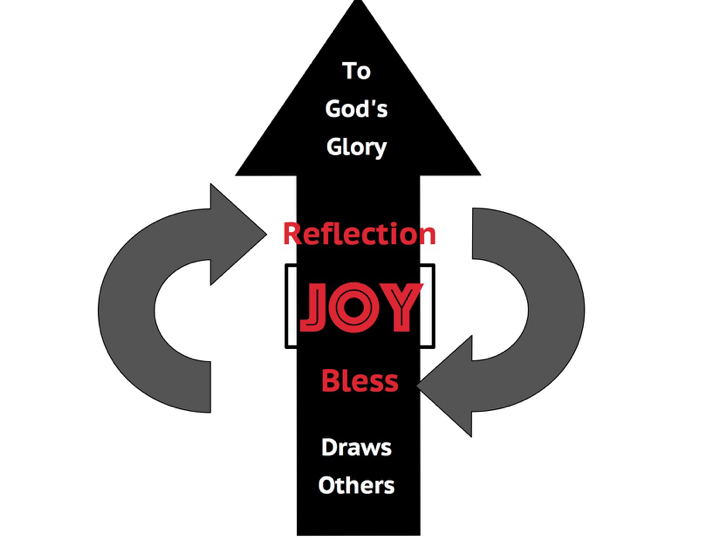
Peter is quick to tell us that trials only last for a little while, but they are sent our way to prove that our faith is genuine. He says that trials result in praise, glory and honor from God to us, and that successfully going through our trials lead to “an inexpressible and glorious joy.”

In trials you probably don’t feel like praising God, but our God-breathed soul is made up of more than just emotions. We also have been given a mind and a will. So here’s what I would suggest—in your trials, use your mind to reflect on the blessings of God. Then use your will to open your mouth. When you you do this, you will experience the emotion of an inexpressible and glorious joy.

In other words: you are more likely to act yourself into feeling than you are you feel yourself into action!

Look at how David did this in Psalm 34. In a huge trial…

  • …he used his mind and will: I will extol the Lord at all times.
  • …then his emotions kicked in: My soul will boast in the Lord.
  • …his worship helped others: let the afflicted hear and rejoice.
  • …and this pointed everyone to God: Glorify the Lord with me; let us exalt His name together.

Seeing your trials as a way to bless God not only benefits you, but it draws others to God’s sustaining power as well.

If you’ve missed any messages in this series, you may find the complete list by clicking here.

Thursdays With Oswald—The Memory Of Sin

This is a periodic series with things I’m reading and pondering from Oswald Chambers. You can read the original seed thought here, or type “Thursdays With Oswald” in the search box to read more entries.

The Memory Of Sin

     No aspect of Christian life and service is in more need of revision than our attitude to the memory of sin in the saint. When the Apostle Paul said “forgetting those things which are behind,” he was talking not about sin, but about his spiritual attainment. Paul never forgot what he had been; it comes out repeatedly in the Epistles—“For I am the least of the apostles, that am not meet to be called an apostle” (1 Corinthians 15:9); “unto me who am less than the least of all saints, is this grace given” (Ephesians 3:8); “…sinners, of whom I am chief” (1 Timothy 1:15). …

     If one wants a touchstone for the depth of true spiritual Christianity, one will surely find it in this matter of the memory of sin. There are those who exhibit a Pharisaic holiness, they thank God with an arrogant offensiveness that they are “not as other men are”; they have forgotten the horrible pit and miry clay from whence they were taken, and their feet set upon a rock through the might of the Atonement. … 

     May the conviction of God come with swift and stern rebuke upon any one who is remembering the past of another, and deliberately choosing to forget their restoration through God’s grace. When a servant of God meets these sins in others, let him be reverent with what he does not understand and leave God to deal with them. 

From Conformed To His Image (emphasis added)

These are good questions for Christians to ask themselves regularly: (1) Am I remembering the sins of others the way I would want others to remember my sins? (2) Am I remembering my forgiven sins the way that God remembers them (Psalm 103:10-12)?

Links & Quotes

link quote

“Are our ears ever open? Are we eager listeners? As ready to hear as God is to speak? Oh, how much we lose of happy wisdom, simply from not listening!” —Horatius Bonar

“It would be a great folly and a great tragedy if a man loved his wedding band more than he loved his bride. But that is what this passage [Romans 1:22-23] says has happened. Human beings have fallen in love with the echo of God’s excellency in creation and lost the ability to hear the incomparable, original shout of love [Psalm 19:1-2].” —John Piper

Charles Spurgeon was a Calvinist, which means he held to the doctrine of predestination, but read how he pulled together both predestination and freewill. “It is a wonderful thing how God effects His purpose while still the creature is free. They who think that predestination and the fulfillment of the divine purpose is contrary to the free-agency of man, know not what they say, nor whereof they affirm. It would be no miracle for God to effect His own purpose, if He were dealing with stocks and stones, with granite and with trees; but this is the miracle of miracles, that the creatures are free, absolutely free, and yet the divine purpose stands. Herein is wisdom. This is a deep unsearchable. Man walks without a fetter, yet treads in the very steps which God ordained him to tread in, as certainly as though manacles had bound him to the spot. Man chooses his own seat, selects his own position, guided by his will he chooses sin, or guided by divine grace he chooses the right, and yet in his choice, God sits as Sovereign on the throne; not disturbing, but still over-ruling, and proving Himself to be able to deal as well with free creatures as with creatures without freedom, as well able to effect His purpose when He has endowed men with thought, and reason, and judgment, as when He had only to deal with the solid rocks and the imbedded sea.” —Charles Spurgeon

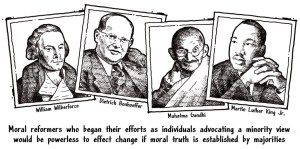
Moral truth advocatesJ. Warner Wallace asks, “Are moral truths a product of culture? Can they be explained by purely naturalistic forces?”

[VIDEO] Are you on the wrong side of history? Check out Jonah Goldberg’s insightful commentary on this question—