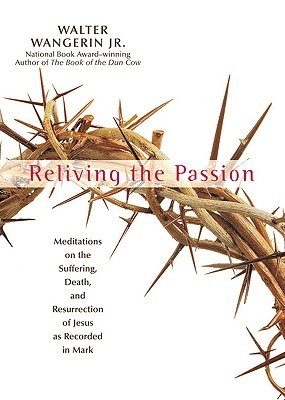
The path that Jesus walked that led from His arrest, to His shameful mistreatment at the hands of religious and irreligious alike, to His crucifixion, and ultimately to His death on Golgotha was so packed with significance and emotion that it has come to be known simply as “the passion of Jesus.” Walter Wangerin, Jr. invites us to walk alongside Jesus through the thought-provoking words in his book Reliving The Passion.
Reliving is set up to be a 40-day journey from Ash Wednesday through Resurrection Sunday, and uses mainly the Gospel of Mark as its source material. Along this journey you will see and learn and feel things you may have previously overlooked.
Wangerin says, “When we genuinely remember the death we deserve to die, we will be moved to remember the death the Lord in fact did die.” To help us remember the passion of Jesus Christ, Wangerin frequently speaks to us in first person. Sometimes he places himself on the scene, and sometimes he invites us to see and feel the passion of Jesus through the eyes of someone who was an eyewitness to those moments of Christ’s passion. In every instance, he invites us to view and feel the passion of Jesus for ourselves.
This is an excellent book for you to read year after year as you approach the Lenten season. Let us never forgot how much God’s love was fully expressed during His journey to the Cross.
Normally I post quotes from books I am reviewing after I have posted the review. But for Reliving, I posted quotes every day throughout the 40-day reading. You can check out all of these quotes by clicking here.
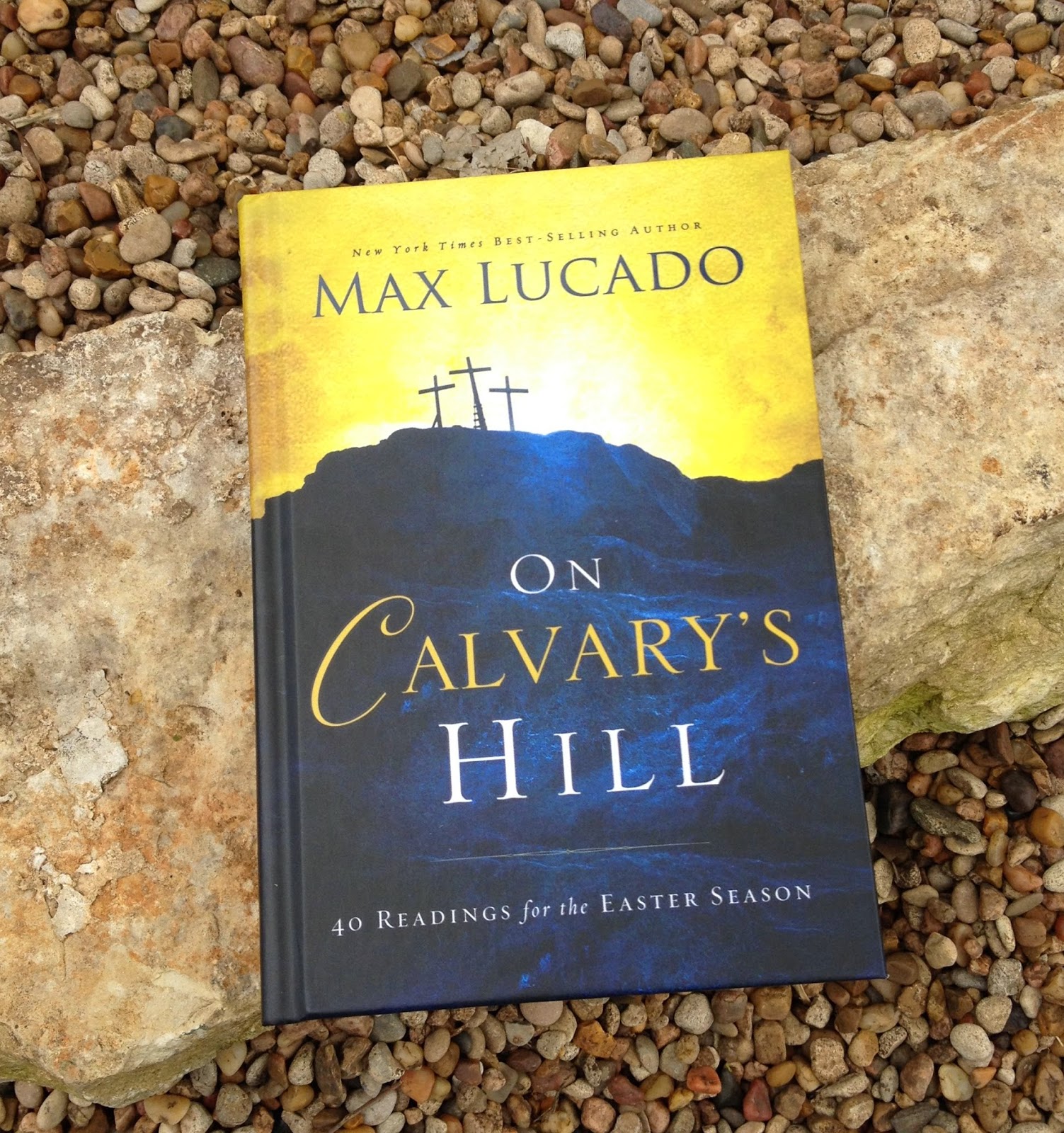
“Want to know the coolest thing about the Incarnation? Not that the One who played marbles with the stars gave it up to play marbles with marbles. Or that the One who hung the galaxies gave it up to hang doorjambs to the displeasure of a cranky client who wanted everything yesterday but couldn’t pay for anything until tomorrow. Not that He, in an instant, went from needing nothing to needing air, food, a tub of hot water and salts for His tired feet, and, more than anything, needing somebody—anybody—who was more concerned about where He would spend eternity than where He would spend Friday’s paycheck. Or that He resisted the urge to fry the two-bit, self-appointed hall monitors of holiness who dared suggest that He was doing the work of the devil. Not that He kept His cool while the dozen best friends He ever had felt the heat and got out of the kitchen. Or that He gave no command to the angels who begged, ‘Just give the nod, Lord. One word and these demons will be deviled eggs.’ Not that He refused to defend Himself when blamed for every sin of every slut and sailor since Adam. Or that He stood silent as a million guilty verdicts echoed in the tribunal of heaven and the Giver of light was left in the chill of a sinner’s night. Not even that after three days in a dark hole He stepped into the Easter sunrise with a smile and a swagger and a question for lowly Lucifer—‘Is that your best punch?’ That was cool, incredibly cool. But the coolest thing about the One who gave up the crown of heaven for a crown of thorns: He did it for you. Just for you.” —Max Lucado, On Calvary’s Hill
Throughout history, lots of martyrs have died for what they believe. But only One had been resurrected from the dead to prove that what He believed and taught was true.
Jesus, however, is not a martyr. His life and His work weren’t cut short. Calvary didn’t happen to Jesus, but He came specifically to die on a Cross. He knew what was going to happen to Him. Check this out…
Jesus predicted not only His death but His resurrection too (John 10:7-18)
Jesus knew exactly how He would die, which was not by stoning at the hands of the Jews, but by crucifixion at the hands of the Romans (John 10:22-33; Mark 8:31; Matthew 26:2)
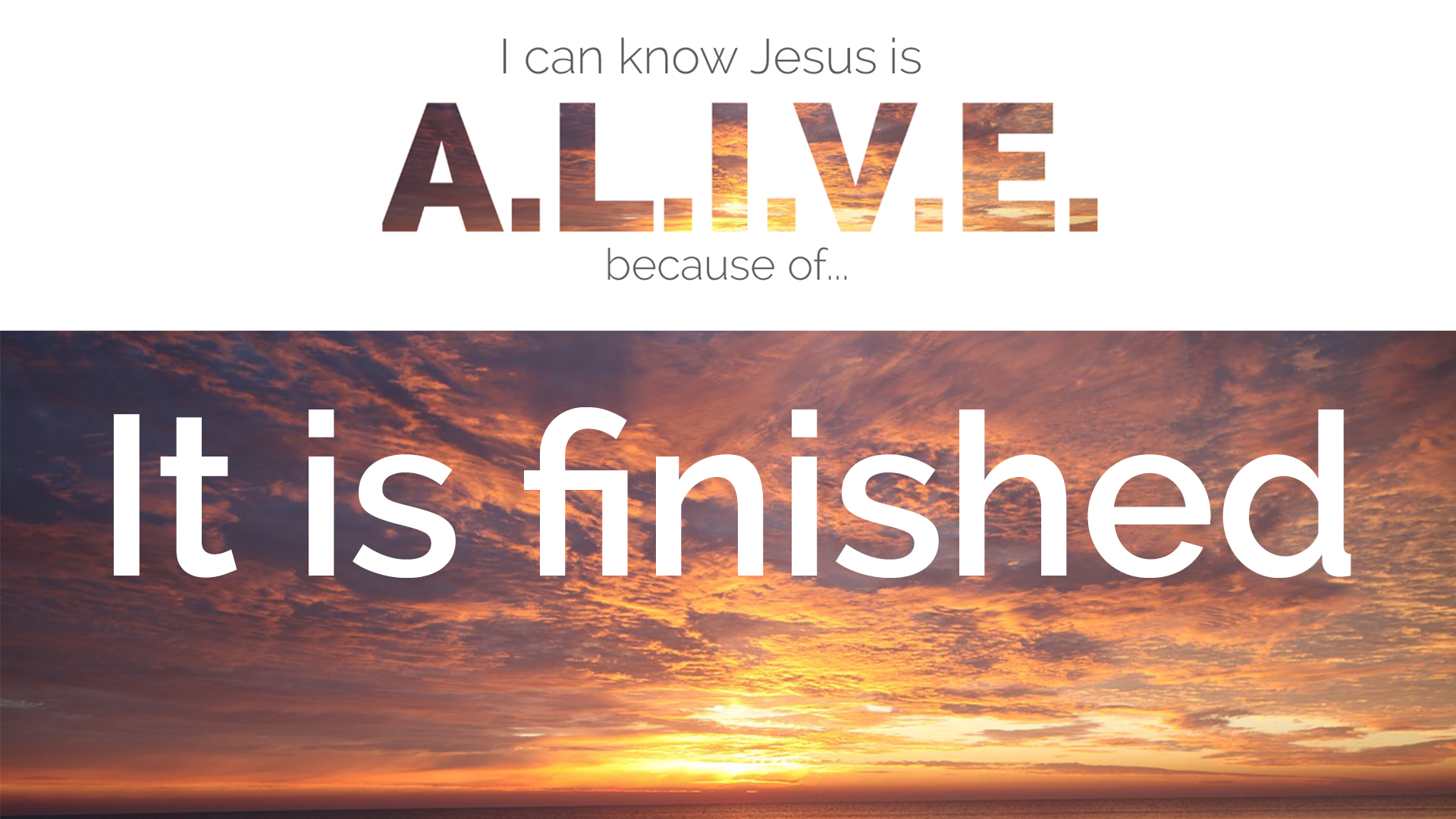
Later, knowing that everything had now been finished, and so that Scripture would be fulfilled, Jesus said, “I am thirsty.” … When He had received the drink, Jesus said,“It is finished.”
Actually His “It is finished” wasn’t just a statement, it was a yell that reverberated throughout the countryside. The Greek words Mark uses are megas phōnē, which sounds a lot like our word megaphone. Jesus wanted to make sure everyone heard Him, and then look at the result:
Then Jesus uttered another loud cry and breathed His last. And the curtain in the sanctuary of the Temple was torn in two, from top to bottom.
The curtain that separated God’s presence from mankind was torn in two. The writer of Hebrews notes, “Our High Priest offered Himself to God as a single sacrifice for sins, good for all time. Then He sat down in the place of honor at God’s right hand.”
What do you conclude from all this? C.S. Lewis offered this challenge:
“A man who was merely a man and said the sort of things Jesus said would not be a great man or a moral teacher. He would either be a lunatic—on the level with the man who says he is a poached egg—or else he would be the devil of hell. You must take your choice. Either this was, and is, the Son of God; or else a madman or something worse. You can shut Him up for a fool… or you can fall at His feet and call Him Lord and God. But let us not come with any patronizing nonsense about His being a great human teacher. He has not left that open to us.”
Jesus told us that He would die, how He would die, when He would die, why He would die, and that He would be resurrected. If you heard all of these claims before His crucifixion, you might think He was a lunatic or a braggart. But after His It Is Finished! declaration, we have only one logical conclusion: Jesus is exactly who He said He was. It was out of love for you that Jesus laid down His life and picked it up again. Will you put your faith in Him today?
We are working our way through 5-parts of this series: “I can know Jesus is A.L.I.V.E. because of….” We’ve already covered:
This is part 1 of a 5-part series with a simple premise: “I can know Jesus is A.L.I.V.E. because of…” and then I am presenting evidence for each of the five letters. This is a look at the letter “A” for Apologetics for the resurrection of Jesus.
For some of my evidence, I am going to use historical texts from the Bible. When I say “historical” I mean that in the scholarly definition: this Book is attested to by historians and literary critics to be an accurate record of actual historical facts. You can read more of the apologetics for the Bible’s authenticity in a post I previously published here.
I would ask you to weigh the evidence for three possibilities concerning the claims of Christians regarding the death and resurrection of Jesus.
(1) Jesus didn’t actually die.
The Romans didn’t invent crucifixion, but they perfected it to be one of the most gruesome forms of torturous death that history has ever known. This leads one to wonder how could anyone go through the torture Jesus did and survive?
A team of medical examiners, after examining the historical account of Jesus’ death concluded: “The difficulty surrounding exhalation leads to a slow form of suffocation. Carbon dioxide builds up in the blood, resulting in a high level of carbonic acid in the blood. The body responds instinctively, triggering the desire to breathe. At the same time, the heart beats faster to circulate available oxygen. The decreased oxygen (due to the difficulty in exhaling) causes damage to the tissues and the capillaries begin leaking watery fluid from the blood into the tissues. This results in a build-up of fluid around the heart (pericardial effusion) and lungs (pleural effusion). The collapsing lungs, failing heart, dehydration, and the inability to get sufficient oxygen to the tissues essentially suffocate the victim. The decreased oxygen also damages the heart itself (myocardial infarction) which leads to cardiac arrest. In severe cases of cardiac stress, the heart can even burst, a process known as cardiac rupture. Jesus most likely died of a heart attack.”
Besides that, the dead body of Jesus was also thoroughly examined by both the Romans who conducted the crucifixion (see Mark 15:43-45) and His friends who prepared His body for burial (John 19:38-40). In addition, two contemporary historians who aren’t friendly to the cause of Christianity (Tacitus and Josephus) both attested to Christ’s death by crucifixion.
(2) Jesus didn’t actually rise from the dead.
Some say the disciples were delusional from their intense grief. But Jesus was seen on more than one occasion, sometimes by one person, sometimes by twos, and several times by large groups (see 1 Corinthians 15:3-8). Some of Jesus’ closest friends weren’t convinced by second-hand testimony but had to see Jesus for themselves (John 20:19-20, 24-28). All four biblical accounts record women seeing the resurrected Jesus. This is significant because women were not allowed to serve as “legal witnesses,” so this wouldn’t have helped the “delusional” disciples at all.
Some say the disciples stole the body of Jesus. But this is problematic because of the armed guards at the tomb of Jesus (Matthew 27:62-66; 28:11-15).
(3) Jesus was crucified and resurrected.
Sir Arthur Conan Doyle’s Sherlock Holmes said, “When you have eliminated the impossible, whatever remains, however improbable, must be the truth.” So after looking at the shortcomings and difficulties of the first two options, let’s consider this third possibility: that it happened just as the historical records in the Bible indicate.
Cold-case detective J. Warner Wallace said of this third possibility, “The last explanation (although it is a miraculous, supernatural explanation) suffers from the least number of liabilities and deficiencies. If we simply enter into the investigation without a pre-existing bias against anything supernatural, the final explanation accounts for all of the evidence without any difficulty. The final explanation accounts for the evidence most simply and most exhaustively, and it is logically consistent…. The final explanation is also superior to all other accounts (given that it does not suffer from all the problems we see with the other explanations).”
Check out the video where I discuss all of these points in more detail, and join me either in person or on Facebook Live for the next four Sundays as we continue looking at the evidence supporting the resurrection of Jesus.
I love reading, and I love sharing my love of good books with others! Here is a list of the books I read and reviewed in 2017. Click on a title to be taken to that review.
This is a weekly series with things I’m reading and pondering from Oswald Chambers. You can read the original seed thought here, or type “Thursdays With Oswald” in the search box to read more entries.
All Christians Are Missionaries
It is easy to forget that the first duty of the missionary is not to uplift the heathen, not to heal the sick, not to civilize savage races, because all that sounds so rational and so human, and it is easy to arouse interest in it and get funds for it. The primary duty of the missionary is to preach “repentance and remission of sins…in His name” [Luke 24:47]. …
The key to the missionary message is the limitless significance of Jesus as the propitiation for our sins. A missionary is one who is soaked in the revelation that Jesus Christ is “the propitiation for our sins; and not for ours only, also for the sins of the whole world” [1 John 2:2]. The key to the missionary message is not the kindness of Jesus; not His going about doing good; not His revealing of the Fatherhood of God; but the remissionary aspect of His life and death. This aspect alone has a limitless significance. …
Worship is the love offering of our keen sense of the worth-ship of God. … To worship God truly is to become a missionary, because our worship is a testimony to Him. It is presenting back to God the best He has given us, publicly not privately.
From So Send I You
Everyone who has made Jesus their Lord and Savior is commissioned to be a missionary: to go tell others about the life-changing work Christ did for you.
Are you thrilled with God’s mercy toward you? Are you overwhelmed with gratitude that Jesus took your place on the Cross? Are you filled with joy at the righteousness with which Jesus has clothed you?
If so, then tell the world! Let your worship show your sense of the worth-ship of God. Sure, you can do this privately, but be sure you do it publicly as well. That is what missionaries do!
Ann Voskamp’s book The Broken Way wrecked me … in a good way! Ann shows us how Jesus steps into our brokenness, and how He then prepared us to take His love into other people’s brokenness. It’s a fantastic book, so you really should check out my book review by clicking here.
“I am not the mistakes I have made; I am the righteousness He has made. I am not the plans I have failed; I am the perfectness He has finished. I am not the wrongs I have done; I am the faultlessness He has been. I am not the sins I have chosen; I am chosen by the Beloved, regardless of my sins. In Christ, I am chosen, accepted, justified, anointed, sealed, forgiven, redeemed, complete, free, Christ’s friend, God’s child, Spirit’s home.”
“You’ve got to give your gifts or they may become your idols.”
“The thread of your life becomes a tapestry of abundant colors only if it ties itself to other lives. The only way to strengthen the fabric of society is to let the threads of your life break away to let Christ, who is in us, weave around other threads. … The strong must disadvantage themselves for the weak, the majority for the minority, or the community frays and the fabric breaks.”
“We will be known for our actual fruits, not the intentions of our imaginations.”
“Don’t we all have to unlearn fear before we can truly learn to love?”
“Jesus comes to give you freely through His passion what every other god forces you to try to get through performance.”
“Compassion says there will only be abundance for me when there is abundance for you.”
“Instead of flexing His muscle, Jesus surrendered His muscle to the nail. Instead of leveraging His position, He leveraged Himself out on a Cross. He made sacrifice His default position. Instead of stonewalling people with His authoritative power, He laid down His authority, lay down in a tomb, lay in a suffering death till the stone was rolled away.”
“The focus of God’s people is not to create explanations for suffering, but to create communities around suffering, co-suffering communities to absorb suffering and see it transform into cruciform grace.”
“Suffering is not a problem that needs a solution as much as it’s an experience that needs compassion.”
“Faith is confidence in the kindness of God, no matter the confusion of circumstances.”
You can read other quotes I’ve shared from The Broken Wayhere and here.
How do you handle a hard passage in the Bible? Peter wrote this about Paul, “His letters contain some things that are hard to understand….” But if we don’t take the time to wrestle with that passage, Peter says this is what happens next: “…which ignorant and unstable people distort, as they do the other Scriptures, to their own destruction” (2 Peter 3:16).
So here’s a 5-step plan I use when I am working through a challenging passage of Scripture.
Ask the Holy Spirit to help you
All Scripture is inspired by the Holy Spirit (2 Timothy 3:16), and the same Holy Spirit lives in a Christian (1 John 2:20). Think about that: the same Holy Spirit that inspired an author to write the words of Scripture is the same Spirit that will illuminate them to you!
Read the difficult passage in context
We will make our task much easier when we “zoom out” from the difficult text and read the whole passage surrounding the difficult verse/phrase. Perhaps we need to “zoom out” even farther to understand why the whole chapter or book was written.
Identify the parts that are clear
Start off by identifying the parts that you do understand, and then see what light that shines on the tricky text.
Cross reference with other Scriptures
Never, ever, ever draw a conclusion from just one passage of Scripture. Paul reminded his audience that he used the “whole counsel of God’s Word” (Acts 20:27) in forming his sermons. If the challenging passage contains an Old Testament passage, look it up; if it references an historical event, read that history. I also like to use biblegateway.com’s excellent search feature to find cross references.
Draw conclusions on what appears to be the main point
Only after you have done step #1-4 should you attempt to draw some conclusions. You will set yourself up for error if you draw a conclusion first, and then try to find other texts in the Bible that agree with you.
The Apostle Peter writes something rather challenging in his first letter. In fact, Martin Luther said this about 1 Peter 3:18-22: “A wonderful text is this, and a more obscure passage perhaps than any other in the New Testament, so that I do not know for a certainty just what Peter means.” If you would like to see how I walk through the 5-step plan on this “obscure passage,” please check out the video below.
“Jesus hasn’t left us with an unapproachable God. ‘There is one God and one mediator between God and men, the Man Christ Jesus” (1 Timothy 2:5). When Jesus’ flesh was torn on the Cross, the curtain was torn in two. It was as if the hands of heaven had been gripping the veil, waiting for this moment. One instant it was whole; the next it was ripped in two from top to bottom. No delay. No hesitation. We are welcome to enter into God’s presence—any day, any time. God has removed the barrier that separates us from Him. The barrier of sin? Down. No more curtain. But we have a tendency to put the barrier back up with the curtain of our heart. Sometimes, no, oftentimes, we allow our mistakes and guilty conscience to keep us from God. Don’t allow a veil of guilt to keep you from your Father. Trust the Cross. The curtain is down, the door is open, and you are welcome in God’s presence.” —Max Lucado, On Calvary’s Hill(emphasis mine)