Self-Evident

“It happens that we meet together once every year, sometime about the 4th of July. … We run our memory back over the pages of history [to 1776]. We find a race of men living in that day whom we claim as our fathers and grandfathers. They were iron men. They fought for the principle that they were contending for; and we understand that by what they then did, it has followed that the degree of prosperity that we now enjoy has come to us. We hold this annual celebration to remind ourselves of all the good done, of how it was done and who did it, and how we are historically connected with it. …

“We have [among us immigrants] who are not descendants at all of these men. … If they look back through this history to trace their connection with those days by blood, they find they have none. … But when they look through that old Declaration of Independence, they find that those old men say that ‘We hold these truths to be self-evident, that all men are created equal.’ And then they feel that that moral sentiment taught in that day evidences their relation to those men, that it is the father of all moral principle in them, and that they have a right to claim it as though they were blood of the blood, and flesh of the flesh of the men who wrote that Declaration. And so they are. That is the electric cord in that Declaration that links the hearts of patriotic and liberty-loving men together, that will link those patriotic hearts as long as the love of freedom exists in the minds of men throughout the world.” —Abraham Lincoln

10 More Quotes From “When A Nation Forgets God”

Erwin Lutzer shares valuable history lessons in his book When A Nation Forgets God. In this book, he reveals some scary parallels between Nazi Germany and the current trends in the United States. To help bolster his case, Dr. Lutzer shares many historical quotes. Here are a few of them.

“The gas chambers of Auschwitz were the ultimate consequence of the theory that man is nothing but the product of heredity and environment—or as the Nazis like to say, ‘Of blood and soil.’ I’m absolutely convinced that the gas chambers of Auschwitz, Treblinka, and Maidanek were ultimately prepared not in some ministry or other of Berlin, but rather at the desks and in the lecture halls of nihilistic scientists and philosophers.” —Victor Frankl, psychologist and Holocaust survivor

“It would be misleading to give the impression that the persecution of Protestants and Catholics by the Nazi state tore the German people asunder or even greatly aroused the vast majority of them. It did not. A people who had so lightly given up their political and cultural and economic freedoms were not, except for a relatively few, going to die or even risk imprisonment to preserve freedom of worship.” —William Shirer, in The Rise And Fall Of The Third Reich

“Any society that would give up a little liberty to gain a little security will deserve neither and lose both.” —Benjamin Franklin

“We all declare for liberty; but in using the same words we do not all mean the same thing. With some the word liberty may mean for each man to do as he pleases with himself, and the product of his labor; while with others the same word may mean for some men to do as they please with other men, and the product of other men’s labor. Here are two, not only different, but incompatible things, called by the same name—liberty. And it follows that each of the things is, by the respective parties called by two different and incompatible names—liberty and tyranny.” —Abraham Lincoln

“This generation is not accidental; each step logically follows from what has preceded: the loss of the Bible leads to the loss of God, for in the Bible God is most clearly revealed; the loss of God leaves man at the naked mercy of his fellows, where might makes right.” —John Warwick Montgomery

“How fortunate for governments that the people they administer don’t think!” —Adolf Hitler

“Create a critical mass of people who cannot discern meaning and truth from nonsense, and you will have a society ready to fall for the first charismatic leader to come along.” —Richard Terrell

“The desire to believe something is much more persuasive than rational argument.” —Winston Churchill

“The magnitude of a lie always contains a certain factor of credibility, since the great masses of the people in the very bottom of their hearts tend to be corrupted rather than consciously and purposely evil, and that, therefore, in view of the primitive simplicity of their minds, they more easily fall a victim to a big lie than to a little one, since they themselves lie in little things, but would be ashamed of lies that were too big.” —Adolf Hitler, in Mein Kampf

“There is no problem in the wider culture that you cannot see in spades in the Christian Church. The rot is in us, and not simply out there. And Christians are making a great mistake by turning everything into culture wars. It’s a much deeper crisis.” —Os Guinness

You can read my review of When A Nation Forgets God by clicking here. And I also shared some quotes from Dr. Lutzer, which are posted here.

10 Quotes From “When A Nation Forgets God”

Dr. Erwin Lutzer discovers some scary parallels in the culture that gave rise to the Nazis and what is happening in America today. Please check out this book! You can read my review by clicking here.

“The role of the church [in Nazi-controlled Germany] was minimized by privatizing faith and instituting laws about what could or could not be said from a pulpit.”

“The American Civil Liberties Union (ACLU) believes that God must be separated not just from government, but from every sphere of American life. Religion—particularly Christianity—must be ousted from government, from law, education, and the workplace.

“Thus with the so-called public square free of any hint of religious values, the vacuum is then filled with secular values: the cheapness of human life (abortion and euthanasia), the promotion of all forms of immorality (including homosexual marriages), and the sexualization of schoolchildren (often with pornography and the ridicule of traditional values).”

“As Americans we must keep in mind that the First Amendment was not intended to mean that atheists and agnostics have veto power over all those who believe in God.”

“Of course the United States is not Germany, and, as we have observed, parallels between us and the Nazi era can easily be overdrawn. But there is this abiding lesson: satan was right when he said, ‘All that and man has he will give for his life’ (Job 2:4). Survival is a powerful drive within us all, and most of us are willing to compromise our values in order to live. And if the government can guarantee our financial future, we support that government even if we intuitively suspect we are being led down a dangerous path.” 

“Moral relativists who believe that laws are nothing more than the result of social conditioning, subject to the whim of leaders and nations, would have to agree with Goehring, Hitler’s designated successor, when at Nuremberg he insisted, ‘This court has no jurisdiction over me, I am German!’ By what laws then, should the Nazis be tried? And what would be the basis of such laws? At Nuremberg, Robert H. Jackson, chief counsel of the United States, argued that there was ‘a law about the law’ that stood in judgment of all men in all countries and societies.”

“We are not required to win our political battles; we are expected to show our commitment even in the face of threats and sanctions. We must not permit the lawmakers or the courts of America to discourage us from doing what we must: representing Christ in our personal and corporate witness. As our freedoms are curtailed, our witness becomes more focused, more challenging. Let us be obedient to a higher law, the law as given us by the Supreme Court of the Universe.”

“When Hitler starved children, he called it putting them on a ‘low-calorie diet.’ And the extermination of Jews was called ‘cleansing the land.’ Euthanasia was referred to as ‘the best of modern therapy.’ Children were put to death in ‘Children’s Specialty Centers.’ … Sanitized terms were used to camouflage unspeakable crimes. Planned massacres were spoken of in clinical terms to mislead the naïve and to assuage the conscience of the perpetrators.”

“Important though the right leaders might be, we must always remember that God is neither Republican nor Democrat. When the Cross is wrapped in the flag of a political party, it is always distorted or diminished.”

“I believe that the spiritual climate of America will never be changed unless we have a revival of what we used to call ‘the laymen.’ That is, we need ordinary people living authentically for Christ in their vocations, among their neighbors, and in positions of influence.”

I will be sharing some more quotes from When A Nation Forgets God soon. Stay tuned, or better yet, subscribe to my blog so you will be notified as soon as these new quotes are posted.

When A Nation Forgets God (book review)

“Forces of secularism lead inevitably to a totalitarian state to which everyone is expected to submit.” These are the ominous words in the introduction to Erwin Lutzer’s book When A Nation Forgets God. In this book, Dr. Lutzer shares seven lessons that America must learn from Nazi Germany.

This is not a scaremongering book, but it is a thoughtful look at the steps Adolf Hitler and the Nazis took to seize control of Germany. Many of the parallels between what they did and what we can see happening in America are quite chilling. Dr. Lutzer warns about how separating God from the government, an over-reliance on the economy, confusing legal and moral terminology, and replacing the role of parents with state mandates all set up a dangerous slide toward a totalitarian state.

Eric Metaxas, who wrote about Dietrich Bonhoeffer’s outspoken opposition to the Nazis right at the time they were coming to power, had this to say about Dr. Lutzer’s book—

“This great ‘experiment in freedom’ call the United States of America is not something that is self-sustaining. Freedom is not our natural condition. It is highly fragile and must be defended in every generation. So if we are unaware of what we have, we will not see it slipping away, as it is indeed doing at this time. That is precisely why Dr. Lutzer’s excellent book is so important. It clearly and powerfully explains what the parallels are between Germany’s fall from grace and the beginning of our own fall.”

Students of history, concerned citizens of the United States of America, and thoughtful Christians will all find When A Nation Forgets God a fascinating read.

I am a Moody Publishers’ book reviewer.

Last Full Measure Of Devotion

“But, in a larger sense, we can not dedicate—we can not consecrate—we can not hallow—this ground. The brave men, living and dead, who struggled here, have consecrated it, far above our poor power to add or detract. The world will little note, nor long remember what we say here, but it can never forget what they did here. It is for us the living, rather, to be dedicated here to the unfinished work which they who fought here have thus far so nobly advanced. It is rather for us to be here dedicated to the great task remaining before us—that from these honored dead we take increased devotion to that cause for which they gave the last full measure of devotion—that we here highly resolve that these dead shall not have died in vain—that this nation, under God, shall have a new birth of freedom—and that government of the people, by the people, for the people, shall not perish from the earth.” —Abraham Lincoln 

Book Reviews From 2016

10 Quotes From “Letters To A Birmingham Jail”

Letters To A Birmingham JailIn Letters To A Birmingham Jail, it was very eye-opening to read how modern-day clergy respond to Dr. Martin Luther King’s 50-year-old “Letter From A Birmingham Jail.” What an innovative book! Check out my review of this book by clicking here, and then enjoy a few quotes.

“Our nation is losing a sense of gratitude for the abundance and great bounty that God has bestowed upon us. In America we have witnessed the god of materialism sink his teeth into the fabric of the human soul. He has unleashed a spirit of rugged individualism, fueled by selfish greed. This has become normalized behavior that discourages a care for the other, and especially for the poor. The hope for America is that we will see our responsibility to care for the least among us in recognition of the truth that every person is created in the very image of God.” —John Perkins

“God-centered, Christ-exalting, Bible-saturated churches where the gospel is cherished—these are the birthplace of the kind of racial harmony that gives long-term glory to God and long-term gospel good to the world.” —John Piper

“Some may have quoted, ‘Wait for the Lord; be strong, and let your heart take courage; wait for the Lord!’ (Psalm 27:14). But this call to wait for the Lord never meant stop doing what He commanded us to do in the pursuit of holy goals. Waiting for the Lord means our action is essential, but His is decisive. The farmer must wait for the harvest. But no one works harder than the farmer.” —John Piper

“Now, to be sure the Bible teaches that the government does exist for the well-being of the people; but too many Christians got lock-jaw, saying very little or nothing when in fact the country needed the engagement of the church and a word from God. Silence and business as usual did severe damage to our prophetic integrity. We’ve made progress but our efforts are still woefully inadequate.” —Crawford W. Loritts, Jr.

“I believe from Genesis to Revelation that God is the God of all nations and all peoples. He created all things, including all peoples, all people groups, all races, and all skin colors. From the beginning of the Bible to the end of the Bible, you see God redeeming all people to Himself. John 3:16 tells us God sent Jesus because ‘God so loved the world.’ The Acts of the Apostles tells the story of the earliest church plants. The gospel-dominated people of Matthew, Mark, Luke, and John spilled over into the launching of gospel communities, or church plants in Acts. Racial and cultural issues surfaced almost immediately. Jesus had actually been the One to begin stirring the pot in His ministry as He intentionally went to Samaria, and did all sorts of things with and for Gentiles that Jewish men were not supposed to do.” —John Bryson

“If the torrential force of the first church as found in the book of Acts is to become our twenty-first-century reality, then the faces of most of our churches must look like the faces of the first-century church: multiethnic.” —Bryan Loritts

“If folks feel that this kind of ‘affirmative action’ equals ‘reverse discrimination,’ we can gently lead them to the apostolic solution to the racial controversy in Acts 6:1-7, where the men appointed to resolve a serious ethnic crisis all appear to be from the minority Hellenistic population! It’s called Christian wisdom.” —Sandy Willson

“The mission of the church, the pursuit of the legacy of Christ, cannot simply be about business and culture as usual. If we allow it to be so simple, we will soon find ourselves in the trap the disciples are caught in as they begin to walk around Samaria out of habit, only to notice that Jesus is going a different way. How often this conflict arises when we attempt to follow Jesus! We set out with the best of intentions, and soon find ourselves not following Him but expecting Him to follow us. The sin in us longs to travel only the road that offers comfort and familiarity. Yet Jesus unapologetically walks the more challenging road, inviting us to witness what He will do if we choose to follow.” —Albert Tate

“Diversity is an implication and hope fueled by the gospel, but it is not the good news. Yet, while the gospel and diversity are not equal ideas, diversity is nevertheless an issue that we are weak in and need to grow in—an issue that requires much time, energy, and prayer.” —Matt Chandler

“Producing homogenous churches can be done with relative ease and a total lack of dependence on the Spirit.” —Matt Chandler

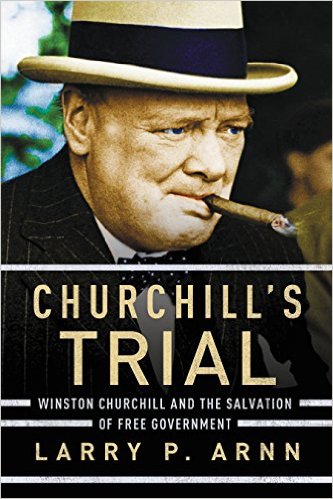
Churchill’s Trial (book review)

Churchill's TrialI have read so much written by and about Winston Churchill, that it’s hard to imagine learning something new about this remarkable man. And yet, I was amazed at how much more I learned in reading Churchill’s Trial by Larry Arnn.

It’s easy to take for granted the freedoms people have in countries like England and the United States because of the foresight of the framers of our Constitutions. But there are trials which put these freedoms in a precarious place, and if it were not for strong and insightful men—like Winston Churchill—those freedoms could have disappeared.

Churchill played key roles in his country, and in world politics, through two world wars, a global depression, the coming of age of new military super-powers, the dawn of the era of atomic warfare, and the rise of Communism. In all of these intense events, the temptation was there to make radical changes to meet the challenge of the moment. Churchill had the wisdom and foresight to leverage the strength of his country’s Constitution, without undermining it nor setting a precedent which would erode future freedoms.

In what Churchill did for England, he also helped strength the resolve of key leaders in the United States, who faced similar challenges in a shifting geopolitical climate. Churchill not only saved the world from the spread of fascism and communism, but he did so in a way that would guarantee freedom for millions of people in generations to follow. The question before us now is: Will we learn from Churchill’s example, or will we fail the trial we now face?

For history buffs, political junkies, and fans of Winston Churchill, Churchill’s Trial is an excellent read.

I am a Thomas Nelson book reviewer.

The American Patriot’s Almanac (book review)

The American Patriot’s AlmanacI feel so blessed to live in the United States of America! With the blessing of living in this great country comes the responsibility of knowing as much as I can about our country’s founding and guiding principles. A wonderful help on this journey of discovery is The American Patriot’s Almanac: Daily readings on America by William Bennett and John Cribb.

I am now on my second time through this book, and I’m still discovering how much there is to love about the USA. Each day Bennett and Cribb present a snapshot of a notable event in our nation’s history, that makes me so proud of our heritage all over again. There are cool stories about both the well-known and little-known folks who sacrificed and invested to make this country what it is.

At only a page a day, there’s no excuse for American patriots not to read this book through over the course of a year, and re-discover what a privilege it is to live in the land of the free and the home of the brave. We all owe it to our future generations to keep these memories alive, so that no one forgets our amazing heritage.

Book Reviews From 2015