This is a weekly series with things I’m reading and pondering from Oswald Chambers. You can read the original seed thought here, or type “Thursdays With Oswald” in the search box to read more entries.
Jeremiah 25-26
[These are notes from Oswald Chambers’ lecture on Jeremiah 25-26.]
The prophets were holy men, not mechanisms; they were “moved by the Holy Ghost” [2 Peter 1:21] to say what they did. Each prophet had a distinct characteristic of his own, they were not all “moved” in the same way. We are not meant to be “channels only,” we are infinitely more responsible than “channels.” …
Jeremiah continually warned the people that if they did not repent and come up to God’s standard for them, He would blight all that they possessed, including Jerusalem and the Temple. That was what enraged them against Jeremiah. They said he used his prophetic right to tell an untruth; for, they argued, God would never destroy His own holy city or the Temple in which He was worshiped (26:11). Any position before God based on a foundation other than living in the light of God and depending upon Him, is doomed to destruction.
From Notes On Jeremiah
God’s Word is still as viable and applicable to us today as it was in the days that Jeremiah and the other prophets spoke, and in the days the New Testament authors penned their words.
J.C. Ryle issued this warning to us, “Let us beware of despising the Old Testament under any pretense whatever. Let us never listen to those who bid us throw it aside as an obsolete, antiquated, useless book. The religion of the Old Testament is the embryo of Christianity. The Old Testament is the Gospel in the bud. The New Testament is the Gospel in full flower. The Old Testament is the Gospel in the blade. The New Testament is the Gospel in full ear.”
God’s Word IS speaking to us today. The question is—are you and I willing to obey what God says to us, or are we more interested in making arguments about its relevance?
I like to think of Horatius Bonar as a tour guide as I read through the Bible, pointing out themes and insights I might have otherwise missed. Check out my full review of Light and Truth—Old Testament by clicking here.
“The elders[1 Chronicles 21:16]. They acknowledge the stroke and the sin: ‘It is the Lord.’ They clothe themselves in sackcloth, they fall upon their faces. So far as we know, they had not shared David’s sin, yet they at once place themselves by his side in confession and humiliation. David had sinned (v. 8), Israel had sinned (2 Samuel 24:1). They identify themselves with both. It is thus that we should take up a ruler’s sin, or a brother’s sin, or a nation’s sin; not blazoning it abroad in private gossip, or in the newspapers, but taking it on ourselves, and carrying it to God.”
“We do great injustice to the Old Testament saints and to their privileges, and no less so to the God who made them what they were, when we conceive of them as possessing an imperfect justification, or an imperfect and uncertain knowledge of their justification. Paul’s declaration was explicit on this point: ‘I know Whom I have believed’; and yet it was not a jot more explicit than that of Job: ‘I know that my Redeemer lives.’ When Paul said, ‘It is God that justifies, who is he that condemns?’ he was only speaking what Job had spoken in ages before: ‘I know that I shall be justified. Who is he that will plead with me?’” [Job 13:18-19]
“Everything in God’s character, has by the Cross of Christ been turned into a reason for trusting Him. The more man knows of Him the more he trusts. Trust is the natural and inseparable response of the soul to the divine revelation of the character of God. It is not what man sees in himself, of his good deeds or good feelings, of his graces, or his repentance, or his regeneration, or his faith; but what he sees in God, that calls out confidence.”
“It is with no distant, unheeding God that we have to do; but with that God who fixes the bounds of our habitation, who counts our hairs, who feeds the ravens, notes a sparrow’s death, clothes the lilies of the field. He is nearer to us than the nearest earthly object or being; more closely in contact with us than we are with one another.”
“We disjoined God from creation, and so see nothing in it of divine life and power. … The separation of God from His works is one of the awful features of human unbelief. How much more of Him should we know, were we to interpret His works aright. … These skies of His are not bent over us in beauty without a meaning. These seas of His do not roll for nothing. These flowers of His are not fragrant and fair for nothing. They do not say to us, ‘God is your enemy, He hates you’; but ‘God is your friend, He pities you, yearns over you, wishes to make you happy.’ How full a gospel does creation to preach to us, according to its kind and measure!”
But I do have one complaint about this book: it’s too short! Bonar has four volumes of commentary on the New Testament (the Gospels, Acts and the Larger Epistles, the Lesser Epistles, and Revelation), but sadly only one volume for all of the Old Testament.
Bonar’s style is not an exhaustive verse-by-verse—or even chapter-by-chapter—commentary on Scripture, but more of a theme-by-theme. Having read the four New Testament volumes first, I knew what to expect when I picked up this book on the Old Testament. Although at times he may remain silent on large swaths of Scripture, when he does spot something that moves his pen to action, it is brilliant insight.
It bears repeating something I noted in a previous review of Bonar’s commentaries: “The Bible is inspired by the Holy Spirit, so He is the best source of illumination when reading Scripture. But Horatius Bonar is clearly a man immersed in the overall message of the Bible, and guided by the Holy Spirit in his writings.” Bonar is an excellent tour guide to help you see items of significance as you journey through the Old Testament.
If you would like to check out my earlier reviews of Bonar’s Light & Truth series:
I love reading, and I love sharing my love of good books with others! Here is a list of the books I read and reviewed in 2017. Click on a title to be taken to that review.
There was a story circulating that a physicist once claimed that the bumblebee was defying the laws of physics and aerodynamics in its flight. Apparently, he calculated that the ratio of the bumblebee’s wing size in comparison to his body size just didn’t make the math work.
But entomologists and physicists quickly jumped in to say, “Hey, look, the bumblebee is flying, so clearly it works!” And then they went to work to try to explain it. They figured out that the bumblebee flaps its wings more back-and-forth than up-and-down, creating tiny hurricanes the propel them through the air. But then that created a whole new set of problems, like how does the bumblebee control a hurricane so precisely as it turns, stops, dives, and climbs. So then they had to create a new explanation, which they named dynamic stall.
All the while, the bumblebee is flapping its too-small wings 230 times per second(!), and going about its daily activities without being able to explain tiny hurricanes, the laws of physics or aerodynamics, or even knowing what dynamic stall is. It simply flies!
The ultimate argument for anything is doing something that critics say is impossible.
Peter tells Christians to be prepared to answer anyone for the reason for the hope that they have (1 Peter 3:15-16). The Greek word for “give an answer” is apologia, from which we get our word apologetic. Here are three apologetics for Christians to use for the hope that they have.
It really comes down to this: My hope is based on the resurrection from the dead of Jesus Christ, which I believe because of the Bible AND because of the change in my life.
The Bible’s authenticity
“No other work in all literature has been so carefully and accurately copied as the Old Testament. The particular discipline and art of the Jewish scribes came out of a class of Jewish scholars between the fifth and third centuries BC. They were called the Sopherim, from a Hebrew word meaning ‘scribes.’ The sopherim, who initiated a stringent standard of meticulous discipline, were subsequently eclipsed by the Talmudic scribes, who guarded, interpreted, and commented on the sacred texts from AD 100 to AD 500. In turn, the Talmudic scribes were followed by the better-known and even more meticulous Masoretic scribes (AD 500-900).” —Josh McDowell, God-Breathed
“No other ancient text is substantiated by such a wealth of ancient textual witnesses as is the New Testament. Roughly 5,500 separate manuscripts are available, variously containing anything from the entire New Testament corpus to a slight fragment of a single verse. … This textual support is far superior to that available for any other ancient documents, such as the classical texts from Greek and Roman writers (e.g., Plato, Aristotle, and Cicero). Only partial manuscripts have survived for many works of antiquity, and it is not unusual to find that the only complete manuscript for some ancient writing is a copy dating from 1,000 years after its composition.” —Archaeological Study Bible, “The New Testaments Texts” (page 1859)
“The biblical Dead Sea Scrolls are up to 1,250 years older than the traditional Hebrew Bible, the Masoretic text. We have been using a one-thousand-year-old manuscript to make our Bibles. We’ve now got scrolls going back to 250 BC. … Our conclusion is simply this—the scrolls confirm the accuracy of the biblical text by 99 percent.” —Dr. Peter Flint
I have shared other apologetic evidence for the authenticity of Scripture here and here.
Christ’s resurrection
In1 Corinthians 15:1-8 Paul lists all of the eyewitnesses to Christ’s resurrection, giving critics ample opportunity to challenge these witnesses in person. If these witnesses would have been perpetrating a hoax, skeptics of their day would have been able to uncover the inconsistencies in their story. If the account of Christ’s resurrection was made-up, it’s doubtful the early Christian martyrs would have “stuck to their story” as they were being tortured, but none recanted.
Josh McDowell notes, “By AD 100, the apostles had died, but the Christian Church was still in its infancy, with fewer than twenty-five thousand proclaimed followers of Christ. But within the next two hundred years, the fledgling church experienced explosive multiplication of growth, to include as many as twenty million people. This means the church of Jesus Christ quadrupled every generation for five consecutive generations!”
My personal experience
“I am a changed person. I am not who I was before I met Jesus” and “My life tends to go better when I live by biblical principles” are both excellent apologetics!
Let others argue that God doesn’t exist, or that you shouldn’t have hope, and then you—like the bumblebee—just keep flying with Jesus! (see 2 Timothy 3:14)
Our annual Q Series is where folks send their questions to me on a variety of subjects and we do our best to answer them. This week many of the questions were about the Bible. Questions like:
What books should be included in the Bible?
What about Bible translations?
Is it okay for the Bible to have pictures in it?
Here’s what we discussed, along with the time this discussion appears on the video:
How was it decided what books would be included in the New Testament? [5:38] **Be sure to check out this post: How We Got The Bible on Biblegateway.
J. Warner Wallace’s list of criteria for New Testament books [9:45]
Did contemporary sources support or refute the New Testament authors? [11:45]
How did the final 27 books of the New Testament make the list? [15:02]
How was it decided what books would be included in the Old Testament? [18:22]
How do we know the Scriptures were accurately transcribed? [22:50] **Be sure to check out this post: Why Trust The Bible? on Biblegateway.
The history surrounding the complete Latin Bible and the Dead Sea Scrolls [23:45]
What are Bible translations and paraphrases (with references to the Wycliffe Bible and the discovery of the Rosetta Stone)? [25:45]
Some cautions about Bible paraphrases [33:23]
Is it okay for a Bible to have pictures in it? [35:16]
Are icons of the Cross acceptable or a blasphemy? [37:42]
How can someone better understand the Bible when they read it for themselves? [41:32]
Why ask questions? [48:39]
We’ll be discussing more questions this upcoming Sunday, so be sure to send them my way. For all of the ways you can send questions, please click here.
One of the way God hints at the arrival of Jesus and what He would do for mankind is found in the names of people. Hebrew names are interesting things. Sometimes they are quite literal. For instance…
A baby who was born at one of Israel’s lowest points was named Ichabod = God’s glory has departed.
A baby who was born with quite a lot of hair was named Esau = hairy baby.
Esau’s twin brother was hanging on to his heel when he was born, so they named him Jacob = the one who grabs the heel.
At other times God tells parents what to name their babies before they are born. These names tell a story in themselves of what is coming…
After a time of upheaval in Israel’s history, God directed the parents to give their son two names: Solomon (which means peace) and Jedidiah (which means beloved by God). This brought reassurance to the parents and to the country.
When God was about to bring a quick answer to a problem, He directed the parents to name their son Maher-Shalal-Hash-Baz, which means God will bring the reward sooner than you think.
But what is most interesting to me is when God changes someone’s name to reflect the new nature in their life.
Abram’s name meant exalted father, but God changed his name to Abraham, which means father of a multitude. His wife’s birth name was Sarai (princess) and it was changed to Sarah (a noble woman).
In these name changes, two things happened (see Genesis 17:1-15):
God put His own name into theirs. God’s name means I AM. We sometimes pronounce it Yahweh, but that is only a guess since the Jews wrote His name without the vowels. That means His name was the unpronounceable YHWH, sort of a breath-sound. So Abram became Abrahaaam and Sarah became Saraaaaah.
God took the burden off them and put it on Himself.It was no longer Abram’s responsibility to become an exalted father, or Sarai’s responsibility to make herself a princess. God said, “Only with Me in you can you become who I want you to be!”
As you follow Abraham and Sarah’s descendants, you will see time and time again God reminding people: You can’t do it on your own. You must have Me in you in order to live the life I have for you!
Hoshea was born as an Israelite slave in Egypt, yet his parents gave him this name that means deliverer. Before God could use Hoshea to bring the Israelites into the Promised Land, He first changed his name to Joshua, which means God is the ultimate deliverer.
Joshua in the BC Hebrew language is the same as Jesus in the AD Greek language.
That’s why when you surrender to Christ and allow Him to be your Lord and Master, He puts His name in you: CHRISTian! A new name, and a brand new nature because of what it means to have Christ in you.
Check out this video where I explain the cool story behind more name changes—
Today we live in 2017 AD. But 1800 years ago the A.D. stood for “Anno Diocletiani” which means “the year of Diocletian,” a ruthless, anti-Christian Roman emperor. In 525 AD, a monk named Dionysius proposed changing the A.D. to “Anno Domini” which means “the year of our Lord,” referring to the Advent of Jesus Christ. Then to mark the dates of the calendar before Christ’s birth properly, the “B.C.” (before Christ) period was introduced.
But BC/AD is just a dating system. There is no such thing as “BC”—there has never been a time before Christ! He has always been! Throughout what we now refer to as the Old Testament (or the BC period), Jesus is constantly revealing Himself through little hints here and there, but when He comes to earth as a Man, all the hints become a bright, blazing, unmistakable Truth!
Just like Dionysius came up with a new dating system based on the Advent of Jesus, the Israelites had a new starting point marked by the Passover (see Exodus 12:1-7). Everything from this point backward is reset and dates are now counted forward from this moment. Before this time they were slaves in Egypt; after this time they were free and called God’s special people.
The “BC” Passover had three important components:
A perfect lamb without any defect (Exodus 12:5)
The lamb is slaughtered at twilight (v. 6)
The blood is applied to the door (v. 7)
When Jesus came to Earth, He showed how He was all three of those elements. In the “AD” Jesus is—
In both BC and AD God declares the same message: “When I see the blood, I will pass over you.” The blood seals the deal and brings God’s forgiveness of sins, and His blessings on the life that is now completely His.
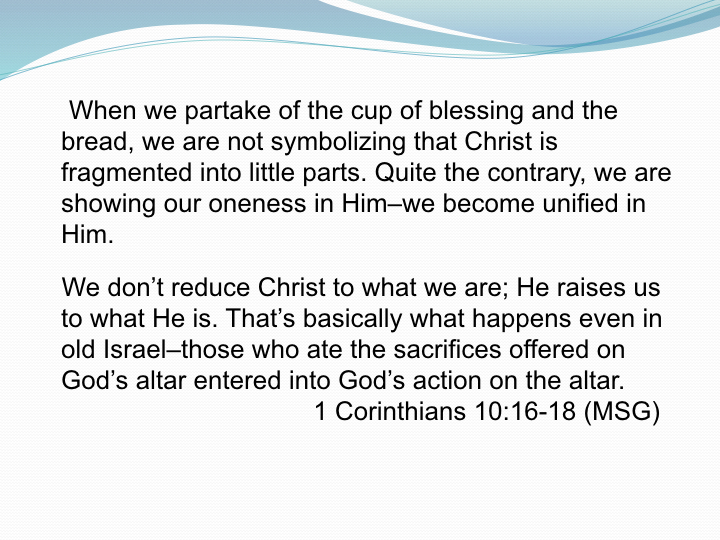
The word remember appears frequently in the BC, as in “remember what God did for you.” In the AD remember appears at a pivotal time—when Jesus shared His last supper with His followers, He told them that Communion would be a time for them to remember all that Jesus did for us as the Perfect Lamb, whose Blood is applied to the Door of our heart, so that God’s judgment could pass over us.
Do you have a Passover date? A time when the BC became AD in your life? If so, good! Keep remembering that, and don’t ever go back to being a citizen of anything but God’s Kingdom.
If not, today can be the first day of a new era for you. By faith you can apply the Blood of the Perfect Lamb to the Door of your heart, and you will no longer be a slave of “Egypt” (a picture of being utterly trapped and unable to help yourself), but a citizen of Heaven! All it takes is for you to believe that Christ’s blood purchased your freedom, so you can ask God the Father to forgive you of all your BC past, and then you can live forever in the AD with Jesus as your Savior and Master!
Check out this video where I explain this BC/AD system more, and join me next week as we learn more about how Jesus Christ bridges the BC/AD divide.
Last Sunday we began a new series called BC / AD, which is helping us discover how Jesus fulfills all of the “hints” we see of Him throughout what we now call the Old Testament. In truth, there is no such thing as “BC,” as there has never been a time before Christ. He always IS.
Yesterday, Jeff Hlavin shared with us a marvelous look at the foreshadowing of Christ’s work on Calvary in the institution of the Old Testament observance of Passover. In the “AD” period, Christians now remember what Jesus did through the observance of Communion.
Watch the video of Pastor Jeff’s message to learn more.
And if you would like to download the handout from his message, please click here → Passover and Communion
If you don’t have a home church in the Cedar Springs area, I invite you to join me on Easter Sunday as we continue to see how Jesus fulfilled in the “AD” all that was promised about Him in the “BC.” It’s going to be a fantastic morning!
This is a weekly series with things I’m reading and pondering from Oswald Chambers. You can read the original seed thought here, or type “Thursdays With Oswald” in the search box to read more entries.
Extravagant Christians
Our reason for giving is not to be because men deserve it, but because Christ tells us to give. All through the Old and New Testaments the counsel is on the line of hospitality. As long as we have something to give, we must give. … The true nature of devotion to Jesus Christ must be extravagance. …
We have deified economy, placed insurance and economy on the throne, consequently we will do nothing on the line of adventure or extravagance. To use the word “economy” in connection with God is to belittle and misunderstand Him. Where is the economy of God in His sunsets and sunrises, in the grass and flowers and trees? God has made a superabounding number of things that are of no use to anyone. …
When a man is rightly related to God he has to see that he enjoys his own life and that others do too.
From Shade Of His Hand
What controls your hospitality and generosity? Is it economy, or an extravagant overflow?
How much God has blessed us with that we should be lavishly giving to others! If we’re not, perhaps Common Sense is on the throne of our hearts instead of our All-Gracious God.



 This is a weekly series with things I’m reading and pondering from Oswald Chambers. You can read the original seed thought here, or type “Thursdays With Oswald” in the search box to read more entries.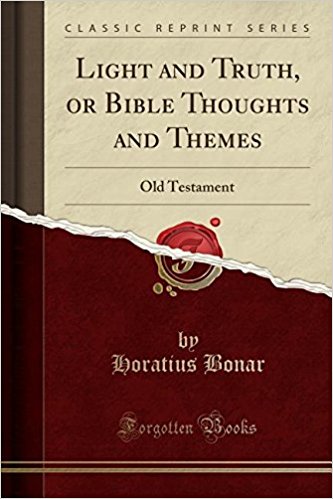






 Craig T. Owens
Light And Truth—The Old Testament (book review)
April 17, 2018 — Craig T. OwensBut I do have one complaint about this book: it’s too short! Bonar has four volumes of commentary on the New Testament (the Gospels, Acts and the Larger Epistles, the Lesser Epistles, and Revelation), but sadly only one volume for all of the Old Testament.
Bonar’s style is not an exhaustive verse-by-verse—or even chapter-by-chapter—commentary on Scripture, but more of a theme-by-theme. Having read the four New Testament volumes first, I knew what to expect when I picked up this book on the Old Testament. Although at times he may remain silent on large swaths of Scripture, when he does spot something that moves his pen to action, it is brilliant insight.
It bears repeating something I noted in a previous review of Bonar’s commentaries: “The Bible is inspired by the Holy Spirit, so He is the best source of illumination when reading Scripture. But Horatius Bonar is clearly a man immersed in the overall message of the Bible, and guided by the Holy Spirit in his writings.” Bonar is an excellent tour guide to help you see items of significance as you journey through the Old Testament.
If you would like to check out my earlier reviews of Bonar’s Light & Truth series:
Share this: