A mark of a godly leader is one who resolutely follows God. No matter what!
Jesus calls His followers to the same path He walked—“No one who puts a hand to the plow and looks back is fit for service in the kingdom of God” (Luke 9:62)
It’s hard because people reject a resolute man.
It’s hard because the accommodations along the way are uncertain.
It’s hard because I have to give up my right to myself.
But the reward is incomparable—Heaven forever with Jesus!
This is part 33 in my series on godly leadership. You can check out all of my posts in this series by clicking here.
This is a weekly series with things I’m reading and pondering from Oswald Chambers. You can read the original seed thought here, or type “Thursdays With Oswald” in the search box to read more entries.
Becoming Carefully Careless
Faith is our personal confidence in a Being Whose character we know, but Whose ways we cannot trace by common sense. … Common sense is mathematical; faith is not mathematical, faith works on illogical lines. …
To have faith tests a man for all he is worth, he has to stand in the common-cents universe in the midst of things which conflict with his faith, and place his confidence in the God Whose character is revealed in Jesus Christ. …
Most of us are pagans in a crisis; we think and act like pagans, only one out of a hundred is daring enough to bank his faith in the character of God. …
Jesus does not say, “Blessed is the man who does not think about anything”; that man is a fool; He says, “Be carefully careless about everything saving one thing—your relationship to God.” … Many people are careless about what they eat and drink, and they suffer for it; they are careless about what they put on, and they look as they have no right to look; they are careless over property, and God holds them responsible for it. Jesus is saying that the great care of the life is to put the relationship to God first and everything else second. Our Lord teaches a complete reversal of all our practical sensible reasonings. Do not make the ruling factor of your life what you shall eat, or what you shall drink, but make zealous concentration on God the one point of your life. … Jesus Christ says, “Reverse the order, get rightly related to Me first, see that you maintain that as the great care of your life, and never put the concentration of your care on the other things.”
From Studies In The Sermon On The Mount
It does seem illogical from our human perspective to not think about the basics of life first and foremost, but Jesus is clear and consistent in His message to us that God should be THE priority. Seek Him first and all the other things fall into place. Be “carefully careless” about everything except your relationship with Jesus!
Don’t be a pagan atheist in a time of trial. Don’t be that 99 out of a hundred that abandons God when times are tough. Instead, be that “one out of a hundred [that] is daring enough to bank his faith in the character of God” no matter what the circumstances are!
For anyone going through a trying time, Stasi Eldredge has given us a timely reminder of how we can tenaciously and defiantly cling to the joy the God gives us. Check out my full book review by clicking here.
“Ignoring reality does not breed joy. Pretending that what is true does not exist is not holy defiance. The seeds of joy can only be firmly planted in the pungent soil of the here and now while at the same time being tethered to eternity. Joy is fully rooted in the truth. Joy embraces all the senses and is fully awake to the laughter, the wonder, and the beauty present in the moment as well as the sorrow, the angst, and the fear. Joy says, ‘Even so, I have a reason to celebrate.’”
“Defiant may not be a word we would normally associate with the living God, but it can actually be quite fitting. Defiance means resistance, opposition, noncompliance, disobedience, dissent, and rebellion. And when it comes to things that would destroy our souls, that is exactly the right response.”
“Joy is not happiness on steroids. It is not happiness squared. … Joy is connected to God and reserved for those who are tapping into His reservoir, who are connected to His life. Joy is rooted in God and His kingdom, in the surety of His goodness, His love for us. It is immovable. Unshakable. Joy is available at all times, day and night, because God and His kingdom are always available to us. … Joy is the heartbeat of heaven, the very light that emanates from Jesus’ heart, so as we grow closer in relationship with God, we’ll also grow in joy.”
“Joy and breakthrough are not opposed to suffering But are available in the midst of it. Suffering is not a failure of faith on our part; its presence does not mean the absence of the presence of God. We can live with suffering and joy simultaneously.”
“Joy is deeply rooted in the availability of God and His kingdom right here, right now. Sometimes we find breakthrough. Sometimes we find a deeper knowing of God in our suffering.”
“Here is the truth we must remember in the middle of this sometimes painful healing process: we matter to the heart of God. He hasn’t taken His eyes off us. He thinks of us constantly. He has hopes and dreams for us. God planned on us before He made the stars, and He planned on us being His. He planned on us sharing our lives with Him on this wild adventure. And His plans are good.”
“God drops things in our laps at just the right time. He puts barriers in our paths that look like roadblocks but are really gifts in disguise, beckoning us to take a closer look at what’s going on inside of us. We can either step over them or choose to pick them up and examine them for the potential they may hold.”
“When the sadness refuses to be silenced and the feelings arise that this is not the life we had signed up for, we can either go to shame or go to God.”
I’ll be sharing more quotes in the near future, so stay tuned…
So He Himself often withdrew into the wilderness and prayed (Luke 5:16).
“So”—in light of what just happened. What happened? Jesus was preaching everywhere, He healed a leper, and great multitudes came to hear Him speak and to be healed. So Jesus had to withdraw frequently to pray and be replenished.
All of us have only a finite amount of energy. When we are sensing that energy level is low, we also need a retreat. Otherwise, our low energy levels can sabotage us and diminish what God wants to do through us.
Then check out the results after Christ’s time of replenishing:
God’s power was “present to heal” (v. 17)
People were saved (v. 20)
Jesus had holy perception (v. 22)
Miracles confirmed the word that Jesus preached (v. 24)
God was glorified (v. 26)
People followed Jesus (vv. 27, 28)
Jesus had enough grace and patience to handle criticism (v. 30)
Jesus had enough wisdom and patience to handle tricky theological questions (vv. 33-39)
J.C. Ryle noted, “The most successful workmen in the Lord’s vineyard are those who are, like their Master, often and much upon their knees.”
Healthy leaders are keenly aware of their own energy levels.
So… A mark of a godly leader is one who frequently retreats.
This is part 32 in my series on godly leadership. You can check out all of my posts in this series by clicking here.
Jesus called satan the father of lies, that means every word he speaks is false. He uses his falsehoods to constantly slander God’s children, “For the accuser of our brothers and sisters has been thrown down to earth—the one who accuses them before our God day and night” (Revelation 12:10).
But we’re not helpless victims against the devil’s slander. The Holy Spirit reminds us of what the Word of God says, and what the God of the Word has done (John 14:26). That Word becomes our sword and shield against the slanderer, “They triumphed over him by the blood of the Lamb and by the word of their testimony” (Revelation 12:10-11).
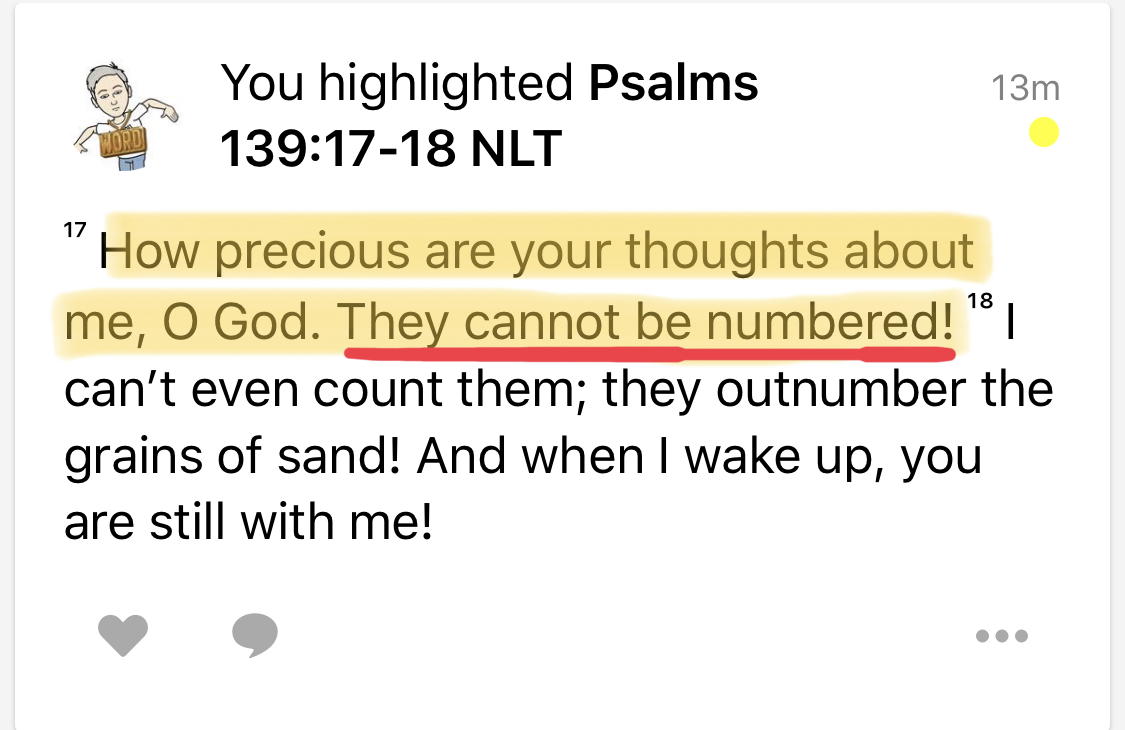
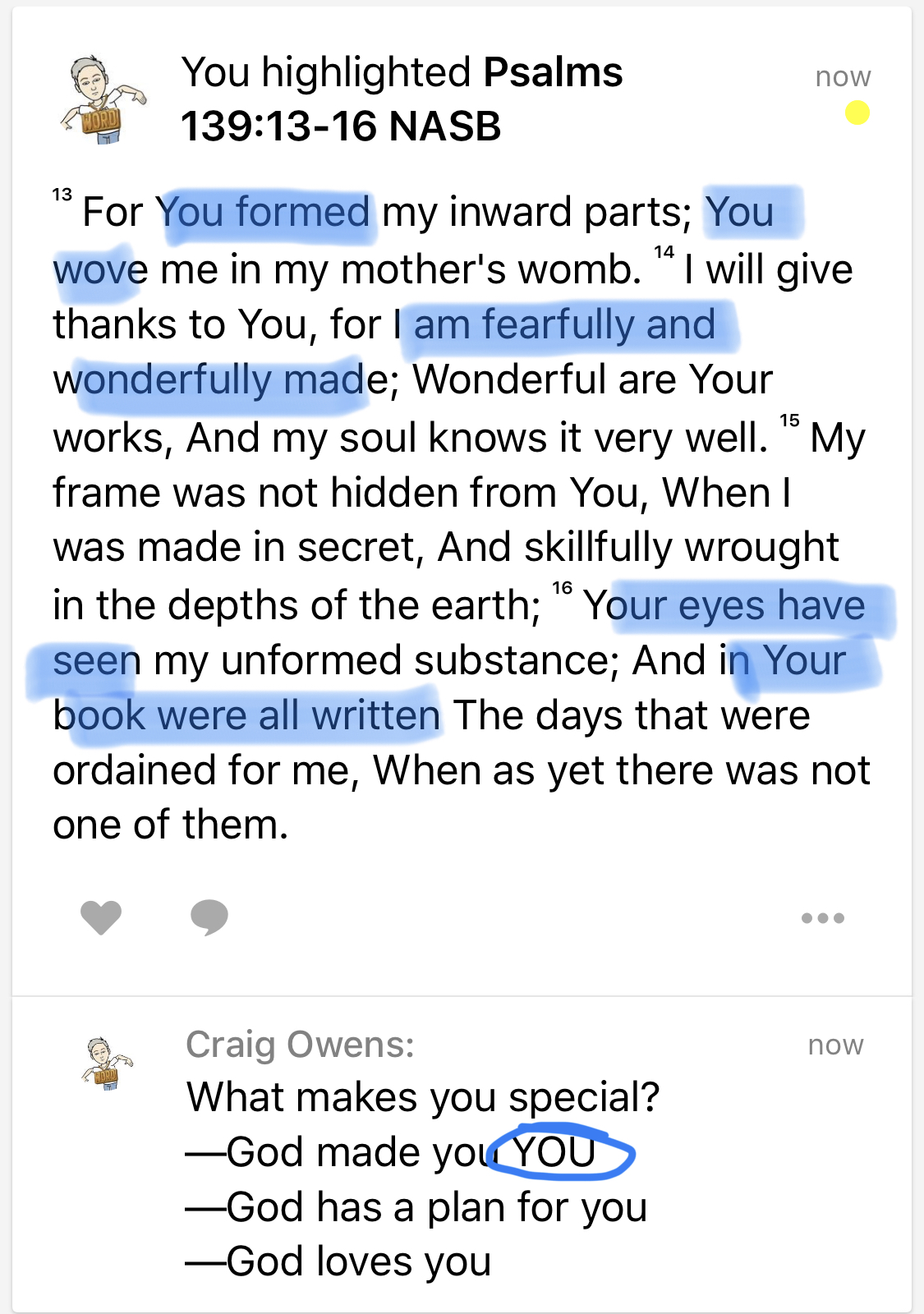
This passage from Psalm 139 is a great weapon to use against the devil whenever he slanderously calls into question your worth in God’s sight. Silence his lies and strike him down with the Truth that your value to God is immeasurable!
This is a request I can continue to make. Jesus is in heaven interceding for me (Hebrews 7:25), and He has given me His Holy Spirit to help me pray (Romans 8:26).
Jesus is the Perfect Pray-er, so He is the one to Whom I should continually say, “Lord, teach me to pray.”
The key thought Jesus presents is persistence (see Luke 11:8-10). Why? Because the One to Whom I persistently appeal has told me to! God is my Heavenly Father—He wants to give the best to His children. He even gives us “how much more”!
I learn to pray by praying.
I have to begin to do it and then let the Holy Spirit instruct me. In the meantime, even my childlike prayers are clarified and amplified by the Spirit, they are used by Jesus to intercede on my behalf, and they are carried into the throne room of Almighty God as an incense before Him. He loves to hear from me, or else He would not have told me to keep on asking, keep on seeking, and keep on knocking.
To paraphrase a father who was in desperate need of Christ’s help, “Lord, I am praying; help me to keep on praying!” (see Mark 9:24)
I love reading, and I love sharing my love of good books with others! Here is a list of the books I read and reviewed in 2018. Click on a title to be taken to that review.
When C.S. Lewis first introduces us to the land of Narnia in The Lion, The Witch and The Wardrobe, we discover that the White Witch has Narnia seemingly under her iron fist, and has made it so that it’s always winter but never Christmas.
“Come on!” cried Mr. Beaver, who was almost dancing with delight. “Come and see! This is a nasty knock for the Witch! It looks as if her power is already crumbling. … Didn’t I tell you, that she’d made it always winter and never Christmas? Didn’t I tell you? Well, just come and see!”
And then they were all at the top and did see.
It was a sledge, and it was reindeer with bells on their harness. But they were far bigger than the Witch’s reindeer, and they were not white but brown. And on the sledge set a person whom everyone knew the moment they set eyes on him. He was a huge man in a bright red robe (bright as holly-berries) with a hood that had fur inside it and a great white beard that fell like a foamy waterfall over his chest. … Some of the pictures of Father Christmas in our world make him look only funny and jolly. But now that the children actually stood looking at him they didn’t find it quite like that. He was so big, and so glad, and so real, that they all became quite still. They felt very glad, but also solemn.
“I’ve come at last,” said he. “She has kept me out for a long time, but I have got in at last. Aslan is on the move. The Witch’s magic is weakening.”
I think the Israelites waiting for their Messiah must have felt a little like the Narnians: always winter, but never Christmas; trapped under the iron-fisted rule of Babylon, and Persia, and Rome.
But as they approached what we now call the year 1 AD, winter is about to end and the Advent of CHRISTmas is about to occur at long last!
You might think that the birth of Jesus brought us the King of Kings. But actually, there were three other “king of kings” that preceded Jesus, who all helped to fulfill God’s ultimate plan.
Nebuchadnezzar was the king of Babylon. God called him “My servant” and also gave him the title “king of kings” (Jeremiah 27:6; Ezekiel 26:7). It was he who defeated Judah and took captives with him to Babylon. Among those captives was a young man named Daniel.
God gave Daniel the ability to interpret Nebuchadnezzar’s dream which foretold of three other kingdoms which would follow Babylon, with the fourth kingdom being called a kingdom of iron. History shows us that Babylon was defeated by the Medes, who were in turn defeated by the Persians, who were themselves defeated by the Greco-Romans.
Artaxerxes was king of the Persians, and he called himself “king of kings” (Ezra 7:12). He helps to facilitate the Jews’ return back to Jerusalem, and even helped fund their efforts to rebuild the temple of Solomon and reestablish worship there.
In 44 BC, Julius Caesar was assassinated, and Octavius was named in Caesar’s will as his adopted son and heir. Eventually, Octavius quelled a 20-year-long civil war and established himself as the unquestioned ruler of the Roman Empire. He changed his name to Caesar Augustus, which means the exalted one. But all throughout the Mediterranean world archeologists have discovered numerous other titles for Caesar Augustus—Divine, Son of God, God Incarnate, God from God, Lord, Redeemer, Liberator, Savior of the World, and King of Kings.
Historian Luke records these words, “In those days Caesar Augustus issued a decree” (Luke 2:1). This decree called everyone to return to his hometown to be registered in Rome’s census. This decree meant that Joseph was obligated to return to Bethlehem. He took his pregnant wife with him to arrive just in time for Jesus to be born.
Jesus—THE eternal and ultimate King of Kings—was born in Bethlehem just as had been prophesied 700 years earlier in the winter of Israel’s captivity:
But you, Bethlehem Ephratah, you are little to be among the clans of Judah; yet out of you shall One come forth for Me Who is to be Ruler in Israel, Whose goings forth have been from of old, from ancient days (eternity). (Micah 5:2)
The coming of THE King of Kings is proof that God sees you too. God brought the king of kings named Nebuchadnezzar, and Artaxerxes, and Caesar Augustus to power just to move two “average Joes” 70 miles from Nazareth to Bethlehem so that THE King of Kings could be born there to fulfill the prophesy.
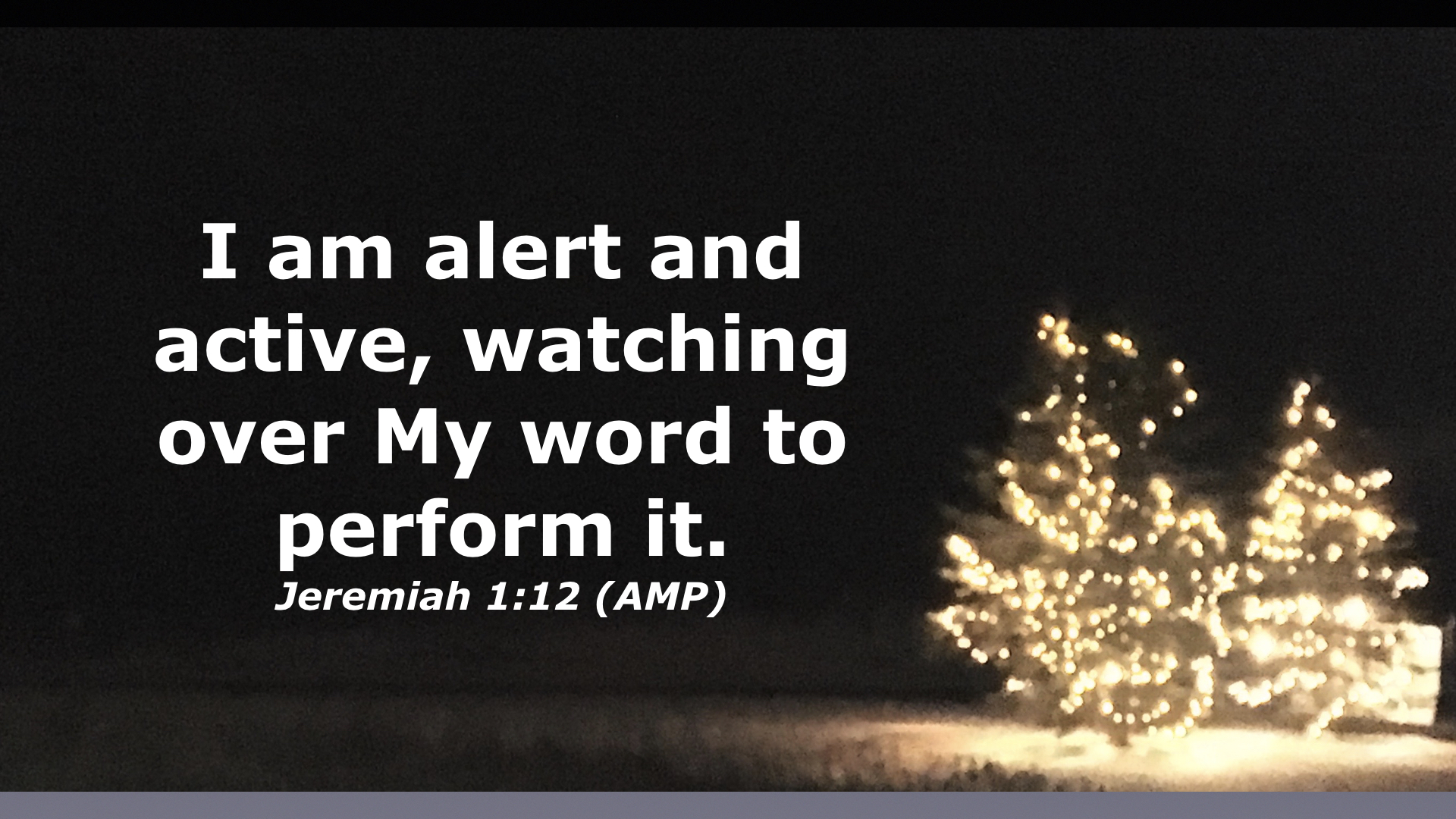
God has a plan for your life. His plan for you was in place before you were even conceived in your mother’s womb. And—even this very moment—He is watching over world events to make sure that every detail of His plan is fulfilled (see Ephesians 2:10; Psalm 139:16; Jeremiah 1:12)!
If you ever feel like you are in a “winter” season of your life—always winter and never Christmas—just remember that God sees you, He has a plan for you, and He will bring an end to your winter just in time to bring you CHRISTmas!
We live in an amazing time—the First Advent of Jesus has already happened in Bethlehem, and yet we are eagerly anticipating Christ’s Second Advent at any moment!
The fourth stanza of Charles Wesley’s classic Christmas carol Hark! The Herald Angels Sing is a wonderful between-the-Advents look at what happened at the First Advent, and what we have to look forward to in the Second Advent. The key thing to note in this stanza is the verbs: come, fix, rise, bruise, efface, stamp, and reinstate.
COME, Desire of nations—What is the “desire of nations”? It’s the restoration of God’s glory on earth, so it’s not really a what but a Who. The prophet Haggai informs us that our Desire is realized in the Advent of Jesus (2:1-9).
FIX in us Thy humble home—At His First Advent, Jesus came and humbly made His home among us, even dying to pay the penalty for our sins (Hebrews 2:14, 17; Philippians 2:7-8).
RISE, the woman’s conquering seed—Although Jesus was obedient to death—even death on a Cross, He didn’t stay dead but was resurrected (Philippians 2:8-9; Revelation 1:18)!
BRUISE in us the serpent’s head—With His death and resurrection, Jesus took away the sting of death from satan, fulfilling one of God’s first prophesies (Genesis 3:15; 1 Corinthians 15:19-26, 54-57).
Adam’s likeness now EFFACE—That means to wipe out, do away with, expunge. That’s exactly what God does with our forgiven sins (Psalm 103:1-4, 10-12)!
STAMP Thine image in its place—Although our sin has been effaced, God doesn’t leave us as blank slates, but instead He allows the image of His Son Jesus to be stamped onto our lives (2 Corinthians 1:21-22; 2 Corinthians 3:18).
REINSTATE us in Thy love—The relationship we longed for is now reborn in us (1 Corinthians 15:49)!
The Desire of Nations HAS come, and yet He WILL come again! We’re living between the Advents now, so a good question for Christians to ask is: “How are we to live?” I think there are three key things—
In celebration that Jesus came at His First Advent to be our Savior
In anticipation of the Second Advent
In obedience to God’s Word (Revelation 22:7)
To take a look at the other stanzas of this Christmas carol, please click here.



 Jesus wasn’t about to be deterred, delayed, or detoured from fulfilling His Father’s mission.







 Craig T. Owens