Links & Quotes

link quote

These are links to articles and quotes I found interesting today.

I love C.S. Lewis’ interaction with children: “As to Aslan’s other name, well I want you to guess. Has there never been anyone in this world who (1.) Arrived at the same time as Father Christmas. (2.) Said he was the son of the Great Emperor. (3.) Gave himself up for someone else’s fault to be jeered at and killed by wicked people. (4.) Came to life again. (5.) Is sometimes spoken of as a Lamb (see the end of the Dawn Treader). Don’t you really know His name in this world? Think it over and let me know your answer! Reepicheep in your coloured picture has just the right perky, cheeky expression. I love real mice. There are lots in my rooms in College but I have never set a trap. When I sit up late working they poke their heads out from behind the curtains just as if they were saying, ‘Hi! Time for you to go to bed. We want to come out and play.’”

[VIDEO] Sarah Palin has a wonderful Dr. Seuss-like poem for Washington, D.C. insiders.

Frank Viola gets it right in Christianeze Revisited.

I love this reminder from Max Lucado’s book Grace: “Muhammad does not indwell Muslims. Buddha does not inhabit Buddhists. Influence? Instruct? Yes. But occupy? No!” You can read my review of Grace by clicking here.

Did you hear about the pastor who died from a rattlesnake bite while handling one during a church service? Check out What’s With The Snakes?

“Oh! my brethren, it were well if this commendation, so forced from the lips of enemies, could also be compelled by our own example. If we could live like Peter and John; if our lives were ‘living epistles of God, known and read of all men;’ if, whenever we were seen, men would take knowledge of us, that we had been with Jesus, it would be a happy thing for this world, and a blessed thing for us.” —Charles Spurgeon

Helpful post for parents, coaches, and teachers from Dr. Tim Elmore: What’s Trending In Kids Today

Adopted By God

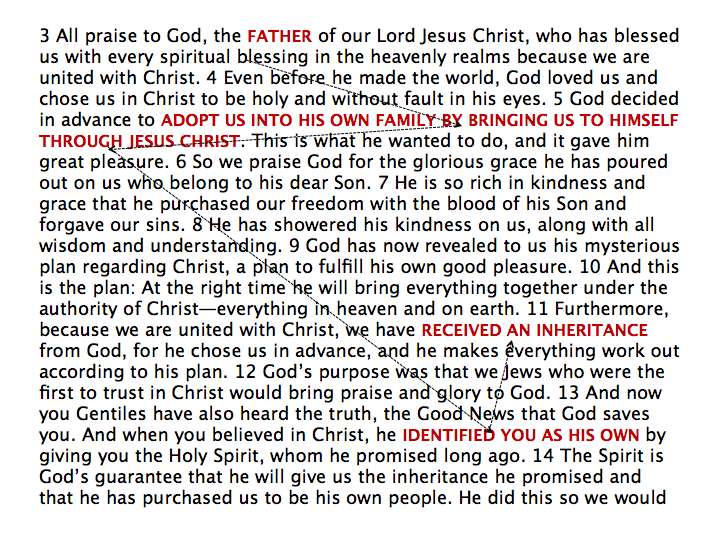
Adopted By GodWe have been working through our series on the Book of Ephesians, and I am so excited to share the speaking responsibilities with Tom Kaastra. Tom pastored a church in the Detroit area for nearly 40 years, and he is bringing such a richness of knowledge to this series!

“If you had one son in whom you found unspeakable delight, would it not be normal as a father to want many more? It is exactly so with the Eternal Father, Who by nature and choice, has desired and purposed to have a vast family of human-divine sons who are just like His Only Begotten Son.” —DeVern Fromke

The opening section of Ephesians 1 is just loaded with words of God’s delight:

  • …it gave Him great pleasure… (v. 5)
  • …the glorious grace He has poured out on us… (v. 6)
  • …He is so rich in kindness and grace… (v. 7)
  • …He has showered His kindness on us… (v. 8)
  • …His own good pleasure… (v. 9)

Not only is God’s delight so ample in this section, but so is be the praise toward God which should be bursting out from us:

  • …all praise to God… (v. 3)
  • …so we praise God… (v. 6)
  • …we bring praise and glory to God… (v. 12)
  • …we would praise and glorify Him… (v. 14)

What is this thing in which God is so delighted, and for which we should be so filled with praise?

It is quite simply this: God has revealed Himself to us as a loving Father, His Son has made it possible for us to come into God’s family, and the Holy Spirit has given us the assurance that we have been adopted by our Heavenly Father.

That’s right … God’s plan was to adopt you into His family. When did He come up with this idea?

  • …before He made the world… (v. 4)
  • …God decided in advance to adopt us… (v. 5)
  • …a plan to fulfill His own good pleasure… (v. 9)
  • …He choose us in advance and He makes everything work out according to His plan… (v. 11)
  • …He promised long ago… (v. 13)

God loves YOU so much that He had a plan from before the beginning of time to adopt YOU into His family. That’s what Jesus made possible through His death on the Cross, and what the Holy Spirit is constantly trying to reveal to YOU!! WOW!!

Please join us next Sunday as we continue our study on this amazing book in the Bible.

What God Will You Choose?

What God:godMy friend Chuck and I have a sort of shorthand when we talk. We’ve been through so many experiences together, that now just a single word can bring to our minds the fullness of that time, with all of its tears and laughter. Someone listening to one of our conversations might not get the full impact, but we sure do!

It’s the same way when we read one of the Apostle Paul’s letters. He is writing to a church or an individual with whom he had a rich, personal experience. So when he alludes to something, those friends who went through that experience with him recall all of the fullness. When reading the letter to the church at Ephesus, you can experience some of that fullness by reading about Paul’s experience in that city in Acts 19.

In Acts 19 you will meet the followers of Jesus who were already there and see them get baptized in the Holy Spirit … watch Paul teach for three months in the synagogue before the Jewish troublemakers run him out … see Paul lecture for the next three years in the Hall of Tyrannus, so that everyone in that province heard the Word of God … see how God authenticated Paul’s ministry with miracles … experience those who tried to counterfeit what Paul was doing … see many in that city turn from their witchcraft and idol worship … and finally experience the tumult of a near-riot started by the merchants who were losing their income on sales of mythological trinkets because so many were turning to Christ.

With this backdrop, you can then understand why Paul uses such specific language in the opening greeting of his letter to Ephesus (see Ephesians 1:1-3). By doing so he is contrasting the followers of Jesus with the followers of Artemis—

  • Christians for whom God has a specific plan (“by the will of God” [1:1a]; see also 1:4 and 2:10) versus Artemis’ followers who felt like they had no choice (Acts 19:26).
  • Christians who are called saints (set apart for God’s special use) and faithful (trusting Jesus implicitly [1:1b]) versus those followers of Artemis who are self-serving (Acts 19:24, 25).
  • Christians who experience God’s grace and peace (1:2) versus those followers of Artemis who did not even know why they were there (Acts 19:32).

But the most specific language is in Ephesians 1:3—Praise be to THE God and Father of our Lord Jesus Christ (emphasis added)….

  • Not “a” god, but “THE” God.
  • Not a god that needs to be appeased, but THE loving Father.
  • Not a god that may or may not be able to respond, but OUR Lord Jesus Christ Who overcame death, hell and the grave so that our sins can be forgiven!

The question Paul invites the Ephesians to consider is the same question we must consider:

What God / god will you choose?

We will be continuing our study on the book of Ephesians next Sunday, and I would love to have you join us!

24 Quotes from “Andrew Murray’s Daily Reader”

Andrew Murray Daily ReaderOver the course of the last year in reading Andrew Murray’s Daily Reader, I literally took down over 40 pages of Murray’s quotes! The quotes I have listed below are not my favorites, but just some of the quotes from the first few pages of my notes. You can read my book review of this truly amazing devotional book by clicking here.

“The true practice of Christianity strives toward having the character of Christ so formed in us that in our most common activities His temper and disposition will be displayed.”

“May this high privilege awaken your desire for relationship with God, to dwell in sweet fellowship with Him and He with you. May it become impossible for you to be satisfied with anything less.”

“The power to believe a promise depends entirely on our faith in the one who promises. It is only when we enjoy a personal loving relationship with God Himself that our whole being is opened up to the mighty influence of His holy presence and the capacity will be developed in us for believing that He gives whatever we ask.” 

“Sin consists in nothing but this, that man determined to be something and would not allow God to be everything.”

“Even as believers we often make it our first aim to find out who we are, what we desire, what pleases us and makes us happy. Then we bring in God in the second place to secure this happiness.” 

“Nothing except constant fellowship with God can teach you as His child to hate sin as God hates it. Nothing but the close fellowship of the living Christ can make it possible for you to understand what sin is and to detest it. Without this deeper understanding of sin, we cannot truly appropriate the victory that Christ made possible for us.”

“To pray constantly only for ourselves is a mark of failure in prayer. It is in intercession for others that our faith and love and perseverance will be stirred up and that the power of the Spirit will be found to equip us for bringing salvation to people.” 

“Here is God’s provision for our holiness, God’s response to our question ‘How can we be holy?’ When we hear the call ‘Be holy, even as I am holy,’ it seems as if there is, and ever must be, a great gulf between the holiness of God and that of humankind. But in Christ is the bridge that spans the gulf—or better, His fullness has filled it up.”

“To worship is our highest privilege. We were created for fellowship with God: of that fellowship, worship is the most sublime expression. All the disciplines of the Christian life—meditation and prayer, love and faith, surrender and obedience—culminate in worship. Recognizing what God is in His holiness, His glory, and His love; realizing what I am as a sinful creature and as the Father’s redeemed child, in worship I gather up my whole being and present myself to my God. I offer Him the adoration and the glory that is due Him. The truest, fullest, and nearest approach to God is worship.”

“We are in such a habit of evaluating God and His work in us by what we feel that it is very likely that on some occasions we will be discouraged because we do not feel any special blessing. Above everything, when you wait on God, do so in the spirit of hope. It is God in His glory, His power, and His love who is longing to bless you.”

“I would like to convince every believer that Jesus loves you; He does not wish to be separated from you for a moment. He cannot bear it. No mother has delighted more in the baby in her arms than does Christ delight in you. He wants both intimate and unceasing fellowship with you. Receive it, dear believer, and say, ‘If it is possible, God helping me, I must have this filling of the Holy Spirit so that I may know and sense the presence of Jesus always dwelling in my heart.’” 

“Discovering the New Testament standard of commitment is not an easy matter. Our preconceived opinions blind us; our surroundings will exercise a powerful influence. Unless there is a sincere desire to truly know the entire will of God, and a prayerful dependence on the Holy Spirit’s teaching, we will search in vain.”

“If you would be full of the Spirit, be full of the Word. … Just as the Scriptures were spoken and written down as men were moved by the Spirit of God, it is only by the Spirit of God that they can be fully understood.” 

“Our waiting on God can have no higher goal than to have His light shine on us and in us and through us all day.”

“May our daily lives be the bright and blessed proof that a hidden power dwells within, preparing us for the glory to be revealed. May our abiding in Christ the Glorified One be our strength to live to the glory of the Father, our enabling to share in the glory of the Son.” 

“Take every opportunity to humble yourself before God and man. Accept with gratitude everything that God allows from within or without, from friend or enemy, in nature or in grace, to remind you of your need for humbling and to help you in it. Reckon humility to be the mother-virtue, your very first duty before God, the one perpetual safeguard of the soul, and set your heart upon it as the source of all blessing. The promise is divine and sure: He that humbles himself shall be exalted.”

“Love for God and love for our neighbor are inseparable; prayer from a heart that is not right with God or that cannot get along with others can have no real effect. Faith and love are interdependent.”

“In the annoyances of daily life, we must be careful not to excuse a hasty temper, sharp words, or rash judgment by saying that we meant no harm, that we did not hold the anger long, or that it is too much to ask of our human nature not to behave in such a manner. Instead, we must seek to forgive as God in Christ has forgiven us, diffusing anger and judgment.”

“God has called us to live a life in the supernatural. Allow your devotional time each day to be as the open gate of heaven through which light and power stream into your waiting heart and from which you go out to walk with God all day.”

“Every soul is worth more than the world and nothing less than the price paid for it by Christ’s blood. Each is within reach of the power that can be tapped through intercession. We have no concept of the magnitude of the work to be done by God’s intercessors or we would cry out to God for an outpouring of the Spirit of intercession.”

“Prayer and the Word are inseparably linked; power in the use of either depends upon the presence of the other. The Word gives you a subject for prayer. It shows you the path of prayer, telling you how God would have you come. It gives you the power for prayer—courage in the assurance that you will be heard. And it brings you the answer to prayer as it teaches what God will do for you. On the other hand, prayer prepares your heart to receive the Word from God himself, to receive spiritual understanding from the Spirit, and to build faith that participates in its mighty working.” 

“God’s purpose was to bring us back to Himself as our Creator, in whose fellowship and glory our happiness can alone be found. God could attain His purposes and satisfy the love of His own heart only by bringing us into complete union with Christ, so that in Him we can be as near to God as Christ is. Oh, the mystery of the love of God!”

“The knowledge of God’s Father-love is the first and simplest—but also the last and highest—lesson in the school of prayer. It is in personal relationship to the living God and fellowship with Him that prayer begins.” 

“As one of His redeemed ones you are His delight, and all His desire is to you, with the longing of a love that is stronger than death, and which many waters cannot quench. His heart yearns for you, seeking your fellowship and your love. If it were needed, He would die again to possess you. As the Father loved the Son, and could not live without Him—this is how Jesus loves you. His life is bound up in yours; you are to Him inexpressibly more indispensable and precious than you can ever know.”

6 Quotes From “The Purpose Of Christmas”

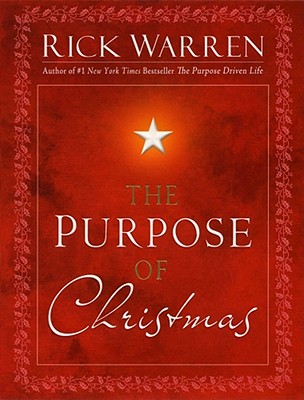
The Purpose Of ChristmasI mentioned in my book review of Rick Warren’s The Purpose Of Christmas that this might be a good book to help families recalibrate the meaning of Christmas each year. As you can see from the quotes I highlighted, this book doesn’t talk directly about Christmas trees, or gifts, or mistletoe, or carols. Rather it goes to the heart of the matter: Why did Jesus need to be born in a stable in Bethlehem? He was born for our salvation, and our reconciliation with God and our fellowman.

“Your capacity for enjoyment is evidence of God’s love for you.”

“No one wants what’s best for you more than God. No one knows better what will make you truly happy!”

“Our natural inclination is to want our own way instead of God’s way. This tendency to make wrong choices instead of right ones is called sin. The middle letter of sin is I, and whenever I place myself at the center of my life, I sin. It is any attitude or action that denies God His rightful place as first in my life.”

“Guilt is the mental price we pay for violating our God-given consciences.”

“I asked Peter Drucker, ‘How did you come to accept Jesus Christ as your Savior?’ He thought about it for a few seconds, then replied, ‘The day that I finally understood grace, I realized I was never going to get a better deal than that!’”

“Reconciliation focuses on the relationship, while resolution focuses on the problem. Always focus on reconciliation first.”

More Spirit-Filled Leaders

Listen to the podcast of this post by clicking on the player below, and you can also subscribe on AppleSpotify, or Audible.

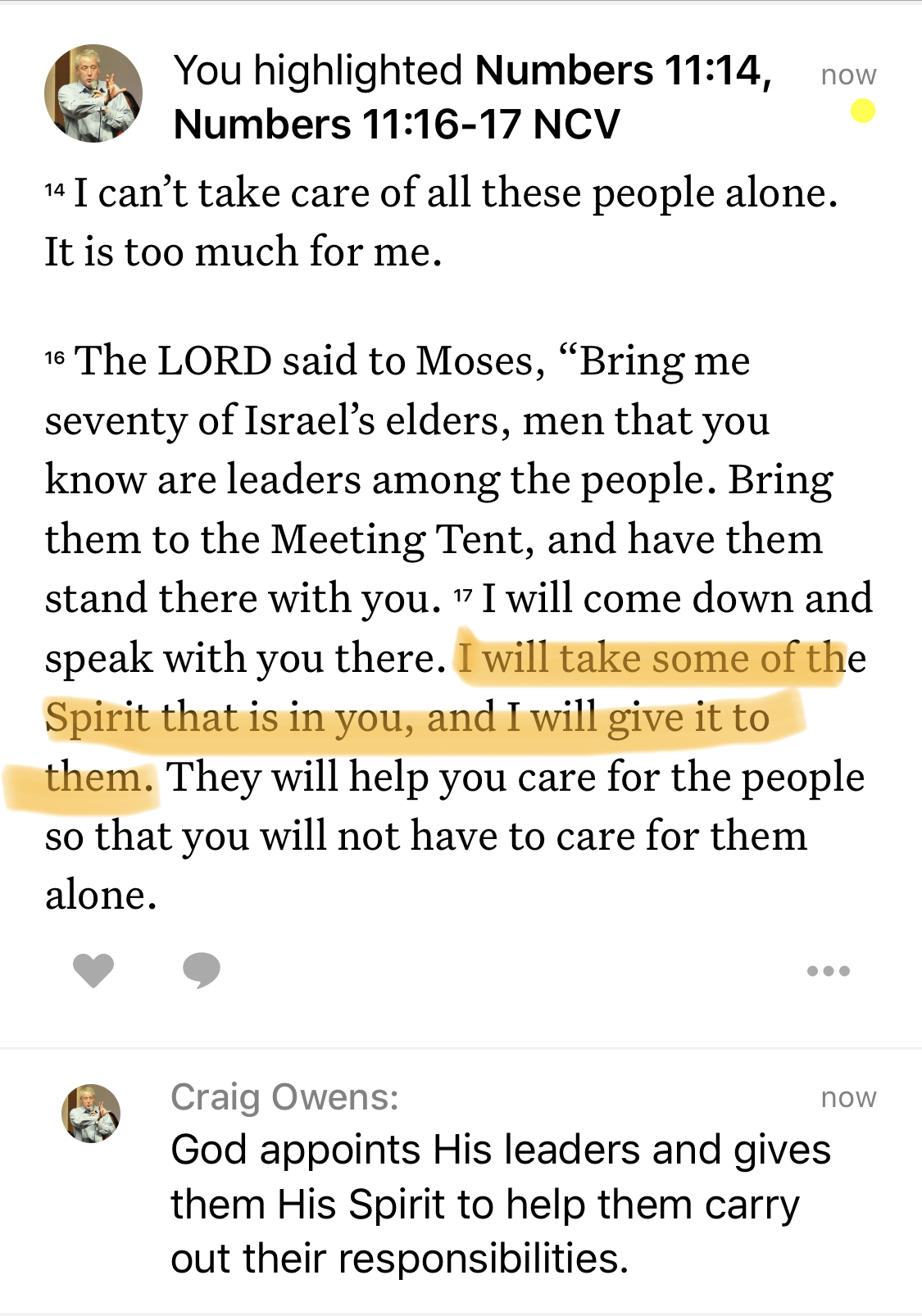
Moses was so right on the mark when he cried out, “I cannot carry all these people by myself; the burden is too heavy for me!” (Numbers 11:14)

It takes a confidently humble man to ask for help (Numbers 12:3). But God gives more grace to that humble person, while He stands aloof from those know-it-alls and those I-can-do-it-all-by-myselfs.

God anointed leaders to assist Moses. He took the same Spirit that was on Moses and imparted it to those 70 leaders. But—note this carefully—the Spirit on Moses was not at all diminished!

Moses’ responsibility was to pick the 70 “who are known to you as leaders” and then the Lord placed His Spirit on them. There were 70 who prophesied but Moses correctly desired “that all the Lord’s people were prophets and that the Lord would put His Spirit on them” (Numbers 11:16-17, 25, 29).

Leadership is necessary, and it is meant to be shared. From the senior leader, this requires:

  1. Humility
  2. Responsibility
  3. Willingness

Oh Lord, raise up more Spirit-empowered leaders!

►► Would you please prayerfully consider supporting this ministry? My Patreon supporters get behind-the-scenes access to exclusive materials. ◀︎◀︎

Teach Compassion

Compassion means to not only feel what someone else is feeling, but then to make a move toward that person to help. In the life of Jesus you will often see the phrase “He was moved with compassion” and then Jesus taught or healed or acted to alleviate someone’s discomfort.

Pastors, we need to teach our congregations to be people of compassion: to feel the needs of those around them and then move to act in the love of Christ.

A.W. Tozer

A.W. Tozer

“The multitudes that were so dear to Christ shall not be less dear to me. If I cannot prevent their moral suicide, I shall at least baptize them with my human tears. I want no blessing that I cannot share. I seek no spirituality that I must win at the cost of forgetting that men and women are lost and without hope. If in spite of all I can do they will sin against light and bring upon themselves the displeasure of a holy God, then I must not let them go their sad way unwept. I scorn a happiness that I must purchase with ignorance. I reject a heaven that I must enter by shutting my eyes to the sufferings of my fellow men. I choose a broken heart rather than any happiness that ignores the tragedy of human life and human death. Though I, through the grace of God in Christ, no longer lie under Adam’s sin, I would still feel a bond of compassion for all of Adam’s tragic race, and I am determined that I shall go down to the grave or up into God’s heaven mourning for the lost and the perishing. —A.W. Tozer (emphasis added)

30 Quotes From “Raising Your Child To Love God”

Raising Your ChildIt’s a book I called a “must read for all parents” (you can read my full book review by clicking here). After typing up my notes of all the quotes I highlighted in this book, I ended up with 18 pages of notes, so these quotes from Andrew Murray’s book are, in my opinion, the cream of the crop. Tomorrow I will share some of the prayers Murray offered in his book.

“Example is better than precept. … Love that draws is more important than law that demands. … Let parents be what they want their children to be.”

“How terrible is the curse and power of sin! Through the father the child becomes a partaker of the sinful nature, and the father so often feels himself too sinful to be a blessing to his child; thus the home becomes a path to destruction rather than to eternal life. But—blessed by God!—what sin destroyed, grace restores. … Let God’s Father-heart and His Father-love be your confidence. As you know and trust Him the assurance will grow that He is fitting you for making your home, in ever-increasing measure, the bright reflection of His own.”

“God seeks a people on earth to do His will. The family is the great institution for this object; a believing and God-devoted father is one of the mightiest means of grace.” 

“What God says of Abraham gives us further insight into the true character of this grace: ‘For I have chosen him, so that he will direct his children and his household after him to keep the way of the Lord.’ The spirit of modern so-called liberty has penetrated even into our family life; and there are parents, who some from a mistaken view of responsibility, some from lack of thought as their sacred calling, somer from love of ease, have no place for such a word as ‘command.’ They have not seen the heavenly harmony between authority and love, between obedience and liberty. Parents are more than friends and advisers; God has clothed them with a holy authority to be exercised in leading their children in the way of the Lord.”

“Oh that Christian parents would realize, just as Judah did, what it means to stand in that place for their child! How often—when our children are in danger because of the prince of this world, when the temptations of the flesh or the world threatened to make them prisoners and slaves, holding them back from ever reaching the Father’s home—are we found careless or unwilling to sacrifice our ease and comfort in order to rescue them!” 

“Oh, that the eyes of God’s people might be opened to the danger that threatens the church! It is not infidelity or superstition, it is the spirit of worldliness in the homes of Christian families, sacrificing the children to the ambitions of society, to the riches or the friendship of the world—that is the greatest danger of Christ’s church. If every home once won for Christ were a training school for His service, we would find in this a secret of spiritual strength no less than all that ordinary preaching can accomplish.”

“With a parent’s love comes a parent’s influence. … The character of a child is formed and molded by impressions; continual communion with the parent can render these impressions deep and permanent. The child’s love for a parent rises to meet the parent’s love.” 

“The first four commandments have reference to God, the last five to our neighbor. In between stands the fifth. It is linked to the first four because to the young child the parent represents God; from him the child must learn to trust and obey God. And this command is the transition to the last five because the family is the foundation of society, and there the first experience comes of all the greater duties and difficulties with humankind at large.”

“The child can only honor what he sees to be ‘worthy of honor.’ And this is the parent’s high calling: always so to speak and act, so to live in the child’s presence, that honor may be spontaneously and unconsciously rendered. … Above all, let parents remember that honor comes from God. Let them honor Him in the eyes of their children, and He will honor them there too.”

“There is nothing that drive home the word of instruction as powerfully as a consistent and holy life. … The entrance of divine truth into the mind and heart, the formation of habits and the training of character—these are not attained by sudden and isolated efforts, but by regular and unceasing repetition.”

“Love knows no sacrifice, counts nothing a burden; love does not rest until it has triumphed.”

“We don’t want to be just another family with whom God dwells and is pleased. Ours must be wholly consecrated to God. And do not be afraid that strength will not be given to keep the vow. It is with the Father in heaven, calling and helping and tenderly working both to will and to do in us, that we are working.”

“We need renewed wisdom directly from above for the individual needs of each child. Daily prayer is the secret of training our children for God. … Those who have already communicated with God and received divine teaching about their children will be those who desire still more and pray earnestly for it.”

“Nothing open the fountains of divine love and renewed love for each other more than the prayerful desire to know how to raise our children to love God.”

“Not to restrain a child is to dishonor God and the child.”

“My duty is never measured by what I feel is within my power to do but by what God’s grace enables me to do.”

“Every thoughtful parent knows that there are times and places when the temptations of sin will be more apt to surprise even the most well-behaved child. Such are the times, both before and after the child goes into a situation or circumstance where he may be tempted, that a praying father and mother should do what Job did, bring the children before God in repentance and faith and where possible to confront them with questions concerning their behavior.”

“Let us ask God to make us very watchful and very wise in availing ourselves of opportunities to admonish our children and to pray audibly with them.”

“In our family’s life, the first thing of importance must not be our earthly happiness, or even the supply of our daily needs, nor seeing to the child’s education for a life of prosperity and usefulness, but rather the yielding of ourselves to God in order to be conveyors of His grace and blessing to our children. Let us live for God’s purpose: deliverance from sin. Thus our family life will forever be brightened with God’s presence and with the joy of our heavenly home to come, of which our earthly one is by the nursery and the image.”

“‘The children of Your servants will live in Your presence; their descendants will be established before You’ (Psalm 102:25-28). Death may separate one generation from another, but God’s mercy connects them as it passes on from one to another; His righteousness, which is everlasting, reveals itself as salvation from generation to generation. … It is God’s will that His salvation should be known from generation to generation in your family too, that your children should hear from you and pass on to their children the praises of the Lord.”

“God’s purpose is that the Holy Spirit should take possession of our sons and daughters for His service; that they should be filled with the Holy Spirit, consecrated for service. They belong to Him and He to them.” 

“Jesus desires that we rise above the experiences of fatherhood on earth to know more deeply the Father in heaven.”

“The earthly father must not only make the Father in heaven his model and guide, but he must so reflect Him that his child will naturally desire to emulate the One whom he so aptly represents. … In a Christian father a child ought to have a better picture than the best of sermons can give of the love and care of the heavenly Father and all the blessing and joy He wants to bestow.”

“If we are to watch over the heavenly quality of our children, we must ourselves be childlike and heavenly-minded. … Children lose their childlikeness all too soon because parents have so little of it.”

“Fathers, you have sons whom you would fain bring to Jesus to be saved, come and hear the lessons the Lord would teach you. Let these children first send you to Jesus in confession, prayer, and trust; your faith can bring them in.”

“Your motherhood is in God’s sight holier and more blessed than you realize.”

“The effect of the good advice parents give is more than neutralized by their own behavior.” 

“A child should never be allowed to feel that his immaturity is not taken into account, that his young reasoning is not regarded, that he has not received empathy, or help, or justice that he expects. This will take a kind of love and thoughtfulness that parents are all too short of.”

“If you feel that you do not know how to teach the Word to them, to make it interesting or exciting for them, take heart—God will make it come alive to them if you are faithful to read it and live it.”

“I am the giver of their physical life, the framer of their character, the keeper of their souls, the trustee of their eternal destiny. I was first blessed that I may bless them, first taught how my Jesus loved me and gave Himself for me that I may know how to love and how to give myself for them. … And the more tenderly my love to them is stirred up, the more I feel the need to be wholly and only the Lord’s, entirely given up to the love that loves and makes itself one with me. This will fill me with a love from which selfishness shall be banished, giving itself in a divine strength to live for the children that God has given me.”

22 Quotes From “The Ragamuffin Gospel”

Ragamuffin GospelThe Ragamuffin Gospel by Brennan Manning really resonated with me. You can read my full book review by clicking here, but below are some of the quotes I especially appreciated.

“The institutional church has become a wounder of the healer rather than a healer of the wounded.” 

“Personal responsibility has replaced personal response. We talk about acquiring virtue as if it were a skill that can be attained, like good handwriting or a well-grooved golf swing. In the penitential seasons we focus on overcoming our weaknesses, getting rid of our hang-ups, and reaching Christian maturity. We sweat through various spiritual exercises as if they were designed to produce a Christian Charles Atlas. Though lip service is paid to the gospel of grace, many Christians live as if only personal disciplines and self-denial will mold the perfect me. The emphasis is on what I do rather on what God is doing. In this curious process God is a benign old spectator in the bleachers who cheers when I show up for morning quiet time.”

“God has a single relentless stance toward us: He loves us. He is the only God man has ever heard of who loves sinners. False gods—the gods of human manufacturing—despise sinners, but the Father of Jesus loves all, no matter what they do.” 

“Jesus comes not for the super-spiritual but for the wobbly and the weak-kneed who know they don’t have it all together, and who are not too proud to accept the handout of amazing grace.”

“The Word we study has to be the Word we pray.”

“We must never allow the authority of books, institutions, or leaders to replace the authority of knowing Jesus Christ personally and directly. When the religious views of others interpose between us and the primary experience of Jesus as the Christ, we become unconvicted and unpersuasive travel agents handing out brochures to places we have never visited.”

“Whatever past achievements might bring us honor, whatever past disgraces might make us blush, all have been crucified with Christ and exist no more except in the deep recess of eternity.” 

“It is unimaginable to picture a wooden-faced, stoic, joyless, and judgmental Jesus as He reclined with ragamuffins.”

“We miss Jesus’ point entirely when we use His words as weapons against others. They are to be taken personally by each of us.” 

“The saved sinner is prostrate in adoration, lost in wonder and praise. He knows repentance is not what we do in order to earn forgiveness; it is what we do because we have been forgiven. It serves as an expression of gratitude rather than an effort to earn forgiveness. Thus the sequence of forgiveness and then repentance, rather than repentance and then forgiveness, is crucial for understanding the gospel of grace.”

“Maybe this is the heart of our hang-up, the root of our dilemma. We fluctuate between castigating ourselves and congratulating ourselves because we are deluded into thinking we save ourselves. We develop a false sense of security from our good works and scrupulous observance of the law. Our halo gets too tight and a carefully disguised attitude of moral superiority results. Or we are appalled by our inconsistency, devastated that we haven’t lived up to our lofty expectations of ourselves. The roller coaster ride of elation and depression continues. Why? Because we never lay hold of our nothingness before God, and consequently, we never enter into the deepest reality of our relationship with Him. But when we accept ownership of our powerlessness and helplessness, when we acknowledge that we are paupers at the door of God’s mercy, then God can make something beautiful out of us.” 

“Honesty is such a precious commodity that it is seldom found in the world or the church. Honesty requires the truthfulness to admit the attachment and addictions that control our attention, dominate our consciousness, and function as false gods. I can be addicted to vodka or to being nice, to marijuana or being loved, to cocaine or being right, to gambling or relationships, to golf or gossiping. Perhaps my addiction is food, performance, money, popularity, power, revenge, reading, television, tobacco, weight, or winning. When we give anything more priority than we give to God, we commit idolatry. Thus we all commit idolatry countless times every day.”

“To be alive is to be broken. And to be broken is to stand in need of grace. Honesty keeps us in touch with our neediness and the truth that we are saved sinners. There is a beautiful transparency to honest disciples who never wear a false face and do not pretend to be anything but who they are. … Getting honest with ourselves does not make us unacceptable to God. It does not distance us from God, but draws us to Him—as nothing else can—and opens us anew to the flow of grace.” 

“When we wallow in guilt, remorse, and shame over real or imagined sins of the past, we are disdaining God’s gift of grace. Preoccupation with self is always a major component of unhealthy guilt and recrimination. … Yes, we feel guilt over sins, but healthy guilt is one which acknowledges the wrong done and feels remorse, but then is free to embrace the forgiveness that has been offered.”

“The evil one is the great illusionist. He varnishes the truth and encourages dishonesty. ‘If we say, “We have no sin,” we are deceiving ourselves, and the truth has no place in us’ (1 John 1:8). satan prompts us to give importance to what has no importance. He clothes trivia with glitter and seduces us away from what is real. He causes us to live in a world of delusion, unreality, and shadows.” 

“At Sunday worship, as in every dimension of our existence, many of us pretend to believe we are sinners. Consequently, all we can do is pretend to believe we have been forgiven. As a result, our whole spiritual life is pseudo-repentance and pseudo-bliss.”

“The way we are with each other is the truest test of our faith. How I treat a brother or sister from day to day, how I react to the sin-scarred wino on the street, how I respond to interruptions from people I dislike, how I deal with normal people in their normal confusion on a normal day may be a better indication of my reverence for life than the antiabortion sticker on the bumper of my car.” 

“A little child cannot do a bad coloring; nor can a child of God do bad in prayer.”

“The call asks, Do you really accept the message that God is head over heels in love with you? I believe that this question is at the core of our ability to mature and grow spiritually. If in our hearts we really don’t believe that God loves us as we are, if we are still tainted by the lie that we can do something to make God love us more, we are rejecting the message of the Cross.” 

“There are some real problems with projecting the perfect image. First of all, it’s simply not true—we are not always happy, optimistic, in command. Second, projecting the flawless image keeps us from reaching people who feel we just wouldn’t understand them. And third, even if we could live a life with no conflict, suffering, or mistakes, it would be a shallow existence. The Christian with depth is the person who has failed and who has learned to live with it.”

“We project into the Lord our own measured standard of acceptance. Our whole understanding of Him is based in a quid pro quo of bartered love. He will love us if we are good, moral, and diligent. But we have turned the tables; we try to live so that He will love us, rather than living because He has already loved us.” 

“No greater sinners exist than those so-called Christians who disfigure the face of God, mutilate the gospel of grace, and intimidate others through fear. They corrupt the essential nature of Christianity.”

20 Quotes From “The Highest Good”

The Highest GoodSome of my most highlighted books are Oswald Chambers’ books, so The Highest Good was no exception. It was difficult to narrow down, but here are 20 of my favorite quotes from this book. (If you would like to read my book review of The Highest Good, click here).

“If I am a child of God, distress will lead me to Him for direction. The distress comes not because I have done wrong, it is part of the inevitable results of not being at home in the world, of being in contact with those who reason and live from a different standpoint.” 

“Spiritual insight is not for the purpose of making us realize we are better than other people, but in order that our responsibility might be added to.”

“God expects us to be intercessors, not dogmatic fault-finders, but vicarious intercessors, until other lives come up to the same standard.” 

“In times of prosperity we are apt to forget God, we imagine it does not matter whether we recognize Him or not. As long as we are comfortably clothed and fed and looked after, our civilization becomes an elaborate means of ignoring God. … But remember God’s blessing may mean God’s blasting. If God is going to bless me, He must condemn and blast out of my being what He cannot bless. ‘Our God is a consuming fire.’ When we ask God to bless, we sometimes pray terrible havoc upon the things that are not of God. God will shake all that can be shaken, and He is doing it just now.”

“God intends our attention to be arrested, He does not arrest it for us. … We are apt to pay more attention to our newspaper than to God’s Book, and spiritual leakage begins because we do not make the effort to lift up our eyes to God.” 

“The majority of us do not enthrone God, we enthrone common-sense. We make our decisions and then ask the real God to bless our god’s decision.”

“When I wish I was somewhere else I am not doing my duty to God where I am.” 

“Let us not be so careful as to how we offend or please human ears, but let us never offend God’s ears.”

“We have not only lost Jesus Christ’s idea of righteousness, but we laugh at the Bible idea of righteousness; our god is the conventional righteousness of the society to which we belong.” 

“It is so absurd to put our Lord as Teacher first, He is not first a Teacher, He is a Savior first. He did not come to give us a new code of morals: He came to enable us to keep a moral code we had not been able to fulfill. … If He is a Teacher only, then He is a most cruel Teacher, for He puts ideals before us that blanch us white to the lips and lead us to a hell of despair. But if He came to do something else as well as teach—if He came to re-make us on the inside and put within us His own disposition of unsullied holiness, then we can understand why He taught like He did.”

“The only way to get out of our smiling complacency about salvation and sanctification is to look at Jesus Christ for two minutes and then read Matthew 5:43-48 and see Who He tells us we are to be like, God Almighty, and every piece of smiling spiritual conceit will be knocked out of us for ever, and the one dominant note of the life will be Jesus Christ first, Jesus Christ second, and Jesus Christ third, and our own whiteness nowhere. Never look to your own whiteness; look to Jesus and get power to live as He wants; look away for one second and all goes wrong.”

“For the past three hundred years men have been pointing out how similar Jesus Christ’s teachings are to other good teachings. We have to remember that Christianity, if it is not a  supernatural miracle, is a sham.”

“The point is that Jesus saw life from God’s standpoint, and we don’t. We won’t accept the responsibility of life as God gives it to us, we only accept responsibility as we wish to take it, and the responsibility we wish to take is to save our own skins, make comfortable positions for ourselves and those we are related to, exert ourselves a little to keep ourselves clean and vigorous and upright; but when it comes to following out what Jesus says, His sayings are nothing but jargon. We name the Name of Christ but we are not based on His one issue of life, and Jesus says, ‘What shall it profit a man, if he shall gain the whole world’—and he can easily do it—‘and lose his own soul.’” 

“It is remarkable how little Jesus directed His speech against carnal and public sins, though He showed plenty of prophetic indignation against the sins of a wholly different class, He preached His grandest sermon to a bad, ignorant woman (John 4:10-14), and one of His most prominent disciples was a publican named Matthew. The one man He ever said He wanted to stay with was another publican called Zaccheus, and some of the most fathomless things He said were in connection with a notoriously bad woman (Luke 7:36-50). … Jesus aroused the conscience of the very worst of them by presenting the highest good.”

“Ask yourself, then, what is it that awakens indignation in your heart? Is it the same kind of thing that awakened indignation in Jesus Christ? The thing that awakens indignation in us is the thing that upsets our present state of comfort and society. The thing that made Jesus Christ blaze was pride that defied God and prevented Him from having His right with human hearts.” 

“If we know that we have received the unmerited favor of God and we do not give unmerited favor to other people, we are damned in that degree.”

“‘If ye then, being evil…’ (Luke 11:13). Jesus Christ is made to teach the opposite of this by modern teachers; they make out that He taught the goodness of human nature. Jesus Christ revealed that men were evil, and that He came that He might plant in them the very nature that was in Himself. He cannot, however, begin to do this until a man recognizes himself as Jesus sees him.” 

“The holiest person is not the one who is not conscious of sin, but the one is more conscious of what sin is. … The purer we are through God’s sovereign grace, the more terribly poignant is our sense of sin. … Sin destroys the capacity of knowing what sin is. … We shall find over and over again that God will send us shuddering to our knees every time we realize what sin is, and instead of increasing hardness in us towards the men and women who are living in sin, the Spirit of God will use it as a means of bringing us to the dust before Him in vicarious intercession that God will save them as He has saved us.”

“‘God is able to make all grace abound toward you.’ Have you been saying, ‘I cannot expect God to do that for me’? Why cannot you? Is God Almighty impoverished by your circumstances? Is His hand shortened that it cannot save? Are your particular circumstances so peculiar, so remote from the circumstances of every son and daughter of Adam, that the Atonement and the grace of God are not sufficient for you? Immediately we ask ourselves these things, we get shaken out of our sulks into a simple trust in God. When we have the simple, childlike trust in God that Jesus exhibited, the overflowing grace of God will have no limits, and we must set no limits to is.” 

“The love of God rakes the very bottom of hell, and from the depths of sin and suffering brings sons and daughters to God.”