The Blood Of Jesus

Horatius Bonar‘They have washed their robes and made them white in the blood of the Lamb.’ Not only the man, but his garments are made white. This is more than cleansing. It is the word used regarding Christ’s transfiguration-garments (Matthew 17:2); the angel-robes (Matthew 28:3); the heavenly clothing (Revelation 4:4); the judgment throne (Revelation 20:2). Whiter than snow or wool, white as the garments of Christ—nay, the ‘head and hair’ of Christ (Revelation 1:14). This is the result of the application of the blood to those who were ‘blacker than the coal,’ redder than crimson. What potency, what virtue, what excellency does this blood contain! How it beautifies and glorifies!

“He gives us this blood as our right of entrance is sprinkled and consecrated by His blood. Let us draw near! The blood removes all cause of dread, all possibility of rejection, nay, gives the certainty of reception. Let us go in! We are sure of a welcome. It gives boldness as well as right of entrance. It says, ‘Draw near boldly.’” —Horatius Bonar, in Light And Truth—Revelation

Other quotes from this book may be read here and here.

Book Reviews From 2016

Thursdays With Oswald—Christ’s Incarnation Means Our Freedom

Oswald ChambersThis is a weekly series with things I’m reading and pondering from Oswald Chambers. You can read the original seed thought here, or type “Thursdays With Oswald” in the search box to read more entries.

Christ’s Incarnation Means Our Freedom

     Other religions deal with sins; the Bible alone deals with sin. The first thing Jesus Christ faced in man was this heredity of sin, and it is because we have ignored it in our presentation of the Gospel that the message of the Gospel has lost its sting, its blasting power; we have driveled it into insurance tickets for heaven, and made it deal only with the wastrel element of mankind. …  

     The revelation is not that Jesus Christ was punished for our sins, but that He was made to be sin. “Him who knew no sin” was made to be sin, that by His identification with it and removal of it, we might become what He was. … Jesus Christ went straight through identification with sin that every man and woman on earth might be freed from sin by His atonement. He went through the depths of damnation and came out more than conqueror; consequently everyone of us who is willing to be identified with Him is freed from the disposition of sin, freed from the connection with the body of sin, and can come out more than a conqueror too because of what Jesus Christ has done. … 

     The Holy Spirit will take my spirit, soul and body and bring them back into communion with God, and lead me into identification with the death of Jesus Christ, until I know experimentally that my old disposition, my right to myself, is crucified with Him, and my human nature is now free to obey the commands of God. 

From The Shadow Of An Agony

As we approach the time of year we celebrate the Incarnation of Jesus, it’s amazing to think that He didn’t come just to identify with our sin, but to be made sin! Without Jesus Christ’s death on a Cross in our place, there is no hope for us.

As we celebrate the First Advent, it’s a good idea to keep in the front our our minds what Christ’s Incarnation means for us. It means we can be freed from sin—free to obey God, and free to look forward to Christ’s Second Advent, where He will take away His saints to be with Him forever!

Christlike Wives And Husbands

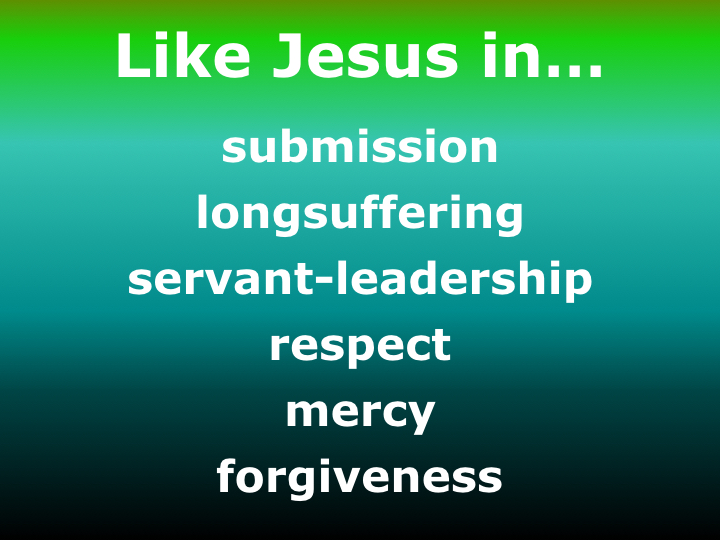
like-jesusTime after time Peter calls Christians to live a counter-cultural lifestyle. The most countercultural example we have ever seen is Jesus Christ.

Peter shows us how Jesus—in the most excruciating situation possible—lived. Heading into the torture of crucifixion

  • He was submissive to His Father’s will
  • He remained focused on the future glory, not just the immediate pain
  • He continued to be a servant-hearted leader
  • He spoke to those around Him respectfully
  • He extended mercy to His tormentors
  • He prayed for (and purchased with His blood) His tormentors’ forgiveness

Peter then tells Christian wives and husbands they are to behave in the same way as Jesus. Wow!

More specifically Peter challenges Christlike wives to be:

  1. Submissive to their husbands—I like how the Amplified Bible says this in verse 1: “subordinate, not as inferior, but out of respect for the responsibilities entrusted to husbands and their accountability to God, and so partnering with them.
  2. Christlike in their behavior.
  3. Distinctive by their purity.
  4. Reverent to God, by honoring the image of God in their husbands.
  5. Beautiful from the inside out.
  6. Consistently doing what is right
  7. Not swayed by fear—“do what is right without being frightened by any fear [that is, being respectful toward your husband but not giving in to intimidation, nor allowing yourself to be led into sin, nor to be harmed]” (v. 6 AMP).

Likewise Peter challenges Christlike husbands to be:

  1. Submissive to their wives—remember the in the same way phrase? That applies to the men too. Submit to one another out of reverence for Christ. … Husbands, love your wives, just as Christ loved the church and gave Himself up for her (Ephesians 5:21, 24).
  2. Considerate of her—the King James Version says, “dwell with them according to knowledge.” That word for knowledge means to study your wife and know what she likes and doesn’t like.
  3. Respectful in the way he treats his wife.
  4. Treating her as a partner and heir in your spiritual heritage.
  5. Understanding the part she plays in your spiritual development—“The same goes for you husbands: Be good husbands to your wives. Honor them, delight in them. As women they lack some of your advantages. But in the new life of God’s grace, you’re equals. Treat your wives, then, as equals so your prayers don’t run a ground” (v. 7 MSG).

Here are two questions I think Christian wives and husbands need to seriously consider: Are you thinking about your role as a husband or wife in biblical terms or cultural terms? If you are thinking in cultural terms, are you willing to try it God’s way?

Our Christian marriages should be “alien” to the way the world operates; they should be counter-cultural. That kind of marriage is what points people to a relationship with Jesus!

If you’ve missed any messages in this series, you may find the complete list by clicking here.

Ken Blanchard & Phil Hodges On Forgiveness

lead-like-jesus“Forgiveness is the way for a heart grounded in the unconditional love of God to respond to the imperfections of others. … EGO-driven leaders, impatient for results, are quick to judge and discount less-than-perfect efforts as failure rather than to forgive and redirect. Forgiveness is a supernatural act, not a natural response to being hurt or let down. It is an act of the will, a choice, of one who has surrendered control to a higher court of judgment. …

“The opposite of forgiveness is judgment. Your motivation for doing something is as important as what you do. In theological terms, judgment is pointing out a fault with a view to condemnation. On the other hand, discernment is pointing out a fault with a view to correction or restoration. When we withhold forgiveness, is it because we are sincerely trying to correct or restore—or is it because there is some benefit to us in condemning?” —Ken Blanchard & Phil Hodges

Jim Daly On Forgiveness

Jim Daly“Have you noticed? It can be a challenge to say, ‘I’m sorry.’ Oh, it’s not hard to speak the words, but it can be tough to say them with sincerity. Why? Probably because we understand that to apologize is to accept responsibility for ill-spoken words or misbehavior. It requires humility on our part, which can often be confused with giving someone else the upper hand over us. That’s why apologies tend to be viewed as a weakness.

“It’s also why people offer apologies that have been stripped of any real meaning. We minimize the severity of our actions; we blame our behavior on others; or maybe we say all the right words, but dilute them with sarcasm or humor. Whatever the method, we recognize a false act of contrition when we see it because the result is always the same: the appearance of an apology without the substance of one. And rather than healing, shallow platitudes often deepen a loved one’s wounds. Like a doctor’s empty syringe, an empty apology pierces the soul but offers nothing that can bring healing.

“That’s why, far from being a weakness, a heart-felt apology requires strength because it demands deep sincerity on behalf of the person offering it. That inner strength and humility often requires God’s grace to express. The Lord’s role is crucial because mending a relationship-gone-wrong has little to do with the specific words we use to express our contrition. The healing comes from the authenticity we pour into our words and actions.” —Jim Daly

12 Quotes From “I Stand At The Door And Knock”

I Stand At The Door And KnockCorrie ten Boom was an amazing woman! To experience the horrors of a Nazi concentration camp, and still retain such a sweet, godly spirit is indeed a miracle of God’s grace. This beautiful spirit of hers come through loud and clear in her book I Stand At The Door And Knock (you may read my book review here). Below are just a few of the many quotes which I highlighted as I read.

“You see, if you and I want to be used, we needn’t rely on ourselves, because it is the Holy Spirit who does it. And that is why we can be at peace in our day-to-day lives. The fact that we wish to be used is a gift from the Holy Spirit in itself.”

“A piece of good advice is to forgive anyone immediately—and I mean immediately— if they say or do something against you. Then the devil won’t have a chance to keep a shadow in your heart.”

“Holiness can bring about a new conflict. We need to take care. The devil wants to lead us into the energy of our inner selves. Preaching yourself, relying on yourself, boasting about your faith, taking pride in your own experiences. And then the devil will say, ‘Revel in your own experiences.’ But that is not right. You should not rely on your past experiences. It may strengthen your faith, but holiness is living out the Jesus Christ living in you.” 

“Imagine, when I had a watchmaker’s shop, you came to me and you bought a gold watch with a gold strap. Imagine that when I wrapped it up for you, I removed the gold strap and hid it. When you came home, you saw that you only had a watch. What would you do? You would say to everybody, ‘Don’t ever buy something from Corrie ten Boom; she doesn’t give you value for money.’ If you and I do not give ourselves entirely to the Lord, we do not give Him the value He has paid for us on the Cross. We were bought at a very high price. That Cross was horrendous. It was an extremely high price to pay for you and me.”

“In my short-sightedness, I thought I had to do everything with my own power, according to my abilities. But everything depends on Hisability, Hispower.”

“The devil may laugh at our plans. He smiles when we are up to our eyes in work. But he quakes when we pray. When we are faithful intercessors he often says to us, ‘Shouldn’t you stop? You have been doing this for such a long time, and can’t you see, the Lord doesn’t listen.’ But he is a liar. Not one of our prayers is lost. … satan laughs when we try hard. He mocks our wisdom, but he trembles when we pray.”

“While I was imprisoned during the war, I knew the Morse code, but it didn’t really help me. What actually supported me was every text and every Christian song I knew by heart. Learning Bible texts and Christian songs by heart is a preparation which we can all do today.”

“Lord Jesus, please forgive us that we so often live a life poor in You, while You suffered so heavily on the Cross so that we would become the King’s rich children. Holy Spirit, open our eyes. Give us a vision, an understanding of our wealth.”

“Religion is no security. The Antichrist will be very religious. A world religion will develop, and he himself will become its god.” 

“Jesus said, ‘Do not let your hearts be troubled.’ Our citizenship is in heaven. We are heaven dwellers. Our home is there.”

“The Bible says, ‘Be filled with the Spirit’ (Ephesians 5:18), which means not only do I have the Holy Spirit, but also does the Holy Spirit have me?”

“We should not rely on our capacities, but on God’s capacities. We shouldn’t draw from our limited resources, but from His immense power.”

I will also be sharing some of Corrie’s quotes on Twitter and Tumblr, so follow me there for more great content.

5 Quotes On Mercy From “The Blessing Of Humility”

The Blessing Of HumilityAs I stated in my review of Jerry Bridges’ book The Blessing Of Humility, reading through these thoughts slowly—Beatitude by Beatitude—would bring about the most life-changing impact. In that spirit, I will be sharing some noteworthy quotes one Beatitude at a time. Here are some quotes on blessed are the merciful (Matthew 5:7)…

“The first four character traits of the Beatitudes…all address our internal character and our relationship to God. Here in this Beatitude, ‘Blessed are the merciful,’ Jesus begins to address our relationship with other people.”

“Note the subtle distinction between compassion and mercy. The Samaritan had compassion [Luke 10:33] and then showed mercy [v. 34-35].”

“Mercy expresses itself in two general areas: In the temporal sense, mercy seeks to meet the physical needs of others, as the Good Samaritan did in Jesus’ parable. The second way mercy expresses itself is granting forgiveness to those who have sinned against us.”

“The magnitude of our sin is not measured by its effects on other people but by its assault upon the infinite majesty and holiness of God.”

“To forgive others means we regard ourselves as ten-thousand-talent debtors [Matthew 18:23-35].” 

 I have previously shared quotes on:

Quotes on the next Beatitude will be posted soon. Stay tuned…

6 Quotes On Meekness From “The Blessing Of Humility”

The Blessing Of HumilityAs I stated in my review of Jerry Bridges’ book The Blessing Of Humility, reading through these thoughts slowly—Beatitude by Beatitude—would bring about the most life-changing impact. In that spirit, I will be sharing some noteworthy quotes one Beatitude at a time. Here are some quotes on blessed are the meek (Matthew 5:5)…

“Meekness is not being timid, spineless, unassertive, and easily dominated. It is not a natural niceness. In fact, it has nothing to do with one’s personality or temperament.”

“There is then a twofold expression of meekness: first toward God and then toward other people. Meekness toward God involves: (1) responsiveness to His Word; (2) submission to His Providence.”

“As I reflect on our evangelical community to the extent I am aware of it, it seems we are more knowers of the Word than doers of the word. … Instead we too often use the Scriptures not as a means of judging ourselves but as a means of judging others, especially those whose sins are more flagrant than ours. The meek person, in contrast, searches the Scriptures (or listens to it taught) not to judge others but to allow the Holy Spirit to judge him or her. In fact, the meek person earnestly desires the Spirit to use His Word to effect a deep change in his or her inner being.”

“Thomas Watson wrote that meekness toward other people consists of three things: the bearing of injuries, the forgiving of injuries, and the returning of good for evil.”

“Because we have been forgiven so much, we have an obligation to forgive those who sin against us. Yet our motive for forgiving should not be our obligation but the realization of how much we have been forgiven.”

“Meekness towards man means bearing patiently with the hurtful actions of others and dealing gently with their failures, not only in the assurance that all of these are under God’s providential control, but in the knowledge that, left to ourselves, we have no claim to be any stronger than the weakest of our friends or any better than the worst of our enemies.” —John Blanchard

I have previously shared quotes on:

Quotes on the next Beatitude will be posted soon. Stay tuned…

5 Quotes On Grace From “The Seven Laws Of Love”

The Seven Laws Of LoveIn The Seven Laws Of Love, Dave Willis gives us some highly practical, biblically-based counsel for investing in all of our relationships. Normally when I share quotes from books, I share all of them at once, but I felt like it would be good to share these quotes a bit more slowly, to give you time to read them and apply them.

The seven laws Dave identifies are:

  1. Love requires commitment (read the quotes here)
  2. Love selflessly sacrifices (read the quotes here)
  3. Love speaks truth (read the quotes here)
  4. Love conquers fear (read the quotes here)
  5. Love offers grace
  6. Love brings healing
  7. Love lives forever

From law #5, here are some quotes on grace—

“If we deserved forgiveness, it wouldn’t be called grace. If we can earn it, it wouldn’t be real love.”

“Jesus was the perfect embodiment of both love and truth. He never told a lie, but at the same time He was never cruel or judgmental with the truth. Every word He spoke was wrapped in love, so even when the truth hurt, He never broke anyone’s trust. Jesus not only modeled how to speak the truth in love, but He also showed us how to offer grace when trust is broken. … Jesus loved Peter enough to give him the opportunity to be forgiven and rebuild trust. That opportunity for grace wasn’t an exclusive offer for Peter; it’s an opportunity God freely extends to all of us who have broken trust (which is everybody). It’s also a command. We can’t receive God’s grace without being willing to extend grace to others.”

“Some people get stuck in a cycle of grudges and mistrust because they wrongly assume that forgiveness and trust are the same thing. It’s vital that we understand their distinctions. Forgiveness can’t be earned; it can only be given freely. That’s why it’s called grace. Trust, however, can’t be given freely; it can only be earned. When someone breaks your trust, you should give your forgiveness instantly, but give your trust slowly as it is earned through consistency of actions by whoever broke your trust. During this period of rebuilding, fight the urge to punish or retaliate. Those actions won’t do anything to promote healing, and healing always needs to be our ultimate objective. Love, after all, is a healing force. You don’t have to trust someone in order to forgive, but you do have to forgive someone in order to make trust possible again.”

“When you’ve broken trust, you must be willing to take immediate action to rebuild it. When someone has broken your trust, you must be willing to provide that person the opportunity to rebuild. Giving someone the chance to reestablish trust is one of the most loving acts you can do for someone.”

“Our responses to present difficulties will often determine our level of future opportunities.”

Check out my review of The Seven Laws Of Love by clicking here.

Watch for the last few quotes from the other laws of love over the next couple of days.