Quotes From “Reliving The Passion”

Walter Wangerin, Jr. has prepared an excellent guide for the Lenten season: Reliving The Passion. Beginning on Ash Wednesday and going all the way through Resurrection Sunday, Wangerin is using the Gospel of Mark to give us some heart-probing thoughts on Christ’s Passion. I typically post quotes after I have completed a book, but I thought I would share a quote or two with you each day through this journey.

Ash Wednesday—“When we genuinely remember the death we deserve to die, we will be moved to remember the death the Lord in fact did die.”

The Second Day Thursday—“Mirrors that hide nothing hurt me. But this is the hurt of purging and precious renewal—and these are mirrors of dangerous grace. The passion of Christ, His suffering and His death, is such a mirror.”

The Third Day Friday—[read Mark 14:27-28 and Mark 16:6-7] “If Jesus ‘will go before’ His disciples from Galilee as He had gone before, then this is a call to follow Him down the hard road of conflict, criticism, enmity, persecution, suffering and death and resurrection. So the passion story becomes a roadmap for all of Jesus’ followers (who deny themselves and take up their crosses) whether Christians martyred in the first, or Christians bold in the twentieth, centuries. Read this story, then, as a detailed itinerary of the disciple’s life. But hear in it as well the constant consolation—not only that He, in ‘going before us,’ is always near us, however hard the persecution; but also that we, in going His way to Galilee, will see Him as He told you.”

The Fourth Day Saturday—“The difference between shallow happiness and a deep, sustaining joy is sorrow. Happiness lives where sorrow is not. When sorrow arrives, happiness dies. It can’t stand pain. Joy, on the other hand, rises from sorrow and therefore can withstand all grief. Joy, by the grace of God, is the transfiguration of suffering into endurance, and of endurance into character, and of character into hope—and the hope that has become our joy does not (as happiness must for those who depend upon it) disappoint us.”

The Fifth Day Monday—“Jesus: Forgive me for making much of what’s minor in Your story, diminishing the important thing. I’ve demanded miracles, healings, benefits for myself. O Lord, raise the Cross as the central beam of my whole life once again! Amen.”

The Sixth Day Tuesday—“Jesus, by the refining fires of Your grace reduce my prideful self to ash after all. Let me become a nothing, that You might be the only Something for me and in me.”

The Seventh Day Wednesday—“It was an act so completely focused upon the Christ that not a dram of worldly benefit was gained thereby [Mark 14:3-9]. Nothing could justify this spillage of some three hundred days’ wages, except love alone. The rulers who sought to kill Jesus were motivated by a certain reasonable logic; but your prodigality appears altogether unreasonable—except for reasons of love. … Love enhances and names in truth. No one else anointed Him and by that gesture declared Him Messiah, the Christ. The act, therefore, was more than beautiful. It was rare and rich with meaning.” 

“Jesus, I love You, I love You! Cleanse me of anything that is not love for You, even though the world will think me preposterous and my friends—some of whom are Your disciples—will not be able to make sense of me. You are all the sense and meaning I need. I love You. Amen.”

The Eighth Day Thursday—“Does the motive of a sin—its rationale, its reasons—make it any less a sin? Isn’t the betrayal of the sovereignty of the Lord in our lives always a sin, regardless of the factors that drove us to betray Him? Yes! Yet we habitually defend ourselves and diminish our fault by referring to reasons why we ‘had to’ do it. We sinners are so backward that we try to justify ourselves by some condition which preceded the sin. Motives console us. That’s why we want so badly to have and to know them. …

“We sinners are so backward! We invert the true source of our justification. It isn’t some preliminary cause, some motive before the sin that justifies me, but rather the forgiveness of Christ which meets my repentance after the sin.”

The Ninth Day Friday—“‘Who will give Me room?’ This is forever a measure of the love which Jesus inspires in human hearts: that there was a householder willing to endanger himself by saying, ‘I will. Come.’ We know almost as little about this man—and as much—as we know of the woman who anointed Jesus. We know him by his action only; and his deed was love. It was a sacrificial love, which puts itself in harm’s way for the sake of the beloved [Mark 14:12-16]. … 

“‘Who will give Me room?’ the Lord Jesus asks today. If we’re experienced, we know the risk. The sophisticated world mocks a meek and sheepish Christian. The evil world hates those in whom Christ shines like a light upon its darksome deeds. Even the worldly church will persecute those who, for Jesus’ sake, accuse its compromises, oppose its cold self-righteousness, and so disclose its failure at humble service.”

The Tenth Day Saturday—“Judas has no better friend than Jesus. Loving him, not loathing him, Jesus grants Judas a moment of terrible self-awareness: ‘One of you will betray Me, the one who is dipping bread into the dish with Me….’ The deed is not yet done. But Jesus sees it coming and, while yet the sinner contemplates the sin, gives Judas three critical gifts: (1) Knowledge; (2) Free will; and (3) Sole responsibility. … Given three gifts by the grace of the dear Lord—[will I] stop?”

The Eleventh Day Monday—“With the apostle Paul the pastor repeats: ‘The Lord Jesus, the same night in which He was betrayed, took bread’ [1 Corinthians 11:23]. Oh, let that pastor murmur those words, the same night, with awe. For who among us can hear them just before receiving the gift of Christ’s intimacy and not be overcome with wonder, stunned at such astonishing love? … In the night of gravest human treachery He gave the gift of Himself. And the giving has never ceased. … Oh, this is a love past human expectation. This is beyond all human deserving. This, therefore, is a love so celestial that it shall endure long and longer than we do. This is grace.”

The Twelfth Day Tuesday—“If anyone continues in a loving relationship with Jesus, it is His love that preserves it, not the love of the other, nor all the piety, nor all the goodness a Christian can muster.”

The Thirteenth Day Wednesday—“Abba, Father,” Jesus cried out, “everything is possible for You. Please take this cup of suffering away from Me. Yet I want Your will to be done, not Mine.” (Mark 14:36)

The Fourteenth Day Thursday—“What takes place in the Garden of Gethsemane is the Lord’s Prayer actually happening, as though the earlier words were a script and this is the drama itself. … When Jesus teaches us to pray, He does not teach plain recitation. Rather, He calls us to a way of being. He makes of prayer a doing. And by His own extreme example, He shows that prayer is the active relationship between ourselves, dear little children, and the dear Father, Abba.”

The Fifteenth Day Friday—“In a garden once [Eden] the Lord God decreed enmity between the serpent and the seed of the woman, enmity to the death. In a garden again [Gethsemane] that enmity produces this pathetic assault: a kiss that can kill. … Behold how the servants of God can bite!”

The Sixteenth Day Saturday—“In the fires of serious persecution the truer elements of one’s character now are revealed. Everything fraudulent, cheap, or hypocritical burns. Every pretense turns to ash. All my false words blow away. What I really am—the core character, the thing God sees when He looks at me…I am indeed. … Take my life: I consecrate it to Thee. Take all that I have and all that I am; replace the self in me with Thine own holy self.”

The Seventeenth Day Monday—“Whenever discipleship puts me in peril, give me the gift of a holy silence—to speak the truth, no less, no more. Amen.”

The Eighteenth Day Tuesday—“Christian, come and look closely: it is when Jesus is humiliated, most seeming weak, bound and despised and alone and defeated that He finally answers the question, ‘Are you the Christ?’ Now, for the record, ‘Yes: I am.’ It is only in incontrovertible powerlessness that He finally links Himself with power: ‘And you will see the Son of Man seated at the right hand of power’ [Mark 14:61-62].”

The Nineteenth Day Wednesday—“Where patience shines, impatience is revealed and hates the attention. Kindness shows unkindness to be hideous. True joy intensifies true bitterness; gentleness enrages belligerence; and self-control proves the pig to be nothing but a pig. … Save me, Lord, from blaming anyone but myself: not You (whose innocence spotlights my sin),  not Your foes (whose sins are my own), not people whose virtues reveal my evil.”

The Twentieth Day Thursday—“There’s a war inside the strong disciple. (The stronger the disciple, the worse the war!) There’s a struggle in Peter between good and evil, between these two commitments: to his Lord and to his own survival. … The forces warring in Peter’s soul seem terribly equal: a tremendous, selfless love for Jesus keeps him there, while a consuming self-interest keeps him lying. He denies himself to stay by his Lord. He denies his Lord to save himself. Both. Good and bad. Peter is paralyzed between the good that he would and the evil that he is. I see this. I recognize this. I cannot divorce myself from this—for Peter’s moral immobilization is mine as well!”

The Twenty-first Day Friday—Very early in the morning, the chief priests, with the elders, the teachers of the law and the whole Sanhedrin, made their plans. So they bound Jesus, led Him away and handed Him over to Pilate (Mark 15:1). What was Jesus thinking during this walk? “Wordlessly, Jesus answers: ‘The walking itself is the sign, child. The loneliness which I have chosen, and the Cross that closes it—these are signs that I love you ever. I have to leave you to love you best. I go where I want you never to go, precisely because I love you.’”

The Twenty-second Day Saturday—“Jesus, ironically, You and Your accusers had the selfsame goal, and by Your very silence, steadfastly, You went as it was written of You. Human beings strategized; human evil sent You to Your Cross. But something huger hovered over the occasion, something of Your own volition: Love.”

The Twenty-third Day Monday—“If they choose Barabbas over Jesus, they choose humanity over divinity. They choose one who will harm them over One Who would heal them.”

The Twenty-fourth Day Tuesday—“‘Why?’ cries Pilate suddenly. He seriously means the question: ‘What evil has He done?’ But we are now at the climax of human hatreds. This rage requires no rationale. This hatred has no reason but itself. God and the children of Adam are enemies, for the children rebelled against their God—and enemies hate. … This is the natural reaction of sinners in the presence of Holy God.”

The Twenty-fifth Day Wednesday—“The crowd is a power to be feared. In fact, its power is the fear it inspires in rulers who know its quickness to riot, its ungovernable lack of sense or of personal integrity. People lose individuality in a crowd. … Sin is brutal. But even the swollen-throated bellowers in the crowd are people to Jesus, whom He regards one by one by one, whom He does not fear, but whom He is serving right now—right now!—by giving His life to ransom them from the very brutishness they are displaying.”

The Twenty-sixth Day Thursday—You have heard that it was said, ‘You shall love your neighbor and hate your enemy.’ But I say to you, love your enemies and pray for those who persecute you [Matthew 5:43-44]. To this you were called, because Christ suffered for you, leaving you an example, that you should follow in His steps. … When they hurled their insults at Him, He did not retaliate; when He suffered, He made no threats. Instead, He entrusted Himself to Him who judges justly [1 Peter 2:21, 23]. “Jesus, there is nothing You ask of me that You have not Yourself exemplified.”

The Twenty-seventh Day Friday—“‘And they led Him out to crucify Him’ (Mark 15:20). Jesus, what can I do for You now? ‘Follow.’”

The Twenty-eighth Day Saturday—They offered Him wine mingled with myrrh; but He did not take it (Mark 15:23). “He will in no wise dull His senses or ease the pain. And so we know. What are the feelings? What has the spirit of Jesus been doing since Gethsemane? Why, suffering. With a pure and willful consciousness, terribly sensitive to every thorn and cut and scornful slur: suffering. This He has chosen. This He is attending to with every nerve of His being—not for some perverted love of pain. He hates the pain. But for a supernal love of us, that pain might be transfigured, forever.”

The Twenty-ninth Day Monday—“If death is the end of all we do, then all we do is futile. … The planets, their civilizations and their loads of people, all need a central sun—to hold them together, to keep them wheeling in good order, to bequeath them shape and meaning. History needs a center. But if that center is empty death, strengthless death, it cannot hold. Things fly apart into absurdity. … But the Creator God put a Cross in the very center of human history—to be its center, ever. The Son of God, the gift of God, the love of God, the endless light of the self-sufficient God filled the emptiness which was death at our core. … We are altogether meaningless, except God touch us. God touched us here at the Cross.”

The Thirtieth Day Tuesday—“O Jesus, does love from the Cross have to hurt so much?—hurt You with dying?—hurt me when Your dying draws me to Yourself?”

The Thirty-first Day Wednesday—Those who were crucified with Him also reviled Him (Mark 15:31). “No, there never was such sorrow as this. And the fools who pass by jeering merely reveal an iniquitous ignorance. … For our sake, God made Him to be sin who knew no sin, so that in Him we might become the righteousness of God (2 Corinthians 5:21). … Jesus has become the rebellion of mankind against its God. He is, therefore, rightly crucified.”

The Thirty-second Day Thursday—My God, why hast Thou forsaken me? Who answers Him? The thunder is silent. The city holds its breath. The heavens are shut. The dark is rejection. This silence is worse than death. No one answers Him. No, not even God. … This is a mystery, that Christ can be the obedient, glorious love of God and the full measure of our disobedience, both at once. But right now this mystery is also a fact.”

The Thirty-third Day Friday—“Perhaps we people will ever be strangers in part and puzzles to one another, always a little lonely. But You, Lord, have searched me and known me. You have searched and loved and saved me even in my ignorance.”

The Thirty-fourth Day Saturday—And Jesus uttered a loud cry and breathed His last [Mark 15:37]. “satan, thou art defeated in My defeat! Sin, disposed of a people! Death, look about thee; thou art not mighty and dreadful. Lo, I close My eyes and die—and death shall be no more.”

The Thirty-fifth Day Monday—“Here is a door through which we by faith may enter Heaven, a doorway made of nails and wood, a crossing, a Cross. … For God so loved the world that He gave His only Son, that whoever believes in Him should not perish but have eternal life. And this ‘giving’—this giving up, this giving away, this giving over—begin indeed in Bethlehem in a cradle made of wood. But it wasn’t done until He was killed by a Cross of wood on Golgotha.”

The Thirty-sixth Day Tuesday—“Grief, while you are grieving, lasts forever. But under God, forever is a day. Weeping, darling Magdalene, may last the night. But joy cometh with the sunrise—and then your mourning shall be dancing, and gladness shall be the robe around you. Wait. Wait.”

The Thirty-seventh Day Wednesday—“Joseph [of Arimathea] is not the same. There’s some new seeing in this kingdom-seeker. A veil’s been torn, a wall breached, a window opened. Perhaps he’s bold because he hopes. Perhaps he hopes because he’s seen a more permanent splendor than ever before, the glory of the Lord.”

Maundy Thursday—“On Maundy Thursday, consider … This is the persistent gift of the Lord’s Last Supper: that every time we faithfully eat and drink it, Jesus comes within us, and we become His temple here.”

Good Friday—When Jesus had tasted it, He said, “IT IS FINISHED!” Then He bowed His head and gave up His spirit (John 19:30).

Holy Saturday—“God is God, Who made the world from nothing—and God as God can still astonish you. … One story is done indeed … But another story—one you can not conceive of (it’s God Who conceives it!)—starts at sunrise.”

Resurrection Sunday—Why are you looking among the dead for Someone alive? He isn’t here! HE IS RISEN FROM THE DEAD! (Luke 24:5-6).
Poetry Saturday—In Christ

In Christ I feel the heart of God. 
Throbbing from heaven through earth: 
Life stirs again within the clod. 
Renewed in beauteous birth. 
The soul springs up, a flower of prayer, 
Breathing his breath out on the air. 

In Christ I touch the hand of God, 
From His pure height reached down, 
By blessed ways before untrod, 
To lift us to our crown;—
Victory that only perfect is 
Through loving sacrifice, like His. 

Holding His hand, my steadied feet 
May walk the air, the seas; 
On life and death His smile falls sweet,—
Lights up all mysteries: 
Stranger nor exile can I be 
In new worlds where He leadeth me. 

Not my Christ only: He is ours; 
Humanity’s close bond; 
Key to its vast unopened powers, 
Dream of our dreams beyond.—
What yet we shall be, none can tell; 
Now are we His, and all is well. —Lucy Larcom

Thursdays With Oswald—Isaiah 6

Oswald ChambersThis is a weekly series with things I’m reading and pondering from Oswald Chambers. You can read the original seed thought here, or type “Thursdays With Oswald” in the search box to read more entries.

Isaiah 6

[These are the notes on Oswald Chambers’ lecture on Isaiah 6.]

     My vision of God depends upon the state of my character. Character determines revelation. … Until I am born again and enter the Kingdom of God I see only along the line of my prejudices. …  

     The purpose of the vision is to enable me to see “the arm of the Lord” behind all circumstances (see Isaiah 53:1). God never gives a man the power to say “I see” until his character proves itself worthy of its purification. What hinders the purging of our perception is that we will build our faith on our experiences instead of on the God who gave us the experiences. My experience is the evidence of my faith, never the ground of it, and is meant to reveal to me a God who is bigger than any experience. …  

     The symbol of the live coal ‘from off the altar’ represents the twofold nature of the substitution of Christ, not only Christ for me, but Christ in me. … 

     God only gives us visions of Himself for one purpose, that we may work them out into character. … After God has given us a time of face-to-face contact with Himself and then puts us into tumults, the temptation is to sit down and say “Where is the blessedness I had when I first knew the Lord?” The Spirit of God holds us steady until we learn to know God, and the details of our lives are established before Him, then nothing on the outside can move us.

From Notes On Isaiah

There are specific reasons God will give us a clearer revelation of Himself—

  1. to purify godly character in us
  2. to help us deal with our own sin
  3. to see God at work in everyday affairs
  4. to keep us energized through trying times
  5. to make us more aware of what Jesus has done for us and in us
  6. to be His messenger among needy people

God doesn’t give visions or revelations just to thrill us or give us an experience. God is perfectly purposeful in everything He does. His visions are for His glory.

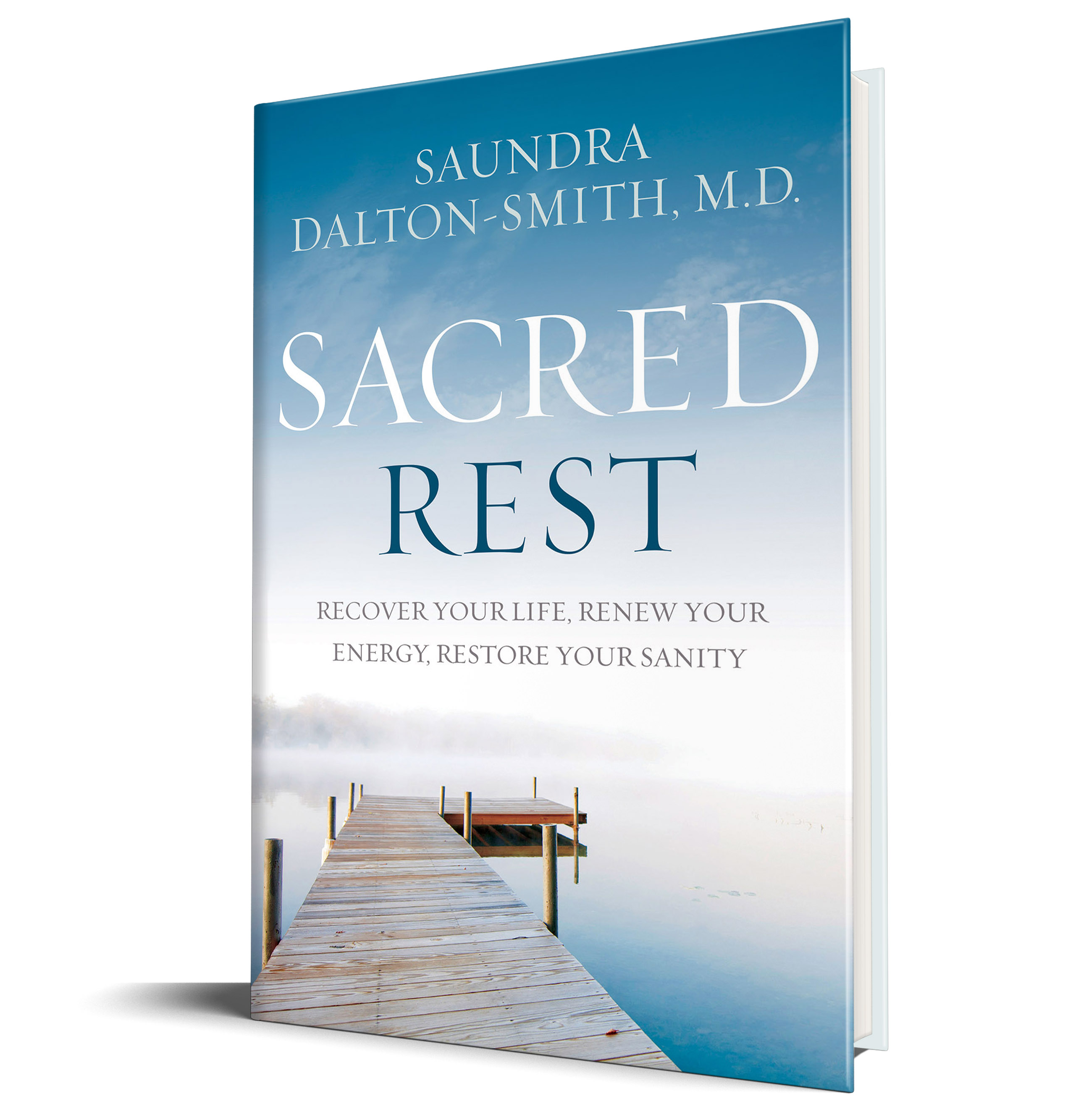
10 Quotes From “Sacred Rest”

Dr. Saundra Dalton-Smith thinks you may be too busy to read her book Sacred Rest, and she was candid enough to admit that she was almost too busy to write it! But rest is absolutely vital to keep our lives on track and productive. Check out my full review of Dr. Dalton-Smith’s book by clicking here.

“When I am resting because my body is weak, I need to remember that I’m not wasting the day doing nothing. I am doing exactly what I need to do. I’m recovering.” —Anonymous 

“There has to be a bridge between good and bad sleep, and that bridge is rest. Sleep is solely a physical activity. Rest, however, penetrates into the spiritual. Rest speaks peace into the daily storms your mind, body, and spirit encounter. Rest is what makes sleep sweet.”

“All rest is not created equal. Much of what we consider rest fails to work because it is not restful. Shifting our activities or changing the location of where we are active is no more restful than doing those same activities at home. The most effective rest occurs when we are purposefully reviving the parts of our life we regularly deplete. Any so-called rest that does not meet this goal isn’t rest; it’s just more work adding to the busyness.”

“As important as it is to rest your body, it’s equally important to quiet your mind from the ongoing influx of information it receives. Much like our social media news feeds, our mental background noise is often infused with negativity. Thoughts about the future are contaminated with anxiety, thoughts about the past are tainted with regret, and thoughts about the present are spoiled with discontentment. The mind is magnificent, but it has its own agenda. Rather than willingly focusing on positive affirming thoughts, the mind prefers to settle upon negative ones that intensify stress, worry, anger, and frustration. It will attempt to occupy your attention with useless information, depleting your time and your energy. Mental rest involves relinquishing the constant stream of thoughts entering your mind quickly and obtaining a sense of cerebral stillness.”

“One should not set about treating the body without the soul. This is exactly why most ailments are beyond the capabilities of Greek healers: they neglect the whole when that is what they should be paying attention to.” —Plato

“Physical pain increases when you are under emotional stress and spiritual distress. Anything you can do to improve emotional pain will also improve how you feel physically.”

“Social rest is when we find comfort in our relationships and social interactions. … Studies show an improved immune system, better cardiovascular health, and less dementia in those who regularly enjoy the companionship of close confidantes.”

“We are not made for rest; rest was made for us. Rest is God’s gift back to His people. His presence is how He connects us to His rest. It is part invitation and part prescription.”

“Excuses are invented reasons we create to defend our behavior. It’s how we rationalize our neglect and how we avoid taking responsibility for our choices. … With excuses, we’ve placed external blame for internal problems and stay in a cycle of unproductivity.”

“A well-rested life is a secret hidden in plain sight. It is a life at one with God, self, and others. It’s a life strengthened by winding down the expectations of others and charging up your expectations for yourself. You become in tune with what you need to be at your best. You become comfortable with your strengths and knowledgeable about your weaknesses. You then use that information to pour into the areas needing strengthening and reinforce areas already strong. You find your sweet spot in living, loving, being, doing, and resting.”

Sacred Rest (book review)

Medical doctor Saundra Dalton-Smith opens her book Sacred Rest with a telling line: “Let’s be honest; we are all just too busy. I am too busy to write this book, and you are probably too busy to read this book.” How true that is! We desperately need quality rest to recuperate from our busy lives, but we’ve fooled ourselves into thinking that rest is a waste of time.

Some people mistakenly think that sleep is rest. But, as Dr. Dalton-Smith quickly points out, that isn’t true. Sleep is required for our good health, but sleep is a natural by-product of rest. Rest isn’t just taking a nap; it goes so much deeper and wider than that.

A good portion of this book is built-around Dr. Dalton-Smith’s acrostic R-E-S-T. She says, “Let me share a little medical secret with you. The most underused, chemical-free, safe, effective, alternative medicine is spelled R-E-S-T: Recognize your risk, Evaluate your current position, Science and research, Today’s application.”

In Sacred Rest, you will learn not only what parts of our lives need rest, but also some highly practical ways to get that rest we so desperately need. This book is not written in medical terminology, but in easy-to-understand principles that anyone can grasp.

Dr. Dalton-Smith shares how she has followed her own prescription for rest, and the difference it has made in her life. Quite simply she says, “What I am promising is that as you begin to understand the role rest plays in your life you will do the following: replace the stress of intense living with the peace of intentional rest, and identify your rest deficit and discover which types of rest you need most.”

Please!—Make time in your busyness to read this book on rest so that you can learn how to be the most you can be without burning yourself out.

I am a Faith Words book reviewer.

A.L.I.V.E.—The “L” Is For Lives Changed

A man named Paul was visiting Athens. While he was in the marketplace, he began to talk with people about Jesus Christ, specifically how Jesus had been crucified and then raised back to life.

His comments caught the attention of two groups of philosophers: the Epicureans who thought all religions were made up and were simply a crutch for the weak-minded and superstitious, and the Stoics who said that a divine power was in everything but wasn’t a Person that could be personally known. These groups said to Paul, “You are presenting some new teachings and strange ideas that we have never heard before! Would you come and address our next meeting?”

In 2004, renowned atheist Anthony Flew announced something that was a “strange idea” to the ears of his followers. Flew presented one of his first papers on atheism at the Socratic Club at Magdalen College, where the Christian literary giant C.S. Lewis served as the chairman. Over the years Flew had sharpened his rhetoric to become one of the best known and most outspoken atheists on the worldwide stage.

Yet in 2004, an 81-year-old Anthony Flew remarked, “I simply had to go where the evidence led,” as Flew announced to the world: there IS a God.

“My discovery of the Divine has been a pilgrimage of reason and not of faith,” wrote Flew in his book There Is A God, which is why last week I shared the first way we can know Jesus is alive in “A” is for apologetics. Today I submit to you the second way one can know that Jesus is A.L.I.V.E.: Lives changed.

Paul, who was asked to speak to the philosophers in Athens about his “strange ideas,” had been given the name Saul by his parents. When it came to religion, Saul took a backseat to no one! He was a purebred Israelite from the tribe of Benjamin (which gave Israel its very first king, who was also named Saul). Saul called himself a “Hebrew of Hebrews” because he kept the Law of Moses and the strict rules of the Pharisees absolutely faultlessly.

When he heard about Jesus (who claimed to be God), and about the followers of Jesus who claimed He had been resurrected from the dead, Saul persecuted these Christians so vehemently that he not only had many of them thrown into prison, but he had many of them killed as well.

That all came to a complete stop when Saul met Jesus for himself! You can read how Saul retold this story in Acts 22:1-16. After this encounter, Saul’s life was 180-degrees different! He even changed his name to Paul to signify his new outlook. Now he was just as adamant to tell people about Jesus as he was previously to harass and persecute Christians.

Paul’s conversion came at a steep price. The Jews with whom he used to associate now turned violently against him. Numerous times they attempted to kill him. In addition, Paul’s newfound faith in Jesus caused him to be persecuted by the Romans as well. The Roman Emperors wanted people to say, “Caesar is lord” but Paul and the other Christians were declaring, “Jesus is Lord.” Paul ended up being executed under Emperor Nero.

Paul had numerous opportunities to recant, but he never came close to doing so. His life was one that was under constant duress and distress and danger precisely because he refused to back down from his claim that Jesus was alive!

Paul isn’t alone. Millions of people around the globe have come to know Jesus as their personal Savior. Many, like Paul, have been harassed for their faith and some even violently persecuted and martyred, and yet they so firmly believed that Jesus is alive that they were willing to go to their early grave with “Jesus is my Lord” still on their lips!

What about you? Have you met Jesus for yourself?

Check out this video where my friend Scott tells his personal story of how an encounter with Jesus has completely changed the trajectory of his life.

Join me next Sunday as we continue with our 5-part series I can know Jesus is A.L.I.V.E. because of… where we will be looking at the letter “I.” You can join me either in person or on Facebook Live. If you missed the previous lesson, check out “A” is for apologetics by clicking here.

Saturday In The Psalms—Happy!!

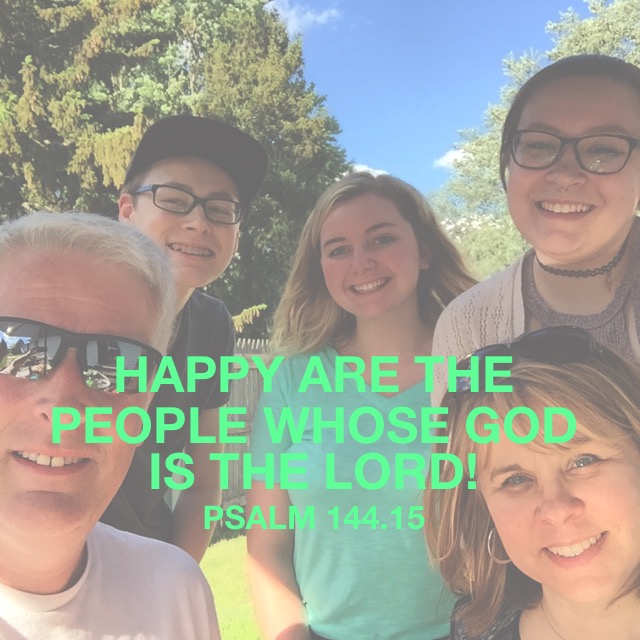
…happy are the people whose God is the Lord! (Psalm 144:15).

Happy indeed are people who have learned that there is only One God, and have also acknowledged Him as the Lord of their life.

David lists some fabulous blessings for those have made God their Lord…

  • …are equipped by God for victory
  • …experience His lovingkindness
  • …are intimately known by God
  • …know that God bends heaven and earth to help those who love Him
  • …are protected from evil people
  • …have new songs to sing
  • …experience God’s miraculous deliverance and rescue
  • …see blessings on their children and their work and their home
  • …are used as peacemakers and unity-restorers

Happy, happy, HAPPY!

Happy are the people who are in such a state;
Happy are the people whose God is the Lord!

Thursdays With Oswald—Isaiah 1

Oswald ChambersThis is a weekly series with things I’m reading and pondering from Oswald Chambers. You can read the original seed thought here, or type “Thursdays With Oswald” in the search box to read more entries.

Isaiah 1

[These are notes from Oswald Chambers’ lecture on Isaiah 1.]

     There is no such thing as fate; a human being always has the power to do the incalculable thing. There are fatal issues, not fate. When God’s decrees come to pass it is because men will not turn. God’s will is supreme, but God never fights against us; it is self-will that fights against God. …  

     If God were love according to our natural view of love He ought never to cause us pain, He ought to allow us to be peaceful; but the first thing God does is to cause us pain and to rouse us wide awake. He comes into our lives all along with ideals and truths which annoy and sting us and break up our rest, until He brings us to the one point, that it is only moral and spiritual relationships which last. That is why God looks cruel judged from the human sentimental standpoint; He loves us so much that He will not prevent us being hurt. …  

     Many a life is paralyzed because this is not realized—“I know God has forgiven me, I know I am right with God, but every now and again I remember the things I did that damaged other lives.” If I put the wrong right with my fellow men, have I become right with God? No, get right with God and He will put you on the way to be right with your fellow men. 

From Notes On Isaiah

Isaiah 1 opens with God taking His people to task for merely going through the motions of worship, with their hearts being far away from Him. Chambers reminds us that this self-will that fights against God will often bring its own pain. Why? Because God loves us too much to let us go unmolested down the path to eternal destruction. Instead, God longs for us to turn our hearts unreservedly to His love and purpose for our lives.

Religious Boredom

“Those Christians who belong to the evangelical wing of the church (which I firmly believe is the only one that even approximates New Testament Christianity) have over the last half-century shown an increasing impatience with things invisible and eternal and have demanded and got a host of things visible and temporal to satisfy their fleshly appetites. Without Biblical authority, or any other right under the sun, carnal religious leaders have introduced a host of attractions that serve no purpose except to provide entertainment for the retarded saints.

“It is now common practice in most evangelical churches to offer the people, especially the young people, a maximum of entertainment and a minimum of serious instruction. It is scarcely possible in most places to get anyone to attend a meeting where the only attraction is God. One can only conclude that God’s professed children are bored with Him, for they must be wooed to meeting with a stick of striped candy in the form of religious movies, games and refreshments. …

“Any objection to the carryings on of our present golden-calf Christianity is met with the triumphant reply, ‘But we are winning them!’ And winning them to what? To true discipleship? To cross-carrying? To self-denial? To separation from the world? To crucifixion of the flesh? To holy living? To nobility of character? To a despising of the world’s treasures? To hard self-discipline? To love for God? To total committal to Christ? Of course the answer to all these questions is no.

“We are paying a frightful price for our religious boredom. And that at the moment of the world’s mortal peril.”

—A.W. Tozer, in Man—The Dwelling Place Of God

A Crime To Be Weak

“The devil would like us to believe that we are in a losing battle; nothing of the sort! We are ‘more than conquerors,’ hilariously more than victors, ‘through Him that loved us’ [Romans 8:31-37].

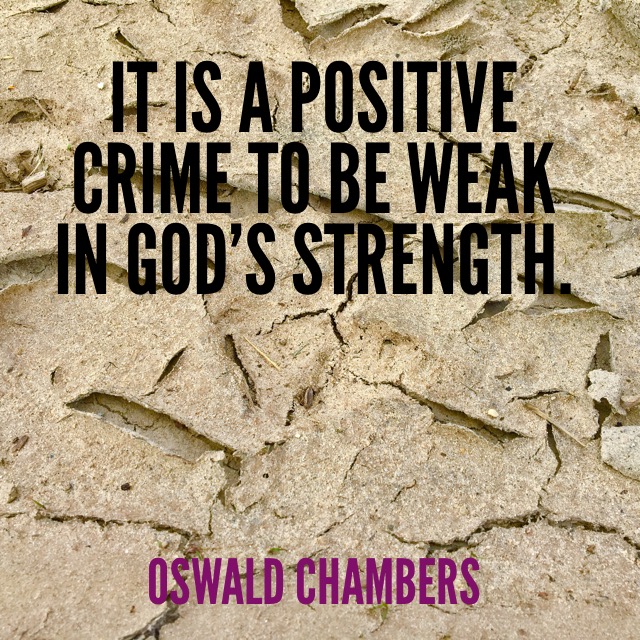
“No power on earth or in hell can conquer the Spirit of God in a human spirit; it is an inner unconquerableness. If you have the whine in you take it out ruthlessly. It is a positive crime to be weak in God’s strength.” —Oswald Chambers, in Run Today’s Race