“Friendship is a path that leads very close to the perfection which consists of the enjoyment and knowledge of God, such that a man who is a friend of man is made into a friend of God, according to what the Savior said in the gospel: ‘Now I will not call you servants, but My friends [John 15:15].’” —Aelred of Rievaulx
In studying the intense volcanic activity on Jupiter’s moon Io, the ICR concludes, “Since 2013, evidence of a youthful solar system has only gotten stronger. Scientists have been forced to acknowledge that Saturn’s rings are indeed young, and belief in deep time continues to pose real problems for conventional scientists.” The prestigious Nature concurs, saying, “Some such proposals make planetary researchers uncomfortable, because it is statistically unlikely that humans would catch any one object engaged in unusual activity—let alone several.”
Parents and teachers trying to keep up with the ever-changing lexicon of today’s youth will really appreciate this list of slang from Axis.
“Those who are really in earnest must be willing to be anything or nothing in the world’s estimation.” —Susan B. Anthony
The story of Esther in the Bible is one of my all-time favorites. “While Esther herself has not been identified, nor has the plot to destroy the Jewish people been confirmed, the absence of evidence is not evidence of absence.” To that point, here are 10 pieces of archeological evidence related to this amazing story.
Charisse Compton asks, “When was the last time meditating on your body elicited worship?” She goes on to make this case from Psalm 139: “Your body, as much as your soul, is one of God’s glorious works. It bears the unmistakable signature of the divine Artist so that, like creation, your body ‘declare[s] the glory of God’ (Psalm 19:1).”
Listen to the podcast of this post by clicking on the player below, and you can also subscribe on Apple, Spotify, or Audible.
If the expected target metrics of today’s program are met, we expect significant workflow performance advancements from team lead positioned individuals.
Does that seem a little complicated? Jargon in the workplace can very quickly cause significant problems, leading to confusion and disengagement in your team. The solution is simple—clear, concise communication. So let’s try this again without the jargon: Greg and I hope that this episode inspires you to remove the jargon from your communication, and as a result you will see your leadership influence grows.
[0:41] Today we are returning to Leadership Builders and Killers with a topic inspired by a series of videos I saw online about business jargon.
[3:21] Greg asks, “Why all the jargon?”
[5:34] Jargon can take away from what you want to communicate, and can cause others to disengage from the conversation.
[8:26] Jargon is antithetical to a commitment to clarity.
[9:33] I share a story of a conversation with students that highlights wisdom we can take into the workplace.
[12:06] One of the lowest form of communication is assumption.
[14:03] It’s important to circle back with people after a meeting to maker sure they understood.
[15:13] Jargon frequently shows up when there’s bad news to share, and when leaders are trying to cast vision.
[16:50] Sometimes we use jargon to hide.
[19:30] I share a story from the life of John Wesley about how he became a better communicator.
[21:14] It’s important to communicate with everyone on an even playing field, and not use jargon to avoid being pinned down.
[22:39] Using jargon can negatively impact your influence as a leader. Conversely, clear communication will lift your influence.
[24:58] Jargon can creep into your communication without you being aware of it. A coach from outside your industry can help you notice these blind spots.
Check out this episode and subscribe on YouTube so you can watch all of the upcoming episodes. You can also listen to our podcast on Spotify and Apple.
Listen to the podcast of this post by clicking on the player below, and you can also subscribe on Apple, Spotify, or Audible.
There is one word that people seem to speak that is blocking the blessings that God wants to send to them.
Check out this latest episode of The Podcast.
Get into God’s Word, and let His Word build your faith to cling to Him in faith until His promise ultimately appears. Don’t let the negative people around you, or your current circumstance, or anything else cause you to walk away from the blessing God wants to give you!
Listen to the podcast of this post by clicking on the player below, and you can also subscribe on Apple, Spotify, or Audible.
Check out a couple of ways I could greet you in this post:
It’s great to see all of you today. I am really glad you stopped by my blog.
In fact, no one is as astute as you are. No one digs into the Scripture the way you do. There is no one else in the world that I would want visiting my blog today.
What did I just do? I went from genuinely complimenting you to flattering you. I bit you. Flattery is a sneaky bite that we need to be aware of.
A compliment is simply defined as an expression of praise or admiration.
Flattery, on the other hand, crosses the line. It’s defined as trying to please someone by excessive or insincere praise. The reason why I call flattery a bite is because the flatterer is only thinking about himself, not about you.
Flatterers are trying to get something for themselves. See how the rich young man tried to do this by flattering Jesus in Mark 10:17. The Amplified Bible brings out the man’s flattery more clearly: Teacher, You are essentially and perfectly morally good.
This man was looking for the secret formula that would get him into Heaven, so he wasn’t complimenting Jesus but flattering Him to get a favorable answer.
Jude described these pseudo-religious people as ones who “flatter others for their own advantage” (Jude 1:16). The NKJV says they use “great swelling words.” Peter describes these same kinds of people as speaking “great swelling words of emptiness” (2 Peter 2:18).
Flatterers are trying to trip you up so they are recognized as your superior. Once again, we can see how tricksters tried this tactic on Jesus in Mark 12:14. We know they are insincere because of the background information Mark gives us in vv. 12-13.
David described flatterers in Psalm 12:1-3. The AMPC says they talk “with flattering lips and double heart” and The Message paraphrases it, “Lies slide off their oily lips. They doubletalk with forked tongues” (v. 2).
Solomon warns us of the net they are setting for us: Those who flatter their neighbors are spreading nets for their feet (Proverbs 29:5).
Flatterers are trying to cover up their own sinfulness. David again diagnoses this in Psalm 36:1-4. This also means that sometimes we can flatter ourselves to avoid dealing with our own sin.
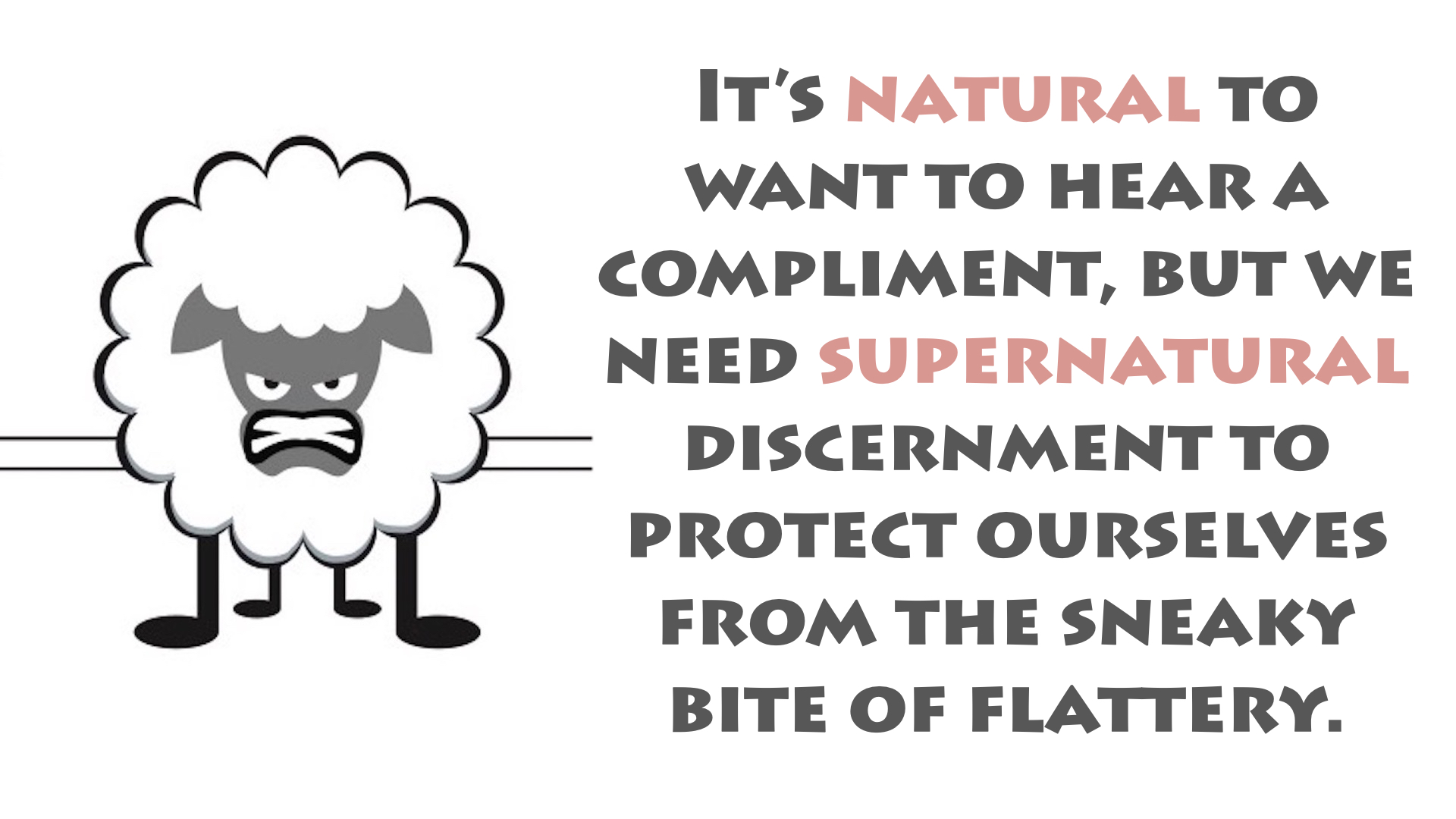
It’s natural to want to hear a compliment, but we need supernatural discernment to protect ourselves from the sneaky bite of flattery.
Look how Jesus did this in Mark 10:17-18. Remember the Amplified Bible that laid it on so thick? Jesus responded correctly: “There is no one essentially and perfectly morally good—except God alone” (v. 18). If we are going to do any comparing at all, let’s compare ourselves to our perfect God and Savior. Remember, we have done a self-check (Psalm 26:2) so we know what’s really there!
Swallowing this flattery only fuels the pride inside us. C.S. Lewis warned, “It was through Pride that the devil became the devil; it is the complete anti-God state of mind. … Pride is a spiritual cancer: it eats up the very possibility of love, or contentment, or even common sense.”
Look at the other example from Jesus in Mark 12:12-15. When Jesus sensed their flattery, He called it what it was: hypocrisy!
Flattery makes you feel like you’re on top of the world. Flattery makes you forget the things the Holy Spirit has revealed to you that needs work. But Jesus asked, “What do you benefit if you gain the whole world but lose your own soul?” (Mark 8:36 NLT).
The sincerest compliment we should all be living to hear is, “Well done, good and faithful servant! Enter into your Master’s happiness forever and ever!” No other voice matters!
Check out the other messages in this series called When Sheep Bite Sheep by clicking here. And if you are a pastor, check out my book When Sheep Bite.
Timothy D. Padgett asks, “Is there such a thing as Judeo-Christianity?” This is an interesting read, but I especially liked this passage: “This is key. When we speak of Judeo-Christianity, we’re not talking about salvation. We are talking about philosophy, even worldview. A Christian worldview must be just that: Christian. A faithful Jew apart from Christ is no more saved than a devout Muslim or an honest atheist, and any philosophy that leaves out the Incarnation will lack its ultimate hope.”
“A human being without a friend is like a beast: for he lacks someone with whom he can share his joy in prosperity and his sadness in adversity, to whom he may unburden his mind when he is preoccupied, with whom he may talk whenever he has had a particularly sublime or illuminating insight…That person is completely alone who has no friend.” —Aelred of Rievaulx
John Stonestreet and Dr. Glenn Sunshine point out that there are some “who believe that AI is a vehicle through which trans-dimensional, non-human intelligences are communicating with us.” Their post is called The Rise of Technopaganism. Of course, this is nothing new: The apostle Paul addressed mankind creating its own god and worshiping it, just as some are now doing with AI.
“It’s better to look ahead and prepare than to look back and regret.” —Jackie Joyner-Kersee
Listen to the podcast of this post by clicking on the player below, and you can also subscribe on Apple, Spotify, or Audible.
Christians should always be striving for a win-win in our relationships. If we try to “win” at the expense of other saints, we all end up losing. So it boils down to this: It’s either a win-win or it’s a lose-lose—there are no other options in God’s Kingdom.
If you would like to watch the full sermon that this clip came from, you can find it here.
You may also be interested in these related posts:
Listen to the podcast of this post by clicking on the player below, and you can also subscribe on Apple, Spotify, or Audible.
Have you ever heard this little saying: “To live above with saints we love, oh, that will be glory. But to live below with saints we know, well, that’s a different story”? I’ve found that it’s sometimes true!
We love Psalm 133:1-3 when the saints are all together. What a great “selling point” to invite someone to be a part of the Christian community! But Psalm 41:7-9 is kind of embarrassing as David talks about former friends who have hurt him deeply.
But being bitten by a fellow sheep is a reality we all have experienced, and, sadly, we will probably have to deal with again in the future. There is a natural way we tend to react when we’ve been bitten, but there is also a supernatural response that the Bible consistently calls us to. This is the God-glorifying way we all need to strive for.
In Acts 23, Paul is standing before the Sanhedrin. He opens his remarks by simply saying he has a clear conscience before God, and the high priest immediately orders that Paul be smacked on the mouth! That seems like a bit of an over-reaction on the part of the high priest, but maybe it was a bit of show of force to let Paul know who was really in charge. Paul responded with an immediate—and natural—reaction when he says, “God will slap you!”
Paul is an old man by this time. He’s been through shipwrecks, beatings, imprisonments, gone without food, traveled more miles than he can count, and preached more sermons than he can remember. His body was giving out on him, and his eyesight was especially weak. Clearly, Paul didn’t realize to whom we was addressing his remarks. But when he became aware, he immediately owned up to his mistake. Paul offered no excuses or justifications, just a quick, simple, sincere apology.
When you have been bitten (slapped) by another sheep, you should ask:
Could I have provoked them by something I said or did?
Could I have hurt them by something I didn’t say or do?
David prayed a great prayer in Psalm 139:23. But this prayer is only effective if we are willing to accept that we may have been the agitator that led to the bite. In the last words that Job speaks in the Book of Job, he is very introspective. Check out all of the “If I have” statements throughout Job 31.
In Psalm 26:2, David invites the Holy Spirit to check him three times!
test me = scrutinize me
try me = assay me
examine me = refine me in the fire
When we are bitten, we should be open to the possiblity that God is using this bite to get my attention—to make me aware of a fault in my life or something that’s been in a blind spot.
So we should consider the following:
Has this kind of bite happened more than once? From different sheep?
Has a spiritually wise person attempted to address this with me before?
Do I ever admit that I’m at fault, or is it always the other person’s fault?
Do I find myself making a list of why they should apologize to me?
When was the last time I apologized to someone else?
If the Holy Spirit reveals something in us, He will also empower us to make the change and make amends. The natural response is to place all the blame on others. The supernatural response to pray Psalm 26:2 before responding.
If we react only the natural way, it is a lose-lose for us and for the whole pasture. But if we learn to respond in a supernatural way, it becomes a win-win for everyone. Listen to the wise words of King Solomon—
He who heeds instruction and correction is not only himself in the way of life but also is a way of life for others. And he who neglects or refuses reproof not only himself goes astray but also causes to err and is a path toward ruin for others. (Proverbs 10:17 AMPC)
Let’s all strive for the supernatural response that is a win-win for the whole Kingdom of God!
Please follow along with all of the messages in this series by clicking here.
P.S. If you are a pastor, you may want to check out my book When Sheep Bite.
You and I will learn lessons in the hard times that we could learn no other way. Then God will use those lessons so we can help minister to others in their hard times. Check out my sermon about interceding for other saints.
ICR’s Dr. Randy Guliuzza says, “Convergent evolution is the fabricated conjecture evolutionists invoke to explain very similar characteristics between creatures that could not have been inherited from a common ancestor and that evolutionists will never accept as having been produced by an intelligently designed internal programming that is specified for common purposes.” This particular article is about bats which have always had the ability to fly. Not one fossil record shows any flightless bats because God created them as flying mammals.
In the early 1900s, Albert Norris was a missionary in India, observing firsthand the spiritual and physical hardships the people faced there. In an article in the Pentecostal Evangel, Norris wrote, “A Christianity that coldly sits down, and goes on its routine of formal work, and allows its fellowmen to starve, or to be obliged to go through all the hard sufferings and exposure connected with famine, without effort to help them, might as well quit its preaching.”
In answering a question about using AI to write a sermon, John Piper answers with an emphatic “no.” I agree! One of the reasons Piper shares: “One of the qualifications for being an elder-pastor-preacher in the Bible is the gift or the ability to teach, didaktikos (1 Timothy 3:2). That means you must have the ability, the gift, to read a passage of Scripture, understand the reality it deals with, feel the emotions it is meant to elicit, be able to explain it to others clearly, illustrate and apply it for their edification. That’s a gift you must have. It’s your number-one job. If you don’t have it, you should not be a pastor.”
“You don’t try to forget the mistake, but you don’t dwell on it. Don’t let it have any of your energy, or any of your time, or any of your space.” —Johnny Cash
Listen to the podcast of this post by clicking on the player below, and you can also subscribe on Apple, Spotify, or Audible.
Every business owner needs to be prepared for an eventual transition. Whether it be retirement, moving on to a new opportunity, or an M&A offer, nobody can run their business forever. In today’s episode Greg and I sit down to discuss Greg’s new book The Business Baton.
[0:35] “Keep your eye on the ball” is important for more than just sports, and far too often business owners forget this advice during the transition process.
[2:48] In chapter seven of The Business Baton, Greg discusses how to manage the pace of a transition.
[4:04] A Navigator can help you keep your focus on running your company during a transition.
[5:34] Greg talks about a few common reasons business owners take their eye off the ball.
[12:50] What does an owner disengaging do to the morale of the company?
[16:53] I share an interesting statistic from The Business Baton.
[19:26] An owners ongoing productivity is essential for maintaining the value of the organization.
[23:49] The Business Baton contains real case studies from organizations that Greg has worked with in the past, so you will likely see examples that line up with your industry.
[25:04] Greg and I share a section from The Business Baton about productivity.
Check out this episode and subscribe on YouTube so you can watch all of the upcoming episodes. You can also listen to our podcast on Spotify and Apple.
Listen to the podcast of this post by clicking on the player below, and you can also subscribe on Apple, Spotify, or Audible.
We tend to be pretty self-centered creatures, filtering everything through our lens. This becomes especially true when we are going though a difficult time.
When I walked through a dark valley, I battled both physical and spiritual forces. People attacked me, but so did my own thoughts. “Why me?” and “I didn’t do anything to deserve this!” led to prayers like, “God, why didn’t You protect me from this? Why won’t you get me out of this?”
Do you hear a common theme? I didn’t while I was in the midst of the battle, but perhaps you hear it—“Why me? I didn’t do anything to deserve this! God, why didn’t You protect me from this? Why won’t You get me out of this?”
In his book Winning With People, John Maxwell shared ‘The Big Picture Principle’: “The entire population of the world, with one minor exception, is composed of others.”
On the other side of my dark valley I learned something about my time in the dark valley—I had grown:
I could help others diagnose depression
I could empathize with others
I could share helpful strategies to those who were struggling
I could intercede for them in prayer
My definition for intercede is to pray for people in a meaningful way because they are too beat up to pray for themselves.
In order to pray for them, I have to know what and how to pray. I can’t know what and how to pray unless I have firsthand experience. So perhaps my dark valley wasn’t for me, but for someone else (see Romans 8:28; 2 Corinthians 1:3-11).
I have talked and blogged so many times about the phrases “one another” and “each other” throughout Scripture. That means that Christian faith is best seen when we are with each other, supporting one another.
Jesus taught us to pray, “Our Father” (Matthew 6:9). The “our” signifies we are praying…
…with Jesus—John 14:13-14
…with other saints—Matthew 18:18-20
Even more than praying with us, Jesus intercedes for us (Hebrews 4:15-16). And Jesus gives us the Holy Spirit (John 14:26) who also intercedes for us and with us (Romans 8:26-27).
We join with our High Priest, helped by our Advocate, as we pray to our Heavenly Father on behalf of our brothers and sisters.
Listen to the interceding and expectation of a joyful answer that David writes in Psalm 20, and also notice how the saints are together—
May the LORD answer you when you are in distress; may the name of the God of Jacob protect you.May He send you help from the sanctuary and grant you support from Zion.May He remember all your sacrifices and accept your burnt offerings.May He give you the desire of your heart and make all your plans succeed.May we shout for joy over your victory and lift up our banners in the name of our God. May the LORD grant all your requests.Now this I know: The LORD gives victory to His anointed. He answers him from His heavenly sanctuary with the victorious power of His right hand.Some trust in chariots and some in horses, but we trust in the name of the LORD our God.They are brought to their knees and fall, but we rise up and stand firm.LORD, give victory to the king! Answer us when we call!
My cousin Dick Brogden wrote, “Jesus never intended us to suffer alone. We may not physically be able to cross oceans or deserts and sit in lonely cells with colleagues—but we are intended to traverse that distance spiritually and to bear the burdens of our brothers in prayer. Followers of Jesus under duress are empowered to bear unimaginable suffering when they know that they do not agonize alone.”
In your prayer time, I encourage you to ask the Spirit to show you lessons you have learned in your dark valleys, and then begin to intercede for your fellow brothers and sisters with the help you have already received.



 Why do you love the power? Servant leaders love what their leadership role allows them to do for other people.