The Lion And The Lamb

Listen to the podcast of this post by clicking on the player below, and you can also subscribe on AppleSpotify, or Audible. Check out the video content in this post by clicking here. 
As we rejoin our series asking, “Is that in the Bible?” we have come to statement #16—The lion will lay down with the lamb. 

Is that in the Bible? No! 

You may be surprised by that because it is one of those phrases repeated so often that people assume it has to be in the Scripture. Even those who don’t have a religious persuasion for their life still accept this phrase as meaning world peace, where former adversaries now live together in harmony.  
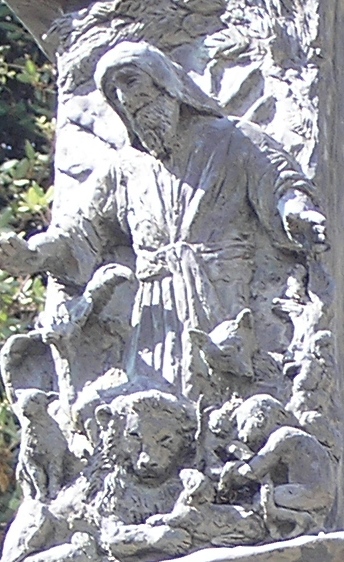
There are some verses in the prophesies of Isaiah from which this phrase may have originated, like Isaiah 11:6. On the 8th anniversary of the modern independence of the nation of Israel (in April 1956), the British parliament presented a bronze Menorah to the Israeli Knesset. Benno Elkan designed this beautiful piece, modeled after the lampstand in the Holy Place of the Temple. On one of the branches, Benno portrays the prophet Isaiah, and at his feet are images of a lion, a wolf, a lamb, and a small child. 

(Check out all of the Scriptures in this post by clicking here.)

But in the images on this menorah, based on so many Kingdom-anticipating passages throughout the Old Testament, is the hope for which we long. Peace is coming. It is peace purchased by the Prince of Peace and it is a peace that only He can establish and maintain. 

To see the peace that will exist in God’s kingdom, we must look back to the beginning of Time. The Book of Isaiah has been called “the Bible within the Bible.” Partly because it is near the middle of the Bible, but partly because its 66 chapters (like the 66 books of the Bible) trace the perfection of God that was marred by sin, the ravages of sin, the redemption that comes only through the Messiah, and His eternal kingdom of peace that is for all who put their faith in Jesus. So today I want us to look at the first book of the Bible, the “Bible within the Bible,” and the last book of the Bible. 

God created perfection in the Earth. Part of His plan included man and animals as herbivores (Genesis 1:29-30). At least one of God’s animals could talk (Genesis 3:1). Given the fact that neither Adam nor Eve were distressed by a talking snake, perhaps there was a way for man and animals to navigate their differences. 

This encounter with the devil led to sin, which also opened the door for further pain and hardship—self-awareness that brought embarrassment, pain in childbirth, difficulty farming the land, and removal from the Garden of Eden (3:16-19). 

Sin continued to ravage (Genesis 6:6). At the time of the Flood, it appears men and animals were still herbivores (vv. 20-21), but that changes after the Flood (9:1-6). 

Sin ravages and destroys and enslaves people in their ungodly passions. God does forgive, but many times the consequences of sin still remain—as we witness in our world today. 

Remember that after Adam and Eve sinned, they were aware of their nakedness. Their attempt to cover themselves was with what they had dominion over: fig leaves (Genesis 3:7). The very first animal sacrifice was performed by God Himself—an innocent calf or lamb had to shed its blood so that God could cover the shame of sin (v. 21). 

Sinful man tries to copy what God did without calling on God Himself, and God sees it for what it is: a sham (Isaiah 65:1-7; Revelation 7:9-10). 

Only Jesus can bridge the gulf between sinful man and righteous God (Isaiah 11:1-9; Revelation 5:1-6; 11-13). 

“[Jesus] endured death as a lamb; He devoured it as a lion.” —Augustine

(see John 1:29; Revelation 1:18)

We get a small glimpse of the eternal kingdom during the Millennial Reign (Isaiah 65:17-25), but the eternal kingdom is the Reality for the saints of God forever (Isaiah 35:8-10; Revelation 21:1-8, 22:1-5)! 
The next time you hear someone long for the day when “the lion will lay down with the lamb,” remind them that the Lion and the Lamb are one in the same. Jesus is BOTH our sacrificial Lamb that died in our place to pay the penalty of our sin AND He is the Lion that devoured death once for all! 

There is an eternal Kingdom where peace and joy and wholeness are indescribable and unending. But we only get into this Kingdom by the blood of the Lamb and the power of the Lion! 

Check out the previous statement we have discussed in this series by clicking here. 

►► Would you please prayerfully consider supporting this ministry? My Patreon supporters get behind-the-scenes access to exclusive materials. ◀︎◀︎
Our Blessed Hope

Listen to the podcast of this post by clicking on the player below, and you can also subscribe on AppleSpotify, or Audible. 

As we wrap up our series looking at our foundational belief statements, I want to combine the last four statements together, not only because they all cover the same theme of end-times events, but also because these statements should give every Christian hope! 

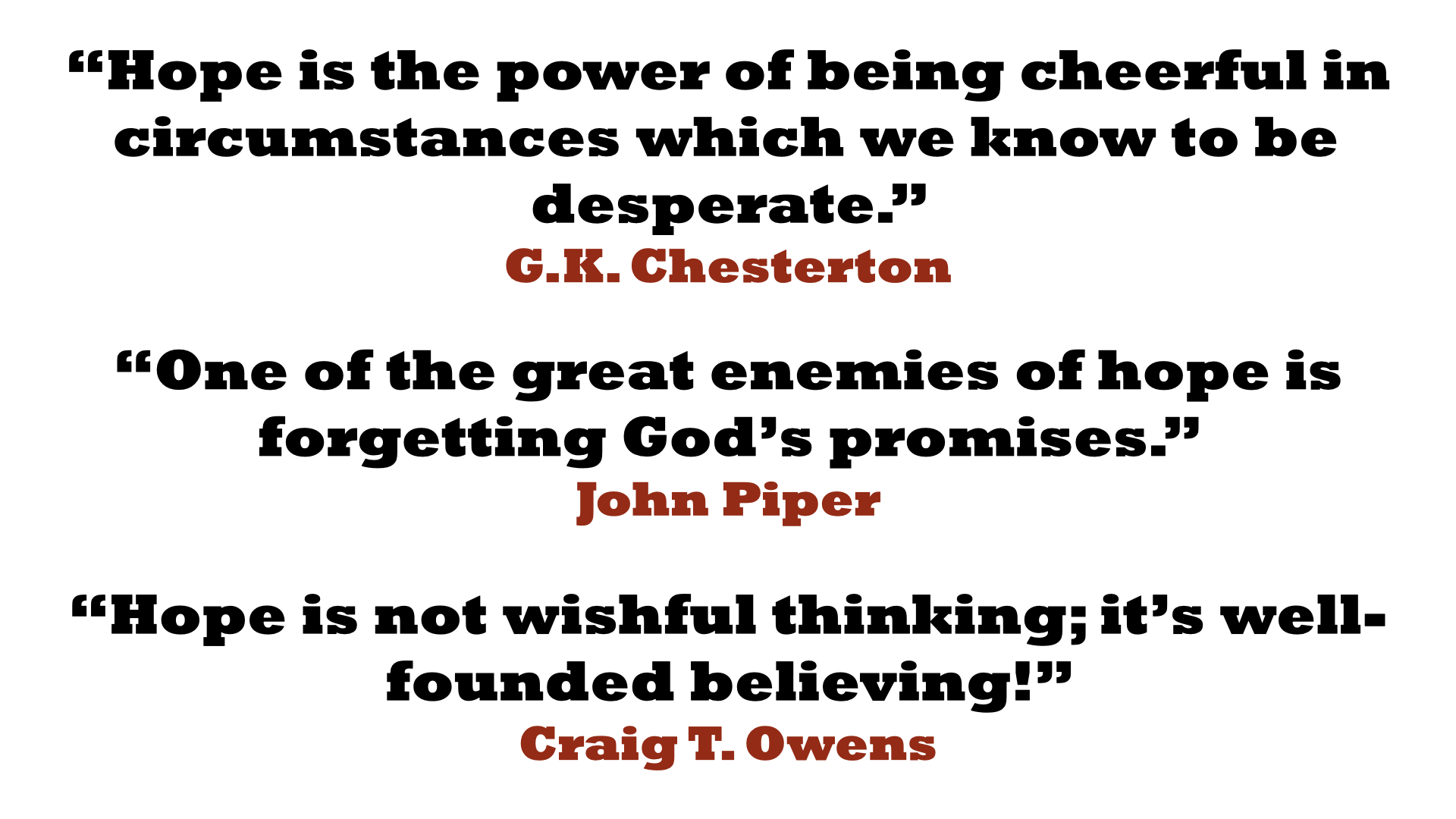
  • “Hope is the power of being cheerful in circumstances which we know to be desperate.” —G.K. Chesterton 
  • “One of the great enemies of hope is forgetting God’s promises.” —John Piper 
  • “Hope is not wishful thinking; it’s well-founded believing!” —Craig T. Owens 

Christians have a fantastic, unshakable, blessed hope on which we can stand not only secure but joyful! 

Foundational truth #13: “The resurrection of those who have fallen asleep in Christ and their translation together with those who are alive and remain unto the coming of the Lord is the imminent and blessed hope of the church.” 

This blessed hope in the future helps us live with joy today! Knowing that death has been defeated and Jesus will come back to take us home with Him should fuel us to say “no” to the temporary pleasures of sin, and live such godly lives that it turns others’ eyes to Jesus (Titus 2:11-14; 1 Corinthians 15:51-52; 1 Thessalonians 4:16-17). 

Foundational truth #14: “The second coming of Christ includes the rapture of the saints, which is our blessed hope, followed by the visible return of Christ with His saints to reign on earth for one thousand years.” 

Sometimes you will hear Christians talk about the “rapture” of the Church. Although this word itself isn’t in the Bible, the Greek word harpazo in 1 Thessalonians 4:17 means “catching up.” It also means “to eagerly claim for one’s self,” which reminds me that Jesus is thrilled to bring His Bride home to be with Him forever! After the Church has been caught up to Heaven, a period of tribulation will plague the earth, followed by Christ’s Second Coming and His millennial reign (Zechariah 14:4-5; Revelation 19:11-15; 20:1-10). 

Foundational truth #15: “There will be a final judgment in which the wicked dead will be raised and judged according to their works. Whosoever is not found written in the Book of Life, together with the devil and his angels, the beast and the false prophet, will be consigned to the everlasting punishment in the lake which burns with fire and brimstone, which is the second death.” 

Christians have no fear of the second (or final) death because our names are written in the Book of Life (Luke 12:4-6; Revelation 20:11-15). Not only is there judgment for the wicked, but there will be rewards for the righteous. 

Foundational truth #16: “In keeping with His promise we are looking forward to a new heaven and a new earth, where righteousness dwells” (2 Peter 3:13). Revelation 21-22 give us a small glimpse of our eternal home. 

In light of these truths, how should Christians live while still on earth? I think there are three ways we should live: 

  1. Live circumspectly
  2. Live on-mission
  3. Live unafraid

(see Ephesians 5:15; Matthew 28:18-20; Proverbs 24:11-12; Jude 1:20-25) 

With this blessed hope of the Second Coming of Jesus and our security in knowing we will remain with Him forever, let’s tell everyone we can how they too can know what it is to live with this hope in their heart. 

If you’ve missed any of the messages in our series exploring our foundational beliefs, you can access the full list by clicking here. 

►► Would you please prayerfully consider supporting this ministry? ◀︎◀︎

Thursdays With Oswald—Isaiah 24-29

Oswald ChambersThis is a weekly series with things I’m reading and pondering from Oswald Chambers. You can read the original seed thought here, or type “Thursdays With Oswald” in the search box to read more entries.

Isaiah 24-29

[These are notes on Oswald Chambers’ lecture on Isaiah 24-29.] 

     The Bible reveals that the material world has been blighted by reason of man’s sin. … Man was intended by God to govern Nature (see Genesis 1:26); instead, he has infected it with his sin and it has become a partaker of the curse with him, so that “the whole creation groans and travails in pain together until now.”

     Men say “We are going to build a holy city on this earth”—you cannot; the earth is infected, it is a diseased chamber, and the holy city will never be on it until God has purged it with fire and taken the epidemic out of it. … God cannot bring in the Millennium by moral renovation, but only by cremation…. 

     The great note of the Bible revelation is not immortality but Resurrection. The doctrine of the Resurrection is that something comes from God Himself direct into the dust of death. … He has swallowed up death forever, the sovereign Lord will wipe away the tears from all faces; He will remove the disgrace of His people from all the earth. The Lord has spoken. In that day they will say, ‘Surely this is our God; we trusted in Him, and He saved us. This is the Lord, we trusted in Him; let us rejoice and be glad in His salvation’ (Isaiah 25:8-9). … 

     The judgments of God are for another purpose than the vindictive spirit of man would like to make out. … You never find that spirit in the prophets; if there is destruction and death it is for one purpose only—deliverance. God is on the line of salvation, not of damnation; He only damns the damnable things. … 

     In our own day we seem to have come to the conclusion that God has made a number of blunders and we have to put them right; we have private notions of our own which if put down in black and white would prove that we do not believe God is intelligent in allowing the history of the world to go on as it has, in allowing sin and war. … We won’t see that behind the whole thing is the wisdom of God, that neither bad men nor the devil himself can do one thing without the direct permission of God. … 

     The devil likes to make us believe that we are in a losing battle. Nothing of the sort! We have to overcome all the things that try to obscure God. The rugged truths of Isaiah point out not only the appalling state of the world as it is, but that we have to live a holy life in it by the power of God, not a sequestered life in particular temples or rituals, but real genuine magnificent men and women of God, no matter what the devil or the world or the flesh may do.

From Notes On Isaiah 

Are you letting God be God? Are you letting God resurrect you and make you holy? Are you giving in to the lie of the devil that you are losing the battle, or are you letting God speak to your mind that you are one of the real genuine magnificent men and women of God who are shining His light and love in a diseased world? 

Looking Ahead To The Second Advent

Celebrating Advent means both looking back at Christ’s First Advent in Bethlehem and looking ahead to His Second Advent at the end of time. Faith in the First Advent fuels hope in the Second Advent. Let’s take a look at the events leading up to and surrounding Christ’s Second Advent to help us appreciate what was begun at His First Advent.

Overarching all of the end times events is a Christian’s blessed hope: “The resurrection of those who have fallen asleep in Christ and their translation together with those who are alive and remain unto the coming of the Lord is the imminent and blessed hope of the church.”

The word “rapture” doesn’t appear in Scripture, but we get this word from the Latin word raptu, which comes from the Greek word harpazo. We first see it when Philip is “caught away” from the Ethiopian’s presence in the desert (Acts 8:39). This is the same word Paul uses when he says that Christians will be “caught up” to meet Christ in the air (see 1 Thessalonians 4:13-17).

Note that the rapture of the Church is not the Second Coming of Christ. His Second Coming takes place at the end of the period known as the Tribulation when Jesus returns to earth as a conquering King and establishes His Millennial Reign on earth (Revelation 19:11-16; 20:1-4).

During Christ’s Millennial Reign, the devil and his cohorts are locked up until the end of the 1000-year reign and are allowed to tempt people one final time. The devil will succeed in tempting quite a few people, as he will once again muster a sizable army to attack Christ and His followers. This decisive battle will culminate in the final judgment.

“There will be a final judgment in which the wicked dead will be raised and judged according to their works. Whosoever is not found written in the Book of Life, together with the devil and his angels, the beast and the false prophet, will be consigned to the everlasting punishment in the lake of fire” (Revelation 20:11-15).

After this will come the New Heavens and New Earth where Christians will commune with God for ever and ever (Revelation 21:1-5, 22-27; 22:1-5, 12-21).

In light of Christ’s First Advent in Bethlehem, and His soon return (His Second Advent), how are Christians to live? In a word: HOPEFUL!

In all of these passages discussing the end times, hope-filled words are used—

  • therefore encourage each other with these words
  • wait for the blessed hope—the glorious appearing of our great God and Savior 
  • stand firm … let nothing move you
  • Jesus says, I am coming soon! My reward is with Me

Jesus also pointed out that Heaven is a place “prepared for you since the creation of the world,” while Hell is “prepared for the devil and his angels.” GOD WANTS YOU WITH HIM IN HEAVEN!

As you rejoice in the First Advent, remember that Christ’s First Coming was to provide a way for you to have your sins forgiven and be able to spend eternity with Him. So as we look forward in hope to Christ’s Second Advent we say with the Apostle John, “Amen. Come, Lord Jesus!”