The Power Cycle

Listen to the podcast of this post by clicking on the player below, and you can also subscribe on Apple, Spotify, or Audible. Check out the video content in this post by clicking here. 
I worked for my friend’s Dad on his lawn service for a few summers. This was a side business for him, and we worked with normal push mowers. The first stop of the early morning was always a challenge to get the mower started. I’d pull on that ripcord and listen to the engine sputter and then stop. Then I’d give it another pull, and perhaps it would run just a bit longer. Eventually the flywheel would keep on spinning, the engine would roar to life, and I could get to work. 

Question: which pull started the mower? I really needed all of the pulls, didn’t I? In other words, I had to put in some effort in order to get the mower to work. Then I could actually be productive in my work. 

Last week we talked about the dual blessings Peter says that God wants to send us—grace and peace. Notice that Peter longs for us to know these in abundance. Not just a small sampling, but overflowing blessings—sort of like my lawnmower that is running at full speed. 

2 Peter 1:3 tells us it is “His divine power has given us everything we need for a godly life through our KNOWLEDGE of Him Who called us by His own glory and goodness.” 

(See all of the Scriptures in this post by clicking here.)

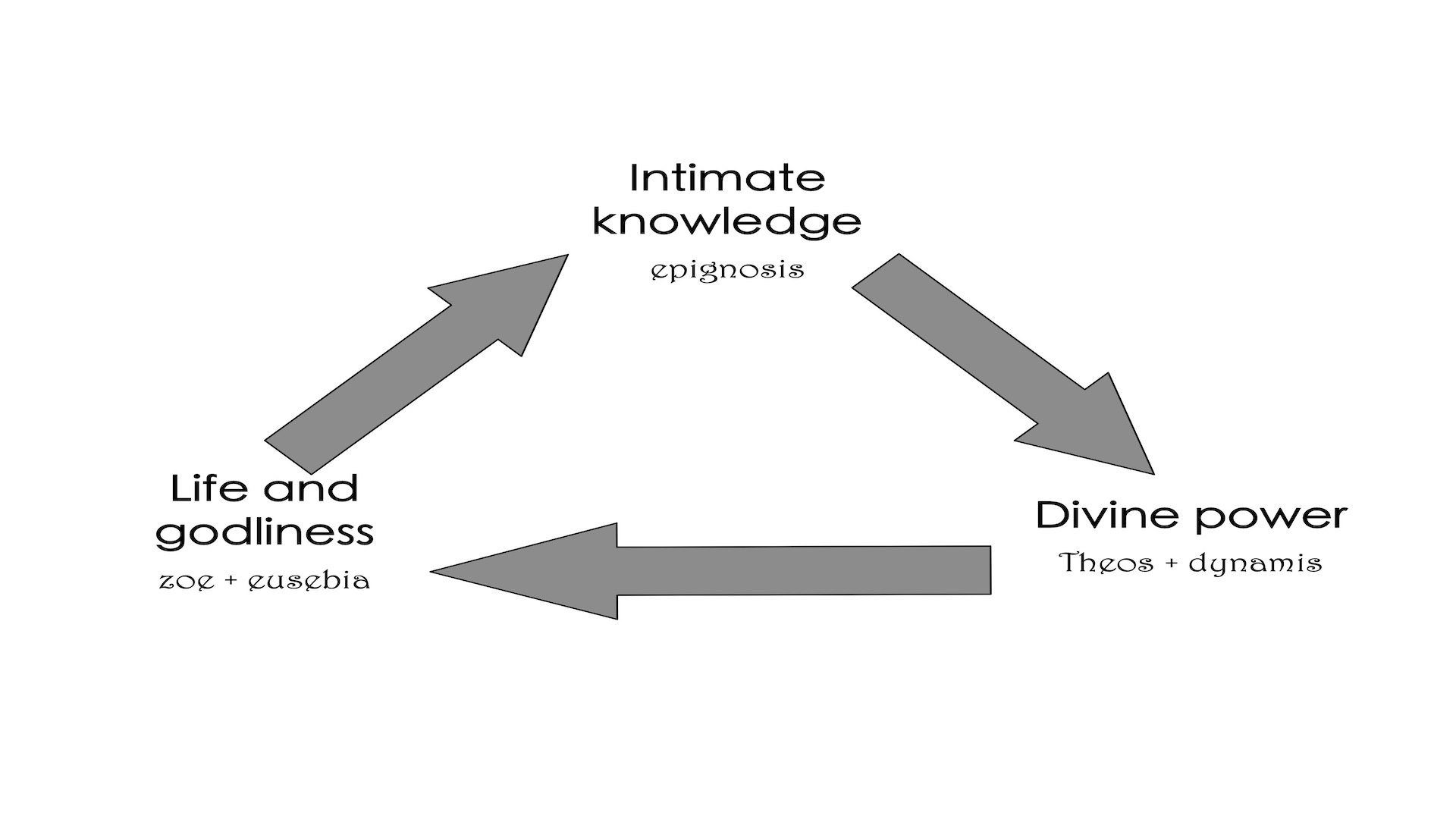
Remember that Greek word means our personal, intimate, experiential knowledge of Jesus. God allows us to know Him intimately (Jeremiah 29:13-14a). Notice it is “His divine power [that] has given us EVERYTHING we need for a godly life.” 

“Divine power” literally means God’s power—Theois dynamis. This is the power which Jesus promised in Acts 1:8. Then His followers were able to live like Jesus, as we see in Acts 3:12; 4:7, 33. 

But Jesus is the One Who got this started for us. HIS divine power has given us everything we need for A GODLY LIFE. 

“Godly life is two words in Greek: “life” and “godliness.” The word for life is zoe. This is everlasting life that is deeper and richer than biological or psychological life. And the word for godliness is eusebia, which is the reverence, respect, and holy fear that gives evidence of one’s assured relationship with God through Jesus. 

Check out two other translations of this verse.

The AMPC says: For His divine power has bestowed upon us all things that are requisite and suited to life and godliness, through the full personal knowledge of Him…. 

And The Message paraphrase says: Everything that goes into a life of pleasing God has been miraculously given to us by getting to know, personally and intimately, the One who invited us to God. 

Here’s the power cycle for saints of God. The more intimately I know Jesus, the more the Holy Spirit’s dynamis power is unleashed in my life. The more His power flows through me, the more godly I can live. The more godly I live, the more I grow in intimacy with Jesus! 

This is a flywheel that can really start spinning! Look at some of the blessings in the next few verses: 

  • Participating in Christ’s divine nature—becoming more and more Christlike (v. 4a). The Greek word is defined as a way of feeling and acting which by long habit has become more and more natural to me. 
  • Escaping the corruption in the world (v. 4b). 
  • Becoming increasingly effective and productive in your knowledge—that’s the word epignosis again—of Jesus (v. 8). 

I had to put the effort in to get the mower’s flywheel spinning so that I could actually do my job. 

Peter says, Jesus got this poem cycle started so that I could be productive for Him. Peter introduces a phrase that we are going to see three more times in this letter: Make every effort (v. 5). 

We are not saved by good works, but we are saved in order to do good works. 

Jesus was empowered to do good works (see Luke 4:18-19 and Acts 10:38), and Jesus calls us to live the same way with the same anointing (John 20:21-22; Acts 4:30-31). 

The cycle of power and godliness and greater intimacy is for you. Make every effort to keep it spinning so that you can bring more glory to God by increasing your capacity to be a blessing to those around you. 

Please check out the other messages in the Friends of the Faith series by clicking here. 

►► Would you please prayerfully consider supporting this ministry? My Patreon supporters get behind-the-scenes access to exclusive materials. ◀︎◀︎
Links & Quotes

If leaders want to get the best ideas and implement the best strategies, they must invite everyone on their team to share from their unique perspective. This is the only way to get the whole picture. Check out this full conversation from The Craig and Greg Show.

I have a lot of new video content on my YouTube channel every week. Please check it out and subscribe so you don’t miss anything.

T.M. Moore writes, “We can know that we love our neighbors when, like Jesus, we go seeking them, in order to touch them with His love.”

This last week marked the 187th anniversary of the first time “O.K.” was first published as an abbreviation. The word’s origin is an interesting story, with some calling it “one of the most ubiquitous terms in the world, and certainly one of America’s greatest lingual exports.”

“Meekness and gentleness are two of the ornaments of our faith. I would that some professed Christians would understand that unholy contentiousness is not after the mind of Christ, it is not according to that gracious command, ‘Take My yoke upon you, and learn of Me; for I am meek and lowly in heart and ye shall find rest unto your souls.’ No, the Christian must be willing to suffer wrongfully, and to bear it in patience; he is never to be one who renders evil for evil, or railing for railing.” —Charles Spurgeon, commenting on Titus 3:2

“Then, since according to the Lord’s warnings the blood of so many will be sought for at the hands of their shepherds, careful watch must be kept, that is, the Word of the Lord must be often preached, and preached by the shepherds, by the Church’s bishops and teachers, that none may perish through ignorance; for he perishes through lack of heed, his blood will be on his own head.” —Columbanus, Letter to Pope Boniface 

“Knowledge will forever govern ignorance.” —James Madison 

“A good friend is like a four-leaf clover, hard to find and lucky to have.” —Irish proverb 

“When a man is getting better he understands more and more clearly the evil that is still left in him. When a man is getting worse he understands his own badness less and less. A moderately bad man knows he is not very good: a thoroughly bad man thinks he is all right. This is common sense, really. You understand sleep when you are awake, not while you are sleeping. You can see mistakes in arithmetic when your mind is working properly: while you are making them you cannot see them. You can understand the nature of drunkenness when you are sober, not when you are drunk. Good people know about both good and evil: bad people do not know about either.” —C.S. Lewis, Mere Christianity 

“If you want to win the day, you’ve got to flip the script. How? The Bible is a good starting point. Scripture is more than our script; it’s our script-cure. And that’s more than a play on words. Scripture confronts the false identities and false narratives perpetrated by the Father of Lies. It reveals the heavenly Father’s metanarrative and the unique role that each one of us plays in it.” —Mark Batterson, Win The Day 

Go Deep—The Gifts Of Wisdom, Knowledge, And Faith

According to 1 Corinthians 12-14, the Holy Spirit operates in nine different gifts to both evangelize the sinner and edify the saints. The apostle Paul says that these gifts are available to all Christians who will allow the Holy Spirit to operate through them.

You may download the participant’s notes for this lesson here → Go Deep – operational gifts of wisdom, knowledge, faith

If you have missed any of the lessons in this series, you can find the complete list by clicking here. You may also be interested in our Go Deep series on the motivational gifts listed in Romans 12, which you can check out here: Go Deep—An Introduction To The Motivational Gifts

If you would like to join us in person for this class, here is where you can find us.

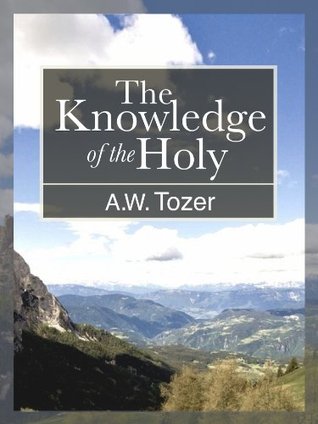
10 Quotes From “The Knowledge Of The Holy”

A.W. Tozer helps us think long and deep about the greatness of God, opening windows of insight that many have not contemplated previously. Check out my full book review of The Knowledge Of The Holy by clicking here. 

“With our loss of the sense of Majesty has come the further loss of religious awe and consciousness of the divine presence. … The decline of the knowledge of the holy has brought on our troubles. A rediscovery of the majesty of God will go along way toward curing them.” 

“What comes into our minds when we think about God is the most important thing about us.” 

“The man who comes to a right belief about God is relieved of ten thousand temporal problems, for he sees at once that these have to do with matters which at the most cannot concern him for very long; but even if the multiple burdens of time may be lifted from him, the one mighty single burden of eternity begins to press down upon him with a weight more crushing then all the woes of the world piled one upon another. …

“But unless the weight of the burden is felt, the gospel can mean nothing to the man; and until he sees a vision of God high and lifted up, there will be no woe and no burden. Low views of God destroyed the gospel for all who hold them.” 

“Among the sins to which the human heart is prone, hardly any other is more hateful to God than idolatry, for idolatry is at bottom a libel on His character. … The essence of idolatry is the entertainment of thoughts about God that are unworthy of Him.” 

“The heaviest obligation lying upon the Christian Church today is to purify and elevate her concept of God until it is once more worthy of Him—and of her.” 

“When the Spirit would acquaint us with something that lies beyond the field of our knowledge, He tells us that this thing is like something we already know, but He is always careful to phrase His description so as to save us from slavish literalism.” 

“An attribute of God is whatever God has in anyway revealed as being true of Himself.” 

“We might be wise to follow the insight of the enraptured heart rather than the more cautious reasonings of the theological mind.” 

“If we ever think well it should be when we think of God.” 

“The harmony of His being is the result not of a perfect balance of parts but of the absence of parts.… An attribute, then, is not a part of God, it is how God is…. The divine attributes are what we know to be true of God. He does not possess them as qualities; they are how God is as He reveals Himself to His creatures.” 

Thursdays With Spurgeon—The Life-Changing Power In The Bible

This is a weekly series with things I’m reading and pondering from Charles Spurgeon. You can read the original seed thought here, or type “Thursdays With Spurgeon” in the search box to read more entries.

The Life-Changing Power In The Bible

     When the Spirit came with His divine life and quickened the entire Book to my newly enlightened soul, the inner meaning shone forth with wondrous glory. … Whatever I found to be in His Word, I received with intense joy. … Moreover, I have found that those points of my character that were most weak have been strengthened, while strong passions have been subdued, evil propensities have been kept under, and new principles have been implanted. I am changed; I am as different from what I was as a man could be who had been annihilated and had then been made over again. Nor do I claim any of the credit for this change—far from it. God has done great things for me, but He has done the same for others and is willing to do it for any soul who seeks His face through Jesus Christ and His great atoning sacrifice. …  

     An idea has long possessed the public mind that a religious man can scarcely be a wise man. It has been the custom to talk of infidels, atheists, and deists as men of deep thought and comprehensive intellect, and to tremble for the Christian controversialist as if he must surely fall by the hand of his enemy. But this is purely a mistake, for the gospel is the sum of wisdom, an epitome of knowledge, a treasure house of truth, and a revelation of mysterious secrets. In it we see how justice and mercy may be married; here we behold inexorable law entirely satisfied and sovereign love bearing away the sinner in triumph. Our meditation upon it enlarges the mind, and as it opens to our soul in successive flashes of glory, we stand astonished at the profound wisdom manifest in it.

From The Autobiography Of Charles Spurgeon 

As Spurgeon experienced, all Christians can experience. Think about this—the same Holy Spirit that inspired the written words of the Bible is the same Holy Spirit in you that can illuminate and apply the words of the Bible to your life! 

Bible-reading, Spirit-empowered Christians should be the most informed, creative, wise people you will ever meet. Not because they have studied nature, but because they are getting to know Nature’s God intimately. The Creator can open up the mysteries of creation better than any scientist or philosopher. 

But we don’t read the Bible just to know God’s Word, but we read the Bible to get to know the God revealed in the Word. He said He would reveal Himself to those who earnestly seek for Him. Ask the Holy Spirit to open your eyes, your mind, your heart as you read your Bible. 

What Place Does Prayer Have?

“What is the place of prayer in your life? What prominence does it have in our lives? It is a question that I address to all. It is as necessary that it should reach the man who is well versed in the Scripture, and who has a knowledge of its doctrine and its theology, as that it should reach anyone else. What part does prayer play in our lives and how essential is it to us? Do we realize that without it we faint? Our ultimate position as Christians is tested by the character of our prayer life.

“It is more important than knowledge and understanding. Do not imagine that I am detracting from the importance of knowledge. I spend most of my life trying to show the importance of having a knowledge of truth and an understanding of it. That is vitally important. There is only one thing that is more important, and that is prayer. The ultimate test of my understanding of the Scriptural teaching is the amount of time I spend in prayer. As theology is ultimately the knowledge of God, the more theology I know, the more it should drive me to seek to know God. Not to know about Him, but to know Him. The whole object of salvation is to bring me to a knowledge of God. I may talk learnedly about regeneration, but what is eternal life? It is that they might know Thee, the only true God in Jesus Christ whom God has sent.

“If all my knowledge does not lead me to prayer there is something wrong somewhere. It is meant to do that. The value of the knowledge is that it gives me such an understanding of the value of prayer, that I devote time to prayer and delight in prayer. If it does not produce these results in my life, there is something wrong and spurious about it, or else I am handling it in a wrong manner.” —Dr. Martyn Lloyd-Jones (emphasis added)

Saturday In The Proverbs—Nourishing (Proverbs 13)

[Each chapter in the Book of Proverbs contains thoughts that fit into a theme; they are not just random thoughts gathered together. In this “Saturday In The Proverbs” series, I will share a theme that I see in each chapter. But the cool thing about God’s Word is that you may see an entirely different theme. That’s great! If you do, I would love for you to share it in the comments below.]

A man shall eat well by the fruit of his mouth … The righteous eats to the satisfying of his soul… (Proverbs 13:2, 25).

God’s wisdom never leaves us flat. Never leaves us with a bad taste in our mouth. Never leaves us unsatisfied. Never leaves us without all that we need. 

God’s wisdom…

  • instructs (v. 1) 
  • satisfies the soul (vv. 2, 12, 25)
  • preserves life (vv. 3, 14)
  • brings real riches (vv. 4, 7, 11)
  • promotes (v. 5) 
  • guards (vv. 6, 8)
  • leaves a legacy (vv. 9, 22, 24)
  • increases peace (v. 10)
  • rewards (v. 13) 
  • brings favor (vv. 15, 18)
  • grows knowledge (v. 16)
  • preserves health (v. 17) 
  • gets things down (v. 19) 
  • gains even more wisdom (v. 20) 
  • repays good (v. 21)
  • wastes nothing (v. 23) 

Wow! How nourishing God’s Wisdom is! 

Saturday In The Proverbs—Wisdom (Proverbs 1)

[Each chapter in the Book of Proverbs contains thoughts that fit into a theme; they are not just random thoughts gathered together. In this “Saturday In The Proverbs” series, I will share a theme that I see in each chapter. But the cool thing about God’s Word is that you may see an entirely different theme. That’s great! If you do, I would love for you to share it in the comments below.]

The fear of the Lord is the beginning of knowledge, but fools despise wisdom and instruction (Proverbs 1:7).

Would you like to see things others don’t see? How about if you could have insight that others don’t have? What if you could keep on getting more, and more, and more knowledge that really mattered? That’s what this entire Book of Proverbs is all about, and the opening chapter sets the tone for the rest of the book.

You have to decide: do you trust God’s knowledge, or do you trust yourself more?

God is to be revered above all else.

God is to be delighted in above all else.

God is to be listened to above all else.

That is what defines pure knowledge: God’s knowledge.

The path to wisdom, then, is to accurately apply God’s pure knowledge.

Lady Wisdom—thankfully for us—makes herself readily available IF we will listen to her. If we do, we will have the best insights into how to use this purest-of-pure knowledge which God gives. When we operate in God’s wisdom and God’s knowledge, He is pleased and He is glorified.

There is always another option we could choose. We could listen to things that others say is “knowledge,” and we could try to figure out things on our own. But if we do, we also have to be willing to accept the consequences for applying that “knowledge” (see vv. 29-31). Ummm, no thank you, I’d rather not be called a fool! 

How To Grow Your Wisdom

wisdom-brings-harmonyDr. Luke is a great “noticer.” Twice he notices and records something about the early life of Jesus that gives us great insight for growing in a wholly healthy way.

First of all, Luke tells us how Jesus grows (check out my thoughts on this by clicking here), and then he begins to zero-in on the four areas in which Jesus grew. The first thing Dr. Luke notes is Christ growing in wisdom (see Luke 2:40 & 52).

Knowledge is not the same thing as wisdom. In fact, lots of people have knowledge without ever having wisdom. But we have to remember that you cannot get wisdom without getting knowledge.

The Greek language as a couple of different words for knowledge:

  • ginosko = head knowledge; information; belief that something is true
  • oida = experiential knowledge; belief in the knowledge you have

Let me give you a quick example. One time my facilities team was overseeing the reinstallation of our zip line from our 30-foot-high ropes course. This zip line stretched some 500 feet from the platform on top of the ropes course all the way down a big hill. After the zip line was replaced, our facilities guys believed that they had successfully connected the zip line. But only Phil believed in their work enough to put on a harness, connect to the zip line, and jump off the platform!

In order to grow in wisdom, we have to have good information (ginosko) to work with. Then we have to test this knowledge in our personal lives (oida). Only this will help us develop wisdom that can be applied to our every-day lives.

Otherwise, Oswald Chambers notes this: “We do not think on the basis of Christianity at all. We are taught to think like pagans for six days a week and to reverse the order for one day, consequently in critical moments we think as pagans and our religion is left in the limbo of the inarticulate.”

Often times the Holy Spirit will use the Bible, or a sermon, or the advice from a friend, or even a “slip of the tongue” to alert us to thoughts that aren’t healthy. Jesus tells us that the so-called “slip of the tongue” is actually a tip off to what’s really in our hearts (see Matthew 12:34). Solomon counsels us to guard our hearts and minds (Proverbs 4:23), and then Paul builds on the guarding theme to tell us to capture our thoughts and make sure they line-up with God’s Word (2 Corinthians 10:5).

This is what develops God-pleasing wisdom. If we don’t constantly grow in this area, we will hold back growth in every other area of our life—physical health, spiritual health, and emotional health, but growing in wisdom brings harmony to all of these areas.

So ask yourself:

  • Am I getting good information?
  • Am I capturing my thoughts to make sure they are healthy?
  • Am I applying what I am learning?

God wants to grow wisdom in you! May He equip you with all you need for doing His will. May He produce in you, through the power of Jesus Christ, every good thing that is pleasing to Him (Hebrews 13:21).

How To Make New Communications Habits

Making new habitsPreviously I wrote about NOT trying to change our bad behaviors. That’s because our behavior is a natural outcome of several other factors (read more about that by clicking here). The important progression goes like this: Thoughts → Values → Attitudes → Behaviors.

The two areas we can address are our thoughts and attitudes. When it comes to interacting with other people, notice carefully the words Jesus said: “Love your neighbor as yourself” (Mark 12:31).

Jesus says that our thoughts about ourselves can limit our thoughts about others. If your thoughts are limited, your value on people and healthy relationships will slide. If those values drop, your attitude about others will begin to sour. And with those thoughts, values and attitude dropping, isn’t it natural to expect that you will struggle getting along with others?

So you must get this clear—

  • God had a plan for you from before the beginning of time (Ephesians 2:10)
  • God knit you together in your mother’s womb (Psalm 139:13-18)
  • God put just the right gifts and talents in you to change the world (Romans 12:3-6; 1 Corinthians 12:4-7).
  • God made you unique (you-nique!).
  • You are a one-of-a-kind masterpiece!

Because you are you-nique, you hear and see the world uniquely, and you respond uniquely. You and I respond mostly by habit.

Habits are good when they are healthy. But unhealthy habits create assumptions and blind spots that can hinder our relationships.

To make new relationship habits requires three things:

  1. Knowledge (what do I need to do)
  2. Skill (how do I need to do it)
  3. Desire (I really want to make this change)

If you want to make some new communication habits, get knowledge from people who love you and from reading the Bible. Then read some books or attend some seminars that will give you new skills. Then combine those with your sincere desire to want to improve your relationship habits, and watch for great things to happen!

I am leading our church through a training on our communication styles. Please join us on Sunday as we learn how to better get along with others. I’d love for you to join us either in person or on our Periscope broadcast.