9 Quotes From “Seeing Jesus”

Nancy Guthrie marvelously shows us how Jesus links the Old Testament prophesies with His New Testament activities. This book makes the Old Testament come alive! Check out my full book review by clicking here, and then enjoy a few quotes from this book.

“satan’s power is wielded in the world in the form of death. What gives him that power is sin and the estrangement from God it brings. But on the Cross, Jesus did what was necessary for sinners to be reconciled with God. The devil thought he was defeating Christ, but in reality Christ was reconciling us to God, defeating the devil, and delivering us out of his clutches.”

“It has always been God’s way to use the weak, the foolish, the imperfect—even the shamefully sinful but ultimately repentant—in His redemptive plan. It is His glory to do so, and will be into eternity.”

“God has always wanted His people to know Him—not in a generic or shallow way, but personally, as He truly is. So He revealed Himself in a progressive way, not only through His name, but also through His glorious presence that dwelt in the Temple, through the Law, and through His mighty deeds on behalf of His people. But these revelations all led up to a definitive revelation in the Person of Jesus.”

“Our security in Christ frees us to enjoy His Sabbath rest. Christ fills our hearts with the same love He has for His Father so that we can honor our parents. Christ fills us with His very own faithfulness so that we can live in sexual purity. He convinces us of all that is ours in Him eternally so that we can stop coveting the things other people have that will not last beyond this life. As we refuse to allow anything else to be a god to us; we honor His name, His day, and our parents; as we value life; as we live in sexual purity and fidelity; as we nurture contentment and integrity, we’re not being merely legalistic. The grace of God is at work in our lives, making us holy and happy in God.”

“Jesus was less interested in explaining Himself to Nicodemus than in offering Himself to Nicodemus. … Jesus wanted Nicodemus to understand that we, too, have been bitten—not by a poisonous snake, but by the poison of sin. We, too, need a cure or we face certain death. And just as God provided the cure to His people in the desert, so has He provided a cure to us. But to experience healing requires something of us. We have to look to Jesus.”

“Jesus came into the world to make God knowable so that we can truly love Him with all our hearts, souls, and minds.”

“Jesus came the first time to offer forgiveness rather than bring down fire. He came down the first time to experience the fiery judgment of God in the place of guilty sinners. But the day is coming when Jesus will ‘come with His mighty angels, in flaming fire, bringing judgment on those who don’t know God and those who refuse to obey the Good News of our Lord Jesus’ (2 Thessalonians 1:7-8).”

“Whereas Proverbs describes a way of wisdom that leads to life and to God, Jesus defined that way in much more personal terms. He said, ‘I am the way, the truth, and the life. No one can come to the Father except through Me’ (John 14:6). The decision, as Jesus made clear, is not merely a matter of behavior or companions, but a choice about how we respond to Him, whether or not we will choose Him as our path, our life.”

“The people of Israel had the law; they knew what God wanted from them and for them. But they didn’t have the power or strength to obey. They knew what to do, but they didn’t have the ‘want-to’ to live as God commanded and to love Him as He desired. God’s commands in the covenant of the law were just a list of external rules. …

“In the new covenant, God’s law would be written on the hearts of His people rather than on stone tablets. He would put His Spirit inside His people. In this way, He would give them a love for His will and His ways, and a hatred of sin. His people would finally be able to love His will and walk in His ways because they would want to.”

9 Quotes From “Take Your Life Back”

take-your-life-backStephen Arterburn and David Stoop have given us a great resource if we are struggling to free ourselves from the wounds that are trapping us in a reactive life. I truly believe Take Your Life Back will start many people on a journey of healing. Check out my full book review by clicking here, and then check out a few quotes from this helpful book.

“When we’re constantly looking at what’s happening with other people and measuring our satisfaction based on how fairly we feel we’ve been treated, we are forever at the mercy of what is going on over there. We’ve wired ourselves to react to whatever scale of comparison we’ve established.”

“The real self, quite simply, is the self that God sees. He sees it all, with all its flaws. He does not approve of or endorse everything He sees, but He loves the person He sees. He does not see an idealized self, free of sin. He sees the real self—sinful, doubtful, and flawed—and yet He accepts the reality of it and loves us in spite of it all.”

“Our reactions to pain and our adaptations to it are unique to ourselves; we are not all the same. But we have several things in common: In one way or another, we have turned our back on reality, and we have allowed all, or portions, of our lives to be controlled by another person, a destructive pattern, or unrealistic expectations. We live on the edge of almost. We are almost breaking free, or we are almost free. We are almost fed up or almost ready to take our lives back.” 

“Denial keeps us from addressing the things we can change, causing us to think that our inability to change everything means we can’t change anything. … Because we either don’t or won’t see how far we are from living the life that God intends for us, we stay in our denial and wait for the magic cure that never materializes. But when we admit that we’re in denial, and when we are willing to break through it, we can begin to move into recovery.”

“When we talk about the elephant in the room, we have a way of describing it as a small rodent. Our internal application for minimizing language automatically converts words like pain into irritation; devastating into difficult; abusive into insensitive; and horrific into unpleasant. Our self-talk is unrealistic, so whenever we communicate with someone else, we present our overwhelming problems as manageable situations that we have completely under control. Because we don’t acknowledge the full scope and intensity of our struggles, we don’t act in realistic ways to free ourselves and take our lives back. We minimize in order to give ourselves permission to do little or nothing to change.”

“Toxic shame undermines our will and our power to stand up for ourselves. … Toxic shame carves out a new normal for those who partake of its poisonous fruit. Rather than seeing themselves as human beings who have made a few mistakes—maybe even some really big mistakes—people who are saturated with toxic shame see their failures as an objective expression of who they are. Before long, they don’t even try to avoid future mistakes. They don’t learn from their errors because they don’t think they can, or need to, learn anything. Repeated mistakes are simply a self-fulfilling prophecy that their shame as written for them. …

“Toxic shame…blinds us to wisdom and insight. It prevents us from cleaning up after ourselves. We start to live in the debris of past mistakes, and that leads us to more debris-producing decisions. We fill our lives with problem after problem because we don’t think we can do any better.”

“There is such a thing as good shame. A better term for it might be godly sorrow. …

“Godly sorrow is a warning sign that we are on the wrong path and need to make some adjustments. Any mistakes we make are not seen as the inevitable result of who we are but as stark reminders that—because of who we are, created in the image of God—we can do better. We are genuinely sorry that we fell short, hurt ourselves or other people, or simply created a lot of hassle that has kept us from living in the good things that God has for us. However, our defective behavior is rightly seen as separate from our identity. Making a mistake doesn’t mean that we are a mistake; it’s simply evidence that we are like every other human being—completely capable of many things, including mistakes. …

“Godly sorrow is a prompt from God, and from a well-developed conscience, that we need something more to achieve all that we want to accomplish. We respond to healthy shame with the desire to get better or do better….”

“Tough love says that I will choose to not give you what you want if it prevents you from attaining what you need.”

“Taking your life back is not just about deciding to defend yourself. It is about finding and removing roadblocks, sinkholes, and dead ends that have disconnected you from other people and stopped your journey from going forward together.”

Thursdays With Oswald—You Don’t Have To Get Worn Out By Sin

Oswald ChambersThis is a weekly series with things I’m reading and pondering from Oswald Chambers. You can read the original seed thought here, or type “Thursdays With Oswald” in the search box to read more entries.

You Don’t Have To Get Worn Out By Sin

     To begin with we are not prepared to accept Jesus Christ’s diagnosis of the human heart, we prefer to trust our own ignorant innocence. Jesus Christ says, “Out of the heart proceed fornication, adultery, murder, lasciviousness, thieving, lying,” etc. (Mark 7:21-23). No man has ever believed that. We have not the remotest conception that what Jesus says about the human heart is true until we come up against something further on in our lives. We are apt to be indignant and say—“I don’t believe those things are in my heart,” and we refuse the diagnosis of the only Master there is of the human heart. We need never know the plague of our own heart and the terrible possibilities in human life if we will hand ourselves over to Jesus Christ; but if we stand on our own right and wisdom at any second an eruption may occur in our personal lives, and we may discover to our unutterable horror that we can be murderers, etc. … 

     Many a man out of havoc and sin and the clanging of the gates of Paradise on the irreparable past, has come to Jesus Christ with a life exhausted by sin. Why should he? We know what Jesus Christ can do for a man in that condition, but why cannot we see what He can do for the man who is not exhausted by sin? God does rescue the man who is down and out in sin, but there is no reason why any man should get there.

From Shade Of His Hand

In this book, Oswald Chambers is walking us through Solomon’s thoughts in Ecclesiastes. Solomon went to the highest of human ecstasies and lowest of human depravity to discover one thing: Nothing apart from a personal relationship with God through Jesus Christ has any meaning at all.

If you have been worn out by sin, come to Jesus and find relief.

But don’t ever, ever, EVER feel like sinning is unavoidable, or that you have to have a “history” in order for God to forgive you. Come to Jesus before sin wears you out, and know the freedom of living a life victorious over sin!

Unforgiveness

moody-forgivenessFrom D.L. Moody’s book Prevailing Prayer

“I believe this is keeping more people from having power with God than any other thing—they are not willing to cultivate the spirit of forgiveness. If we allow the root of bitterness to spring up in our hearts against some one, our prayer will not be answered.” …

“It may be that you are saying: ‘I do not know that I have anything against anyone.’ Has anyone anything against you? Is there someone who thinks you have done them wrong? Perhaps you have not; but it may be they think you have. I will tell you what I would do before I go to sleep tonight; I would go and see them, and have the question settled. You will find that you will be greatly blessed in the very act.” …

“It is human to err, but it is Christ-like to forgive and be forgiven.” …

“As Matthew Henry says: ‘We do not forgive our offending brother aright nor acceptably, if we do not forgive him from the heart, for it is that God looks at. No malice must be harbored there, nor ill will to any; no projects of revenge must be hatched there, nor desires of it, as there are in many who outwardly appear peaceful and reconciled. We must from the heart desire and seek the welfare of those who have offended us.’”

Check out more quotes from Prevailing Prayer by clicking here.

Check out my review of Prevailing Prayer by clicking here.

Poetry Saturday—Confession

Horatius BonarNo, not despairingly 
Come I to Thee; 
No, not distrustingly 
Bend I the knee; 
Sin hath gone over me, 
Yet is this still my plea, 
Jesus hath died. 
Ah, mine iniquity 
Crimson has been; 
Infinite, infinite, 
Sin upon sin; 
Sin of not loving Thee, 
Sin of not trusting Thee. 
Infinite sin. 
Lord, I confess to Thee 
Sadly my sin; 
All I am, tell I Thee, 
All I have been. 
Purge Thou my sin away, 
Wash Thou my soul this day; 
Lord, make me clean! —Horatius Bonar

The Blood Of Jesus

Horatius Bonar‘They have washed their robes and made them white in the blood of the Lamb.’ Not only the man, but his garments are made white. This is more than cleansing. It is the word used regarding Christ’s transfiguration-garments (Matthew 17:2); the angel-robes (Matthew 28:3); the heavenly clothing (Revelation 4:4); the judgment throne (Revelation 20:2). Whiter than snow or wool, white as the garments of Christ—nay, the ‘head and hair’ of Christ (Revelation 1:14). This is the result of the application of the blood to those who were ‘blacker than the coal,’ redder than crimson. What potency, what virtue, what excellency does this blood contain! How it beautifies and glorifies!

“He gives us this blood as our right of entrance is sprinkled and consecrated by His blood. Let us draw near! The blood removes all cause of dread, all possibility of rejection, nay, gives the certainty of reception. Let us go in! We are sure of a welcome. It gives boldness as well as right of entrance. It says, ‘Draw near boldly.’” —Horatius Bonar, in Light And Truth—Revelation

Other quotes from this book may be read here and here.

Book Reviews From 2016

Thursdays With Oswald—Christ’s Incarnation Means Our Freedom

Oswald ChambersThis is a weekly series with things I’m reading and pondering from Oswald Chambers. You can read the original seed thought here, or type “Thursdays With Oswald” in the search box to read more entries.

Christ’s Incarnation Means Our Freedom

     Other religions deal with sins; the Bible alone deals with sin. The first thing Jesus Christ faced in man was this heredity of sin, and it is because we have ignored it in our presentation of the Gospel that the message of the Gospel has lost its sting, its blasting power; we have driveled it into insurance tickets for heaven, and made it deal only with the wastrel element of mankind. …  

     The revelation is not that Jesus Christ was punished for our sins, but that He was made to be sin. “Him who knew no sin” was made to be sin, that by His identification with it and removal of it, we might become what He was. … Jesus Christ went straight through identification with sin that every man and woman on earth might be freed from sin by His atonement. He went through the depths of damnation and came out more than conqueror; consequently everyone of us who is willing to be identified with Him is freed from the disposition of sin, freed from the connection with the body of sin, and can come out more than a conqueror too because of what Jesus Christ has done. … 

     The Holy Spirit will take my spirit, soul and body and bring them back into communion with God, and lead me into identification with the death of Jesus Christ, until I know experimentally that my old disposition, my right to myself, is crucified with Him, and my human nature is now free to obey the commands of God. 

From The Shadow Of An Agony

As we approach the time of year we celebrate the Incarnation of Jesus, it’s amazing to think that He didn’t come just to identify with our sin, but to be made sin! Without Jesus Christ’s death on a Cross in our place, there is no hope for us.

As we celebrate the First Advent, it’s a good idea to keep in the front our our minds what Christ’s Incarnation means for us. It means we can be freed from sin—free to obey God, and free to look forward to Christ’s Second Advent, where He will take away His saints to be with Him forever!

Christlike Wives And Husbands

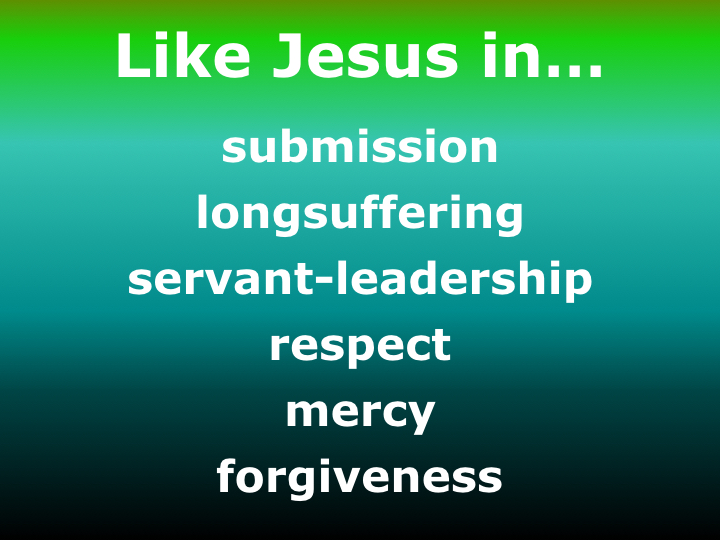
like-jesusTime after time Peter calls Christians to live a counter-cultural lifestyle. The most countercultural example we have ever seen is Jesus Christ.

Peter shows us how Jesus—in the most excruciating situation possible—lived. Heading into the torture of crucifixion

  • He was submissive to His Father’s will
  • He remained focused on the future glory, not just the immediate pain
  • He continued to be a servant-hearted leader
  • He spoke to those around Him respectfully
  • He extended mercy to His tormentors
  • He prayed for (and purchased with His blood) His tormentors’ forgiveness

Peter then tells Christian wives and husbands they are to behave in the same way as Jesus. Wow!

More specifically Peter challenges Christlike wives to be:

  1. Submissive to their husbands—I like how the Amplified Bible says this in verse 1: “subordinate, not as inferior, but out of respect for the responsibilities entrusted to husbands and their accountability to God, and so partnering with them.
  2. Christlike in their behavior.
  3. Distinctive by their purity.
  4. Reverent to God, by honoring the image of God in their husbands.
  5. Beautiful from the inside out.
  6. Consistently doing what is right
  7. Not swayed by fear—“do what is right without being frightened by any fear [that is, being respectful toward your husband but not giving in to intimidation, nor allowing yourself to be led into sin, nor to be harmed]” (v. 6 AMP).

Likewise Peter challenges Christlike husbands to be:

  1. Submissive to their wives—remember the in the same way phrase? That applies to the men too. Submit to one another out of reverence for Christ. … Husbands, love your wives, just as Christ loved the church and gave Himself up for her (Ephesians 5:21, 24).
  2. Considerate of her—the King James Version says, “dwell with them according to knowledge.” That word for knowledge means to study your wife and know what she likes and doesn’t like.
  3. Respectful in the way he treats his wife.
  4. Treating her as a partner and heir in your spiritual heritage.
  5. Understanding the part she plays in your spiritual development—“The same goes for you husbands: Be good husbands to your wives. Honor them, delight in them. As women they lack some of your advantages. But in the new life of God’s grace, you’re equals. Treat your wives, then, as equals so your prayers don’t run a ground” (v. 7 MSG).

Here are two questions I think Christian wives and husbands need to seriously consider: Are you thinking about your role as a husband or wife in biblical terms or cultural terms? If you are thinking in cultural terms, are you willing to try it God’s way?

Our Christian marriages should be “alien” to the way the world operates; they should be counter-cultural. That kind of marriage is what points people to a relationship with Jesus!

If you’ve missed any messages in this series, you may find the complete list by clicking here.

Ken Blanchard & Phil Hodges On Forgiveness

lead-like-jesus“Forgiveness is the way for a heart grounded in the unconditional love of God to respond to the imperfections of others. … EGO-driven leaders, impatient for results, are quick to judge and discount less-than-perfect efforts as failure rather than to forgive and redirect. Forgiveness is a supernatural act, not a natural response to being hurt or let down. It is an act of the will, a choice, of one who has surrendered control to a higher court of judgment. …

“The opposite of forgiveness is judgment. Your motivation for doing something is as important as what you do. In theological terms, judgment is pointing out a fault with a view to condemnation. On the other hand, discernment is pointing out a fault with a view to correction or restoration. When we withhold forgiveness, is it because we are sincerely trying to correct or restore—or is it because there is some benefit to us in condemning?” —Ken Blanchard & Phil Hodges