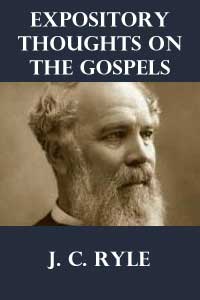
 J.C. Ryle has given us a wonderful commentary on the Gospels in his Expository Thoughts On The Gospels. Check out my full book review here, and then enjoy a few quotes from Ryle’s insights on the Gospel of Matthew.
“The rulers of this world have often call themselves Great, Conqueror, Bold, Magnificent, and the like. The Son of God is content to call Himself Savior. These souls which desire salvation may draw near to the Father with boldness, and have access with confidence through Christ. It is His office and His delight to show mercy. ‘For God didn’t send His Son into the world to judge the world, but that the world should be saved through Him’ (John 3:17).”
“Trust Him at all times with all your sorrows. He will not despise you. Pour out all your heart before Him in prayer, and keep nothing back. He can sympathize with His people.”
“Let us beware of resting satisfied with head-knowledge. It is an excellent thing, when rightly used. But a man may have much of it, and yet perish everlastingly. What is the state of our hearts? This is the great question. A little grace is better than many gifts. Gifts alone save no one. Grace leads on to glory.”
“Here is one among many reasons why we ought to be diligent readers of our Bibles. The Word is the sword of the Spirit. We shall never fight a good fight, if we do not use it as our principal weapon. The Word is the lamp for our feet. We shall never keep the King’s highway to heaven, if we do not journey by its light. … Knowledge of the Bible never comes by intuition, it can only be obtained by diligent, regular, daily, attentive, wakeful reading.”
“Aim at letting men see that we find Christianity makes us happy. Never let us forget that there is no religion in looking melancholy and gloomy. Are we dissatisfied with Christ’s wages and Christ’s service? Surely not! Then let us not look as if we were.”
“Let the prayer ‘Lord, increase our faith,’ always form part of our daily petitions. We never perhaps know the weakness of our faith until we are placed in the furnace of trial and anxiety. Blessed and happy is that person who finds by experience that his faith can stand the fire, and that he can say with Job, ‘though He slays me yet will I trust in Him’ (Job 13:15).”
“The more clearly we see Christ’s power, the more likely we are to realize Gospel peace. Our position may be trying. Our hearts may be weak. The world may be difficult to journey through. Our faith may seem too small to carry us home. But let us take courage when we think on Jesus, and not be cast down. Greater is He that is for us than all those who are against us. Our Savior can raise the dead. Our Savior is Almighty.”
“Great grace and common sense are perhaps one of the rarest combinations. … Our Lord Jesus Christ Himself is our most perfect example. None were ever so faithful as He. But none were ever so truly wise. Let us make Him our pattern, and walk in His steps.”
“Let us not be ashamed to say that we expect a literal fulfillment of unfulfilled prophecy. Let us frankly allow that there are many things we do not understand, but still hold our ground tenaciously, believe much, wait long, and not doubt that all will one day be made clear.”
“Are we ever mocked and persecuted and thought foolish because of our religion? Let us bear it patiently and pray for those who persecute us. They know not what they are doing. They will certainly alter their minds one day. We may yet hear them confessing that we were wise and they were foolish. The whole world shall one day acknowledge that the saints of God made a wise choice.”
“We can never attach too much importance to the atoning death of Christ. It is the leading factor in the Word of God, on which the eyes of our soul are to be ever fixed. Without the shedding of His blood, there is no remission of sin. It is the cardinal truth on which the whole system of Christianity hinges. Without it the Gospel is an arch without a key stone, a fair building without a foundation, a solar system without a sun.”
Quotes from Ryle’s comments on the Gospels of Mark, Luke, and John coming soon.



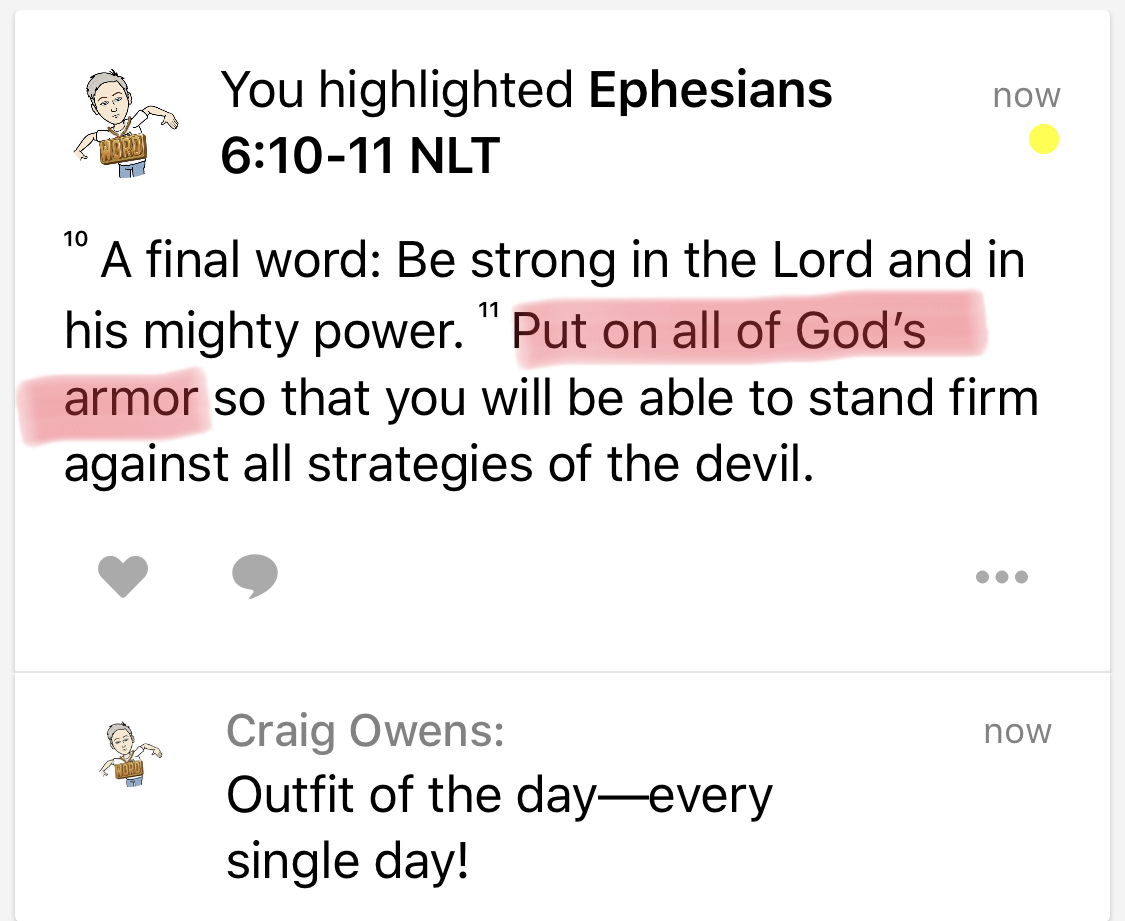 Finally, be strong in the Lord and in His mighty power (Ephesians 6:10).



 Craig T. Owens
Thursdays With Spurgeon—Comments On Commentaries
March 5, 2020 — Craig T. OwensComments On Commentaries
It has been said that the passage I have taken for my text [Isaiah 7:1-17] is one of the most difficult in all the Word of God. It may be so. I certainly did not think it was until I saw what the commentators had to say about it, and I rose up from reading them perfectly confused! One said one thing, and another denied what the other had said. And if there was anything that I liked, it was self-evident that it had been copied from one to the other and handed through the whole of them!
One set of commentators tells us that this passage refers entirely to some person who was to be born within a few months after this prophecy….
Well, that seems a strange frittering away of a wonderful passage, full of meaning, and I cannot see how they can substantiate their view when we find the evangelist Matthew quoting this very passage in reference to the birth of Christ [Matthew 1:22-23]….
I find, moreover, that many of the commentators divide the sixteenth verse from the fourteenth and fifteenth verses, and they read the fourteenth and fifteenth verses exclusively of Christ, and the sixteenth verse of Shear-Jashub….
Then another view, which is the most popular of all, is to refer the passage, first of all, to some child who was then to be born, and afterward, in the highest sense, to our blessed Lord Jesus Christ. …
But I think that if I had never read those books at all, but had simply come to the Bible without knowing what any man had written upon it, I would have said, ‘There is Christ here as plainly as possible! Never could His name had been written more legibly than I see it here.’
From The Birth Of Christ
Spurgeon was not advocating that we never consult commentaries because elsewhere he said about the use of commentaries: “I find it odd that he who thinks so highly of what the Holy Spirit teaches him speaks so little of what the Holy Spirit teaches others also.”
But what I believe Spurgeon is advocating here is this important principle—The best commentary on a passage of Scripture is another passage of Scripture. Which is why he used the passage in Matthew to help him understand the passage in Isaiah.
God makes Himself clear in His Word. The same Holy Spirit that inspired the pen of those who wrote the words in the Bible is the same Holy Spirit in you that can illuminate those words to your heart and mind.
Commentators have their place. I believe that place is after you have prayed through and wrestled with a passage of Scripture for yourself. Think of commentators as the answers in the back of your math book. After you have worked through the equations for yourself, go to the answer key to verify your answers. If you simply look up the answer before you wrestle with the problem, how have you benefitted yourself?
And always remember that God’s Word is infallible, but men are fallible. Commentators may provide an insight that helps you see something more clearly, but they are never a substitute for God’s very own word on a matter.
Should you use commentaries? Sure! Find a good one, but consult it only after you have asked the Holy Spirit to help illuminate the passage, and after you have allowed the commentary of Scripture itself to shine its light on the difficult verse or passage.
Share this: