First of all, I encourage you to watch the first few minutes of the video below for an amazing story about honking horns. Trust me on this one—it’s a memorable story that will go along way toward helping you defeat anxiety when it rears its ugly head in your life.
What kills joy and happiness and gratitude? Anxiety is the killer.
What makes people so full of joy-killing anxiety? In a word: fear. Fear of missing out … Fear of falling short … Fear of not measuring up … Fear of bad things that might happen.
If anxiety kills joy, what kills anxiety? Anxiety—the joy-killer—is itself killed when joy is expressed.
Being grateful forwhat you have kills the anxiety of what you don’t have.
Being thankful forwhat you have kills the fear of what you may be missing.
Being grateful forwhat you have kills the anxiety of the bad stuff that may never even happen.
If joy kills anxiety, how can we develop more of it? Most people would say, “If you’re happy, give thanks” or “If you’re happy, honk.” But really it’s the other way around: “If you want to be happy, honk!”
Don’t fret or worry. Instead of worrying, pray. Let petitions and praises shape your worries into prayers, letting God know your concerns. Before you know it, a sense of God’s wholeness, everything coming together for good, will come and settle you down. It’s wonderful what happens when Christ displaces worry at the center of your life. (Philippians 4:6-7)
Honking your thanks is not only good for you, but it’s good for everyone around you who hears your “honk! honk!” of gratitude. David experienced this in Psalm 34:1-3. Even when he was at a low point, when he started praising God other anxious people began to experience joy as well.
Can I challenge you to join me in doing two things for at least the rest of this month:
Keep a gratitude journal in a notebook, on your computer, or in your phone or tablet. Regularly write down those things for which you are grateful.
Don’t keep your gratitude to yourself, but share it with the world. Use hashtag #honk to let people know you are using joy to kill anxiety in your heart.
Honk! Honk! Honk! It’s good for you; it’s good for others; and it brings glory to God.
How do you handle a hard passage in the Bible? Peter wrote this about Paul, “His letters contain some things that are hard to understand….” But if we don’t take the time to wrestle with that passage, Peter says this is what happens next: “…which ignorant and unstable people distort, as they do the other Scriptures, to their own destruction” (2 Peter 3:16).
So here’s a 5-step plan I use when I am working through a challenging passage of Scripture.
Ask the Holy Spirit to help you
All Scripture is inspired by the Holy Spirit (2 Timothy 3:16), and the same Holy Spirit lives in a Christian (1 John 2:20). Think about that: the same Holy Spirit that inspired an author to write the words of Scripture is the same Spirit that will illuminate them to you!
Read the difficult passage in context
We will make our task much easier when we “zoom out” from the difficult text and read the whole passage surrounding the difficult verse/phrase. Perhaps we need to “zoom out” even farther to understand why the whole chapter or book was written.
Identify the parts that are clear
Start off by identifying the parts that you do understand, and then see what light that shines on the tricky text.
Cross reference with other Scriptures
Never, ever, ever draw a conclusion from just one passage of Scripture. Paul reminded his audience that he used the “whole counsel of God’s Word” (Acts 20:27) in forming his sermons. If the challenging passage contains an Old Testament passage, look it up; if it references an historical event, read that history. I also like to use biblegateway.com’s excellent search feature to find cross references.
Draw conclusions on what appears to be the main point
Only after you have done step #1-4 should you attempt to draw some conclusions. You will set yourself up for error if you draw a conclusion first, and then try to find other texts in the Bible that agree with you.
The Apostle Peter writes something rather challenging in his first letter. In fact, Martin Luther said this about 1 Peter 3:18-22: “A wonderful text is this, and a more obscure passage perhaps than any other in the New Testament, so that I do not know for a certainty just what Peter means.” If you would like to see how I walk through the 5-step plan on this “obscure passage,” please check out the video below.
There was a story circulating that a physicist once claimed that the bumblebee was defying the laws of physics and aerodynamics in its flight. Apparently, he calculated that the ratio of the bumblebee’s wing size in comparison to his body size just didn’t make the math work.
But entomologists and physicists quickly jumped in to say, “Hey, look, the bumblebee is flying, so clearly it works!” And then they went to work to try to explain it. They figured out that the bumblebee flaps its wings more back-and-forth than up-and-down, creating tiny hurricanes the propel them through the air. But then that created a whole new set of problems, like how does the bumblebee control a hurricane so precisely as it turns, stops, dives, and climbs. So then they had to create a new explanation, which they named dynamic stall.
All the while, the bumblebee is flapping its too-small wings 230 times per second(!), and going about its daily activities without being able to explain tiny hurricanes, the laws of physics or aerodynamics, or even knowing what dynamic stall is. It simply flies!
The ultimate argument for anything is doing something that critics say is impossible.
Peter tells Christians to be prepared to answer anyone for the reason for the hope that they have (1 Peter 3:15-16). The Greek word for “give an answer” is apologia, from which we get our word apologetic. Here are three apologetics for Christians to use for the hope that they have.
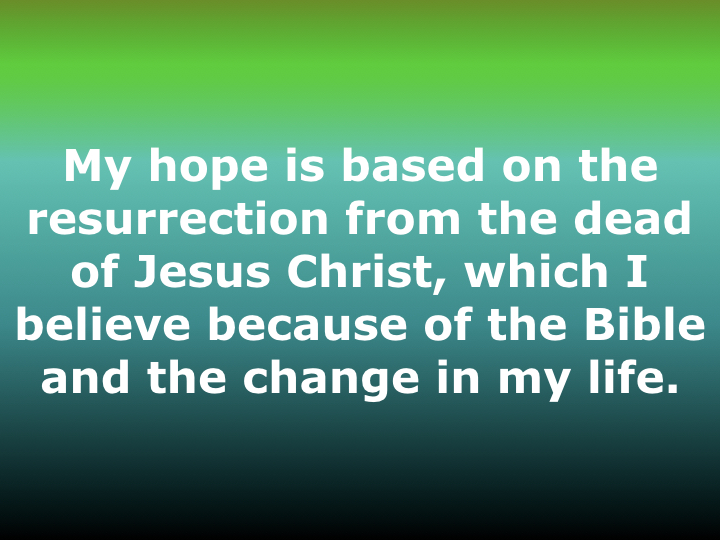
It really comes down to this: My hope is based on the resurrection from the dead of Jesus Christ, which I believe because of the Bible AND because of the change in my life.
The Bible’s authenticity
“No other work in all literature has been so carefully and accurately copied as the Old Testament. The particular discipline and art of the Jewish scribes came out of a class of Jewish scholars between the fifth and third centuries BC. They were called the Sopherim, from a Hebrew word meaning ‘scribes.’ The sopherim, who initiated a stringent standard of meticulous discipline, were subsequently eclipsed by the Talmudic scribes, who guarded, interpreted, and commented on the sacred texts from AD 100 to AD 500. In turn, the Talmudic scribes were followed by the better-known and even more meticulous Masoretic scribes (AD 500-900).” —Josh McDowell, God-Breathed
“No other ancient text is substantiated by such a wealth of ancient textual witnesses as is the New Testament. Roughly 5,500 separate manuscripts are available, variously containing anything from the entire New Testament corpus to a slight fragment of a single verse. … This textual support is far superior to that available for any other ancient documents, such as the classical texts from Greek and Roman writers (e.g., Plato, Aristotle, and Cicero). Only partial manuscripts have survived for many works of antiquity, and it is not unusual to find that the only complete manuscript for some ancient writing is a copy dating from 1,000 years after its composition.” —Archaeological Study Bible, “The New Testaments Texts” (page 1859)
“The biblical Dead Sea Scrolls are up to 1,250 years older than the traditional Hebrew Bible, the Masoretic text. We have been using a one-thousand-year-old manuscript to make our Bibles. We’ve now got scrolls going back to 250 BC. … Our conclusion is simply this—the scrolls confirm the accuracy of the biblical text by 99 percent.” —Dr. Peter Flint
I have shared other apologetic evidence for the authenticity of Scripture here and here.
Christ’s resurrection
In1 Corinthians 15:1-8 Paul lists all of the eyewitnesses to Christ’s resurrection, giving critics ample opportunity to challenge these witnesses in person. If these witnesses would have been perpetrating a hoax, skeptics of their day would have been able to uncover the inconsistencies in their story. If the account of Christ’s resurrection was made-up, it’s doubtful the early Christian martyrs would have “stuck to their story” as they were being tortured, but none recanted.
Josh McDowell notes, “By AD 100, the apostles had died, but the Christian Church was still in its infancy, with fewer than twenty-five thousand proclaimed followers of Christ. But within the next two hundred years, the fledgling church experienced explosive multiplication of growth, to include as many as twenty million people. This means the church of Jesus Christ quadrupled every generation for five consecutive generations!”
My personal experience
“I am a changed person. I am not who I was before I met Jesus” and “My life tends to go better when I live by biblical principles” are both excellent apologetics!
Let others argue that God doesn’t exist, or that you shouldn’t have hope, and then you—like the bumblebee—just keep flying with Jesus! (see 2 Timothy 3:14)
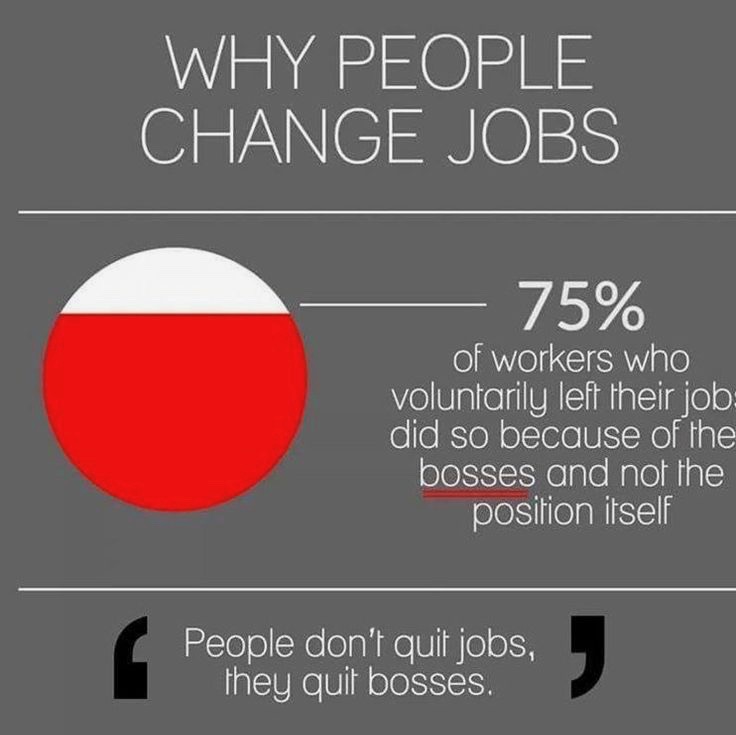
I read a statistic that 75% of people who voluntarily left their jobs did so because of a problem with their boss. In other words, 3-out-of-4 people didn’t quit their job, they quit their boss. In my personal experience this is equally as true in the church world—Most people don’t quit their church, they quit a bad pastor.
Sadly, those who do quit their church usually do so the wrong way. As a result they become either de-churched (they don’t attend anywhere), or cynical in the next church they do attend.
Who is a bad pastor?
One who is no longer effective because he is stuck in an old way of doing things
One who is theologically off
One who is unwilling to admit an error, ask forgiveness, and make amends
One who uses his position to build his kingdom instead of God’s kingdom
We have a great example of how to handle a bad spiritual leader in the story of David and Saul (see 1 Samuel 24). David had done nothing wrong, yet Saul was trying to kill him. At one point David’s men urged David to take matters into his own hands, and he almost did. He got close enough to Saul to cut off a corner of his robe, but quickly discovered that was too close. Immediately after doing so David was conscience-stricken!
Then look how David responded:
David rebuked his men as he reminded them that Saul was their “master” and “the Lord’s anointed.”
David “bowed down and prostrated himself” before Saul as he apologized.
David called him his “master,” “father,” and “the Lord’s anointed.”
David said he would leave the matter in God’s hands, allowing God to “judge between you and me.”
And twice David declared, “My hand will not touch you!”
This humble reply got Saul’s attention. Saul wept as he said, “You have treated me well, but I have treated you badly.” Saul then asked David to be kind to his descendants.
Then this conclusion—David gave Saul his oath, and then went away to a safe place.
The New Testament captures these same ideas for today’s Christians. We are told not to lightly entertain an accusation against spiritual leaders (1 Timothy 5:19), but to submit and obey to biblically-correct leaders (Hebrews 13:17).
The Bible gives us only two options for dealing with spiritual leaders…
SUBMIT & OBEY or WALK AWAY
Two wrongs don’t make a right. Responding in an unscriptural way to an unscriptural pastor’s way is just as wrong as what the pastor was doing wrong in the first place!
So give the bad pastor your oath that you will not lay a hand (or a word!) on them, and then remove yourself to a safe place. Submit and obey, or walk away and leave them in God’s capable hands.
Over the past couple of weeks, people have been rattled by both real and imagined catastrophic events. We experienced a fabulous astronomical sight in a full solar eclipse, wept for our fellow citizens in Texas and Florida as hurricanes battered their businesses and homes, and then dealt with doomsayers who predicted the end of the world and the second coming of Jesus Christ.
Peter spent a lot of time right next to Jesus, soaking up His teaching and observing how Jesus lived. One thing Peter never saw in Jesus was panic.
So it’s not unexpected that Peter would write to followers of Jesus: Don’t fear what the world fears (1 Peter 3:14). Instead, Peter counsels his friends to keep their focus on Jesus.
Don’t run around in fear, but instead in your hearts set apart Christ as Lord. Some other translations say things like…
…revere Christ as Lord
…acknowledge Him as Lord
…worship Christ as Lord of your life
…keep your hearts at attention, in adoration before Christ (see 1 Peter 3:15)
In other words: let Jesus Christ be your focal point.
When you live this way—focused on the eternal Jesus and not the temporary shakings on earth—Earthlings are bound to notice that there is something different about you. So Peter tells us to always be prepared to give an answer to everyone who asks you the reason for the hope that you have.
Hope—not wishful thinking, but a rock-solid, joyful, confident expectation!
This hope is the Christian’s secret weapon!
This hope is unshakable during difficult times. This hope is unshakable on death’s doorstep. This hope is unshakable when the end of the world is predicted.
The Christian who has a personal experience of the hope that Jesus brings is never at the mercy of the happenings in the world nor the arguments from non-Christians.
But Peter cautions us to never use this hope as a club. He tells us to make sure we never use hope as a means of feeling superior to others. Instead we are to speak to others about our hope gently, respectfully, and with a clear conscience.
So here’s my question to you, fellow Christian: Can those around you see your hope? When they’re fearful and running for cover, do they see you right alongside them, or do they see you standing firm in hope as you keep your eyes fixed on Jesus. Your hope is a powerful persuader for a personal relationship with Jesus Christ!
Christians should be the best at loving others and supporting them through a tragedy. When someone’s world is rocked by an unexpected heartache like a miscarriage, a suicide, a difficult medical diagnosis, or even a hurricane, here is my list of 10 steps to help someone through this trying time. You may watch this short video, or see the list of 10 items below…
Don’t defend God (like Job’s friends tried to do).
Pray for the Holy Spirit to give you insight.
Remind them of their responsibility now—your choices to go forward, how will you honor their memory, how can you help others in a similar situation, what does this make you think about your eternity?
Stay in touch for the long haul. Remember the birthday of their dead loved one; be there for the anniversary date of a marriage, the day their loved one died; go to those doctor’s appointments with them; roll up your sleeves and work alongside them. Use your creativity to proactively be there for them.
Listen to the podcast of this post by clicking on the player below, and you can also subscribe on Apple, Spotify, or Audible.
Before ascending back to Heaven, Jesus commissioned His followers. He gave them a mission that Christians often refer to as The Great Commission.
Jesus said, “All authority in heaven and on earth has been given to Me. Therefore go and make disciples of all nations, baptizing them in the name of the Father and of the Son and of the Holy Spirit, and teaching them to obey everything I have commanded you. And surely I am with you always to the very end of the age.”
There are several pictures in the New Testament of how the Church could live out this Great Commission, but one of the pictures that I find the most helpful is that of a Body.
The human body is an amazing creation! Just to accomplish the simple task of picking up something between our thumb and forefinger is a miracle in itself. The structure of bones and ligaments and tendons, the interaction of nerves in the fingers coordinating with the optical nerve, not to mention the enzymes and blood vessels that are all doing their part.
Yet if any part is not functioning properly, that simple action becomes more difficult. Maybe it even becomes impossible.
The Church is the same way. Every part of the Church Body has to be functioning in healthy order for the whole Body to be effective.
Here are four aspects of a healthy Church Body that the Apostle Paul lists in Ephesians 4:
Caring for one another
Mobilizing for evangelism
Making disciple-makers
Helping organize for more meaningful ministry
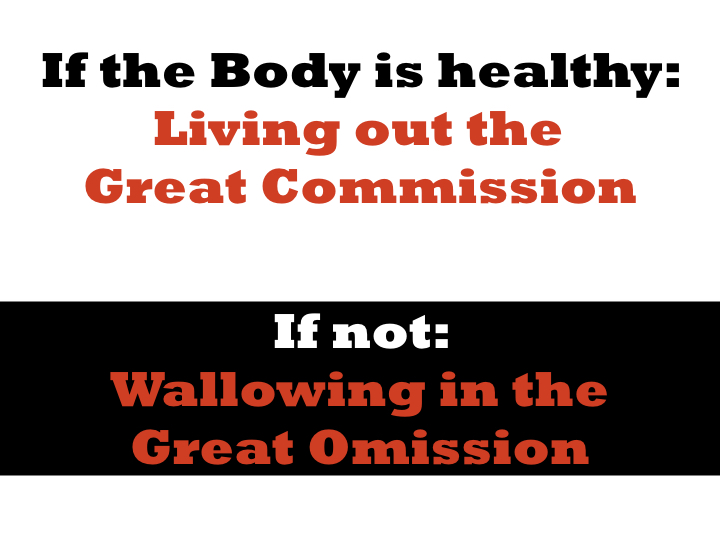
If every part of the Body is doing its part, we’re Living out the Great Commission.
If some parts are missing or unhealthy, we’re Wallowing in the Great Omission.
It’s not about your church (small “c”) or my church. It’s about all Christian disciples being a part of one Church—one Body—going into all the world and making disciples of all peoples. That’s what the Church is supposed to be doing!
Our annual Q Series is where folks send their questions to me on a variety of subjects and we do our best to answer them. This week we tackled questions like:
What does Christ’s Parable of the Sower mean?
Can people lose their salvation?
Are micro-chips implanted in humans the start of “the mark of the beast”?
What does “666” stand for?
Why aren’t all of my prayers answered?
Here’s what we discussed, along with the time this discussion appears on the video:
Our annual Q Series is where folks send their questions to me on a variety of subjects and we do our best to answer them. This week many of the questions were about the Bible. Questions like:
What books should be included in the Bible?
What about Bible translations?
Is it okay for the Bible to have pictures in it?
Here’s what we discussed, along with the time this discussion appears on the video:
How was it decided what books would be included in the New Testament? [5:38] **Be sure to check out this post: How We Got The Bible on Biblegateway.
J. Warner Wallace’s list of criteria for New Testament books [9:45]
Did contemporary sources support or refute the New Testament authors? [11:45]
How did the final 27 books of the New Testament make the list? [15:02]
How was it decided what books would be included in the Old Testament? [18:22]
How do we know the Scriptures were accurately transcribed? [22:50] **Be sure to check out this post: Why Trust The Bible? on Biblegateway.
The history surrounding the complete Latin Bible and the Dead Sea Scrolls [23:45]
What are Bible translations and paraphrases (with references to the Wycliffe Bible and the discovery of the Rosetta Stone)? [25:45]
Some cautions about Bible paraphrases [33:23]
Is it okay for a Bible to have pictures in it? [35:16]
Are icons of the Cross acceptable or a blasphemy? [37:42]
How can someone better understand the Bible when they read it for themselves? [41:32]
Why ask questions? [48:39]
We’ll be discussing more questions this upcoming Sunday, so be sure to send them my way. For all of the ways you can send questions, please click here.



 First of all, I encourage you to watch the first few minutes of the video below for an amazing story about honking horns. Trust me on this one—it’s a memorable story that will go along way toward helping you defeat anxiety when it rears its ugly head in your life.
 Can I challenge you to join me in doing two things for at least the rest of this month:







 Craig T. Owens
The Q Series—Parables, End Times, And Prayer
August 21, 2017 — Craig T. OwensHere’s what we discussed, along with the time this discussion appears on the video:
We will be answering your questions one more time next Sunday. Please click here to find all the ways you can submit your questions.
Share this: