Check out this episode and subscribe on YouTube so you can watch all of the upcoming episodes. You can also listen to our podcast on Spotify and iTunes.
I have the privilege of pastoring Calvary Assembly of God. One of the things I am honored to do is share a message from God’s Word with our church each week. Sharing the messages is one thing, but reminding folks of what has been shared is another. This is something that resonated with both the apostle Peter and the apostle Paul.
Peter wrote, “Dear friends, this is now my second letter to you. I have written both of them as reminders to stimulate you to wholesome thinking” (2 Peter 3:1). And Paul not only told the Romans that “I have written you quite boldly on some points to remind you of them again” (Romans 15:15), but he also taught his protege Timothy to “keep reminding God’s people of these things” (2 Timothy 2:14).
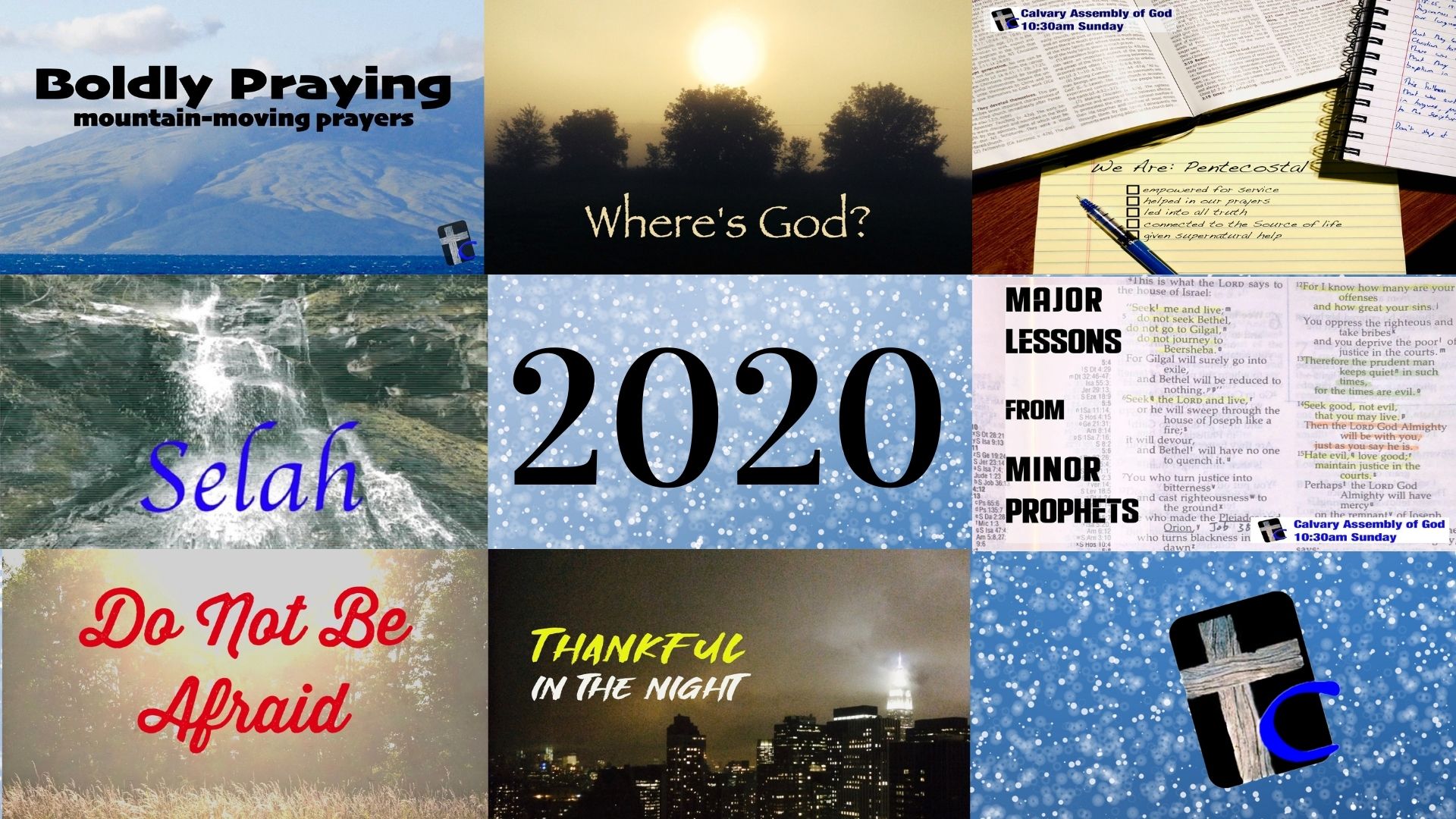
With that backdrop, here is a listing of the sermon series that I presented this year. Clicking on each series title will take you to a list of all of the sermons in that series.
Prayer Plan—A Christian’s strategy is worked out in the prayer closet. John Piper noted, “Why do God’s children so often fail to have consistent habits of happy, fruitful prayer? Unless I’m badly mistaken, one of the reasons is not so much that we don’t want to, but that we don’t plan to.” These messages taught us to have a plan to pray.
Where’s God—We’ve all asked that question. Something happens that rocks our world, and we wonder where in the world God is.We call out to God and He seems silent. We search our hearts to see if we can discern something we’ve done wrong, and seeing nothing amiss we cry out again, “God, where are You?”So where is God in our heartache? In our abandonment? In our sorrows? In our distress? In death? Believe it or not, God may be closer in His silence than you’ve ever perceived before.
We Are: Pentecostal—Pentecost for over 1500 years was a celebration in Jerusalem that brought in Jews from all over the world. But on the Day of Pentecost that came just ten days after Jesus ascended back into heaven, the meaning of Pentecost was forever changed! Followers of Jesus—now empowered by an infilling of the Holy Spirit—began to take the good news of Jesus all over the world. These Spirit-filled Christians preached the Gospel and won converts to Christ even among hostile crowds, performed miracles and wonders, stood up to pagan priests and persecuting governmental leaders, and established a whole new way of living as Christ-followers. We, too, can be Pentecostal followers of Jesus Christ today.
Selah—The word Selah appears nearly 70 times in the Bible, almost exclusively in the Psalms. Although it is primarily a musical term, it applies beautifully to our summer series. It means a pause. Throughout the Psalms, Selah appears at the end of a verse, at the end of the psalm, or sometimes even mid-sentence. But each one of them is perfectly placed by the Spirit-inspired authors to get us to take a breath and deeply contemplate what we just read or sang.
Major Lessons From Minor Prophets—Sometimes the naming of things gives us an inaccurate picture of the thing being named. For instance, many people think the “old” in Old Testament means outdated or perhaps updated by the “new” in the New Testament. When in fact, both Testaments are needed to give us the full picture of God’s love and glory. A similar thing happens with the headings “major prophets” and “minor prophets.” It makes it sound like the major prophets have something major to say to us, while we could take or leave the minor messages of the minor prophets. In reality, they were given these headings simply because of the volume of writing—the five major prophets consist of 182 chapters, whereas the 12 minor prophets only have 67 chapters. The volume of their writing may be minor, but their content carries major messages of meteoric power!
Thankful In The Night—The psalmist wrote, “Yet the Lord will command His loving-kindness in the daytime, and in the night His song shall be with me” (Psalm 42:8). Notice that the psalmist was praising GodINthe night, not praising HimFORthe night. Many people have gone through what has been called “the dark night of the soul.” I don’t think anyone has ever given thanks because of being in a dark time, but certainly they have given thanks afterward because of the lessons learned in that dark time. Quite simply put, there are some things God wants to teach us that we can learn in no other way than to go through a dark night. So we can learn to be thankful evenINthose nights.
Do Not Be Afraid—There are more angels sent by God concerning one event than anywhere else in the Bible—the Advent of Jesus. Clearly, this is a big deal: The coming to earth of God Himself! You would think this would be an occasion for great joy. But all four of the angelic appearances around the birth of Jesus have the same message: Do not be afraid. Why are people so afraid? It’s because fear invites us to make a decision to trust God completely. People remain crippled by fear when they try to deal with fear by themselves. But when they learn to fear God instead, there is an almost inexpressible joy and freedom that explodes in our hearts!
We will be returning to a couple of these series in 2021, and we’ll be launching some brand new ones as well. In either case, if you don’t have a home church in the northern Kent County area, I would love to have you join us!
When Gabriel told Mary that she would be the mother of Jesus, he said that “the Lord God will give Him the throne of His father David.” Just before the angel showed up Luke noted that Mary was “pledged to be married to a man named Joseph, a descendant of David” (Luke 1:27, 32).
At this time in history marriages were often arranged to preserve and strengthen family lines. Both Joseph and Mary could trace their family lineage through the royal line of Israel’s King David.
Mary is betrothed to Joseph. Betrothal was considered as strong as a marriage with the only exception being that the couple didn’t yet live together nor sleep together. Betrothal usually lasted a year and would require a divorce to cancel it.
The word Luke uses for “consider” is not even close to what’s happening in Joseph’s mind. The word means to revolve around and around in your mind, like trying to solve a Rubik’s Cube.
Consider Joseph’s options. If he divorces Mary—which was apparently his first reaction—Mary would be publicly embarrassed. Not to mention that Joseph knew that God hated divorce.
If Joseph decided to proceed with the marriage, he would either have to confess he was the father of her child—which could result in both of them being stoned—or admit that she was pregnant by another man—which would be a permanent disgrace for Mary’s family.
In either case, both families would be shamed!
While Joseph was still considering all these unsavory options an angel says to him, “Joseph, son of David, do not be afraid.” By calling him by that title he is really saying, “I know how important your family heritage is to you. I know how important Mary’s family heritage is to her. But do not be afraid to take Mary home as your wife because this all fits into God’s plan.
Would it have been easier on Joseph and Mary and their families if God could have waited until after they were married? Of course! But then it wouldn’t fit into God’s miraculous plan, because 700 years earlier God promised that Jesus would be born of an unmarriedvirgin.
Fearing what’s coming in the future means we have forgotten Who already knows the future.
If you seem paralyzed by a no-win dilemma like Joseph was, first DON’T do what Joseph did: pray! Then DO what Joseph did after hearing the angel: obey.
Remember Who knows you and Who knows your future, and then take each step on your journey as God directs you.
According to the dictionary, fear is a distressing emotion we feel whether the threat is real or imagined. Five hundred years ago, Michel de Montaigne said, “My life has been filled with terrible misfortune; most of which never happened.” Even more recently, an extensive study found that 85 percent of things people feared never happened!
According to the dictionary, faith is trust in something even without proof or evidence. That sounds tremendously close to the biblical definition of faith: Now faith is the assurance—the confirmation, the title deed—of the things we hope for, being the proof of things we do not see and the conviction of their reality—faith perceiving as real fact what is not revealed to the senses. (Hebrews 11:1 AMP)
Mary is the second person to whom an angel says “Do not be afraid” in the First Advent story. Consider her story alongside Zechariah’s story and especially notice when these words were spoken. The angel Gabriel first tells Mary, “Greetings, you who are highly favored! The Lord is with you.”
Mary’s initial response is being “greatly troubled.” This Greek word means an internal agitation that today psychologists would call “cognitive dissonance.” In other words, what Mary believed about herself didn’t line up with what God believed about her. Her next response is wondering how she could ever measure up to God’s high standard of her.
It’s at this point that Gabriel says those key words, “Do not be afraid, Mary, you have already found favor with God.” She didn’t have to make herself worthy of God’s favor because she already had it! Now Mary just had to believe it.
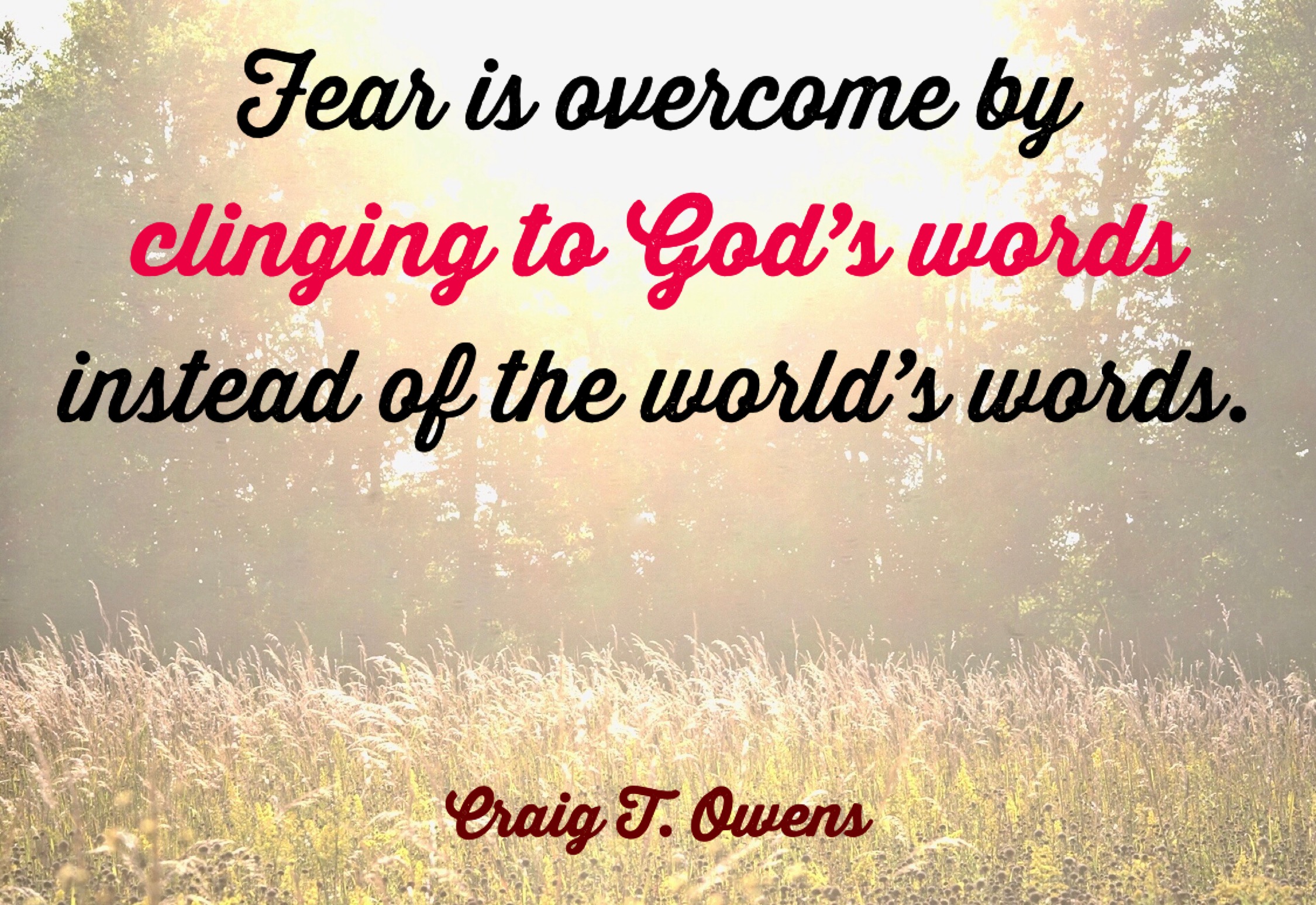
Fear is overcome by clinging to God’s words instead of the world’s words.
Mary did indeed choose this. Her song (in vv. 46-55) is loaded with Old Testament references, and she concludes by singing to God, “You have helped Your servant Israel, remembering to be merciful to Abraham and his descendants forever, even as You said to our fathers.”
Here’s the truth—
Your Word, Lord, is eternal; it stands firm in the heavens. (Psalm 119:89)
God is not human, that He should lie, not a human being, that He should change His mind. Does He speak and then not act? Does He promise and not fulfill? (Numbers 23:19)
And Jesus would tell us that clinging to God’s words puts us on the surest of foundations that no storm of life could ever shake (Luke 6:46-49)!
Clinging to God’s words lets us realize God’s grace toward us.
If you know Jesus as your Savior, you can insert your name in the same place where Gabriel said to Mary: “Do not be afraid, ____________, you have found favor with God!”
Have you ever had a really good scare? Maybe in the dark or when you were young? Then in the light or as you got older you thought, “Why was I afraid of that?” Our relief came from the fact that we think we know more. But here’s the problem: there is a difference between a healthy fear and an unhealthy fear, so not every fear is something we should try to alleviate.
Sometimes we treat too lightly the things that are really quite powerful. Consider the arrival of Jesus in Bethlehem. There are more angels sent by God surrounding this one event than anywhere else in all the Bible. Yet all four angelic appearances have the same message: “Do not be afraid.”
Why would people fear what we now celebrate as such a joyous event? I think it’s because God Himself—the All-Holy Creator of the Universe—is coming near to sinful man (see John 1:9; 1 Timothy 6:15-16).
God is holy, and His holiness is unapproachable by sin. At the exact same moment, God is love, and His love desires for us to approach Him. We cannot make this happen on our own, which leads to more fear.
In the Greek language of the New Testament phobeō is the main word for “fear.” This word can be defined as either fleeing from a terrible thing or clinging in obedience to an awesomely reverent thing. Jesus said the same things when He told us, “I tell you, my friends, do not be afraid of those who kill the body and after that can do no more. But I will show you whom you should fear: Fear Him who, after your body has been killed, has authority to throw you into hell. Yes, I tell you, fear Him” (Luke 12:4-5).
In the Advent story, the first appearance of “Do not be afraid” is when an angel appears to Zechariah. Why would Zechariah be so afraid at the approach of God? I think there may have been three reasons:
Herod was king—making the society Zechariah lived in politicized and irreligious
Zechariah was without a priestly heir to carry on his family name
his wife Elizabeth may have sinned—at least that’s what people would have whispered about her barrenness
All of this added up to Zechariah feeling like God was displeased with them and that He was only coming close to bring fiery judgment.
The angel told Zechariah not to fear because “your prayer has been heard.” In other words, “I am inviting you to trust in what God HASalreadydone versus trusting in what you might or might not be able to do on your own.” Phobeō was an invitation to choose reverential obedience (holy fear) of the eternal over the terror of the temporal.
Sadly, Zechariah initially clung to the negative phobeō. Yet after Elizabeth did conceive and John was born, this was transformed into holy, reverential fear, as heard in the Spirit-inspired song he sang. Notice in Luke 1:67-75 Zechariah’s emphasis on all that God has done: He has come, He has redeemed, He has raised, He said, He has kept His covenant, He has rescued, He has enabled.
Have you put yourself in the category of “unworthy of God’s favor”? Has fear crippled you—like it had done with Zechariah—from continuing to pray, believe, and try?
Fear is an invitation to evaluate in who or in what I have placed my trust.
I invite you to accept the invitation to take your eyes off the temporary and put them on the Eternal One. “…The time is coming quickly, and what I show you will come true. It may seem slow in coming, but wait for it; it will certainly take place, and it will not be delayed.”(Habakkuk 2:3 GNT)
Check out the other messages in this Do Not Be Afraid series by clicking here.
I have shared three lessons I learned going through dark times in my life (you can check them out here, here, and here), but we aren’t even close to exhausting all of the lessons that can be learned in the night. I want to teach you one principle that will allow for lifelong learning and application of these nighttime lessons.
The apostle Paul shared how he had matured during his times of struggle. He told the Corinthians he realized that God had delivered him in the past, was delivering him now, and would continue to deliver him in the future (see 2 Corinthians 1:3-11). The key is to hang in long enough to actually see how God brings about the deliverance and teaches the lessons.
Paul told the Corinthians, “No temptation has overtaken you except what is common to mankind. And God is faithful; He will not let you be tempted beyond what you can bear. But when you are tempted, He will also provide a way out so that you can ENDURE it”(1 Corinthians 10:13). And the writer of Hebrews said, “So do not throw away your confidence; it will be richly rewarded. You need toPERSEVERE so that when you have done the will of God, you will receive what He has promised” (Hebrews 10:35-36).
The Greek word translated “persevere” means keeping focused on the goal despite the struggles that it takes to get there. Jesus used this same Greek word at the conclusion of His parable of the sower: “The seed on good soil stands for those with a noble and good heart, who hear the Word, retain it, and by PERSEVERING produce a crop”; a crop that Jesus said was a hundred times more than what was sown (see Luke 8:5-15).
I love riding my bike on the White Pine Trail by my house. My long rides have a really fun stretch where I am flying downhill! But as fun as that part is, I’m not really building anything of lasting value. However, when I am coming back uphill and I want to quit because my legs are burning and I can hardly breathe, that becomes a valuable struggle. I cannot build endurance by any other way than to push myself just a little bit farther each time. When I want to quit, I pedal just a few more feet. Gradually, the uphill becomes less daunting.
A friend gave me a t-shirt I like to wear on my rides. When I put it on the blue-lettered message on the shirt says, “Do It!” but as I struggle uphill and the sweat begins to pour off my body, a new message emerges: “Don’t Quit!”
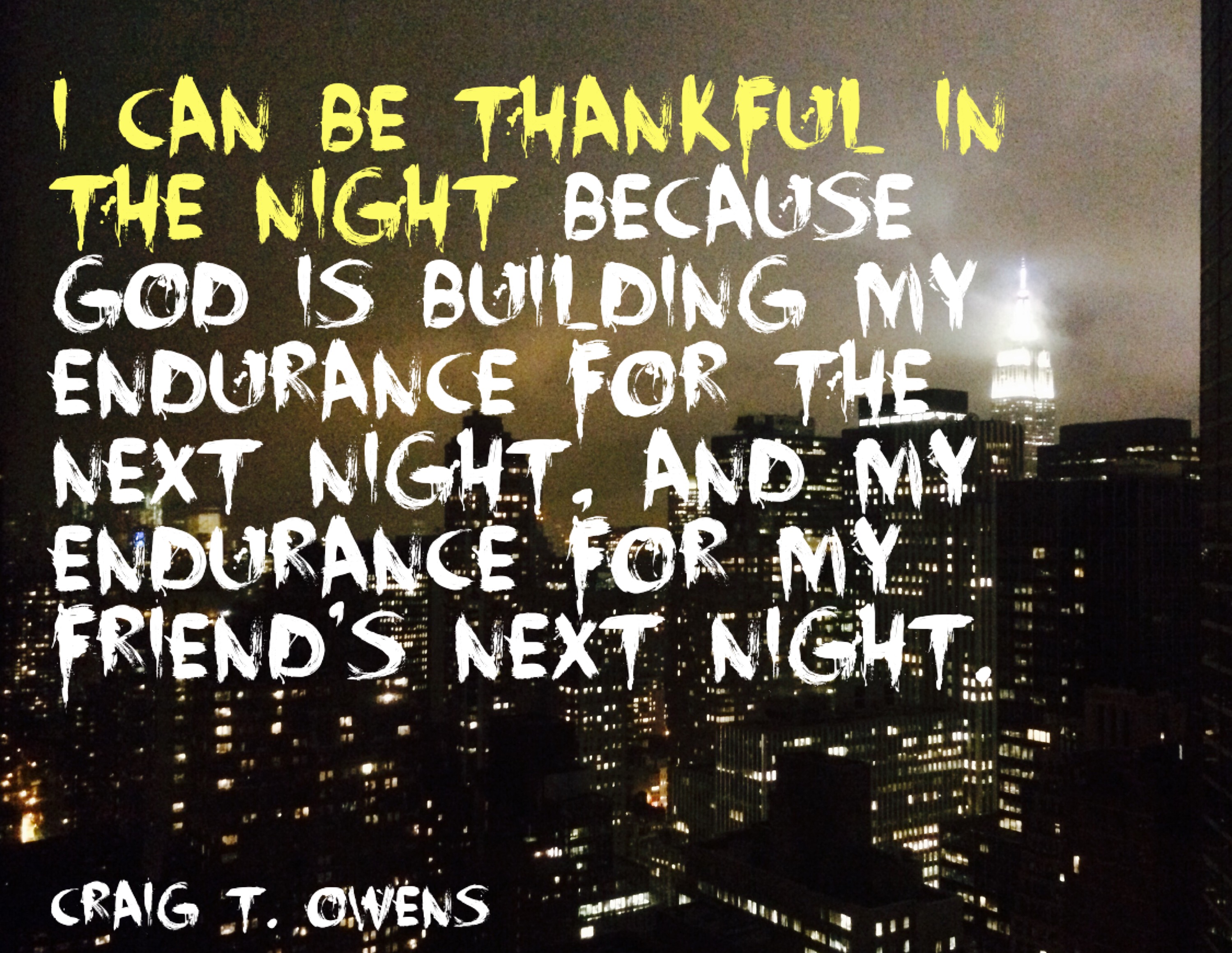
Remember that as you struggle and persevere, you are not only building your own endurance, but you are strengthening yourself to be able to help others. So we can be thankful IN the night because God is building our endurance for the next night, and our endurance for our friend’s next night.
Ken Blanchard teaches us to catch people doing something right
the lasting impact of a simple text I sent to a teammate
Greg says gratitude is both an attitude and an action
being ungrateful makes people feel like products
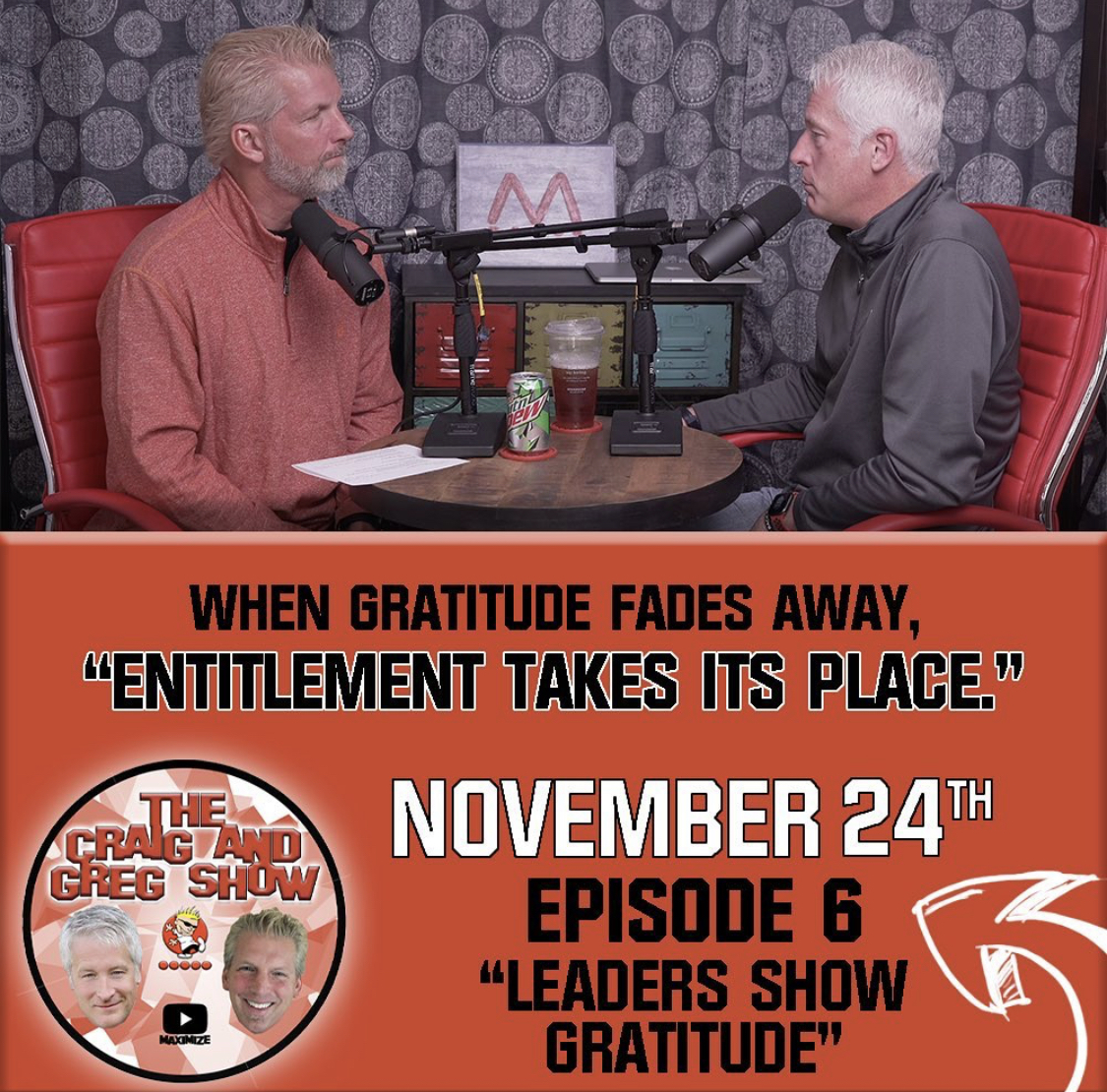
when gratitude fades, entitlement takes its place
you cannot compliment too often: more people die from a broken heart than from a big head
being around grateful people is energizing
Greg says being grateful leads to great-filled leaders
more ways to be entered into our November drawing
Check out this episode and subscribe on YouTube so you can watch all of the upcoming episodes. You can also listen to our podcast on Spotify and iTunes.
I’m an up-and-at-em, carpe diem kinda guy. Nothing gets me down for very long—I’m resilient and self-motivated. So I used to have a hard time relating to people who weren’t wired the same way. That is until I went through a time in my life where getting up-and-at-em was one of the hardest things I had to do each day.
In the midst of this dark night, I would ask God, “Why is this happening to me? What did I do wrong?” But I heard the Holy Spirit gently but unmistakably remind me, “This isn’t about you!”
The dictionary says that empathy is nearly a transliterated word from the Greek word empatheia. It means to be in suffering, but the emphasis is more on imaginativeempathy. Something like, “If I was them and I was in that situation, I bet it might feel like this.”
In the New Testament, a different Greek word is translated sympathy, which is also a transliterated word from the Greek sympatheō. This word means to enter into another’s suffering, but the emphasis is on experientialempathy.In other words, I don’t have to imagine how you might feel, but I know how you feel because I’ve gone through the same thing myself.
Just as the Holy Spirit taught me this lesson, let me say the same thing to you: the dark night you are going through isn’t about you. It’s about learning empathy SO THAT you can help others persevere all the way to the end!
Think about the dark night Jesus went through just before His crucifixion. He might have asked His Father, “Why is this happening to Me? What did I do wrong?” But He knew why He was going through this night: it was to prepare Him to be the perfect empathetic High Priest for all of us (check out these verses in Hebrews).
When we invite Jesus to be our Lord and Savior, we become a part of His Body (1 Corinthians 12:13, 26).
Dr. Paul Brand was a renowned hand surgeon and missionary who worked with leprosy patients in India for years. He learned that leprosy doesn’t mangle a person’s foot or hand, but their lack of ability to feel pain does. He wrote, “A body only possesses unity to the degree that it possess pain…. We must develop a lower threshold of pain by listening, truly listening, to those who suffer. … The body protects poorly what it does not feel.”
Sometimes we have to go through the painful, dark nights so that we can learn to feel others’ pain so that we can learn empathy.
Through those nights we can learn to hear what others aren’t saying, and feel what others aren’t expressing. We don’t have to ask, “Can I help?” but rather, “I’m here to help because I know what you’re going through.”
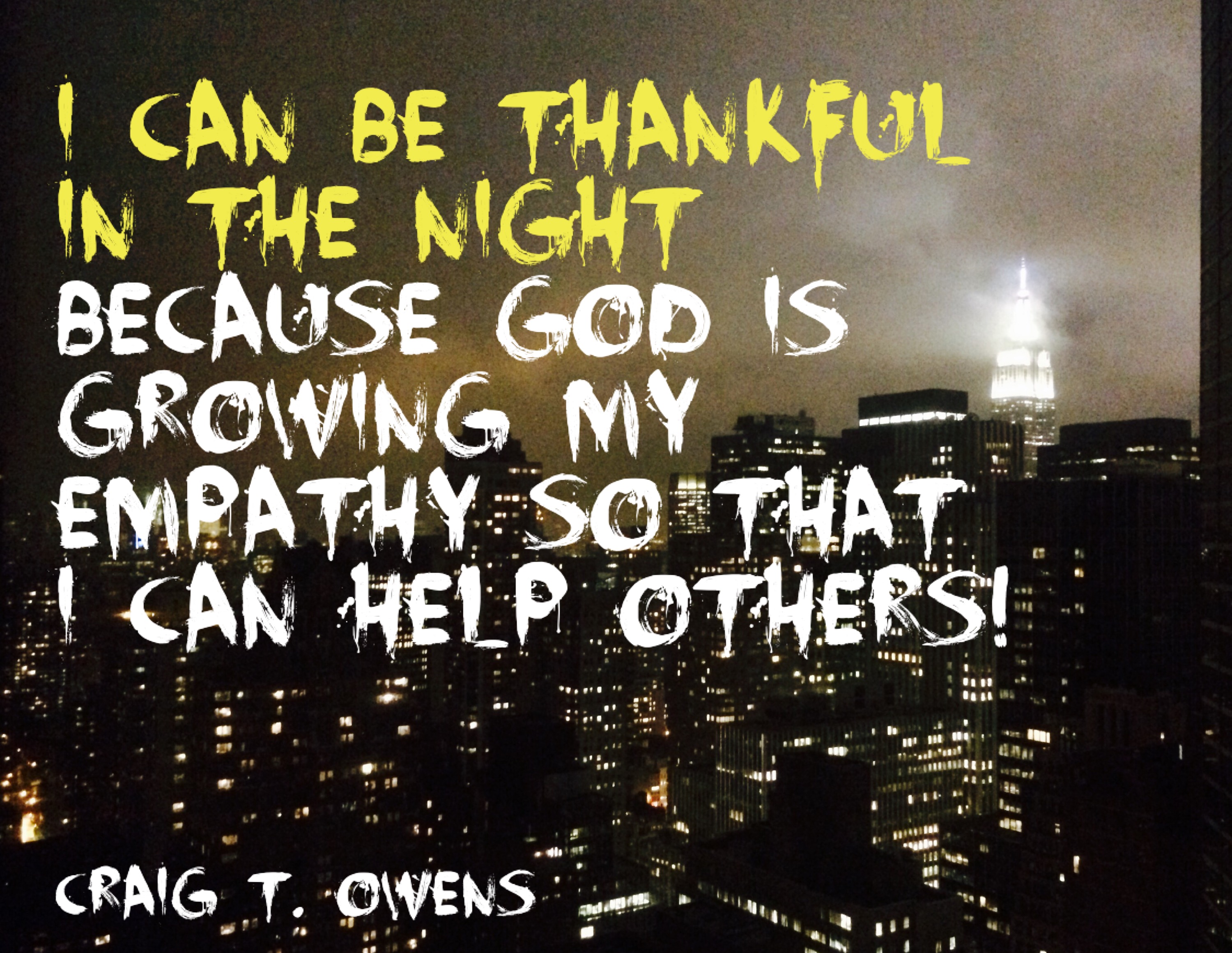
You cannot truly empathize until you go through your own dark night. I can be thankful IN the night because God is growing my empathy so that I can help others!
A mark of a maturING saint is one who when he realizes he is in a trough begins to praise God in anticipation of the blessings which are coming! Even the most mature Christian you know hasn’t “arrived”; we are all a work-in-progress. Going through the dark nights is one way God helps mature our understanding of contentment.
You know the differences between a need and a want: a need is something vital, something I require to survive; a want is something that would be nice to have.
In good times I can convince myself that my wants are really the same as my needs. In the bright, sunny times a lot of wants mistakenly get called needs. But in the dark nights, this confusion is quickly clarified!
In Philippians 4, Paul explains what he has learned about needs as he went through some very challenging, dark times. When he says he knows what a need is, he isn’t exaggerating a bit (see 2 Corinthians 11:24-28). And yet the Amplified Bible has Paul saying, “Not that I am implying that I was in any personal want.”
That’s because Paul was learnING contentment. The verb tense here means I have learned, I am learning, and I will keep on learning. It was an ongoing process that helped him clarify needs from wants. The word Paul uses for content is unique in all the New Testament and it means independent of external circumstances, or as the Amplified Bible says, “satisfied to the point where I am not disturbed or disquieted in whatever state I am.”
Paul uses another unique word in verse 12 when he says “I have learned.” This is a different Greek word from the previous verse. This time it means disciplined by experience to know how to respond. In other words, Paul disciplined himself to reflect on the lessons he learned in the night. The cliche “Experience is the best teacher” isn’t necessarily true. Lots of people go through experiences and never learn a single thing. Instead, we should say, “Evaluatedexperience is the best teacher.” That’s exactly what Paul is saying here: “I have learned lessons in my time of meditation after going through a dark night.”
The English dictionary defines contentment in two important phrases:
Satisfied with what I have. In Psalm 16, David learned that he had everything he needed in God, and Jesus reminded us that “your Father knows what you NEED before you ask Him” (Matthew 6:8).
Satisfied with who I am. Paul knew that “God, who set me apart from my mother’s womb and called me by His grace, was pleased” (Galatians 1:15). God made Paul on purpose and for a purpose, and Paul was satisfied with who he was in Christ. God made you on purpose too!
Our relationship with Jesus is a maturING one. It’s only IN Christ that I can be satisfied with what I have, and satisfied with who I am. It’s only IN the night that my wants get separated from my needs, by learnING contentment.
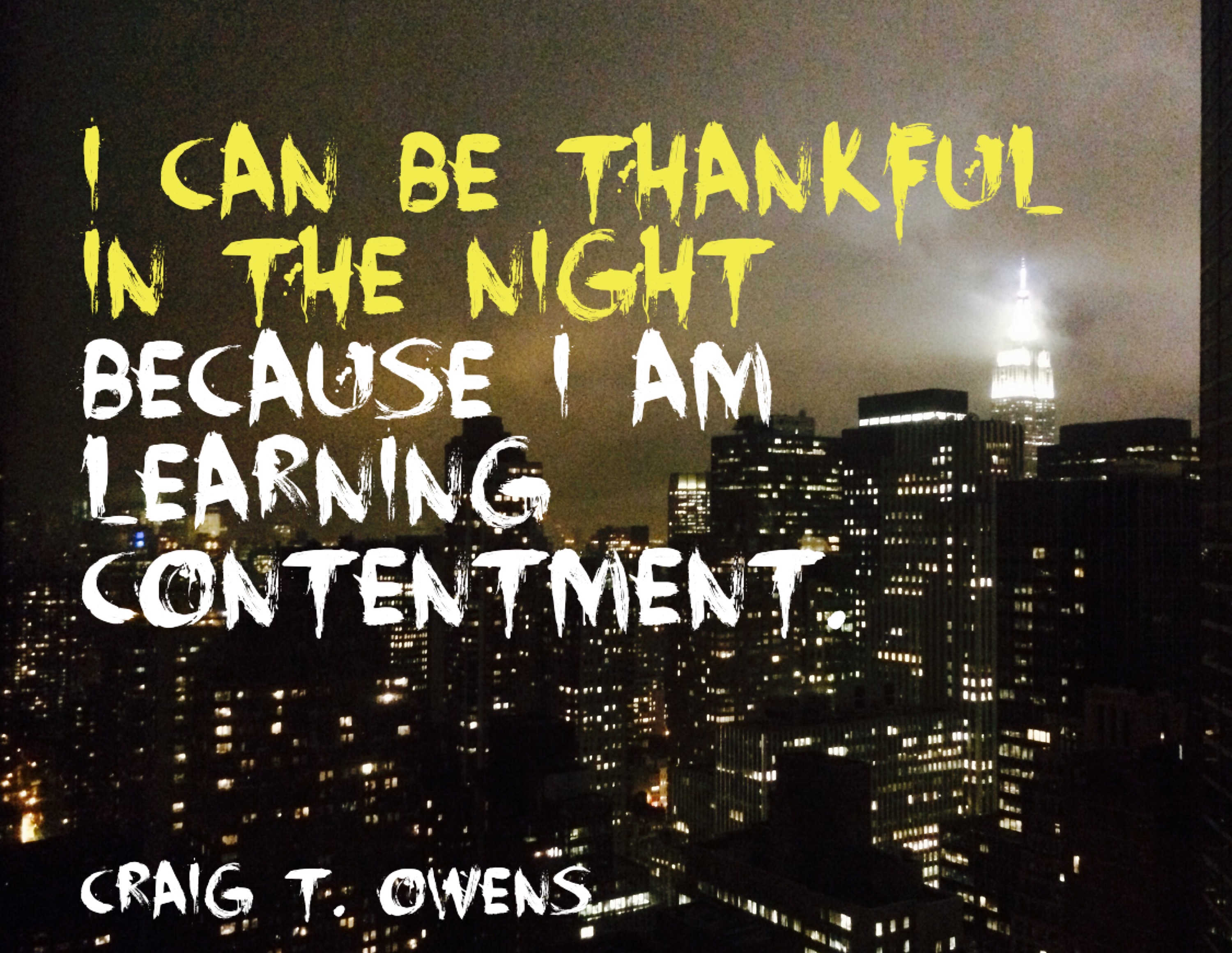
I can be thankful in the night because I am learning contentment.
how to get in the drawing for a special monthly prize
helping wounded veterans stay on the move through the Oscar Mike organization
some astounding stats about our veterans
how we can best show gratitude to our veterans
Greg and I share some cool stories of our interactions with veterans
some insights into true sacrifice
Check out this episode and subscribe on YouTube so you can watch all of the upcoming episodes. You can also listen to our podcast on Spotify and iTunes.



 On this episode of “The Craig And Greg Show” we talk about: