9 More Quotes From “So Send I You”

So Send I You is a collection of lectures Oswald Chambers delivered to students who felt a call to missions work. But Chambers made clear that every Christian is a missionary—“A missionary and a Christian ought to be one and the same.” Here are a few more quotes from this challenging book.

“It is God who saves men; we have to do the discipling after they are saved.”

“Our Lord calls to no special work; He calls to Himself. Pray to the Lord of the harvest, and He will engineer your circumstances and send you out.”

“Our Lord’s word ‘go’ simply means ‘live,’ and Acts 1:8 describes the ‘going.’ Jesus did not say to the disciples—‘Go into Jerusalem, go into Judea, go into Samaria, go into the uttermost part of the earth’; but—‘You shall be My witnesses’ in all these places: He undertakes to establish the goings. So many people are obsessed with this idea—‘What are you going to do?’ I hope none of us are going to do anything: I hope we are going to be what He wants us to be.”

“We adapt the New Testament to suit our own ideas; consequently we look on Jesus Christ as One Who assists us in our enterprises. The New Testament idea is that Jesus Christ is the absolute Lord over His disciples.”

“One way in which satan comes as an angel of light to Christians today is by telling them there is no need to use their minds. We must use our minds; we must keep the full power of our intellect ablaze for God on any subject that awakens us in our study of His Word.”

“Unless the missionary knows God and trusts in Him entirely, he will step down to a lower level and compromise, and tell the people they need not do certain things in exactly the way that Jesus indicates. But if he stands true to God, he will preach the truth, at whatever cost to the converts. No nervous system can stand that strain, no sensitiveness of mind can stand that test, nothing but the Holy Ghost can stand it, because He has the mind of God.”

“Loyalty to the commission [see Matthew 28:19-20] means, first of all, that the missionary sets himself to find out all that his Lord taught. There is not a greater test for loyal concentration than that. Jesus did not say—‘Teach salvation,’ or ‘teach sanctification,’ or ‘teach divine healing,’ but—‘Teach whatsoever I have commanded you.’ … A missionary is not sent by Jesus Christ to do medical work, educational work, industrial work; all that is part of the ordinary duty of life, and a missionary ought to be so equipped that he does these things naturally. But Jesus Christ never sends His disciples to do these things; He sends His disciples to teach, to ‘make disciples of all the nations.’”

“God does not do anything with us, only through us; consequently the one thing God estimates in His servants is the work of the Holy Spirit.”

“The real center of the disciple’s devotion is watching with Jesus [see Matthew 26:38]. When once we have learned to watch with Him, the thought of self is not kept down because it is not there to keep down; self-effacement is complete. Self has been effaced by the deliberate giving up to another self in sovereign preference, and the manifestation of the life in the actual world of things is—‘I am not my own, but His.’”

My full book review of So Send I You is here, and you can check out the first set of quotes I shared from So Send I You by clicking here. And be sure to check out my weekly series “Thursdays With Oswald” where I share longer passages from his book I am currently reading.

Book Reviews From 2017

I love reading, and I love sharing my love of good books with others! Here is a list of the books I read and reviewed in 2017. Click on a title to be taken to that review.

#Truth

10 Commitments For Dads

50 Core American Documents

A New Kind Of Apologist

Absolute Surrender

As Kingfishers Catch Fire

Born After Midnight

Brady vs. Manning

Cherish

Everything You Always Wanted To Know About God

Evidence That Demands A Verdict

How Great Is Our God

If

Interpretation Of The Scriptures

Islam Booklets

Joy To Your World

Know Who You Are

Leadership Promises For Every Day

Live Dead Journey

Live Dead Life

Longing For A Changed World

Man—The Dwelling Place Of God

Marching Off The Map

No Limits

On Calvary’s Hill

Ordering Your Private World

Paths To Power

Peace In The Face Of Cancer

Prevailing Prayer

Run Today’s Race

Seeing Jesus

Shade Of His Hand

Take Your Life Back

The Broken Way

The Christian Book Of Mystical Verse

The Christian In Complete Armour

The Christmas Candle

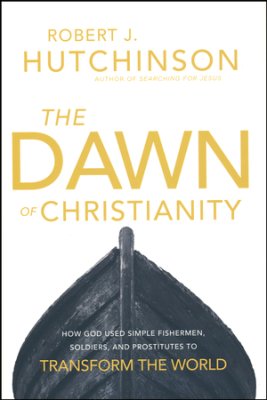
The Dawn Of Christianity

The Servant As His Lord

The World’s Last Night

Transforming Grace

When A Nation Forgets God

Your Next 24 Hours

Here are my book reviews for 2011.

Here are my book reviews for 2012.

Here are my book reviews for 2013.

Here are my book reviews for 2014.

Here are my book reviews for 2015.

Here are my book reviews for 2016.

3 Apologetics For Your Christian Hope

There was a story circulating that a physicist once claimed that the bumblebee was defying the laws of physics and aerodynamics in its flight. Apparently, he calculated that the ratio of the bumblebee’s wing size in comparison to his body size just didn’t make the math work.

But entomologists and physicists quickly jumped in to say, “Hey, look, the bumblebee is flying, so clearly it works!” And then they went to work to try to explain it. They figured out that the bumblebee flaps its wings more back-and-forth than up-and-down, creating tiny hurricanes the propel them through the air. But then that created a whole new set of problems, like how does the bumblebee control a hurricane so precisely as it turns, stops, dives, and climbs. So then they had to create a new explanation, which they named dynamic stall.

All the while, the bumblebee is flapping its too-small wings 230 times per second(!), and going about its daily activities without being able to explain tiny hurricanes, the laws of physics or aerodynamics, or even knowing what dynamic stall is. It simply flies!

The ultimate argument for anything is doing something that critics say is impossible.

Peter tells Christians to be prepared to answer anyone for the reason for the hope that they have (1 Peter 3:15-16). The Greek word for “give an answer” is apologia, from which we get our word apologetic. Here are three apologetics for Christians to use for the hope that they have.

It really comes down to this: My hope is based on the resurrection from the dead of Jesus Christ, which I believe because of the Bible AND because of the change in my life.

  1. The Bible’s authenticity

“No other work in all literature has been so carefully and accurately copied as the Old Testament. The particular discipline and art of the Jewish scribes came out of a class of Jewish scholars between the fifth and third centuries BC. They were called the Sopherim, from a Hebrew word meaning ‘scribes.’ The sopherim, who initiated a stringent standard of meticulous discipline, were subsequently eclipsed by the Talmudic scribes, who guarded, interpreted, and commented on the sacred texts from AD 100 to AD 500. In turn, the Talmudic scribes were followed by the better-known and even more meticulous Masoretic scribes (AD 500-900).” —Josh McDowell, God-Breathed

“No other ancient text is substantiated by such a wealth of ancient textual witnesses as is the New Testament. Roughly 5,500 separate manuscripts are available, variously containing anything from the entire New Testament corpus to a slight fragment of a single verse. … This textual support is far superior to that available for any other ancient documents, such as the classical texts from Greek and Roman writers (e.g., Plato, Aristotle, and Cicero). Only partial manuscripts have survived for many works of antiquity, and it is not unusual to find that the only complete manuscript for some ancient writing is a copy dating from 1,000 years after its composition.” —Archaeological Study Bible, “The New Testaments Texts” (page 1859)

“The biblical Dead Sea Scrolls are up to 1,250 years older than the traditional Hebrew Bible, the Masoretic text. We have been using a one-thousand-year-old manuscript to make our Bibles. We’ve now got scrolls going back to 250 BC. … Our conclusion is simply this—the scrolls confirm the accuracy of the biblical text by 99 percent.” —Dr. Peter Flint

I have shared other apologetic evidence for the authenticity of Scripture here and here.

  1. Christ’s resurrection 

In 1 Corinthians 15:1-8 Paul lists all of the eyewitnesses to Christ’s resurrection, giving critics ample opportunity to challenge these witnesses in person. If these witnesses would have been perpetrating a hoax, skeptics of their day would have been able to uncover the inconsistencies in their story. If the account of Christ’s resurrection was made-up, it’s doubtful the early Christian martyrs would have “stuck to their story” as they were being tortured, but none recanted.

Josh McDowell notes, “By AD 100, the apostles had died, but the Christian Church was still in its infancy, with fewer than twenty-five thousand proclaimed followers of Christ. But within the next two hundred years, the fledgling church experienced explosive multiplication of growth, to include as many as twenty million people. This means the church of Jesus Christ quadrupled every generation for five consecutive generations!

  1. My personal experience

“I am a changed person. I am not who I was before I met Jesus” and “My life tends to go better when I live by biblical principles” are both excellent apologetics!

Let others argue that God doesn’t exist, or that you shouldn’t have hope, and then you—like the bumblebee—just keep flying with Jesus! (see 2 Timothy 3:14)

If you’ve missed any messages in this series, you may find the complete list by clicking here.

What Is The Church Supposed To Be Doing?

Listen to the podcast of this post by clicking on the player below, and you can also subscribe on AppleSpotify, or Audible.

Before ascending back to Heaven, Jesus commissioned His followers. He gave them a mission that Christians often refer to as The Great Commission.

Jesus said, “All authority in heaven and on earth has been given to Me. Therefore go and make disciples of all nations, baptizing them in the name of the Father and of the Son and of the Holy Spirit, and teaching them to obey everything I have commanded you. And surely I am with you always to the very end of the age.”

There are several pictures in the New Testament of how the Church could live out this Great Commission, but one of the pictures that I find the most helpful is that of a Body.

The human body is an amazing creation! Just to accomplish the simple task of picking up something between our thumb and forefinger is a miracle in itself. The structure of bones and ligaments and tendons, the interaction of nerves in the fingers coordinating with the optical nerve, not to mention the enzymes and blood vessels that are all doing their part.

Yet if any part is not functioning properly, that simple action becomes more difficult. Maybe it even becomes impossible.

The Church is the same way. Every part of the Church Body has to be functioning in healthy order for the whole Body to be effective.

Here are four aspects of a healthy Church Body that the Apostle Paul lists in Ephesians 4:

  1. Caring for one another
  2. Mobilizing for evangelism
  3. Making disciple-makers
  4. Helping organize for more meaningful ministry

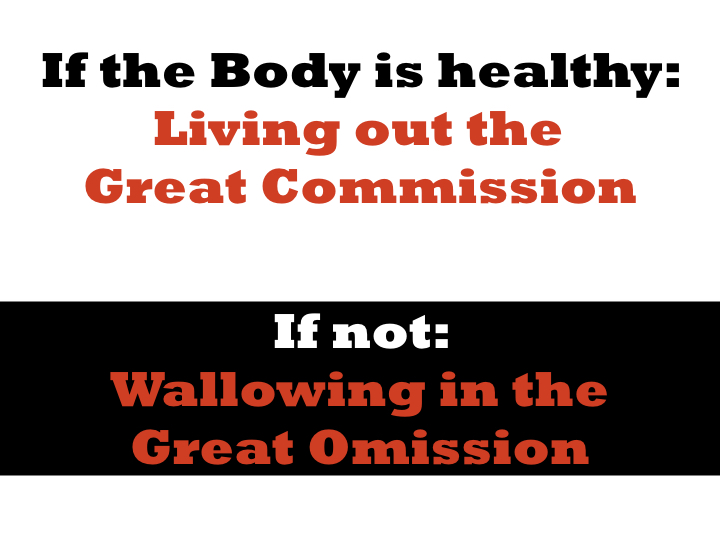
If every part of the Body is doing its part, we’re Living out the Great Commission.

If some parts are missing or unhealthy, we’re Wallowing in the Great Omission.

It’s not about your church (small “c”) or my church. It’s about all Christian disciples being a part of one Church—one Body—going into all the world and making disciples of all peoples. That’s what the Church is supposed to be doing!

►► Would you please prayerfully consider supporting this ministry? My Patreon supporters get behind-the-scenes access to exclusive materials. ◀︎◀︎

The Q Series—The Bible

Our annual Q Series is where folks send their questions to me on a variety of subjects and we do our best to answer them. This week many of the questions were about the Bible. Questions like:

  • What books should be included in the Bible?
  • What about Bible translations?
  • Is it okay for the Bible to have pictures in it?

Here’s what we discussed, along with the time this discussion appears on the video:

  • How was it decided what books would be included in the New Testament? [5:38] **Be sure to check out this post: How We Got The Bible on Biblegateway.
  • J. Warner Wallace’s list of criteria for New Testament books [9:45]
  • Did contemporary sources support or refute the New Testament authors? [11:45]
  • How did the final 27 books of the New Testament make the list? [15:02]
  • How was it decided what books would be included in the Old Testament? [18:22]
  • Evidence presented by the Apostle Paul [20:31]
  • How do we know the Scriptures were accurately transcribed? [22:50] **Be sure to check out this post: Why Trust The Bible? on Biblegateway.
  • The history surrounding the complete Latin Bible and the Dead Sea Scrolls [23:45]
  • What are Bible translations and paraphrases (with references to the Wycliffe Bible and the discovery of the Rosetta Stone)? [25:45]
  • Some cautions about Bible paraphrases [33:23]
  • Is it okay for a Bible to have pictures in it? [35:16]
  • Are icons of the Cross acceptable or a blasphemy? [37:42]
  • How can someone better understand the Bible when they read it for themselves? [41:32]
  • Why ask questions? [48:39]

We’ll be discussing more questions this upcoming Sunday, so be sure to send them my way. For all of the ways you can send questions, please click here.

The Cure For Spiritual Fanaticism

“Some time after Pentecost a group of believers met to pray for strength and power to meet the emergency then facing them, and to enlist the help of God on their behalf. ‘And when they had prayed, the place was shaken where they were assembled together; and they were all filled with the Holy Ghost, and they spake the Word of God with boldness’ (Acts 4:31). Some of these were of the original number filled at Pentecost. It is hardly conceivable that God acted contrary to His own will in filling them again after Pentecost. Still other outpourings are recorded in Acts 8, Acts 10 and Acts 19. All these occurred some years after the original act.

“In brief, the teaching of the New Testament is that the outpouring at Pentecost was the historic beginning of an era which was to be characterized by a continuous outpouring of the Holy Spirit. …

“This anti-emotionalism, though it is sponsored by some good people and travels in pretty orthodox company, is nevertheless an unwarranted inference, not a scriptural doctrine, and is in violent opposition to psychology and common sense. Where in the Bible are feeling and faith said to be at odds? The fact is that faith engenders feeling as certainly as life engenders motion. We can have feeling without faith, it is true, we can never have faith without feeling. Faith as a cold, unemotional light is wholly unknown in the Scriptures. …

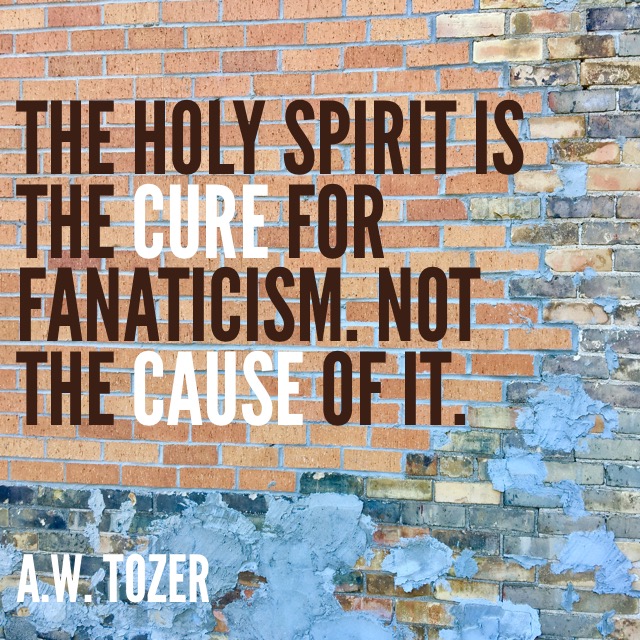
“The Holy Spirit is the cure for fanaticism. Not the cause of it.”

—A.W. Tozer, in Paths To Power

8 Quotes From “Paths To Power” by A.W. Tozer

As I said in my book review, A.W. Tozer’s words frequently make me say both “Ouch!” and “Amen!” Maybe you’ll feel the same thing in these few quotes.

“Left to herself the Church must have perished as a thousand abortive sects had done before her, and have left nothing for a future generation to remember. That the Church did not so perish was due entirely to the miraculous element within her. That element was supplied by the Holy Spirit who came at Pentecost to empower her for her task. For the Church was not an organization merely, not a movement, but a walking incarnation of spiritual energy. …

“In short, the Church began in power, moved in power, and moved just as long as she had power. When she no longer had power she dug in for safety and sought to conserve her gains. But her blessings were like manna: when they tried to keep it overnight it bred worms and stank. So we have had monasticism, scholasticism, institutionalism; and they have all been indicative of the same thing: absence of spiritual power.” 

“The weakness in our message today is our overemphasis on faith with a corresponding underemphasis on obedience. This has been carried so far that ‘believe’ has been made to double for ‘obey’ in the minds of millions of religious persons.”

“In every denomination, missionary society, local church, or individual Christian this law operates. God works as long as His people live daringly; He ceases when they no longer need His aid.” 

“To any casual observer of the religious scene today, two things will at once be evident: one, that there is very little sense of sin among the unsaved, and two, that the average professed Christian lives a life so worldly and careless that it is difficult to distinguish him from the unconverted man.”

“It is always dangerous to isolate a truth and then press it to its limit without regard to other truth.”

“It may be stated as an axiom of the Christian system that whatever makes sin permissible is a foe of God and an enemy of the souls of men.”

“Some time after Pentecost a group of believers met to pray for strength and power to meet the emergency then facing them, and to enlist the help of God on their behalf. ‘And when they had prayed, the place was shaken where they were assembled together; and they were all filled with the Holy Ghost, and they spake the Word of God with boldness’ (Acts 4:31). Some of these were of the original number filled at Pentecost. It is hardly conceivable that God acted contrary to His own will in filling them again after Pentecost. Still other outpourings are recorded in Acts 8, 10 and 19. All these occurred some years after the original act.

“In brief, the teaching of the New Testament is that the outpouring at Pentecost was the historic beginning of an era which was to be characterized by a continuous outpouring of the Holy Spirit.”

“This anti-emotionalism, though it is sponsored by some good people and travels in pretty orthodox company, is nevertheless an unwarranted inference, not a scriptural doctrine, and is in violent opposition to psychology and common sense. Where in the Bible are feeling and faith said to be at odds? The fact is that faith engenders feeling as certainly as life engenders motion. We can have feeling without faith, it is true, we can never have faith without feeling. Faith as a cold, unemotional light is wholly unknown in the Scriptures.”

6 Quotes From “The Dawn Of Christianity”

Robert J. Hutchinson makes the history around the birth, life, death, and resurrection of Jesus, as well as the history of Christ’s followers after His resurrection, come to life in The Dawn Of Christianity. Check out my full review by clicking here.

“Skeptics make much of the fact that historians have no independent corroboration from outside sources of most of the events described in the Gospels, but this is common with ancient history and hardly unique to Christianity. For example, virtually everything historians know about the Three Hundred, the Spartan warriors who held off a Persian invasion at the mountain pass of Thermopylae in 480 BC, comes from the writings of a single Greek author, Herodotus. What’s more, the earliest copy historians have of Herodotus’s chronicle of this event, The Histories, dates to the tenth century AD—or more than 1,350 years after it was written! In comparison, historians have a cornucopia of historical sources and archaeological evidence about Jesus of Nazareth and the early Christian community. For example, more than fifty papyrus manuscripts of New Testament texts exist that date before AD 300. The earliest of these manuscripts, a papyrus fragment from the Gospel of John known as P52, dates to around AD 125 or just thirty years after the original was likely written.”

“Around 20 BC, the half-Jewish King Herod the Great set himself the task of renovating and expanding the temple and surrounding area. There had been a small natural plateau there before, fixed atop the ridge in the northeastern corner of Jerusalem; but Herod wanted something far more spectacular. He therefore enclosed this natural plateau on all sides with four immense retaining walls, some more than one hundred feet high, made up of massive rectangular ashlars, or cut stones, that weighed as much as 415 tons each. These stones are so large that even modern cranes and bulldozers would have some difficulty moving them. Herod then filled in this entire quadrangle with stones and dirt, creating an artificial hilltop plaza—roughly 1,500 feet long by 1,000 feet wide—of more than thirty-five acres. In modern terms, Herod’s Temple Mount is so large that about twenty-six American football fields could fit in the space available. This massive engineering marvel has endured for two thousand years and still stands today, almost wholly intact.”

“Simon the Rock continued to loudly protest that he was willing to die, if need be, but would never deny Jesus. The other disciples said the same. This is one of those incidents that even many skeptics believe must be historical under the ‘criterion of embarrassment,’ which means that the Christian community was unlikely to invent a story that cast such a bad light on its leaders; therefore, it must have actually happened.” 

“Recent archaeological discoveries are showing that the New Testament in general, and the Gospels in particular, are far more reliable historical sources than previous generations of New Testament experts realized.”

“All four Gospels report that this board, what the Romans called the titulus, held the inscription ‘The King of the Jews.’ John’s Gospel alone reports that Jesus’ name was also on the titulus, ‘Jesus of Nazareth, the King of the Jews,’ and that it was written in Hebrew, Latin, and Greek (19:19-20). In Latin the charge read Iesus Nazarenus Rex Iudaeorum, which is why, to this day, the letters INRI appear at the top of crucifixes.”

“In 1968, archaeologists uncovered a first-century tomb at Giv’at ha-Mivtar, northeast of Jerusalem. Inside the tomb they found in ossuary containing the skeleton of a crucified man—the first and only relic of a crucified man found in Israel. Inscribed on the ossuary was his name in Hebrew: Yehochanan. On top of the bone of his right heel was a wooden board, and through the board, and his heel, was a 4.5-inch iron nail.”

New Name = New Nature

All throughout the Old Testament we find hints about Jesus. Then as the New Testament dawns, the brilliant light of Jesus makes sense of all the hints we had previously seen.

One of the way God hints at the arrival of Jesus and what He would do for mankind is found in the names of people. Hebrew names are interesting things. Sometimes they are quite literal. For instance…

    • A baby who was born at one of Israel’s lowest points was named Ichabod = God’s glory has departed.
    • A baby who was born with quite a lot of hair was named Esau = hairy baby.
    • Esau’s twin brother was hanging on to his heel when he was born, so they named him Jacob = the one who grabs the heel.

At other times God tells parents what to name their babies before they are born. These names tell a story in themselves of what is coming…

    • After a time of upheaval in Israel’s history, God directed the parents to give their son two names: Solomon (which means peace) and Jedidiah (which means beloved by God). This brought reassurance to the parents and to the country.
    • When God was about to bring a quick answer to a problem, He directed the parents to name their son Maher-Shalal-Hash-Baz, which means God will bring the reward sooner than you think.

But what is most interesting to me is when God changes someone’s name to reflect the new nature in their life.

Abram’s name meant exalted father, but God changed his name to Abraham, which means father of a multitude. His wife’s birth name was Sarai (princess) and it was changed to Sarah (a noble woman).

In these name changes, two things happened (see Genesis 17:1-15):

  1. God put His own name into theirs. God’s name means I AM. We sometimes pronounce it Yahweh, but that is only a guess since the Jews wrote His name without the vowels. That means His name was the unpronounceable YHWH, sort of a breath-sound. So Abram became Abrahaaam and Sarah became Saraaaaah. 
  2. God took the burden off them and put it on Himself. It was no longer Abram’s responsibility to become an exalted father, or Sarai’s responsibility to make herself a princess. God said, “Only with Me in you can you become who I want you to be!”

As you follow Abraham and Sarah’s descendants, you will see time and time again God reminding people: You can’t do it on your own. You must have Me in you in order to live the life I have for you!

Hoshea was born as an Israelite slave in Egypt, yet his parents gave him this name that means deliverer. Before God could use Hoshea to bring the Israelites into the Promised Land, He first changed his name to Joshua, which means God is the ultimate deliverer.

Joshua in the BC Hebrew language is the same as Jesus in the AD Greek language.

Jesus Christ is the ultimate example of being able to fully deliver people not just from physical slavery, but from the eternal consequences of sin. Man cannot save himself, but Jesus Christ can.

That’s why when you surrender to Christ and allow Him to be your Lord and Master, He puts His name in you: CHRISTian! A new name, and a brand new nature because of what it means to have Christ in you.

Check out this video where I explain the cool story behind more name changes—

Does Your Life Have A “BC/AD” Split?

Today we live in 2017 AD. But 1800 years ago the A.D. stood for “Anno Diocletiani” which means “the year of Diocletian,” a ruthless, anti-Christian Roman emperor. In 525 AD, a monk named Dionysius proposed changing the A.D. to “Anno Domini” which means “the year of our Lord,” referring to the Advent of Jesus Christ. Then to mark the dates of the calendar before Christ’s birth properly, the “B.C.” (before Christ) period was introduced.

But BC/AD is just a dating system. There is no such thing as “BC”—there has never been a time before Christ! He has always been! Throughout what we now refer to as the Old Testament (or the BC period),  Jesus is constantly revealing Himself through little hints here and there, but when He comes to earth as a Man, all the hints become a bright, blazing, unmistakable Truth!

Just like Dionysius came up with a new dating system based on the Advent of Jesus, the Israelites had a new starting point marked by the Passover (see Exodus 12:1-7). Everything from this point backward is reset and dates are now counted forward from this moment. Before this time they were slaves in Egypt; after this time they were free and called God’s special people.

The “BC” Passover had three important components:

  • A perfect lamb without any defect (Exodus 12:5)
  • The lamb is slaughtered at twilight (v. 6)
  • The blood is applied to the door (v. 7)

When Jesus came to Earth, He showed how He was all three of those elements. In the “AD” Jesus is—

In both BC and AD God declares the same message: “When I see the blood, I will pass over you.” The blood seals the deal and brings God’s forgiveness of sins, and His blessings on the life that is now completely His.

The word remember appears frequently in the BC, as in “remember what God did for you.” In the AD remember appears at a pivotal time—when Jesus shared His last supper with His followers, He told them that Communion would be a time for them to remember all that Jesus did for us as the Perfect Lamb, whose Blood is applied to the Door of our heart, so that God’s judgment could pass over us.

Do you have a Passover date? A time when the BC became AD in your life? If so, good! Keep remembering that, and don’t ever go back to being a citizen of anything but God’s Kingdom.

If not, today can be the first day of a new era for you. By faith you can apply the Blood of the Perfect Lamb to the Door of your heart, and you will no longer be a slave of “Egypt” (a picture of being utterly trapped and unable to help yourself), but a citizen of Heaven! All it takes is for you to believe that Christ’s blood purchased your freedom, so you can ask God the Father to forgive you of all your BC past, and then you can live forever in the AD with Jesus as your Savior and Master!

Check out this video where I explain this BC/AD system more, and join me next week as we learn more about how Jesus Christ bridges the BC/AD divide.