When biblical authors use repetition or parallelism, it’s important to take note. They are wanting to make sure their message is heard loud and clear. They want what they’re sharing to stand out from everything around it. This is sort of how we would use bold or italics, a different colored font, or even a LARGER FONT to make something stand out.
In this Psalm…
…the Lord is clothed in majesty and strength
…He is established, immovable, everlasting, from time immemorial, firm, unshakeable
…“God ismightier than the thunder of the great waters, mightier than the breakers of the sea—the Lord on high is mighty”
…His Word is very sure, lasting forever, holy, unchangeable, endless
The bottom line—
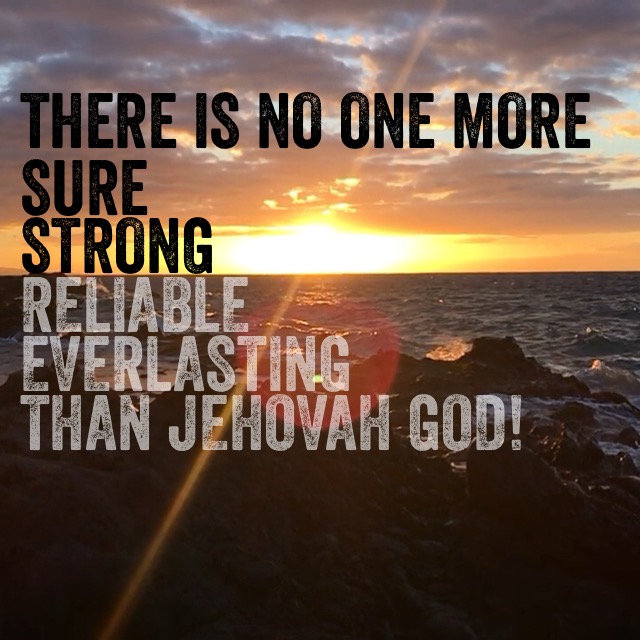
There is no one more sure, strong, reliable, and everlasting than Jehovah God!
This is a weekly series with things I’m reading and pondering from Oswald Chambers. You can read the original seed thought here, or type “Thursdays With Oswald” in the search box to read more entries.
Using The Sword For Good And Not Harm
The priest replied, “The sword of Goliath the Philistine, whom you killed in the Valley of Elah, is here.…” David said, “There is none like it; give it to me.” (1 Samuel 21:9)
Now it seems quite obvious that if you are not David and are trying to use Goliath’s sword, you will do far more harm to yourself than damage to the enemy. You must be in the direct line of succession to David. … What is the same family connection in this dispensation? Why, those who are born again of the Spirit of God, and those who are so identified with the Lord Jesus that they have entered into the experience of entire sanctification. When they use the Word of God they do not damage themselves, nor hurt other souls; but they do great damage to the kingdom of the devil and bring benefit to the souls of men. …
The Christian worker must rely on the Holy Spirit to direct them as to what to say in the case of every soul that comes. Do not rely on your memory, do not remember how you dealt with cases in the past, but recognize and rely on the Holy Spirit that He will bring to your remembrance the particular verse for you to apply at this time. … Beware of anything that does not fling you straight back in reliance on the Holy Spirit as the most practical factor you know in bringing it to your remembrance the Word of God and how to apply it. …
For the word of God is living and powerful, and sharper than any two-edged sword, piercing even to the division of soul and spirit, and of joints and marrow, and is a discerner of the thoughts and intents of the heart. (Hebrews 4:12)
A remarkable thing about this Book of God is that for every type of human being we come across there is a distinct, clear line laid down here as to the way to apply God’s truth to it.
From Workmen Of God
If Christians are going to help others, they have to start with helping themselves. They do this by immersing themselves in the Word of God and allowing the Holy Spirit to show them how to live out the biblical principles. This equips us to help others.
Then when someone in need comes to us, don’t be too quick to draw your spiritual sword. Listen to them and listen to the Holy Spirit. The Spirit of God can direct you to the right Word of God for that person’s need. This is the only way to use the sword of the Spirit in a way that will help others, glorify God, and make you unashamed before God of your conduct.
When I was growing up and struggling with a problem, my Mom would always challenge me with one simple question—“Have you prayed about it?”
This is a great question because it helps us keep the main thing the main thing.
Typically we have three substitutes for prayer—
(1) Ignoring the problem. We’re like the board of directors that was facing falling sales and falling profits, but their solution was to just wait for something magical to happen.
(2) Talking about the problem. Christians often call this “a prayer request.” We take 10 minutes to give our friends all the gory, depressing details of our situation and oftentimes say “please pray for me” as we walk away. Solomon said, “Talk is cheap, like daydreams and other useless activities” (Ecclesiastes 5:7).
(3) Working to solve the problem. This isn’t in the Bible, but many times we act as if it is: God helps those who help themselves. Instead, God wants us to call on Him so He can reveal things to us (see Jeremiah 33:3).
Something that is in the Bible is this: “Ask whatever you wish, and it will be done for you.” But there is a condition for this, and it’s the part of the sentence that comes before the asking that makes all the difference—
If you remain in Me and My words remain in you, ask whatever you wish, and it will be done for you (John 15:7).
Oswald Chambers said, “We are apt to think of prayer as a common-sense exercise of our higher powers in order to prepare us for work; whereas in the teaching of Jesus, prayer is not to fit us for the ‘greater works,’ prayer is the work. Prayer is…the means whereby we assimilate more and more of His mind, and the means whereby He unveils His purposes to us.”
Prayer IS the work!
We don’t ignore the problem, and we don’t just talk about the problem. But neither do we pray and then work on the problem. Prayer is the work!
It can’t be stated enough: Prayer doesn’t prepare us to work, prayer IS the work.
Even the Apostle Paul identified this in his teaching on spiritual warfare. In language similar to what Jesus said in John 15:7, Paul says, “Be strong IN the Lord and IN His mighty power. Put on the full armor of God SO THAT you can take your stand against the devil’s schemes” (Ephesians 6:10-11).
Paul doesn’t tell us to ignore the devil’s schemes, nor does he tell us to talk about them. But neither does he tell us to put on God’s armor to fight against the devil’s schemes. He tells us to put on the armor of God so that we can pray (see Ephesians 6:18-20).
The armor of God is NOT to fight in, but to shield us while we pray!
PRAYER IS THE BATTLE … PRAYER IS THE WORK
When you are facing a difficulty, don’t ignore it, don’t just talk about it, and don’t go to work fighting it. Listen to the Holy Spirit asking you, “Have you prayed about it,” and then drop to your knees and PRAY!
This principle is illustrated so wonderfully in the life of David. We’ll be looking at David’s prayers over the next few weeks, and I hope you will join me in learning that prayer is the battle!
A psalm. A song for the Sabbath day (preface to Psalm 92).
The Sabbath is—
a day of reflection
a day of rejoicing
a day of reconnecting
a day of meditating on past blessings
a day of strengthening for the upcoming week
a day of acknowledging the Creator
a day of appreciating creation
a day of assessing the investment of my God-given talents
a holy day—different from all other days
So … “It is good to give thanks to the Lord, and to sing praises to Your name, O Most High; to declare Your lovingkindness in the morning, and Your faithfulness every night” (vv. 1, 2).
Sabbath is not just a noun, but a verb—sabbathing—something that can be done every day, but something which also takes on special significance for the one day each week that we set aside as our holy day or worship and reflection.
The Creator’s works and wisdom should be pondered and praised as we sabbath (vv. 4-6), something “a fool” doesn’t take time to do.
As we sabbath, we should confess to God—and then turn over to Him—those things which have overly preoccupied our minds (vv. 7-9).
We should recommit that the place of growth and blessing is in God’s presence (v. 13) as we endeavor to keep our hearts there. And then we can be energized and joy-filled as we contemplate His blessing which never diminishes nor grows old (vv. 14, 15).
Truly sabbathing is a good thing!
Do you have a Sabbath day? Do you find time to regularly sabbath in God’s presence?
Jesus told His followers, “As the Father has sent Me, so send I you” (John 20:21). So Send I You by Oswald Chambers is a series of lectures to his students that were preparing to be missionaries. But, as Chambers makes perfectly clear, every Christian is a missionary.
Samuel M. Zwemer said about this book, “A preface or forward is scarcely needed to introduce the reader to this treasure-house of thought on missions. Those who have read other books by our friend, Oswald Chambers, know what to expect. A message not for superficial minds and hearts. Those who love to think on the kingdom and whose hearts the King has entered will not be disappointed as they read these pages.”
Truly this is not a book for superficial minds, as Chambers challenges Christians to look at life through the eyes of Jesus, to be on a mission just as Jesus was. His lectures are solidly founded on Scripture, showing us how Jesus intended His followers to conduct themselves.
If you are ready to be more used by God, then So Send I You is for you. You will be both challenged and encouraged and equipped to be a more effective disciple and missionary for Jesus Christ.
A lot of Christians struggle with what is considered “worldly,” trying hard to avoid such things. In our last Q Series, this was a question that was asked by a couple of people: what exactly makes something “worldly”? Check out this short video clip…
In the video I reference the following Scriptures:
I love reading, and I love sharing my love of good books with others! Here is a list of the books I read and reviewed in 2017. Click on a title to be taken to that review.
A little boy wanted to do something special for his family, so he thought he would do something he had seen his mother do dozens of times: bake a cake. Quickly he looked through a cookbook and got to work.
Dad was the first one to come home and heard an unusual clatter in the kitchen. Peeking around the corner he saw his son wearing his wife’s apron, slightly dusted in flour, and vigorously stirring a big bowl of batter.
“What are you doing, son” Dad asked.
Without looking up from his work the boy proudly answered, “I’m making a cake, Dad!”
Dad looked around the kitchen and saw all the proper ingredients out, so he was somewhat assured when he asked, “So how’s it going?”
The little boy paused and looked up at him, “Pretty good I think. I’m just having a little trouble with the ‘tbls” and ‘tsps.’”
For those of you who have done any baking, you know that “tbls” are tablespoons and “tsps” are teaspoons. If you get those mixed up, the cake might not turn out very well. For instance, adding a teaspoon of baking powder when the recipe calls for a tablespoon might result in a flat cake. Or adding a tablespoon of salt when the recipe asks for a teaspoon might making a rather salty cake.
Abbreviations only work if everyone is on the same page with you. If they’re not, it could be rather unsavory or maybe even dangerous.
In 1816, Joseph Mohr penned the words to what some have called the best-known Christmas carol in the world: Silent Night! Holy Night!
I’m not really sure how “silent” the night Jesus was born really was: a village so filled with people that no bedrooms were available, a mother in labor, a crying newborn, animals in a stable disturbed by the mother and child, singing angels, and curious shepherds. But let’s leave that part alone for a while.
Although it may not have been a silent night, it most assuredly was aHoly Night! That full title gives us the full impact of what happened at Christ’s First Advent.
Holy means something unlike anything else; someone or something devoted to God; something divine; something with God’s fingerprints all of it. I see at least three divinely holy things in this carol.
The virgin birth of Jesus.
Not only was the birth of Jesus a fulfillment of prophesy (see Isaiah 7:14 and Matthew 1:18-25), but it was also an indication of God’s miracle-working power. The fact the Luke gives so many specific details about that birth night (see Luke 2:1-2) also lets us know that this isn’t a “once upon a time” myth.
The involvement of angels in the affairs of humans.
Angels bring messages to key people before the birth of Jesus (Luke 1:11, 26; Matthew 1:20) and on the night of His birth (Luke 2:9-14). John also gives us a peek behind the scenes of the massive spiritual warfare taking place the night of Christ’s birth (see Revelation 12:1-5). Paul tells us that we, too, are involved in this spiritual battle, but that because of Christ’s Advent we’re more than conquerors through Jesus (Ephesians 6:12; Romans 8:37).
The full deity and the full humanity of Jesus.
Jesus was fully Man and fully God (see Philippians 2:5-7; Matthew 26:63-64; John 8:54-58). This is so important, because without this we would be lost. If Jesus wasn’t fully Man, He wouldn’t know how to help us; if He wasn’t fully God, He couldn’t help us.
So when you hear this carol playing, ask someone if they know the title. More than likely they will say, “Silent Night.” To which you can easily reply, “Actually it’s Silent Night! Holy Night! and I’d like to tell you three amazing, holy things that took place!”
Let’s never abbreviate away the miracles. It may or may not have been a Silent Night, but it most certainly was a Holy Night! These supernatural miracles surrounding Christ’s First Advent provided us freedom from sin, and a rock-solid hope of our eternal reward in Heaven at Christ’s Second Advent.
Have mercy … heal me … deliver me … save me … (Psalm 6:2, 4).
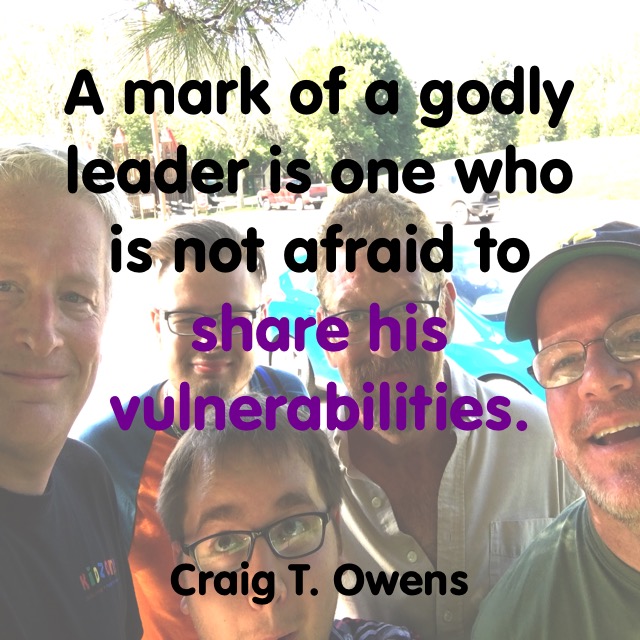
A mark of a godly leader is one who is not afraid to share his vulnerabilities.
David freely admits his fear of punishment, his need for God’s help, and his grief that robbed him of sleep.
But he also admitted just as freely his rock-solid assurance of God’s help:
The Lord has heard my weeping
The Lord has heard my supplication
The Lord will receive my prayer
Godly leaders are confidently transparent before God and before those around them. God delights in that transparency, and He delights to answer vulnerable prayers.
This is Part 17 in my series on godly leadership. You can check out all of my posts on this topic by clicking here.
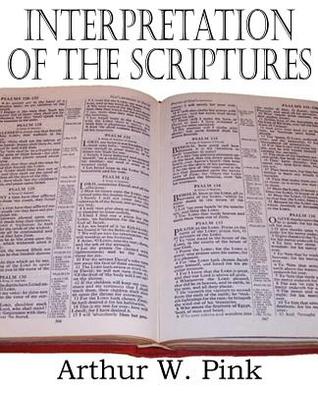
You don’t have to be a pastor to benefit from reading Interpretation Of The Scriptures by A.W. Pink, rather I think all students of the Bible will benefit from reading this classic book. However, the Apostle James did warn that “not many of you should presume to be teachers” because “we who teach will be judged more strictly” (James 3:1). In that light, A.W. Pink directs several of this comments in this book exclusively to those who teach/preach from the Bible. Here are a few of those quotes.
“The preacher’s task is both the most honorable and the most solemn of any calling, the most privileged and at the same time the most responsible one.”
“The ministry is no place for trifiers and idlers, but for those who are prepared to spend and be spent in the cause of Christ. The preacher ought to work harder than the miner, and to spend more hours per week in his study than does the man of business in his office.”
“Particularly does the minister need to attend unto this injunction ‘take heed unto thyself’ in his study of the Scriptures, reading them devotionally ere he does so professionally; that is, seeking their application and blessing to his own soul before searching for sermonic materials.”
“To ‘open’ the Scriptures helpfully to the saints requires something more than a few months’ training in a Bible institute, or a year or two in a seminary. None but those who have been personally taught of God in the hard school of experience are qualified so to ‘open’ the Word that Divine light is cast upon the spiritual problems of the believer, for while Scripture interprets experience, experience is often the best interpreter of Scripture.”
“The preacher should be with his time as the miser is with his gold—saving it with care, and spending it with caution.”
“Great care needs ever to be taken that we do not expound our own minds instead of God’s.”
“The preacher should be, above everything else, a man of the Book, thoroughly versed in the contents of God’s Word, one who is able to bring forth out of his treasure ‘things new and old’ (Matthew 13:52). The Bible is to be his sole text-book, and from its living waters he is to drink deeply and daily.”
“Commentaries we consult only after we have made a first-hand and exhaustive study of a passage.”
“It is at the feet of God that the preacher must take his place, learning from Him the meaning of His Word, waiting upon Him to open its mysteries, looking to Him for his message.”
“To discourse upon the chemical properties of food will not feed a starving man, neither will tracing out the roots of the Hebrew and Greek words (necessary though that be in its proper place) the better enable Christ’s followers to fight the good fight of faith.”
“Scripture must be allowed to speak for itself, and it does so only so far as the preacher sets forth its genuine import. Not only is he to explain its terms, but also the nature of the ideas they express, otherwise he is apt to make use of scriptural terms and yet give them an unscriptural sense.”
To read the other quotes I shared from Interpretation Of The Scriptures, click here. You may also check out my full book review by clicking here.



 When biblical authors use repetition or parallelism, it’s important to take note. They are wanting to make sure their message is heard loud and clear. They want what they’re sharing to stand out from everything around it. This is sort of how we would use bold or italics, a different colored font, or even a LARGER FONT to make something stand out.




 Craig T. Owens