Have you ever had a really bad job? How about a job that you said, “This job is killing me”? They probably weren’t as bad as the job Ernest Shackleton advertised for:
“Men Wanted for Hazardous Journey. Small wages, bitter cold, long months of complete darkness, constant danger, safe return doubtful. Honor and recognition in case of success.”
And probably not as bad as the help wanted ad for the Pony Express:
“Wanted. Young, skinny, wiry fellow not over 18. Must be expert riders, willing to risk death daily. Orphans preferred.”
Several times in his letter to Christians, the Apostle Peter tells Christians that living in a Christ-honoring way on earth is going to be tough. So are Christians just supposed to grin and bear it? Are they just supposed to slap a smile on their face and hang on until the end?
In a word: No!
Instead, Peter points out seven ways Christians can live so that they will point others to Jesus.
Live in reverent fear of an All-Righteous Judge who doesn’t miss a thing we say or do (1:17)
Live such good lives that consistently glorify God (2:12)
Live as the best of citizens, respecting those in leadership (2:13-17)
Live as good employees (2:18)
Live as Christ’s ambassadors by following the example of Jesus (2:19-24)
Live with your spouse faithfully and submissively (3:1, 7)
When the first Christians lived this way, everyone spoke well of them and held them in high regard because Christians…
Transformed life for women
Built the first hospitals
Founded the first free medical dispensaries
Established orphanages and homes for the aged
Made life better for children
Brought a dignity to marriage
“Anyone who asks the question: ‘What has Christianity done for the world?’ has delivered himself into a Christian debater’s hands. There is nothing in history so unanswerably demonstrable as the transforming power of Christianity and of Christ on the individual life and on the life of society.” —William Barclay
Bottom line—We need to live so that people will say “I♥ those Christians!”
There was a story circulating that a physicist once claimed that the bumblebee was defying the laws of physics and aerodynamics in its flight. Apparently, he calculated that the ratio of the bumblebee’s wing size in comparison to his body size just didn’t make the math work.
But entomologists and physicists quickly jumped in to say, “Hey, look, the bumblebee is flying, so clearly it works!” And then they went to work to try to explain it. They figured out that the bumblebee flaps its wings more back-and-forth than up-and-down, creating tiny hurricanes the propel them through the air. But then that created a whole new set of problems, like how does the bumblebee control a hurricane so precisely as it turns, stops, dives, and climbs. So then they had to create a new explanation, which they named dynamic stall.
All the while, the bumblebee is flapping its too-small wings 230 times per second(!), and going about its daily activities without being able to explain tiny hurricanes, the laws of physics or aerodynamics, or even knowing what dynamic stall is. It simply flies!
The ultimate argument for anything is doing something that critics say is impossible.
Peter tells Christians to be prepared to answer anyone for the reason for the hope that they have (1 Peter 3:15-16). The Greek word for “give an answer” is apologia, from which we get our word apologetic. Here are three apologetics for Christians to use for the hope that they have.
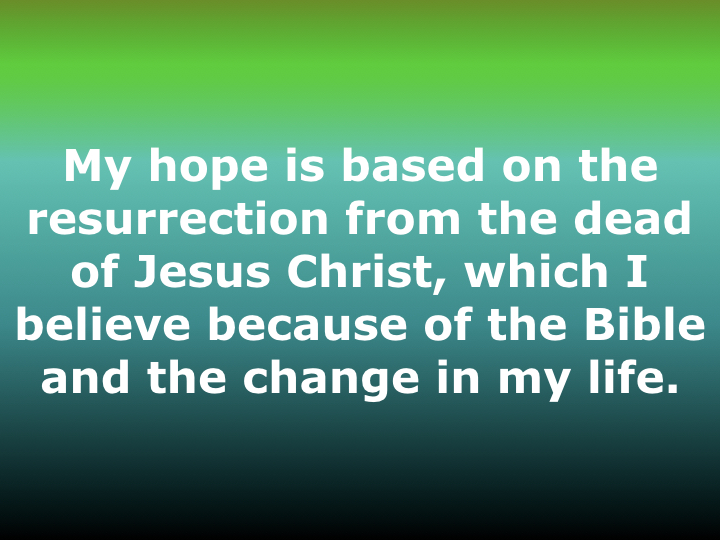
It really comes down to this: My hope is based on the resurrection from the dead of Jesus Christ, which I believe because of the Bible AND because of the change in my life.
The Bible’s authenticity
“No other work in all literature has been so carefully and accurately copied as the Old Testament. The particular discipline and art of the Jewish scribes came out of a class of Jewish scholars between the fifth and third centuries BC. They were called the Sopherim, from a Hebrew word meaning ‘scribes.’ The sopherim, who initiated a stringent standard of meticulous discipline, were subsequently eclipsed by the Talmudic scribes, who guarded, interpreted, and commented on the sacred texts from AD 100 to AD 500. In turn, the Talmudic scribes were followed by the better-known and even more meticulous Masoretic scribes (AD 500-900).” —Josh McDowell, God-Breathed
“No other ancient text is substantiated by such a wealth of ancient textual witnesses as is the New Testament. Roughly 5,500 separate manuscripts are available, variously containing anything from the entire New Testament corpus to a slight fragment of a single verse. … This textual support is far superior to that available for any other ancient documents, such as the classical texts from Greek and Roman writers (e.g., Plato, Aristotle, and Cicero). Only partial manuscripts have survived for many works of antiquity, and it is not unusual to find that the only complete manuscript for some ancient writing is a copy dating from 1,000 years after its composition.” —Archaeological Study Bible, “The New Testaments Texts” (page 1859)
“The biblical Dead Sea Scrolls are up to 1,250 years older than the traditional Hebrew Bible, the Masoretic text. We have been using a one-thousand-year-old manuscript to make our Bibles. We’ve now got scrolls going back to 250 BC. … Our conclusion is simply this—the scrolls confirm the accuracy of the biblical text by 99 percent.” —Dr. Peter Flint
I have shared other apologetic evidence for the authenticity of Scripture here and here.
Christ’s resurrection
In1 Corinthians 15:1-8 Paul lists all of the eyewitnesses to Christ’s resurrection, giving critics ample opportunity to challenge these witnesses in person. If these witnesses would have been perpetrating a hoax, skeptics of their day would have been able to uncover the inconsistencies in their story. If the account of Christ’s resurrection was made-up, it’s doubtful the early Christian martyrs would have “stuck to their story” as they were being tortured, but none recanted.
Josh McDowell notes, “By AD 100, the apostles had died, but the Christian Church was still in its infancy, with fewer than twenty-five thousand proclaimed followers of Christ. But within the next two hundred years, the fledgling church experienced explosive multiplication of growth, to include as many as twenty million people. This means the church of Jesus Christ quadrupled every generation for five consecutive generations!”
My personal experience
“I am a changed person. I am not who I was before I met Jesus” and “My life tends to go better when I live by biblical principles” are both excellent apologetics!
Let others argue that God doesn’t exist, or that you shouldn’t have hope, and then you—like the bumblebee—just keep flying with Jesus! (see 2 Timothy 3:14)
Amy Carmichael was a committed follower of Jesus Christ! She served as a missionary in India, where she operated an orphanage, for 55 years. During all that time, she never took a furlough, but remained at her post, faithfully loving Indian children with God’s love. She wrote a number of books, but perhaps the most hard-hitting is a little book simply called If.
This isn’t a book for everyone. In fact, Amy herself wrote, “It is clear, I think, that such a booklet as this is not meant for everyone, but only for those who are called to be undershepherds.” By ‘undershepherds,’ Amy is referring to those who feel God has called them into full-time vocational ministry.
(A little side-note. I feel the Bible is clear that all followers of Christ are to be involved in ministry [see Ephesians 4:11-16], but God has appointed some to positions where their ministry is also their vocation. These ‘undershepherds’ [see 1 Peter 5:2-3] will have to give account to God for the handling of their vocational ministry [Hebrews 13:17]. It is to these folks that Amy writes.)
Amy set the bar high for herself. She expected to be continually growing in her level of commitment to Christ, and she expected that her outward life would continually show greater devotion to her Savior. If comes out of Amy’s personal introspection in the Holy Spirit’s presence on how she was progressing in her faith-walk with God.
If is written as a series of challenges that all follow the same format: “If I don’t measure up to God’s standard in this area … then I know nothing of Calvary love.” I realize this sounds challenging. In fact, this book smacked me right between the eyes! This is why If is only for a small segment of people.
God’s plan has always been for His leaders to organize and oversee His ministry.
The important thing for us to distinguish is “His.” It’s not a man or woman saying, “I will be a leader,” or even a God-appointed leader saying, “I am going to build up my ministry.”
The New Testament gives us a fourfold purpose for the Body of Christ:
Mobilizing for evangelism
Organizing for more meaningful ministry
Making disciple-makers
Caring for one another
We see God’s leaders involved in all of these aspects—
Mobilizing for evangelism—Peter pointed out the need for an apostle to be appointed to replace Judas, thus returning their ranks to the 12 apostles just as Jesus had originally said (Acts 1:15-22).
Organizing for more meaningful ministry—Everywhere Paul founded a church, he also appointed leaders to oversee and shepherd that church.
Making disciple-makers—Paul tells us that God appointed five offices of leaders in the church who had the specific task of preparing church members to do the ministry of building maturity in the church (Ephesians 4:11-16).
Caring for one another—The First Church set the pace for providing care for all who were in need, including organizing leaders to oversee specific care ministries (Acts 6:1-5).
What about a church congregation’s responsibility to their leaders? I see five areas:
Hold them accountable to the Word (Acts 17:11). The Bible has to be THE standard to which leaders are held.
Give them your confidence and submission after they have shown accountability to their biblical mandate (Hebrews 13:17).
Over the past couple of weeks, people have been rattled by both real and imagined catastrophic events. We experienced a fabulous astronomical sight in a full solar eclipse, wept for our fellow citizens in Texas and Florida as hurricanes battered their businesses and homes, and then dealt with doomsayers who predicted the end of the world and the second coming of Jesus Christ.
Peter spent a lot of time right next to Jesus, soaking up His teaching and observing how Jesus lived. One thing Peter never saw in Jesus was panic.
So it’s not unexpected that Peter would write to followers of Jesus: Don’t fear what the world fears (1 Peter 3:14). Instead, Peter counsels his friends to keep their focus on Jesus.
Don’t run around in fear, but instead in your hearts set apart Christ as Lord. Some other translations say things like…
…revere Christ as Lord
…acknowledge Him as Lord
…worship Christ as Lord of your life
…keep your hearts at attention, in adoration before Christ (see 1 Peter 3:15)
In other words: let Jesus Christ be your focal point.
When you live this way—focused on the eternal Jesus and not the temporary shakings on earth—Earthlings are bound to notice that there is something different about you. So Peter tells us to always be prepared to give an answer to everyone who asks you the reason for the hope that you have.
Hope—not wishful thinking, but a rock-solid, joyful, confident expectation!
This hope is the Christian’s secret weapon!
This hope is unshakable during difficult times. This hope is unshakable on death’s doorstep. This hope is unshakable when the end of the world is predicted.
The Christian who has a personal experience of the hope that Jesus brings is never at the mercy of the happenings in the world nor the arguments from non-Christians.
But Peter cautions us to never use this hope as a club. He tells us to make sure we never use hope as a means of feeling superior to others. Instead we are to speak to others about our hope gently, respectfully, and with a clear conscience.
So here’s my question to you, fellow Christian: Can those around you see your hope? When they’re fearful and running for cover, do they see you right alongside them, or do they see you standing firm in hope as you keep your eyes fixed on Jesus. Your hope is a powerful persuader for a personal relationship with Jesus Christ!
All of these quotes are taken from Josh McDowell’s book 10 Commitments For Dads…
“Our desire and need for intimacy and relationship is rooted in the image of God as One (see Deuteronomy 6:4). Marriage and marital sex between a man and woman reflects His nature of oneness and unity.”
“Human sexuality involves every aspect of a person’s being—and sex is meant to connect us on every level.”
“Respecting the boundaries of sexual morality and the ‘stop’ signs for extramarital and premarital sex does bring protection and provision. Protection from: guilt, unplanned pregnancy, sexually transmitted diseases, sexual insecurity, emotional distress. Provision for: spiritual rewards, optimum atmosphere for child-raising, peace of mind, trust, true intimacy.”
“Sex as God designed it was meant to be lived within the context of healthy boundaries…. Following God’s design then allows a couple to experience the beauty of sex as it was meant to be experienced.”
“Purity is God’s boundary that provides for a maximum sex life and protects us from the negative consequences of sexual immorality [1 Thessalonians 4:3-5, 7].”
“Where did sexual purity come from? From the very character of God Himself. God says, ‘Be holy, for I am holy’ (1 Peter 1:16). ‘All who have this I hope [of being like Christ when He returns] in Him purify themselves, just as [God] is pure’ (1 John 3:3).”
“We were created by God with the desire and longing to be that ‘one and only’ to someone else. That desire came directly from the very nature of God Himself … ‘He is the faithful God…’ (Deuteronomy 7:9).”
“Because true love’s priority is to protect and provide for the one being loved, God’s kind of love will not do things that are harmful to the security, happiness, and welfare of another person.”
You can check out my review of 10 Commitments For Dadshere. I also shared some other quotes from this helpful book here.
Christians are citizens of Heaven who are merely passing through Earth, so this isn’t a Christian’s final home. Because of this, it’s not unusual for Earthlings to mistreat, insult, and even persecute these “aliens and strangers.”
How are Christians supposed to respond to this?
First off, let’s make sure the persecution is for the right reason. Jesus said, “Blessed are you when people insult you, persecute you and falsely say all kinds of evil against you because of Me” (Matthew 5:11).
Jesus also told us that this persecution has a blessing in it: we would be able to share our faith in Jesus Christ at the highest levels on Earth: “On account of Me you will stand before governors and kings as witnesses to them” (Mark 13:9).
In 1 Peter 3:8, the apostle tells us how to live with everyone, Christian and Earthling alike:
Harmoniously—keep The Main Thing the main thing; don’t get caught up in petty arguments
Empathetically—put yourself in others’ shoes
Kindly—treat everyone like a sibling that shares the same parents with you
Compassionately—be strong enough to handle other people’s stuff
Courteously—remember this: manners matter!
This list may be easy to live out when people are friendly to you, but what about when unfriendly Earthlings are downright mean to you? In the very next verse Peter gives us two Don’ts and one Do:
Don’t repay evil with evil—Jesus is our example of this (see 1 Peter 2:21-23)
Don’t insult the insulters—treat others as you want them to treat you (Luke 6:31)
Do bless those who slander and persecute you—Jesus says we get absolutely no credit if we only treat kind people kindly (see Luke 6:32-33)
In Psalm 35 David is dealing with people who are fighting against him. They are saying mean things and trying to do even meaner things. This prayer shows both God’s part and our part…
God’s part—defend me against the evildoers … remind me of Your salvation … pursue those who are falsely pursuing me … stay close to me.
My part—listen to God’s voice of assurance … live quietly … don’t give others cause to mistreat me … pray for those who persecute me … continually turn my thoughts and praise to God.
Peter wraps up this thought with these words—Who is going to harm you if you are eager to do good? But even it you should suffer for what is right, you are blessed (1 Peter 3:13-14).
Don’t give in to mistreatment and lash out in anger. Trust God to handle things. Keep on living a good life that is focused on bringing God all the glory due His name!
Peter pulls no punches as he calls Christians for what they are (or perhaps what they really should be): aliens … strangers … peculiar people.
But how can that be, especially in the United States of America? Survey after survey says that upwards of 95% of Americans claim to believe in God, and fully 8-out-of-10 of every American call themselves a Christian.
You only need to take a look at our schools, our government, or our entertainment to see how “alien” biblical values are with current cultural trends. I think all of us have experienced that when we try to live by a biblical standard, people roll their eyes at us (at best) or maybe outright mock us. Perhaps the term “aliens” is not so much for what we say we believe, but how we live what we believe.
That’s why Peter calls us peculiar (1 Peter 2:9). This word means a people so focused on what God wants, that they don’t have time to worry about what the world wants. Peculiar people are so focused on “Your kingdom come and Your will be done” that they don’t pay attention to “keeping up with the times.”
Peter says that the inevitable outcomes of this peculiar lifestyle are accusations of wrong doing, unjust treatment, insults, and slander, just to name a few (see 1 Peter 2:12, 19, 21-23; 3:16).
When we are treated this way, Peter tells Christians about their alien response:
Love one another deeply
Live good lives doing good deeds
Do not retaliate with insults or threats
Live in such a hope-filled way that others can’t help to ask you about it (see 1:22; 2:12, 23; 3:15)
So… how “alien” is your Christianity? Are you doing so many good things that it catches the attention of others? Are you responding to mistreatment in a Christ-honoring manner? Do you speak with others gently and respectfully? Is your life so full of hope in your eternal home in Heaven that people can’t help but ask you for the reason for the hope you have?
Don’t worry about being popular; be peculiar. Be so alien to this world’s values that you compel others to encounter Jesus Christ as you have!
My mind and heart were expanded once again at this year’s Global Leadership Summit! Bill Hybels opened the conference with a call to leaders to promote civility in our areas of influence. Here are a few notes I jotted down.
“The solution to incivility must begin with me.” —Bill Hybels
“Christians do not get to chose whom they will respect [1 Peter 2:17].” —Bill Hybels
Bill Hybels’ 10 rules of respect:
Leaders must set the standard of how to disagree without demonizing the other person.
Leaders must allow spirited conversations without it getting personal.
Leaders must not interrupt others who are talking.
Leaders must limit their volume level and eliminate belittling words.
Leaders must set the example of being courteous.
Leaders must never stereotype.
Leaders must apologize immediately if they are wrong.
Leaders must form opinions carefully.
Leaders must set the example of showing up on time and doing what they say they will do.
Leaders must set rules of respect for the organization and enforce them relentlessly.
Bill Hybels closed with this challenge—“When was the last time I reflected deeply on my own convictions about respecting others?”
If I were to ask five different Christians to give me a definition of sanctification, I just might get five different definitions!
Part of this comes from incorrect either-or thinking. However, Jesus seems to tell us that sanctification requires a both-and thinking.
In Christ’s prayer for His followers in John 17, He uses the word sanctified three times (see verses 17-19). Although He is using the same Greek word each time, He uses a different “flavor” of the word to make it really clear what He means.
First of all, the Greek word for sanctified means the process of being made into a saint. So sometimes I like to say the word this way: SAINT-ified.
Check out Christ’s prayer. First He says, “I sanctify Myself,” and then He says, “that they too may be truly sanctified.” Same Greek word, but each time is slightly tweaked.
Jesus uses a “flavor” of Greek which means sanctification is something that He has done completely and totally on His own once and for all. In other words, Christians are completely and totally sanctified at the very moment they surrender their life to Him.
But when He talks about His followers, the “flavor” of Greek means sanctification is something that is an ongoing process. In other words, we are being SAINT-ified.
So which is it? Sanctified once, or sanctified through an ongoing process?
It’s not either-or. It’s both-and!
Think about a married couple. From the moment the pastor says, “I now pronounce you husband and wife” they are married. It is done; fully completed. There is nothing the bride or groom can do to become more married.
However, the groom can begin to look at the marriage through his bride’s eyes. Then he can serve her in a way that helps her feel more joy, more satisfaction, and more fulfillment within the marriage. Neither of them becomes more married, but they can get more enjoyment within the marriage.
The same thing for Christians. At the moment we ask Jesus to be our Lord and Savior we are saved from the penalty of our sins. We can’t be more saved. But through the process of SANIT-ificiation we can experience more joy, more satisfaction, and more fulfillment within our relationship with Jesus.
My paraphrase of 1 Peter 1:15-16—But just as He who called you has paid for your once-for-allsaint-ification, sokeep on beingsaint-ifiedin all you do; for it is written: “Be holy, because I am holy.”
What about you? Are you satisfied with just being saved, or are you striving for a joy-filled, more fulfilling, increasingly satisfied relationship with Jesus Christ? It can truly be a wonderful both-and relationship!



 Have you ever had a really bad job? How about a job that you said, “This job is killing me”? They probably weren’t as bad as the job Ernest Shackleton advertised for:
 Instead, Peter points out seven ways Christians can live so that they will point others to Jesus.









 Craig T. Owens