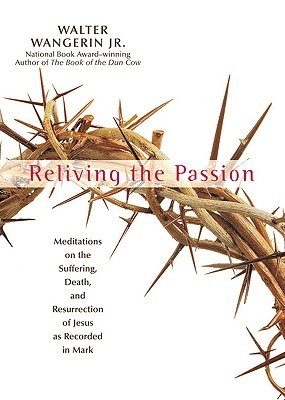
 Walter Wangerin, Jr. has prepared an excellent guide for the Lenten season: Reliving The Passion. Beginning on Ash Wednesday and going all the way through Resurrection Sunday, Wangerin is using the Gospel of Mark to give us some heart-probing thoughts on Christ’s Passion. I typically post quotes after I have completed a book, but I thought I would share a quote or two with you each day through this journey.
Ash Wednesday—“When we genuinely remember the death we deserve to die, we will be moved to remember the death the Lord in fact did die.”
The Second Day Thursday—“Mirrors that hide nothing hurt me. But this is the hurt of purging and precious renewal—and these are mirrors of dangerous grace. The passion of Christ, His suffering and His death, is such a mirror.”
The Third Day Friday—[read Mark 14:27-28 and Mark 16:6-7] “If Jesus ‘will go before’ His disciples from Galilee as He had gone before, then this is a call to follow Him down the hard road of conflict, criticism, enmity, persecution, suffering and death and resurrection. So the passion story becomes a roadmap for all of Jesus’ followers (who deny themselves and take up their crosses) whether Christians martyred in the first, or Christians bold in the twentieth, centuries. Read this story, then, as a detailed itinerary of the disciple’s life. But hear in it as well the constant consolation—not only that He, in ‘going before us,’ is always near us, however hard the persecution; but also that we, in going His way to Galilee, will see Him as He told you.”
The Fourth Day Saturday—“The difference between shallow happiness and a deep, sustaining joy is sorrow. Happiness lives where sorrow is not. When sorrow arrives, happiness dies. It can’t stand pain. Joy, on the other hand, rises from sorrow and therefore can withstand all grief. Joy, by the grace of God, is the transfiguration of suffering into endurance, and of endurance into character, and of character into hope—and the hope that has become our joy does not (as happiness must for those who depend upon it) disappoint us.”
The Fifth Day Monday—“Jesus: Forgive me for making much of what’s minor in Your story, diminishing the important thing. I’ve demanded miracles, healings, benefits for myself. O Lord, raise the Cross as the central beam of my whole life once again! Amen.”
The Sixth Day Tuesday—“Jesus, by the refining fires of Your grace reduce my prideful self to ash after all. Let me become a nothing, that You might be the only Something for me and in me.”
The Seventh Day Wednesday—“It was an act so completely focused upon the Christ that not a dram of worldly benefit was gained thereby [Mark 14:3-9]. Nothing could justify this spillage of some three hundred days’ wages, except love alone. The rulers who sought to kill Jesus were motivated by a certain reasonable logic; but your prodigality appears altogether unreasonable—except for reasons of love. … Love enhances and names in truth. No one else anointed Him and by that gesture declared Him Messiah, the Christ. The act, therefore, was more than beautiful. It was rare and rich with meaning.”
“Jesus, I love You, I love You! Cleanse me of anything that is not love for You, even though the world will think me preposterous and my friends—some of whom are Your disciples—will not be able to make sense of me. You are all the sense and meaning I need. I love You. Amen.”
The Eighth Day Thursday—“Does the motive of a sin—its rationale, its reasons—make it any less a sin? Isn’t the betrayal of the sovereignty of the Lord in our lives always a sin, regardless of the factors that drove us to betray Him? Yes! Yet we habitually defend ourselves and diminish our fault by referring to reasons why we ‘had to’ do it. We sinners are so backward that we try to justify ourselves by some condition which preceded the sin. Motives console us. That’s why we want so badly to have and to know them. …
“We sinners are so backward! We invert the true source of our justification. It isn’t some preliminary cause, some motive before the sin that justifies me, but rather the forgiveness of Christ which meets my repentance after the sin.”
The Ninth Day Friday—“‘Who will give Me room?’ This is forever a measure of the love which Jesus inspires in human hearts: that there was a householder willing to endanger himself by saying, ‘I will. Come.’ We know almost as little about this man—and as much—as we know of the woman who anointed Jesus. We know him by his action only; and his deed was love. It was a sacrificial love, which puts itself in harm’s way for the sake of the beloved [Mark 14:12-16]. …
“‘Who will give Me room?’ the Lord Jesus asks today. If we’re experienced, we know the risk. The sophisticated world mocks a meek and sheepish Christian. The evil world hates those in whom Christ shines like a light upon its darksome deeds. Even the worldly church will persecute those who, for Jesus’ sake, accuse its compromises, oppose its cold self-righteousness, and so disclose its failure at humble service.”
The Tenth Day Saturday—“Judas has no better friend than Jesus. Loving him, not loathing him, Jesus grants Judas a moment of terrible self-awareness: ‘One of you will betray Me, the one who is dipping bread into the dish with Me….’ The deed is not yet done. But Jesus sees it coming and, while yet the sinner contemplates the sin, gives Judas three critical gifts: (1) Knowledge; (2) Free will; and (3) Sole responsibility. … Given three gifts by the grace of the dear Lord—[will I] stop?”
The Eleventh Day Monday—“With the apostle Paul the pastor repeats: ‘The Lord Jesus, the same night in which He was betrayed, took bread’ [1 Corinthians 11:23]. Oh, let that pastor murmur those words, the same night, with awe. For who among us can hear them just before receiving the gift of Christ’s intimacy and not be overcome with wonder, stunned at such astonishing love? … In the night of gravest human treachery He gave the gift of Himself. And the giving has never ceased. … Oh, this is a love past human expectation. This is beyond all human deserving. This, therefore, is a love so celestial that it shall endure long and longer than we do. This is grace.”
The Twelfth Day Tuesday—“If anyone continues in a loving relationship with Jesus, it is His love that preserves it, not the love of the other, nor all the piety, nor all the goodness a Christian can muster.”
The Thirteenth Day Wednesday—“Abba, Father,” Jesus cried out, “everything is possible for You. Please take this cup of suffering away from Me. Yet I want Your will to be done, not Mine.” (Mark 14:36)
The Fourteenth Day Thursday—“What takes place in the Garden of Gethsemane is the Lord’s Prayer actually happening, as though the earlier words were a script and this is the drama itself. … When Jesus teaches us to pray, He does not teach plain recitation. Rather, He calls us to a way of being. He makes of prayer a doing. And by His own extreme example, He shows that prayer is the active relationship between ourselves, dear little children, and the dear Father, Abba.”
The Fifteenth Day Friday—“In a garden once [Eden] the Lord God decreed enmity between the serpent and the seed of the woman, enmity to the death. In a garden again [Gethsemane] that enmity produces this pathetic assault: a kiss that can kill. … Behold how the servants of God can bite!”
The Sixteenth Day Saturday—“In the fires of serious persecution the truer elements of one’s character now are revealed. Everything fraudulent, cheap, or hypocritical burns. Every pretense turns to ash. All my false words blow away. What I really am—the core character, the thing God sees when He looks at me…I am indeed. … Take my life: I consecrate it to Thee. Take all that I have and all that I am; replace the self in me with Thine own holy self.”
The Seventeenth Day Monday—“Whenever discipleship puts me in peril, give me the gift of a holy silence—to speak the truth, no less, no more. Amen.”
The Eighteenth Day Tuesday—“Christian, come and look closely: it is when Jesus is humiliated, most seeming weak, bound and despised and alone and defeated that He finally answers the question, ‘Are you the Christ?’ Now, for the record, ‘Yes: I am.’ It is only in incontrovertible powerlessness that He finally links Himself with power: ‘And you will see the Son of Man seated at the right hand of power’ [Mark 14:61-62].”
The Nineteenth Day Wednesday—“Where patience shines, impatience is revealed and hates the attention. Kindness shows unkindness to be hideous. True joy intensifies true bitterness; gentleness enrages belligerence; and self-control proves the pig to be nothing but a pig. … Save me, Lord, from blaming anyone but myself: not You (whose innocence spotlights my sin), not Your foes (whose sins are my own), not people whose virtues reveal my evil.”
The Twentieth Day Thursday—“There’s a war inside the strong disciple. (The stronger the disciple, the worse the war!) There’s a struggle in Peter between good and evil, between these two commitments: to his Lord and to his own survival. … The forces warring in Peter’s soul seem terribly equal: a tremendous, selfless love for Jesus keeps him there, while a consuming self-interest keeps him lying. He denies himself to stay by his Lord. He denies his Lord to save himself. Both. Good and bad. Peter is paralyzed between the good that he would and the evil that he is. I see this. I recognize this. I cannot divorce myself from this—for Peter’s moral immobilization is mine as well!”
The Twenty-first Day Friday—Very early in the morning, the chief priests, with the elders, the teachers of the law and the whole Sanhedrin, made their plans. So they bound Jesus, led Him away and handed Him over to Pilate (Mark 15:1). What was Jesus thinking during this walk? “Wordlessly, Jesus answers: ‘The walking itself is the sign, child. The loneliness which I have chosen, and the Cross that closes it—these are signs that I love you ever. I have to leave you to love you best. I go where I want you never to go, precisely because I love you.’”
The Twenty-second Day Saturday—“Jesus, ironically, You and Your accusers had the selfsame goal, and by Your very silence, steadfastly, You went as it was written of You. Human beings strategized; human evil sent You to Your Cross. But something huger hovered over the occasion, something of Your own volition: Love.”
The Twenty-third Day Monday—“If they choose Barabbas over Jesus, they choose humanity over divinity. They choose one who will harm them over One Who would heal them.”
The Twenty-fourth Day Tuesday—“‘Why?’ cries Pilate suddenly. He seriously means the question: ‘What evil has He done?’ But we are now at the climax of human hatreds. This rage requires no rationale. This hatred has no reason but itself. God and the children of Adam are enemies, for the children rebelled against their God—and enemies hate. … This is the natural reaction of sinners in the presence of Holy God.”
The Twenty-fifth Day Wednesday—“The crowd is a power to be feared. In fact, its power is the fear it inspires in rulers who know its quickness to riot, its ungovernable lack of sense or of personal integrity. People lose individuality in a crowd. … Sin is brutal. But even the swollen-throated bellowers in the crowd are people to Jesus, whom He regards one by one by one, whom He does not fear, but whom He is serving right now—right now!—by giving His life to ransom them from the very brutishness they are displaying.”
The Twenty-sixth Day Thursday—You have heard that it was said, ‘You shall love your neighbor and hate your enemy.’ But I say to you, love your enemies and pray for those who persecute you [Matthew 5:43-44]. To this you were called, because Christ suffered for you, leaving you an example, that you should follow in His steps. … When they hurled their insults at Him, He did not retaliate; when He suffered, He made no threats. Instead, He entrusted Himself to Him who judges justly [1 Peter 2:21, 23]. “Jesus, there is nothing You ask of me that You have not Yourself exemplified.”
The Twenty-seventh Day Friday—“‘And they led Him out to crucify Him’ (Mark 15:20). Jesus, what can I do for You now? ‘Follow.’”
The Twenty-eighth Day Saturday—They offered Him wine mingled with myrrh; but He did not take it (Mark 15:23). “He will in no wise dull His senses or ease the pain. And so we know. What are the feelings? What has the spirit of Jesus been doing since Gethsemane? Why, suffering. With a pure and willful consciousness, terribly sensitive to every thorn and cut and scornful slur: suffering. This He has chosen. This He is attending to with every nerve of His being—not for some perverted love of pain. He hates the pain. But for a supernal love of us, that pain might be transfigured, forever.”
The Twenty-ninth Day Monday—“If death is the end of all we do, then all we do is futile. … The planets, their civilizations and their loads of people, all need a central sun—to hold them together, to keep them wheeling in good order, to bequeath them shape and meaning. History needs a center. But if that center is empty death, strengthless death, it cannot hold. Things fly apart into absurdity. … But the Creator God put a Cross in the very center of human history—to be its center, ever. The Son of God, the gift of God, the love of God, the endless light of the self-sufficient God filled the emptiness which was death at our core. … We are altogether meaningless, except God touch us. God touched us here at the Cross.”
The Thirtieth Day Tuesday—“O Jesus, does love from the Cross have to hurt so much?—hurt You with dying?—hurt me when Your dying draws me to Yourself?”
The Thirty-first Day Wednesday—Those who were crucified with Him also reviled Him (Mark 15:31). “No, there never was such sorrow as this. And the fools who pass by jeering merely reveal an iniquitous ignorance. … For our sake, God made Him to be sin who knew no sin, so that in Him we might become the righteousness of God (2 Corinthians 5:21). … Jesus has become the rebellion of mankind against its God. He is, therefore, rightly crucified.”
The Thirty-second Day Thursday—“My God, why hast Thou forsaken me? Who answers Him? The thunder is silent. The city holds its breath. The heavens are shut. The dark is rejection. This silence is worse than death. No one answers Him. No, not even God. … This is a mystery, that Christ can be the obedient, glorious love of God and the full measure of our disobedience, both at once. But right now this mystery is also a fact.”
The Thirty-third Day Friday—“Perhaps we people will ever be strangers in part and puzzles to one another, always a little lonely. But You, Lord, have searched me and known me. You have searched and loved and saved me even in my ignorance.”
The Thirty-fourth Day Saturday—And Jesus uttered a loud cry and breathed His last [Mark 15:37]. “satan, thou art defeated in My defeat! Sin, disposed of a people! Death, look about thee; thou art not mighty and dreadful. Lo, I close My eyes and die—and death shall be no more.”
The Thirty-fifth Day Monday—“Here is a door through which we by faith may enter Heaven, a doorway made of nails and wood, a crossing, a Cross. … For God so loved the world that He gave His only Son, that whoever believes in Him should not perish but have eternal life. And this ‘giving’—this giving up, this giving away, this giving over—begin indeed in Bethlehem in a cradle made of wood. But it wasn’t done until He was killed by a Cross of wood on Golgotha.”
The Thirty-sixth Day Tuesday—“Grief, while you are grieving, lasts forever. But under God, forever is a day. Weeping, darling Magdalene, may last the night. But joy cometh with the sunrise—and then your mourning shall be dancing, and gladness shall be the robe around you. Wait. Wait.”
The Thirty-seventh Day Wednesday—“Joseph [of Arimathea] is not the same. There’s some new seeing in this kingdom-seeker. A veil’s been torn, a wall breached, a window opened. Perhaps he’s bold because he hopes. Perhaps he hopes because he’s seen a more permanent splendor than ever before, the glory of the Lord.”
Maundy Thursday—“On Maundy Thursday, consider … This is the persistent gift of the Lord’s Last Supper: that every time we faithfully eat and drink it, Jesus comes within us, and we become His temple here.”
Good Friday—When Jesus had tasted it, He said, “IT IS FINISHED!” Then He bowed His head and gave up His spirit (John 19:30).
Holy Saturday—“God is God, Who made the world from nothing—and God as God can still astonish you. … One story is done indeed … But another story—one you can not conceive of (it’s God Who conceives it!)—starts at sunrise.”
Resurrection Sunday—Why are you looking among the dead for Someone alive? He isn’t here! HE IS RISEN FROM THE DEAD! (Luke 24:5-6).



 The Bible says that satan prowls around like a lion, looking for an opening to devour Christians. Are you battle ready? The Apostle Peter gives us all of the battle preparation that we will need to be victorious!