Greg and I challenge you to take a phrase from our amazing military personnel: Change “I work here” to “I serve here.” Then just as we express our thanks to our active duty and retired service members—“Thank you for your service”—others at our workplaces can say the same thing to us.
“The human mind never goes so fast as that except when it has got into a groove.” —G.K. Chesterton
“In the opening paragraph of Revelation, we’re met by the encouragement, ‘Blessed are those . . . who keep what is written in [this prophecy]’ (1:3). Then at the conclusion we’re reminded, ‘Blessed is the one who keeps the words of the prophecy of this book’ (22:7; see also 22:9).” Justin Dillehay then outlines three ways Christians can “keep” the Book of Revelation.
“For it is not so much of our time and so much of our attention that God demands; it is not even all our time and all our attention; it is ourselves. … When we try to keep within us an area that is our own, we try to keep an area of death. Therefore, in love, He claims all. There’s no bargaining with Him.” —C.S. Lewis, The Weight of Glory
T.M. Moore also wrote about the Intimate Glory we have in Jesus: “The greatness of our great salvation is to be known in the Presence of Jesus, God With Us, and the intimacy of peace, safety, rest, and joy we know in Him. Take away all the outward trappings and benefits of our salvation, and we will still, like Peter, be overjoyed just to be with Jesus. The hope of sharing in His glory—not just then and there but now and here in all we do—refreshes and excites our soul and energizes our bodies for daily obedience.”
Listen to the podcast of this post by clicking on the player below, and you can also subscribe on Apple, Spotify, or Audible.
An old Sunday School song had me joyfully singing, “I’m in the Lord’s army!” I loved playing “Army” with my friends and I also loved this song and the idea behind it, but it seems like many seasoned saints today get a little uncomfortable with the idea of a militant Church. But military-like precision was drilled into everything the Church was taught from the days of Moses all through the end of the New Testament.
Let’s just consider the precision of the movement of the tribes of Israel. For 40 years in the wilderness they were an army on the move, and they moved with precision that was drilled into them.
Numbers 2 lays out the precise encampment arrangements.
Numbers 10:14-36 tells us precisely how they marched out with the vanguard, supporting troops, and rearguard.
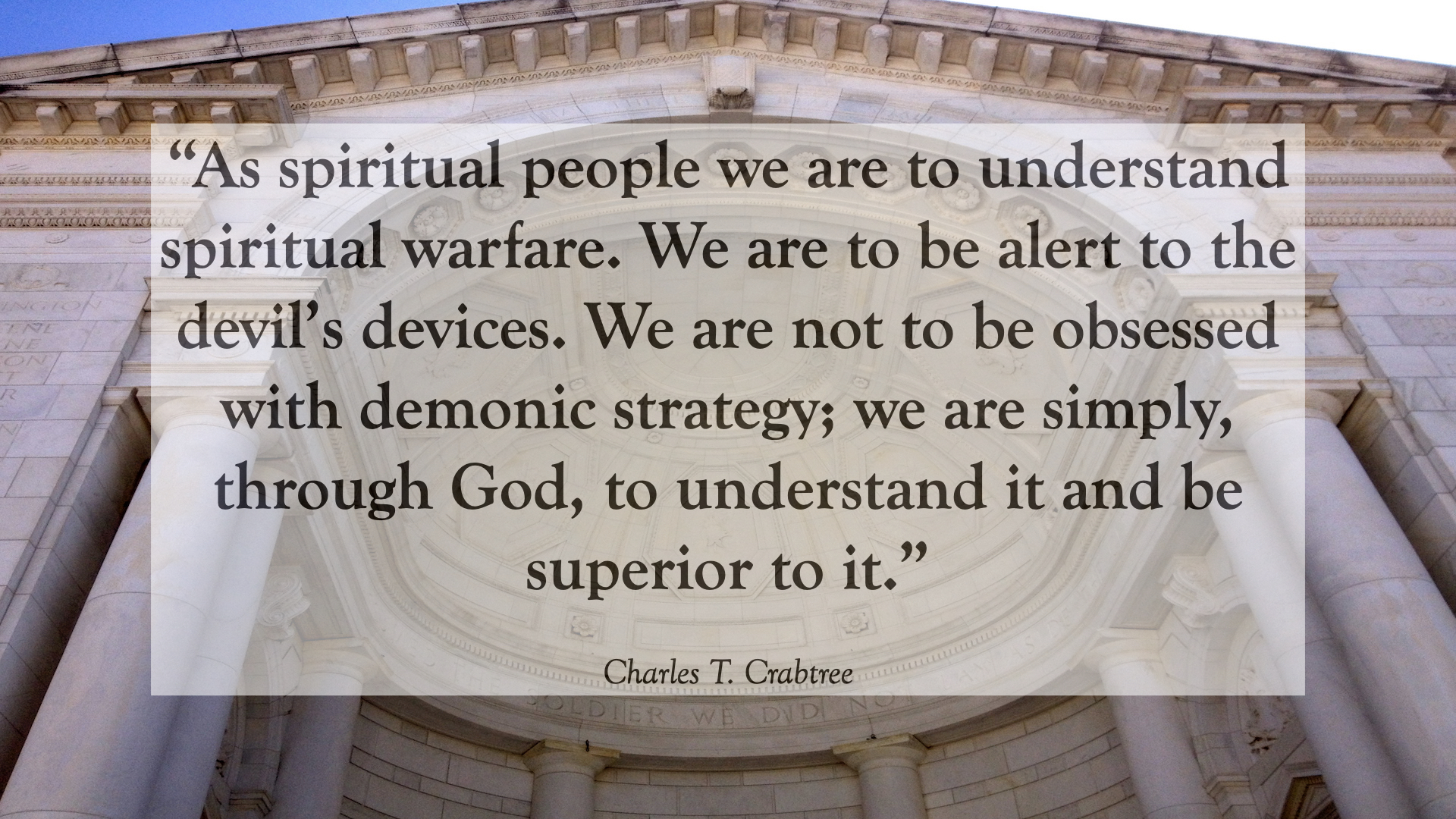
Charles T. Crabtree wrote, “As spiritual people we are to understand spiritual warfare. We are to be alert to the devil’s devices. We are not to be obsessed with demonic strategy; we are simply, through God, to understand it and be superior to it.”
We are in a spiritual battle that requires spiritual armor (Ephesians 6:11-13), and we must practice for precision in which armor and which weapons to use (2 Corinthians 10:4; 2 Timothy 2:3-4).
My friend Dan Chastain spent more than 20 years serving in the US Army, and he notices several parallels between what the Bible says about military leaders and what he learned in his long military service. He shared four key characteristics of warriors:
Dedication to honorable service
Obedience and loyalty to whom and what they serve
Integrity at all costs
Selfless service
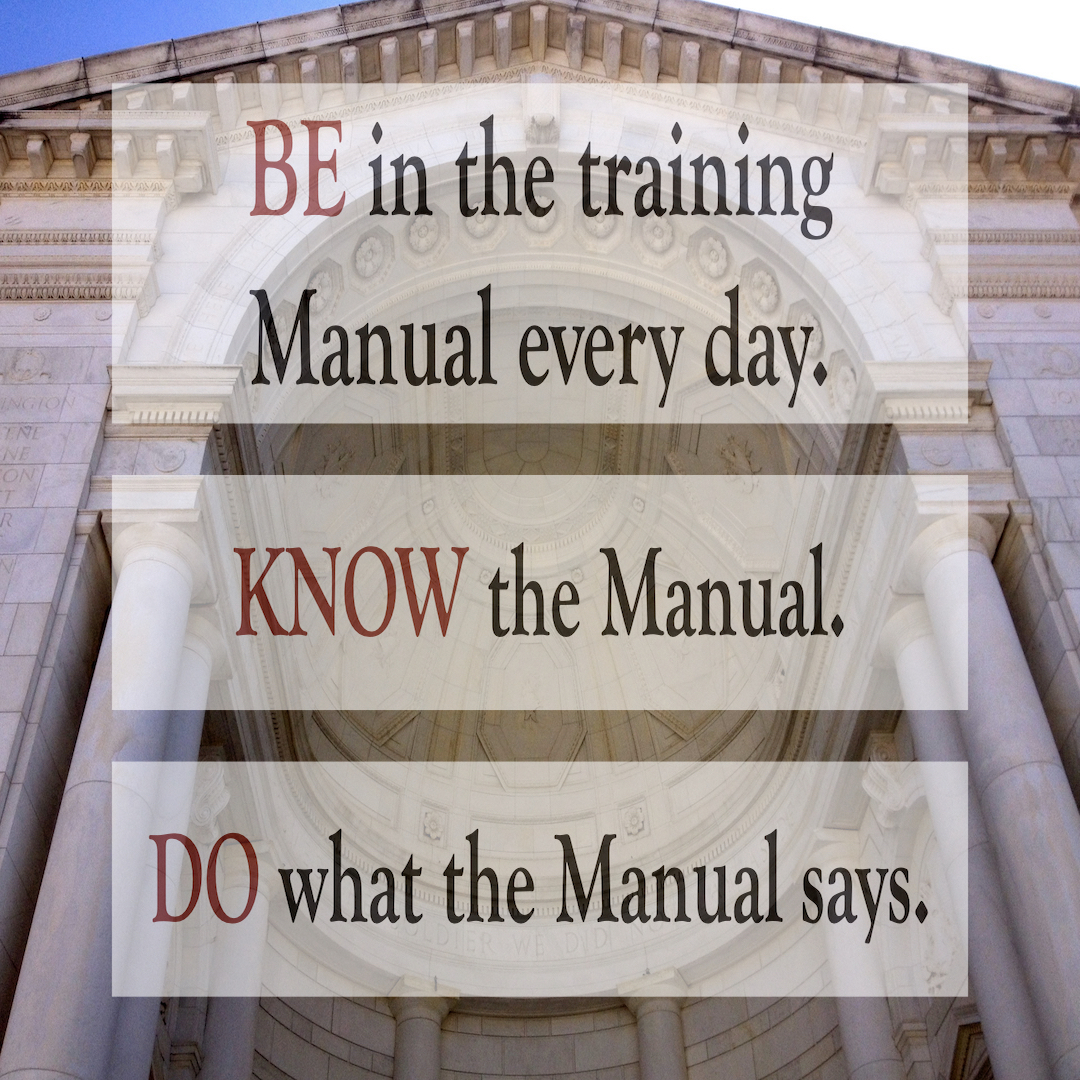
Dan also shared the US Army’s model of Be, Know, and Do. Which is also vital for Christian warriors today.
When Joshua—the general of the Israelite army—took over, he was given this directive by God: Meditate on God’s Word so that you can live by it (Joshua 1:6-8), and the New Testament would agree (2 Timothy 3:16-17). So we, too, will learn from the military leaders that Scripture has given us how to practice our precision in the Lord’s Army.
Let’s make sure we can finish well. As Paul said to Timothy, “Fight the good fight of the faith. … I have fought the good fight, I have finished the race, I have kept the faith” (1 Timothy 6:12; 2 Timothy 4:7).
You can start today by applying Be, Know, and Do with the Training Manual for the Lord’s Army every single day:
Be in the training Manual every day
Know the Manual
Do what the Manual says
Follow along with all of the messages in our series on The Lord’s Army.
Listen to the podcast of this post by clicking on the player below, and you can also subscribe on Apple, Spotify, or Audible.
The 12th Song of Ascent (Psalm 131) was written by David to remind us to rely on God’s help even more as we progress on the journey (or mature in our faith). In the 13th Song (Psalm 132), the psalmist says, “Remember David” and his passion for God’s people to experience God’s righteousness and joy. In order for us to know that, we have to remember Jesus.
Those who put this collection of Songs of Ascent together now include David’s fourth song (Psalm 133) in this collection which expresses his desire for unity among God’s people.
Can you imagine the pilgrims starting out from their individual villages? Maybe there’s not very many of them to begin with and traveling is pretty easy, but they do have to be vigilant against dangers on the road.
As they progress, they begin to join with pilgrims from other villages. Maybe these are from the same tribe, perhaps even distant relatives. The journey may go a bit slower now that there are more people to keep track of, and some complications of personality may start to arise. But the level of safety and assistance also increases.
Soon the group is getting larger as they now join with pilgrims from other tribes. These aren’t near relatives at this point, so there may be more complications, but there is even greater encouragement, safety, and potential.
Aha! Potential.
We’ve gone singing with a small ensemble to singing in a choir. And David is anticipating us singing in an even larger, majestic choir! There will undoubtedly be more problems, but there is also assuredly so much more potential, beauty, and strength in their combined worship.
My friend Dan Chastain has over 20 years of experience in the United States Army. He points out that the Army did the same things in his day as we read in the Old Testament.
The unity of a fighting force, Dan said, is a blessing. David was a professional soldier. Many people today join the military because of this professional, unity, and camaraderie. Maintaining this unity is the responsibility of everyone, because disunity leads to mistrust, chaos, and defeat.
David says this choir paints a picture—“it is like” (v. 2) and “it is as if” (v. 3). He is saying that God desires overflowing blessings on His people (v. 2), and that God desires saturating blessings on His people (v. 3). Why? Because God wants to give us more than enough for our needs so that there is plenty left for those who aren’t brothers and sisters yet. He longs for our choir to include people from every tribe, race, and nation.
Just as we said last week that a Christian’s joy is a testimony, a choir of Christians is an even more compelling testimony!
David calls this unity “good” which really means so much better than the alternative. And he calls this unity “pleasant.” The Hebrew word literally means singing a sweet sound!
The Hebrew word for “unity” here is also instructive. It means to be together in the same place—not just in spirit and desire—but in physical proximity. This is exactly the picture we see in the first Church (Acts 2:44, 46-47), as well as the picture of the choir from every nation, tribe, people, and language singing around God’s throne in Heaven (Revelation 7:9-10).
In order to navigate all of the differences of personality that could keep us from this unity, we have to work at. We need the attitude of Jesus (Philippians 2:1-5). This requires a daily transformation of our minds (Romans 12:1-3), and this transformed mind is what helps us move from a small ensemble to a majestic choir (Romans 12:4-5, 16-18).
Listen to the podcast of this post by clicking on the player below, and you can also subscribe on Apple, Spotify, or Audible.
I love reading, and I love sharing my love of good books with others! Here is a list of the books I read and reviewed in 2021. Click on a title to be taken to that review.
Listen to the podcast of this post by clicking on the player below, and you can also subscribe on Apple, Spotify, or Audible.
Sometimes you might hear it said of someone’s leadership mettle or leadership philosophies that they are “battle-tested.” In the case of Hal Moore On Leadership, this is literally true!
Perhaps you’ve seen the movie “We Were Soldiers Once…And Young,” which recounts the first full-scale military battle in Vietnam between Moore’s 450-man force and the 2000 soldiers of the North Vietnamese Army. Despite being completely surrounded and severely out-gunned, Moore’s First Cavalry decisively defeated the NVA.
General Moore’s leadership principles won the day for his men in that battle. But even then, his principles had already been battle-tested under fire in the Korean War, and put to the test in the various assignments that Hal Moore faced in his highly-decorated military career. Moore was continually tasked by superior officers to re-tool underperforming units, or step in where tensions were high, or help reorganize when the Army was experiencing some growing pains.
Moore not only excelled at every assignment, but he kept meticulous notes that are now available to any leader in this excellent book.
Hal Moore On Leadership is partially a biography, but mostly his story is told as the backdrop for the leadership principles that were proven to be correct time and time again.
Students of both leadership and military history will find this book enjoyable and practical.
[0:36] One thing I have learned about veterans that I have appreciated.
[1:35] Giving a shout-out to our favorite veterans.
[2:35] We wonder how many current leaders would agree to step into tough roles if they weren’t getting paid to do so.
[3:35] What intrigues us about volunteers.
[5:15] What else motivates people beside getting a paycheck?
[6:35] Leaders help their people get involved in a bigger cause—they help them see beyond the organization’s “bottom line” as a way to energize their team.
[8:29] Some leadership examples from our military personnel.
[9:18] What any leader should be able to learn from veterans: respect, understanding of the chain of command, innovation while follow the mission plan.
[11:13] How having veterans on your team can benefit your organization.
[13:41] What we can learn from our veterans about defending our values.
[14:00] Greg shares a great quote on defining true heroes.
[15:20] Find a way to invest in your people and unleash their potential.
Check out this episode and subscribe on YouTube so you can watch all of the upcoming episodes. You can also listen to our podcast on Spotify and Apple.
how to get in the drawing for a special monthly prize
helping wounded veterans stay on the move through the Oscar Mike organization
some astounding stats about our veterans
how we can best show gratitude to our veterans
Greg and I share some cool stories of our interactions with veterans
some insights into true sacrifice
Check out this episode and subscribe on YouTube so you can watch all of the upcoming episodes. You can also listen to our podcast on Spotify and iTunes.
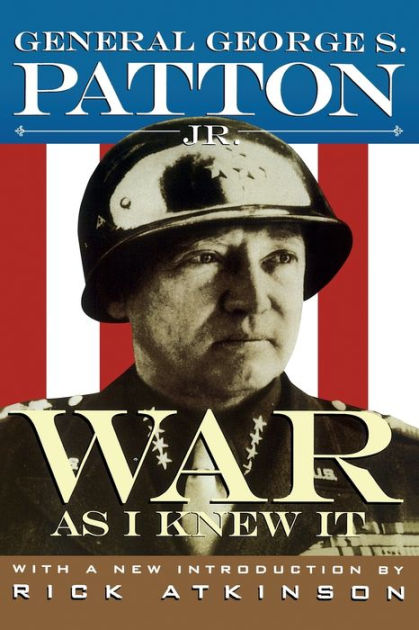
General George Patton gives us an insightful leadership look into how his army was able to accomplish so much during such a short time in World War II. Check out my full book review by clicking here.
“An ounce of sweat saves a gallon of blood.”
“This is another example of the many I’ve encountered in life where great disappointments have proven to be the road to future success.”
“Successful generals make plans to fit the circumstances, but do not try to create circumstances to fit plans.”
“The 8th of May, 1945, marked exactly two-and-a-half years since we had landed in Africa. During all that time we had been in practically continuous battle, and when not in battle had been under the strain of continuous criticism, which I believe is harder to bear.”
“It is unfortunate and to me a tragic fact, that in our attempts to prevent war we have taught our people to belittle the heroic qualities of the solider.”
“Wars are not won by defensive tactics. … The best armor and the best defense is a rapid and well-directed fire.”
“An army commander does what is necessary to accomplish his mission, and that nearly eighty percent of his mission is to arouse morale in his men.”
“Don’t delay. The best is the enemy of the good. By this, I mean that a good plan violently executed now is better than a perfect plan next week.”
Throughout my life, I’ve had the privilege of meeting World War II soldiers who fought in the Third Army in Europe. I’ve said to them, “Oh, so you were Patton’s man.” And the response is always the same, “Yes sir!” they proudly respond with a smile. General George Patton was a unique military leader, and his memoirs called War As I Knew It capture his uniqueness.
George Patton lived as if he were always in pursuit of something big. He always pushed himself, those under his command, and even those in leadership over him, to keep moving forward. His memoirs cover the final 2+ years of World War II, from the time he landed his troops in Africa until Germany surrendered.
Patton’s Third Army was an unstoppable force! They covered more ground, took more territory, captured or killed more enemy combatants, liberated more cities, and destroyed more enemy material than any other army in US history! This was because of Patton’s drive, and because of his strenuous personal preparation before the war even started.
These memoirs record Patton’s successes, but he also is transparent enough to list where he miscalculated and where he was simply a beneficiary of good fortune.
For students of leadership, US history, or military history, War As I Knew It is a very insightful book.