11 More Quotes From “The Broken Way”

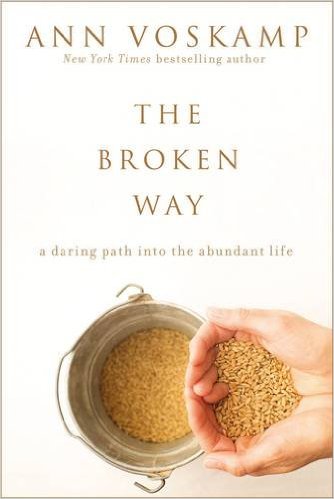
Ann Voskamp’s book The Broken Way wrecked me … in a good way! Ann shows us how Jesus steps into our brokenness, and how He then prepared us to take His love into other people’s brokenness. It’s a fantastic book, so you really should check out my book review by clicking here.

“I am not the mistakes I have made; I am the righteousness He has made. I am not the plans I have failed; I am the perfectness He has finished. I am not the wrongs I have done; I am the faultlessness He has been. I am not the sins I have chosen; I am chosen by the Beloved, regardless of my sins. In Christ, I am chosen, accepted, justified, anointed, sealed, forgiven, redeemed, complete, free, Christ’s friend, God’s child, Spirit’s home.”

“You’ve got to give your gifts or they may become your idols.”

“The thread of your life becomes a tapestry of abundant colors only if it ties itself to other lives. The only way to strengthen the fabric of society is to let the threads of your life break away to let Christ, who is in us, weave around other threads. … The strong must disadvantage themselves for the weak, the majority for the minority, or the community frays and the fabric breaks.”

“We will be known for our actual fruits, not the intentions of our imaginations.”

“Don’t we all have to unlearn fear before we can truly learn to love?”

“Jesus comes to give you freely through His passion what every other god forces you to try to get through performance.”

“Compassion says there will only be abundance for me when there is abundance for you.”

“Instead of flexing His muscle, Jesus surrendered His muscle to the nail. Instead of leveraging His position, He leveraged Himself out on a Cross. He made sacrifice His default position. Instead of stonewalling people with His authoritative power, He laid down His authority, lay down in a tomb, lay in a suffering death till the stone was rolled away.”

“The focus of God’s people is not to create explanations for suffering, but to create communities around suffering, co-suffering communities to absorb suffering and see it transform into cruciform grace.”

“Suffering is not a problem that needs a solution as much as it’s an experience that needs compassion.”

“Faith is confidence in the kindness of God, no matter the confusion of circumstances.”

You can read other quotes I’ve shared from The Broken Way here and here.

Thursdays With Oswald—What Does It Mean To ‘Confess’ Christ?

Oswald ChambersThis is a weekly series with things I’m reading and pondering from Oswald Chambers. You can read the original seed thought here, or type “Thursdays With Oswald” in the search box to read more entries.

What Does It Mean To ‘Confess’ Christ? 

     We receive the Spirit of Christ as a gift, but we do not receive His mind, we have to construct that [see Philippians 2:5], and this is done in the same way that we construct the natural mind, viz., by the way our disposition reacts when we come in contact with external things. …  

     “You call Me Master and Lord, and rightly so, for that is what I am”; but does it mean any more to us than the mere saying of it? “Now that I, your Lord and Teacher, have washed your feet, you should do as I have done for you” and we cannot do it by sentiment. It was in the hour when Jesus knew “that the Father had put all things under His power, and that He had come from God and was returning to God” that He began to wash the disciples’ feet; and it is when we realize our union with Jesus Christ as our Lord and Master that we shall follow His example. [see John 13:1-4, 12-15] … 

     To “confess” Christ means to say, not only with the tongue, but with every bit of our life, that Jesus has come into our flesh.

From So Send I You

It’s one thing to say, “I am a Christian,” and it’s a completely different thing to live like Christ.

The Holy Spirit will continually bring a Christian into situations where we had the opportunity to develop the mind of Christ. As we develop His mind in us, it will naturally mean that we will “confess” Christ with our thoughts, words, and actions.

My prayer is that we will continually be focused on our Christ-like “confession.”

Handling Tough Texts

How do you handle a hard passage in the Bible? Peter wrote this about Paul, “His letters contain some things that are hard to understand….” But if we don’t take the time to wrestle with that passage, Peter says this is what happens next: “…which ignorant and unstable people distort, as they do the other Scriptures, to their own destruction” (2 Peter 3:16).

So here’s a 5-step plan I use when I am working through a challenging passage of Scripture.

  1. Ask the Holy Spirit to help you

All Scripture is inspired by the Holy Spirit (2 Timothy 3:16), and the same Holy Spirit lives in a Christian (1 John 2:20). Think about that: the same Holy Spirit that inspired an author to write the words of Scripture is the same Spirit that will illuminate them to you!

  1. Read the difficult passage in context

We will make our task much easier when we “zoom out” from the difficult text and read the whole passage surrounding the difficult verse/phrase. Perhaps we need to “zoom out” even farther to understand why the whole chapter or book was written.

  1. Identify the parts that are clear

Start off by identifying the parts that you do understand, and then see what light that shines on the tricky text.

  1. Cross reference with other Scriptures

Never, ever, ever draw a conclusion from just one passage of Scripture. Paul reminded his audience that he used the “whole counsel of God’s Word” (Acts 20:27) in forming his sermons. If the challenging passage contains an Old Testament passage, look it up; if it references an historical event, read that history. I also like to use biblegateway.com’s excellent search feature to find cross references.

  1. Draw conclusions on what appears to be the main point

Only after you have done step #1-4 should you attempt to draw some conclusions. You will set yourself up for error if you draw a conclusion first, and then try to find other texts in the Bible that agree with you.

The Apostle Peter writes something rather challenging in his first letter. In fact, Martin Luther said this about 1 Peter 3:18-22: “A wonderful text is this, and a more obscure passage perhaps than any other in the New Testament, so that I do not know for a certainty just what Peter means.” If you would like to see how I walk through the 5-step plan on this “obscure passage,” please check out the video below.

If you’ve missed any messages in this series, you may find the complete list by clicking here.

10 Quotes From “As Kingfishers Catch Fire”

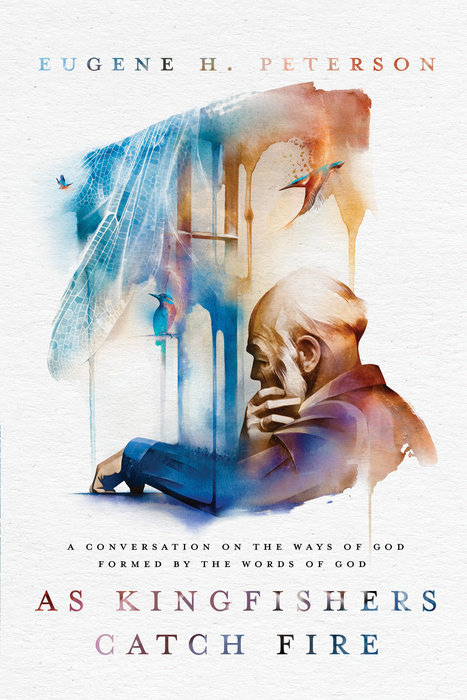
As Kingfishers Catch Fire is a collection of 49 sermons from Eugene Peterson. Check out my full book review by clicking here. Below are a few quotes that caught my attention.

“The Christian life is the lifelong practice of attending to the details of congruence—congruence between ends and means, congruence between what we do and the way we do it, congruence between what is written in Scripture and our living out what is written, congruence between a ship and its prow, congruence between preaching and living, congruence between the sermon and what is lived in both preacher and congregation, the congruence of the Word made flesh in Jesus with what is lived in our flesh.”

“Science and religion are opposites, the way your thumb and forefinger are opposites: if you are going to get a grip on things, you need them both.”

“Friendship is not a way of accomplishing something but a way of being with another in which we become more authentically ourselves.”

“Naming an event a miracle doesn’t mean we can’t understand it. It means we can’t anticipate it. It means we can’t reproduce it. We cannot control it. There is more going on then we can comprehend.”

“There are people today who mistakenly look at those [Ten] Commandments as restrictive, not realizing that for those who first heard them—and for those who hear them still, in faith—they provide for and preserve the values of the free life. The reality and truth of God is protected from commercialization and manipulation. Human life is honored. The dignity of work is protected. Close personal relationships are preserved. Truth is respected. Each of the commands articulates a reality and a value that protects a free life.”

“Aaron made a god, a golden calf. At that moment Aaron quit being their pastor and became their accomplice. There are some people who are always looking for a religion that makes no demands and offers only rewards, a religion that dazzles and entertains, a religion in which there is no waiting and no emptiness. And they can usually find someone like Aaron who will help them make it up, some sort of golden calf religion.”

“Acts of love cannot be canned and then used off the shelf. Every act of love requires creative and personal giving, responding, and serving appropriate to—context specific to—both the person doing the loving and the person being loved.”

“Our habit is to talk about God, not to Him. We love discussing God. The psalms resist these discussions. They are not provided to teach us about God but to train us in responding to Him.”

“The Christian life is not, in the first place, something we do. It consists of the healthy and mature formation of our lives by the Spirit, the Holy Spirit. Christian living goes off the rails badly when it is conceived as a program or routine that we engage in or skills that we master.”

“In prayer we do not act. God does. In prayer we do not develop a technology that sets the gears and pulleys of miracle in motion. We participate in God’s action. ‘Not my will but Yours.’”

13 Introspective Questions From “Longing For A Changed World”

As Ralph Lehman made his case for Christian to (re)establish a prayer focus for revival in his book Longing For A Changed World, he asked several penetrating questions. Here are a few of them for you to consider.

“[Josiah’s revival] was one revival that began with the leaders of government. Are we praying for our leaders?”

“Our government has entered many areas that were once considered to be the Church’s sphere of ministry. How can we lead our churches back into these areas?”

“Have you considered that you are grieving the Spirit when you deprive Him of conversing with God by choosing not to pray?”

“As men of prayer, should we not strive to be like the great prayer warriors of the Bible?”

“Tertullian, a church father who lived in the Roman Empire around 200 A.D., stated that the Roman emperor and his armies benefited greatly from the prayers of the Christians who interceded on their behalf. Can we present the same argument to our political leaders today?”

“What would we be willing to leave or to set aside for the sake of more time in prayer, seeking the Kingdom and righteousness of God?”

“Do we seek the Lord of revival, or merely desire His blessings?”

“If we do not enjoy God’s presence, through His Word and prayer, we are missing the true blessing God intends for us—the blessing of Himself. If we will not seek the presence of God day by day, how can we expect Him to go with us in our daily lives?”

“If God was willing to take the Israelites into the Promised Land without His presence [Exodus 33:3-4], what does this say to the proponents of the ‘health and wealth’ gospel?”

“Even though we have been blessed immeasurably by living here in the United States, do our hearts long for God’s rule to be acknowledged in our land? Do we yearn to abide in His presence? Or are we idle in our contentment with the milk and honey?”

“Sometimes, our areas of giftedness become spheres where we fail to ask God for strength. Have you considered your strengths may be the very areas that satan exploits?”

“Are we praying for revival, are we also praying that we would conduct ourselves in such a way that the world would take notice, even if this meant for us to suffer?”

“Is the God of today’s church big enough to surprise us?”

You can check out some other quotes from Longing For A Changed World by clicking here, and my full book review is available here.

If (book review)

Amy Carmichael was a committed follower of Jesus Christ! She served as a missionary in India, where she operated an orphanage, for 55 years. During all that time, she never took a furlough, but remained at her post, faithfully loving Indian children with God’s love. She wrote a number of books, but perhaps the most hard-hitting is a little book simply called If.

This isn’t a book for everyone. In fact, Amy herself wrote, “It is clear, I think, that such a booklet as this is not meant for everyone, but only for those who are called to be undershepherds.” By ‘undershepherds,’ Amy is referring to those who feel God has called them into full-time vocational ministry.

(A little side-note. I feel the Bible is clear that all followers of Christ are to be involved in ministry [see Ephesians 4:11-16], but God has appointed some to positions where their ministry is also their vocation. These ‘undershepherds’ [see 1 Peter 5:2-3] will have to give account to God for the handling of their vocational ministry [Hebrews 13:17]. It is to these folks that Amy writes.)

Amy set the bar high for herself. She expected to be continually growing in her level of commitment to Christ, and she expected that her outward life would continually show greater devotion to her Savior. If comes out of Amy’s personal introspection in the Holy Spirit’s presence on how she was progressing in her faith-walk with God.

If is written as a series of challenges that all follow the same format: “If I don’t measure up to God’s standard in this area … then I know nothing of Calvary love.” I realize this sounds challenging. In fact, this book smacked me right between the eyes! This is why If is only for a small segment of people.

Thursdays With Oswald—How God Prepares Us For His Service

Oswald ChambersThis is a weekly series with things I’m reading and pondering from Oswald Chambers. You can read the original seed thought here, or type “Thursdays With Oswald” in the search box to read more entries.

How God Prepares Us For His Service 

     Preparation is not something suddenly accomplished, but a process steadily maintained. It is easy to imagine that we get to a settled state of experience where we are complete and ready; but in work for God it is always preparation and preparation. … 

     In writing to the Philippians Paul mentions two “perfections”: “not as though I…were already perfect” (3:12); “Let us therefore, as many be perfect…” (3:15). The first refers to the perfection of attainment; the second to the perfection of adjustment to God. … When we are sanctified, we are perfectly adjusted to God, but we have done nothing yet, we are simply perfectly fit to begin. … Think of Christ’s eyes fastening on us and pointing us out before God as He says—“Father, that is My work; that is the meaning of Gethsemane, that is the meaning of Calvary. I did all that man’s work in him, all that woman’s work in her; now You can use them.” … 

     When we are first put right with God, it is the great general principles that are at work, then God begins to make the conscience sensitive here and there. Don’t quench the Spirit. His checks are so tiny that common sense cannot detect them. … When He checks, never debate, but obey at once. … He does not come with a voice like thunder, with strong emphatic utterance—that may come ultimately; but at the beginning His voice is as gentle as a zephyr. At the same time it carries an imperative compulsion—we know the voice must be obeyed. The “go” of preparation is to let the Word of God scrutinize.

From So Send I You

When we invited Jesus into our lives to be our Lord and Savior, we are perfectly ready to be used in service for God.

Now begins the saint-ifying process. The Holy Spirit will gently, but insistently, point out what we need to address. The more sensitive we are to those “checks,” and the quicker we are to obey the Spirit’s prompting, the better prepared we are to answer God’s call to “go.”

Are you letting the Voice of God scrutinize you, so that you can be prepared to be used in service for Him?

Is Sin For Me Sin For You?

In our recent Q Series, I was asked a great question: If God has told me that something is a sin for me, does that mean that it is a sin for everyone?

Using a personal example from my life, and using two biblical examples (in Samson and John the Baptizer) I shine some light on this question …

You might also be interested to check out some other Q&As regarding the Bible, end-times prophecy, parables, and prayer.

Saturday In The Psalms—Delight & Meditate

Blessed is the man who does not walk in the counsel of the wicked or stand in the way of sinners or sit in the seat of mockers. But his delight is in the law of the Lord, and on His law he meditates day and night. (Psalm 1:1-2)

This chapter sets the agenda for the entire book of the Psalms by contrasting those whose ear is to the culture, and those whose ear is to God.

The one who prospers in God’s kingdom is one who delights in God’s Word and meditates on it.

Delights to know God more, to grow in Him more, to walk in His ways more. It is his passion. It sets his agenda.

Meditates prayerfully on God’s Word. He is constantly evaluating his world, his thoughts, his decisions on what God has revealed in Scripture. It is in meditation that the Holy Spirit Who inspired the Word can now illuminate it to the particular situation in which the godly man finds himself.

Delight and Meditate—it’s a Your-kingdom-come-Your-will-be-done lifestyle that not only pleases God, but brings His blessings on the delightful meditator’s life.

Thursdays With Oswald—Spiritual Honor

Oswald ChambersThis is a weekly series with things I’m reading and pondering from Oswald Chambers. You can read the original seed thought here, or type “Thursdays With Oswald” in the search box to read more entries.

Spiritual Honor

     “I am a debtor to Greeks and to Barbarians” (Romans 1:14). Do I feel this sense of indebtedness to Christ Paul felt with regard to every unsaved soul I meet, every unsaved nation? Is it a point of spiritual honor with me that I do not hoard blessings for myself? The point of spiritual honor in my life as a saint is the realization that I am a debtor to every man on the face of the earth because of the Redemption of the Lord Jesus Christ.” …

     Am I doing anything to enable Jesus Christ to bring His Redemption into actual manifestation in other lives? I can do it only if the Holy Spirit has wrought in me this sense of spiritual honor. When I realize what Jesus Christ has done for me, then I am a debtor to every human being until they know Him too.” …

     Is it my conviction among men that every man can be presented “perfect in Christ Jesus”? Or do I allow men’s sins and wrongs so to obliterate the power of the Redemption that I sink under them?

From So Send I You

Some powerful questions for every Christian to honestly answer:

  • Does my salvation mean enough to me that I am burning with passion for others to know this salvation too?
  • Am I hoarding God’s blessings, or am I passing them on?
  • What am I doing to make sure everyone knows about Jesus?
  • Do I write some people off as “unsavable,” or do I believe Jesus can reach every single person?
  • Am I living like I really believe that?