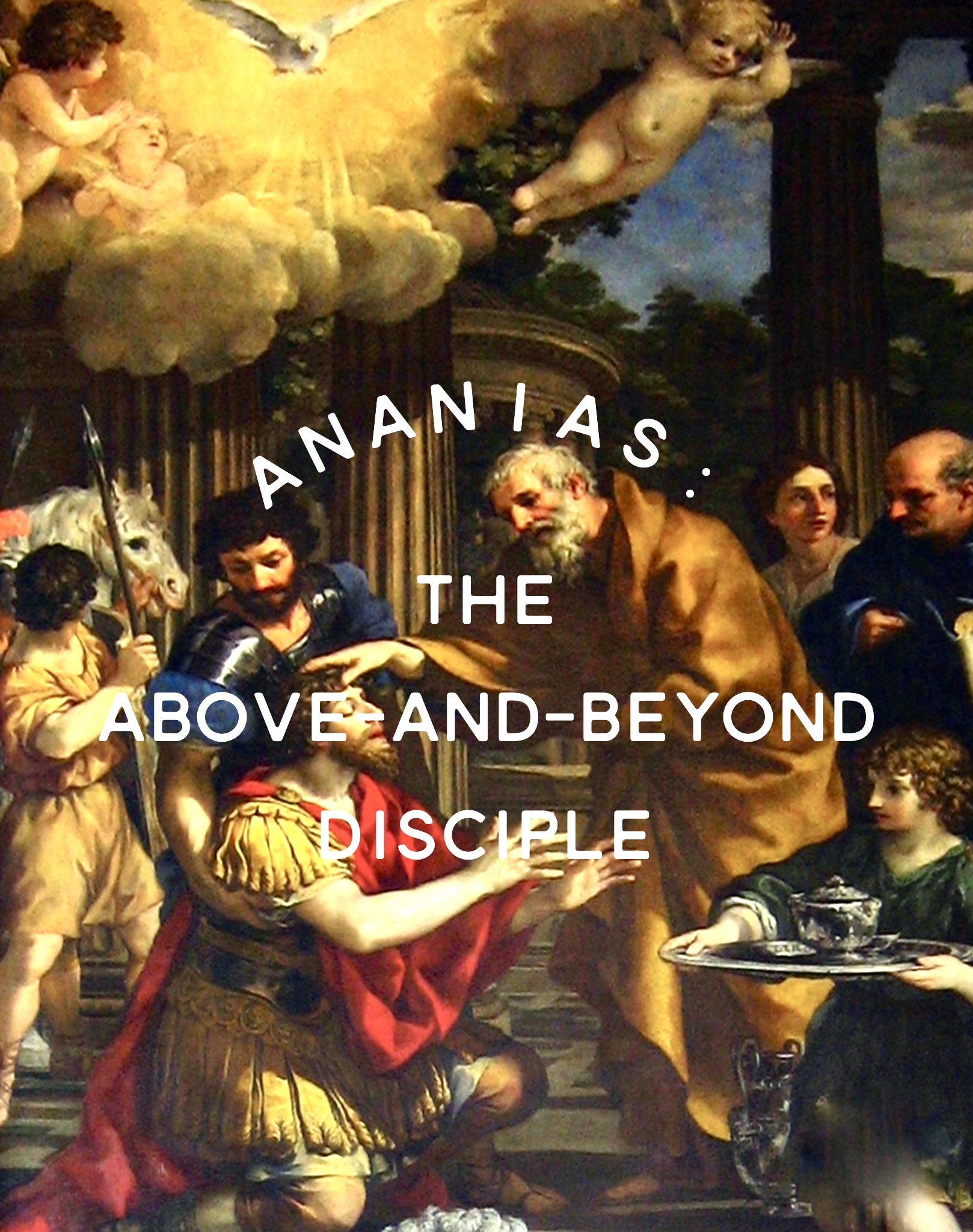
The Above-And-Beyond Disciple

Listen to the podcast of this post by clicking on the player below, and you can also subscribe on AppleSpotify, or Audible. 

It is nearly impossible to overstate how fearful Christians in the first century were of the Jewish zealot named Saul of Tarsus. Saul called himself “extremely zealous for the traditions of my fathers” (Galatians 1:14) as he sought to seek out and destroy all who were followers of The Way. 

(Check out all of the verses in this post by clicking here.)

Not only was he personally bent on his ruthless mission, but he had the full sanctioning of the Sanhedrin (Acts 8:3, 9:1-2). This was the religious body that had successfully goaded Pontius Pilate into crucifying Jesus. 

So you can imagine the apprehension in Ananias’ heart when Jesus calls him to visit with Saul after he had encountered Jesus for himself. Ananias said, “I’ve heard all about this man and the harm he has done. And I also know he has come to my city with the authority to drag Christians off to prison” (Acts 9:13-14). 

Ananias’ interaction with Jesus seems to me to echo the prayer that Jesus prayed in the Garden of Gethsemane. It is as if Ananias is praying, “Is there another way? But not my will but Yours be done, Lord” (see Luke 22:42). 

Ananias is called a disciple of Jesus (Acts 9:10), and Paul even refers to him later as “a devout observer of the law and highly respected by all the Jews” (22:12). In other words, Ananias is an early church leader. What he does or doesn’t do here will set the pace for other Christians. 

So I love the fact that Ananias didn’t just begrudgingly do only what Jesus instructed him, but he said and did only what Christ’s love could empower him to say and do. 

Jesus told Ananias to lay his hands on Saul and pray for the restoration of his sight (9:12). Ananias did more. He laid his hands on him in such a loving way (9:17), that Luke uses the same word as when Jesus laid His hands on people for their healing (c.f. Luke 13:13). Ananias even called him “brother Saul” (9:17). 

Jesus told Ananias to simply pray for Saul’s physical healing, but Ananias did more: he prayed for Saul to be baptized in the Holy Spirit as well (9:17, 22:13). 

Jesus told Ananias what His plan was for Saul’s ministry, but He didn’t tell Ananias that he had to repeat that to Saul. Ananias did more: He reaffirmed to Saul what Jesus had already said to him and encouraged him to get up, be baptized, and began to do what Jesus had told him to do (9:15-16, 22:14-16). 

When Ananias called Saul “brother,” he used the term that fellow Christians used for each other (Philippians 4:1; Hebrews 2:11; 1 John 3:14). That means that Ananias is the first one to recognize the genuine conversion of Saul the persecutor to Paul the Christian. 

When the love of Jesus is in us, we will not be looking for ways to begrudgingly obey what Jesus tells us, but we cannot wait to lavishly do more loving things out of the overflow of Christ’s love in us. What a fantastic example Ananias has give all of us who call ourselves Christians! 

►► Would you please prayerfully consider supporting this ministry? My Patreon supporters get behind-the-scenes access to exclusive materials. ◀︎◀︎

What’s Your Passion?

Listen to the podcast of this post by clicking on the player below, and you can also subscribe on AppleSpotify, or Audible. 

A quick recap: We are all gifted by God, but we typically restrict ourselves to a comfort zone which is much smaller than our God-given gift zone. In order to maximize our impact for the Kingdom of God, we are going to have to get uncomfortable with staying comfortable—we are going to have to trust God as we push out further into our gifts. 

Last week I gave you a homework assignment to think about the things you love to do. Why do we need to know this? Because it is one of the indicators of our areas of giftedness. 

In the whole carrot-versus-stick discussion, you will find that most people are motivated by reward way more than they are by the fear of punishment. Look at how these God-fearing men were motivated by the God’s rewards:

  • David—1 Samuel 17:26-27, 29-30 
  • Paul—1 Corinthians 9:24; 2 Timothy 4:8 
  • Jesus—Hebrews 12:2; Philippians 2:9-11 

(Check out all of the Scriptures in this post by clicking here.)

Who’s more likely to get the reward: the one who loves what they are doing or the one who hates what they are doing? We are more likely to stick with what we love doing, and you are going to love doing what you are gifted by God to do. 

Why we do what we do is much more important that what we do (Isaiah 1:11, 13, 15; Matthew 7:22-23). 

We have been gifted by God to do great things. When we do those great things, we are rewarded and it brings God glory. That realization should answer the question of why we do what we do (Ephesians 2:10). 

The way we see the world, what motivates us, and how we act are all determined by our gifts. We are working on the same Great Commission, but how we live that out will be different because of our different gifts. 

In the Old Testament, the saints wanted Zion to be strong and God-glorifying: 

  • David fought battles and wrote worship songs 
  • Solomon gave wise proverbs 
  • Josiah brought about reforms 
  • Ezra encouraged the Israelite governor and high priest 
  • Daniel encouraged the Babylonian rulers 
  • Nehemiah built the wall

In the New Testament era, the saints should all want the Body of Christ to be strong and God-glorifying. Toward that goal, we still need warriors, worshipers, wisemen, reformers, teachers, counselors, workers. 

Toward that goal, we all have a part to play (Ephesians 4:12). Check out the example of Paul in…

  • …Thessalonica: Paul was in the synagogue on three Sabbaths (Acts 17:1-2; 2 Thessalonians 3:8)  
  • …Corinth: Paul was synagogue on the Sabbath days, but after Silas and Timothy arrived, Paul was able to be preaching every day for 18 months (Acts 18:1-5, 11) 

What’s the difference? Silas and Timothy used their gifts so that Paul could use his. Without the “enzyme” of Silas and Timothy’s gifting, the whole Body of Christ would have been impoverished. 

One of the things that will help your spot your areas of giftedness is noticing what you are passionate about—What do you love to do? 

Let me give you three things to consider:

  1. When can I do this again? vs. When will this be over? 
  2. When I do this, I’m tired but fulfilled vs. When I do this, I’m tired. 
  3. I would do this without pay vs. I would rather find something else to do. 

Our prayer should echo what Paul prayed:

For this reason, since the day we heard about you, we have not stopped praying for you. We continually ask God to fill you with the knowledge of His will through all the wisdom and understanding that the Spirit gives, so that you may live a life worthy of the Lord and please Him in every way: bearing fruit in every good work, growing in the knowledge of God. (Colossians 1:9-12)

If you’ve missed any of the messages in our series Living in Your Gift Zone, you can find them all here. 

►► Would you please prayerfully consider supporting this ministry? My Patreon supporters get behind-the-scenes access to exclusive materials. ◀︎◀︎
Eternal > Temporal

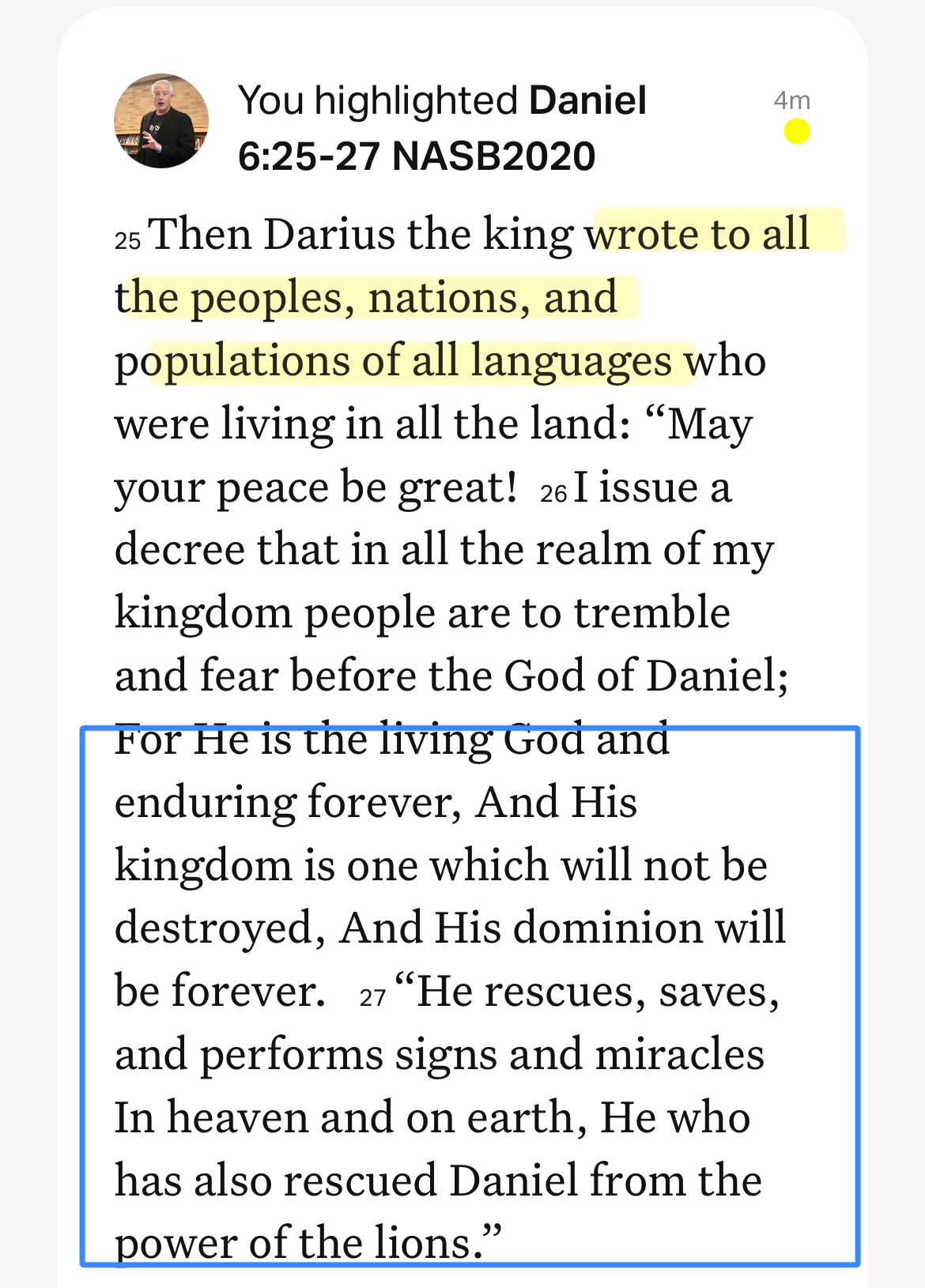
Then Darius the king wrote to all the peoples, nations, and populations of all languages who were living in all the land: “May your peace be great! I issue a decree that in all the realm of my kingdom people are to tremble and fear before the God of Daniel; for He is the living God and enduring forever, snd His kingdom is one which will not be destroyed, snd His dominion will be forever. He rescues, saves, and performs signs and miracles in heaven and on earth, He who has also rescued Daniel from the power of the lions.” (Daniel 6:25-27)

In order for God’s glory and fame to be proclaimed “to all the peoples, nations, and populations of all languages,” Daniel had to spend a single night with ravenous lions. 

When you are facing adversity—even death threats—don’t ask, “God, why is this happening to me?” Instead you can declare, “God, You are going to be highly glorified among all the people! I will remain faithful and steadfast in my trust in You!” 

The extent to which God will reveal His glory is not worthy to be compared to the single night we have to endure. “For I consider that the sufferings of this present time are not worthy to be compared with the glory that is to be revealed to us” (Romans 8:18). 

I talk more about Darius’ change of heart in my post Why We Pray For Government Leaders.

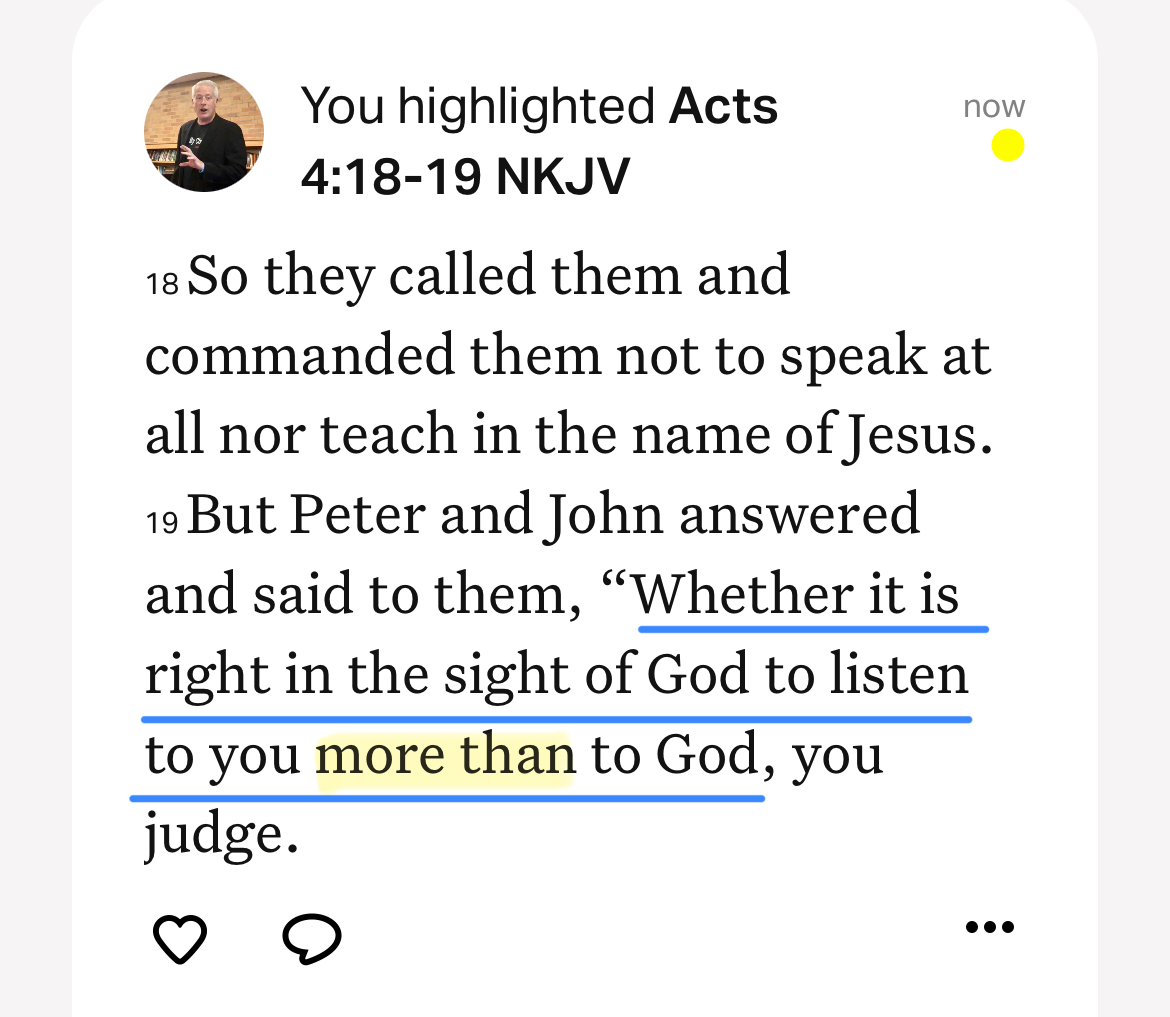
Dr. Henry Halley points out another way the eternal trumps the temporal: “There is no authority apart from God. When human authority rejects God’s authority, it becomes twisted and loses its right to demand compliance (Acts 4:19-20, 5:29). God’s people are responsible to obey the government because it has been set in place by God [Romans 13:1-2; Daniel 4:17], but when government directs against God’s will, the Giver of all authority has the higher claim on our allegiance. We must resist any command that is against God’s will (Exodus 1; Daniel 3; Hebrews 11:23).”

Reassuring The Timid Soul

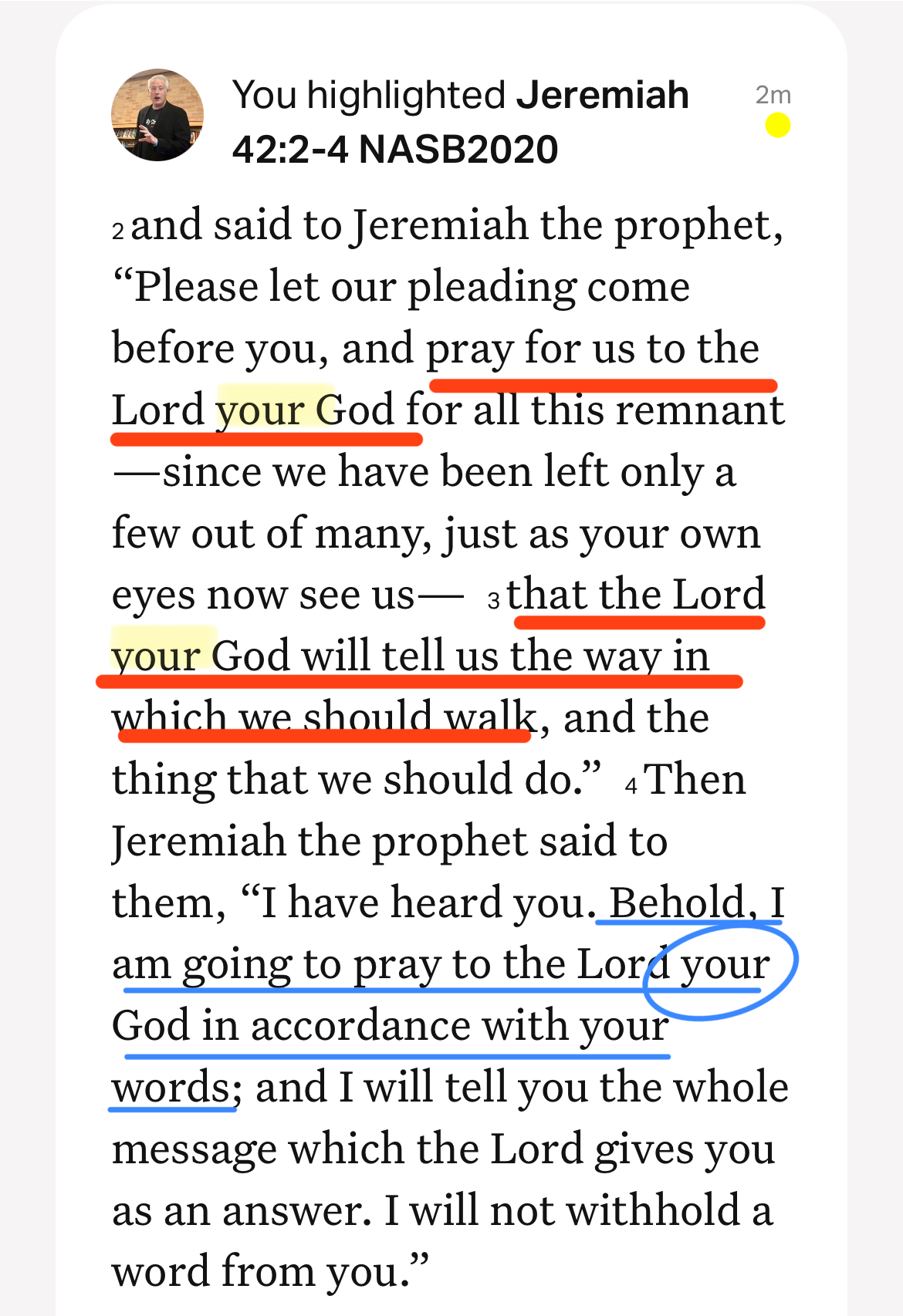
…All the people from the small to the great approached and said to Jeremiah the prophet, “Please let our pleading come before you, and pray for us to the Lord your God for all this remnant—since we have been left only a few out of many, just as your own eyes now see us—that the Lord your God will tell us the way in which we should walk, and the thing that we should do.” Then Jeremiah the prophet said to them, “I have heard you. Behold, I am going to pray to the Lord your God in accordance with your words; and I will tell you the whole message which the Lord gives you as an answer. I will not withhold a word from you.” (Jeremiah 42:1-4)

You can hear the distance that the people felt from God in the words they say to Jeremiah, “the Lord YOUR God.” 

But Jeremiah reassures them that God still sees them and loves them when he responds with the exact same words—not “the Lord my God” (as the people thought he would say) but “the Lord YOUR God.” 

This word of encouragement from Jeremiah helped this same group of people to see God in the right light: “Whether it is pleasant or unpleasant, we will listen to the voice of the Lord OUR God to whom we are sending you, so that it may go well for us when we listen to the voice of the Lord OUR God” (v. 6).

This is a good reminder for all of us that we need to encourage one another whenever we have the opportunity. “Let’s approach [our] God with a sincere heart in full assurance of faith … and let’s consider how to encourage one another in love and good deeds” (Hebrews 10:22, 24).

You may want to check out my post A Unique Look At “Church” for some further thoughts about encouraging our brothers and sisters.

The Serenity Prayer

Listen to the podcast of this post by clicking on the player below, and you can also subscribe on AppleSpotify, or Audible. 

I am a big fan of Alcoholics Anonymous (AA). They are founded on biblical principles. I would paraphrase two of the most important ones as: (1) We need a Savior to set us free and (2) We need friends to lean on. James 5:16 says this as succinctly as any verse: “Therefore confess your sins to each other and pray for each other so that you may be healed. The prayer of a righteous person is powerful and effective.” 

(Check out all of the Scriptures in this blog post by clicking here.) 

AA says: “Often times, a person with substance use disorder may have a need for control that can prevent them from achieving peace of mind. They may feel frustrated that they cannot control the actions of other people and turn to substances like alcohol to control their feelings, even though the control that alcohol provides is a farce. The Serenity Prayer is a gentle reminder that letting go and accepting a loss of control can help put an end to the substance abuse cycle.” 

In light of our series called Is That in the Bible? let’s ask, is the serenity prayer in the Bible. 

No, it’s not, but still there are some very important principles we shouldn’t miss from this prayer. 

The full prayer is—

God grant me the serenity to accept the things I cannot change; courage to change the things I can; and wisdom to know the difference. 
Living one day at a time; enjoying one moment at a time; accepting hardships as the pathway to peace;
Taking, as He did, this sinful world as it is, not as I would have it; trusting that He will make all things right if I surrender to His will;
That I may be reasonably happy in this life and supremely happy with Him forever and ever in the next. Amen.


Should Christians pray a prayer like this? Biblically, there is nothing wrong with Christians praying prayers that have been written by men or women, provided that they don’t contradict the words God has spoken to us. 

Remember James 5:16 that we looked at earlier? The Personalized Promise Bible has a prayer for that verse: 

If I have stumbled in any way, I do not need to fret over it—I can rest in full confidence that the Lord loves me and forgives all of my shortcomings. I also know that sin is a hindrance to my healing. Therefore, if there is any sin in my life I repent of it. I confess my sins to trusted brothers and sisters in Christ, gaining strength and praying in agreement with them so that I will be healed. 

And then they cross-reference about 10 more biblical passages that support this prayer—Psalm 103:1-5; Isaiah 53:4-5; 1 Peter 2:24; Matthew 9:22, 29; 18:19, 20; Mark 11:22-26; 16:18; Hebrews 12:1-3; Galatians 6:1-2. 

In a similar fashion, I see several passages of Scripture that are woven into the serenity prayer. 

“God grant me the serenity to accept the things I cannot change; courage to change the things I can; and wisdom to know the difference.” Proverbs 1:2-3 describes the help God’s wisdom gives us for daily living. 

“Living one day at a time; enjoying one moment at a time.” Jesus taught us to pray each day for our daily bread (Matthew 6:8, 11). 

“Accepting hardships as the pathway to peace.” Jesus also taught us to pray, “Your will be done on earth as it is in Heaven” (Matthew 6:10), and He also prayed a very similar prayer Himself when He was in the Garden of Gethsemane, “Yet not as I will, but as You will” (Matthew 26:39). 

“Taking, as He did, this sinful world as it is, not as I would have it; trusting that He will make all things right if I surrender to His will.” Jesus promised us both trouble in this world and His overcoming power to stand strong in that trouble (John 16:33). 

“That I may be reasonably happy in this life and supremely happy with Him forever and ever in the next. Amen.” Jesus promises eternal rewards that vastly outweigh the trouble we may face in this life (Luke 12:32; Matthew 25:21, 34). 

The bottom line: The Bible is not just a Book to read through but a Book to pray through. ALL Scripture is for ALL servants of God. ALL Scripture is applicable to ALL the circumstances we will ever face in life.  

If something like the serenity prayer—or any other man-made prayer—is based on Scripture and helps give voice to your prayers, use them! But use them as guides to help you begin to form your own prayers from biblical passages you are reading for yourself.

Check out some of the other topics we have covered in this Is That in the Bible? series here.  

►► Would you please prayerfully consider supporting this ministry? My Patreon supporters get behind-the-scenes access to exclusive materials. ◀︎◀︎
Assured Expectation

Listen to the podcast of this post by clicking on the player below, and you can also subscribe on AppleSpotify, or Audible. 

A recent movie set box office records. Many Hollywood commentators are surmising that it is because the unlikely duo in the movie does something so noble at the end of the movie. Throughout the movie one of the main characters takes to calling himself “Jesus.” At the end of this movie, this character and his friend take the full brunt of the evil on them in the hopes of saving the universe. 

Of course, this storyline isn’t new to Hollywood or even in ancient literature. This epic quest is longed for in the human heart, looking for a hero to selflessly sacrifice himself to save everyone else around them. 

The only problem is that these heroes aren’t sure if their sacrifice is actually going to work. 

This, of course, isn’t the case with Jesus. Angels announce before His incarnation that He will save His people. Jesus Himself says, “I will lay down My life for My friends and I will take it up again.” And in the very last book of the Bible we read that before Time even began, Jesus was already seen as the sacrificial Lamb slain for the deliverance of His people. 

This story doesn’t start in Bethlehem, but when John 1:1 says, “In the beginning,” the language there is really saying, “From before there was a beginning, Jesus our Hero already knew the outcome of His selfless sacrifice.”  

We see hints and foreshadowing of this Most Epic Story all throughout history and throughout Scripture. Like in Psalm 132—the longest of the Songs of Ascent (at 18 verses, the next longest song is only half its length). 

(Check out all of the Scriptures in this post by clicking here.) 

The key verse (v. 10) is in the middle: it connects David and Jesus. The words “Anointed One” is one word in Hebrew: Masiah which is Messiah. In the New Testament,  the word Christ also means Anointed One. 

What do we learn in the first half of this song. It opens with the words, “O LORD, remember David…” (v. 1). 

Because this psalmist mentions the same incident that we discussed in Psalm 131, this is another reason why I think David had the incident of moving the ark of the covenant to Jerusalem in mind when he wrote the previous song (see Psalm 132:2-5; 2 Samuel 6:17). The people continued to rejoices as David made arrangements and provided building materials for his son Solomon to build the temple (vv. 6-9). 

Look at how verse 10 connects David to Jesus the Messiah. In verse 2, David swore an oath to the Lord, but he was physically unable to fulfill his promise. In verse 11 (also see 2 Samuel 7:11-16), “The Lord swore an oath to David.” 

God was able to fulfill His promise, which we see in the life, death, resurrection, and  ascension of Jesus, and then in the promised outpouring of the Holy Spirit. On the Day of Pentecost, Peter declares this in his sermon—connecting the work of Jesus to the prophesy of King David (Acts 2:22-36). 

We can sum up the first half of Psalm 132 with the words “Remember David.” And we can sum up the second half of this song of ascent with the words “Remember Jesus.”  

Remember Jesus [the] Christ, raised from the dead, descended from David (2 Timothy 2:8). 

I like this verse from the Amplified Bible: Constantly keep in mind Jesus Christ (the Messiah) as risen from the dead, as the prophesied King descended from David, according to the good news (the Gospel) that I preach.  

David swears an oath (v. 2) but has no power to fulfill it. God swears an oath (v. 11-12) and fulfills it (Luke 1:33; Revelation 11:15). 

David longs for blessings for the priests and saints (v. 10) but has no power to make it happen. God says, “I will” bless the priests and saints (vv. 13-18; 1 Peter 2:5-9; Revelation 1:6). 

All of our longings for a Hero—for salvation, for purpose, for meaning—are fulfilled in Jesus. All of God’s promises for these things are fulfilled in Jesus. All of our life should be lived in this joyful assurance (Hebrews 10:35-39; Revelation 3:11)! 

Not only should we not stumble in the homestretch, but we should live in such joyful assurance of God’s promises that we soar across the finish line! 

If you cannot remember anything else, remember David and remember Jesus. 

Check out all of the other Songs of Ascent by clicking here. 

►► Would you please prayerfully consider supporting this ministry? My Patreon supporters get behind-the-scenes access to exclusive materials. ◀︎◀︎

Links & Quotes

Godly men honor their wives by having eyes only for them. Fellas, if you find your eyes wandering you need to tell yourself, “That’s not mine!” and then quickly put your eyes back where they belong. Check out my full message to men on Father’s Day.

I have lots of new content every week, which you can check out on my YouTube channel.

From a recent article at The Institute for Creation Research: “Astronomers using the James Webb Space Telescope have recently confirmed that two galaxies are extremely distant, with one becoming the new record holder as the most distant galaxy from Earth. … By uniformitarian reckoning, this galaxy existed just 290 million years after the supposed Big Bang, yet it looks too mature for its age. … This new record-breaker is just the latest example of the ‘distant mature galaxy problem’ that has long plagued the Big Bang model.” These galaxies are all the masterpiece of one Creator! Here is another resource from a biblical perspective that outlines what the “in the beginning” moment (Genesis 1:1) may have looked like.

“Give me the preacher who opens the folds of my heart; who accuses me, convicts me, and condemns me before God; who loves my soul too well to suffer me to go on in sin, unreproved, through fear of giving me offence; who draws the line with accuracy, between the delusions of fancy, and the impressions of grace; who pursues me from one hiding place to another, until I am driven from every refuge of lies; who gives me no rest until he sees me, with unfeigned penitence, trembling at the feet of Jesus; and then, and not till then, soothes my anguish, wipes away my tears, and comforts me with the cordials of grace.” —Samuel Pearce

Matthew Emadi writes, “The New Testament quotes Psalm 110 more than any other Old Testament passage. The apostles and the early church loved Psalm 110 for its majestic depiction of the Lord Jesus Christ and His reign over all nations.” Here’s how to read Psalm 110 in light of the words and works of Jesus.

J. Warner Wallace, at a Q&A session, answers questions about why some Bible translators have marked a couple of passages as unreliable, and why some books that claim to be authentic accounts aren’t included in the canon of Scripture. 

I always love when archeological discoveries confirm once again the historicity of the Bible! Here is an archeological biography of Esarhaddon.

“So the writer [of the Book of Hebrews] urges his readers, as part of being faithful to Him Who called them, to consider Jesus, to strive for the glory of Jesus, and to fix their minds on Jesus as the key to knowing daily strength for faithfulness (Hebrews 12:1-2). What does this entail? … The writer of Hebrews admits that he learned to look to Jesus by paying attention to those who had known Him, listening carefully to their words, and laying hold on them with faith (Hebrews 2:1-4). As he heard the apostles and studied the Scriptures of the Old Testament, the picture of Jesus presented there began to become increasingly clear. … The lesson is plain: Jesus is being revealed in the Scriptures of the Old and New Testament. Wherever we read or study in the Scripture, Jesus is present, making Himself known. We can see Jesus throughout the Bible, and consider Him as He is presented to us, in all His majesty, beauty, and power. Our responsibility is to read the Bible in such a way as to recognize what God is revealing about His Apostle and our High Priest, Jesus Christ.” —T.M. Moore

Continuing To Walk With God

Listen to the podcast of this post by clicking on the player below, and you can also subscribe on AppleSpotify, or Audible.

My leadership podcast partner Greg Heeres and I were discussing a leader’s epitaph. Greg asked me an unusual question: What did I want to be said on my own epitaph?

Take a listen to this snippet from The Craig and Greg Show—

The story I told about Enoch can be found in Genesis 5:3-24 and Hebrews 11:5-6. 

I’ve also blogged a couple of times about Enoch: “And then he died…” and “Walking intimately.” 

You can watch the full Craig and Greg Show episode that this clip from by clicking here.

►► Would you please prayerfully consider supporting this ministry? My Patreon supporters get behind-the-scenes access to exclusive materials. ◀︎◀︎

Right Remembering

Listen to the podcast of this post by clicking on the player below, and you can also subscribe on AppleSpotify, or Audible. 

Jesus hung on the Cross for about 6 hours. He was mostly silent during this time—His seven statements from the Cross would have taken less than a minute to say them all back-to-back. 

He hung silently and thoughtfully. I know He was thoughtful because John records, “Later, knowing that all was now completed, and so that the Scriptures would be fulfilled, Jesus said, ‘I am thirsty’” (John 19:28). 

Movie directors will often show a flashback scene where their character looks back to remember what came before. I think during this silent time on the Cross, Jesus reviewed His public ministry. He reviewed every jot and tittle of every promise His Father had made, and He knew that each and every one had been completed.  

This culminating event on the Cross was the fulfillment of the big picture that God had been painting all along. The system of sacrifices centered in the tabernacle or the temple had been trying to show us something. 

There were daily sacrifices and annual sacrifices; there were sacrifices for willful sins and sacrifices for unintentional sins; there were sacrifices for priests and for laypeople. Day after day, week after week, month after month, year after year, decade after decade, century after century these sacrifices continued, never feeling like the work was finished. 

These practices were only a shadow, but a shadow that foretells the Reality—

The law is only a shadow of the good things that are coming—not the realities themselves. For this reason it can never, by the same sacrifices repeated endlessly year after year, make perfect those who draw near to worship. … The reality, however, is found in Christ. (Hebrews 10:1; Colossians 2:17) 

(Check out all of the Scriptures in this post by clicking here.)

Jesus knew that He had come as the Reality (John 13:1), but before this final event on the Cross that would fully reveal the Reality, Jesus had one last thing to do: He wanted to share a final meal with His friends (Luke 22:7-15). 

Jesus said that eagerly desired to eat the Passover meal with them. This Passover remembrance looked backwards to the deliverance from Egypt and was celebrated year after year, decade after decade, century after century. 

The events were so long ago that they may have seemed like fading shadows to those who were celebrating this meal over a millennia after the fact. Jesus brought Reality. 

Jesus knew He was the most powerful Person on earth, but He also knew that He had come to serve (Mark 10:45; John 13:3-5). To demonstrate His servanthood…

  • He washed the feet of His betrayer 
  • He washed the feet that would run away from Him in terror 
  • He prepared them for what was coming 

Peter boldly declared that he would never run away, and Matthew and Mark record that all of the other disciples declared the same thing—(Luke 22:33; Matthew 26:35; Mark 14:31). But Jesus knew the prophecy that said, “I will strike the Shepherd, and the sheep of the flock will be scattered (Matthew 26:31). 

So Jesus prepared them by praying for them, and He prepared them by showing them the Reality of all those daily, weekly, monthly, annual, and Passover sacrifices (Luke 22:17-20, 31-32). 

Jesus was the completion of this sacrifices (Hebrews 7:26-28, 9:11-14)! 

The prophecy God gave in Jeremiah was completed in Christ’s broken body and spilled blood on the Cross—“For I will forgive their wickedness and will remember their sins no more” (Jeremiah 31:31-34; Hebrews 8:12). 

The purpose of this Last Supper—this meal that completes so many jots and tittles—is to remember. The devil wants you to remember what YOU did. Jesus wants you to remember what HE did. 

Good Friday and the celebration of Communion helps us remember correctly that Jesus paid in-full the penalty for our sins, so now our forgiven sins are forgotten sins. The moment we sin, there is already the remedy for our sins that has been paid for. We repent, ask forgiveness, and receive His immediate cleaning. 

Such amazing love! 

If you have missed any of the messages in this series looking at some of the jots and tittles of prophecy that are fulfilled in Jesus, you can check them all out by clicking here.  

►► Would you please prayerfully consider supporting this ministry? My Patreon supporters get behind-the-scenes access to exclusive materials. ◀︎◀︎

Winning Souls, Not Arguments

Listen to the podcast of this post by clicking on the player below, and you can also subscribe on AppleSpotify, or Audible. 

The men who were guarding Jesus mocked Him and beat Him. They blindfolded Him and hit Him again and then demanded, “Prophesy! Who hit You?” And it wasn’t just the physical abuse, but they heaped mocking insult upon mocking insult upon Jesus (Luke 22:64-65). 

All four of the Gospel writers recount how Jesus responded to both the physical and verbal abuse: 

  • To the false charges before the Sanhedrin, Jesus remained silent (Matthew 26:57-63) 
  • To the spitting and hitting by the members of the Sanhedrin, Jesus remained silent (Matthew 26:67-68) 
  • To the physical abuse of the guards, along with their mocking insults, Jesus remained silent (Mark 14:65; Luke 22:64-65) 
  • To the mocking He endured before King Herod, Jesus remained silent (Luke 23:9-11) 
  • To the false charges announced to Governor Pilate, Jesus remained silent (Matthew 27:12-14) 
  • To the insults and mocking thrown His way as He hung on the Cross, Jesus remained silent (Matthew 27:38-44; Mark 15:29-32; Luke 23:35-36) 

His only verbal response was after being slapped in the face by one of the officials in the Sanhedrin. Jesus said, “If I said something wrong, testify as to what is wrong. But if I spoke the truth, why did you strike Me?” (John 18:22-23). 

These are what we call an ad hominem attack. That is attacking the person, instead of confronting the ideas or arguments the person is presenting. 

The self-control of Jesus here is absolutely astounding! Peter records, “When they held their insults [and their fists and their spit] at Him, He did not retaliate; when He suffered, He made no threats. Instead, He entrusted Himself to Him who judges justly” (1 Peter 2:23). 

Even as His trial got underway, Luke records, “the council of the elders of the people…met together, and Jesus was led before them” (Luke 22:66).

Dr. Henry Halley points out that extra-biblical sources have told us that this trial violated at least four of the Sanhedrin’s own rules:

  1. Meeting on the morning of a festival 
  2. Meeting in Caiaphas’ personal residence 
  3. Trying a defendant without defense 
  4. Passing the verdict of a death sentence in one day instead of two days 

I would add a fifth rule which is found in Scripture: At least two witnesses need to be in agreement with their testimony for there to be a death sentence (Deuteronomy 17:6, 19:5; Mark 14:55-59). 

When the Sanhedrin then hauled Jesus before Pontius Pilate, even their charges made before the governor in Luke 23:1-2 were flimsy at best: 

  1. Subversion—there is no proof for this 
  2. Opposing taxes to Rome—this was false (see Luke 20:20-25) 
  3. Jesus was a rival to the Roman throne—not true 

And still Jesus remained almost completely silent! He only spoke when asked a direct question, but He remained silent throughout the false accusations, the verbal taunts, and the physical abuse. 

When I am treated unfairly, when the rules are bent against me, when false charges are lodged against me, I get angry! I want to defend myself! I want to put my accusers or abusers in their place! 

Could Jesus have prevented His arrest? Yes (Matthew 26:53)! 

Could Jesus have defended Himself before the Sanhedrin, Pilate, and King Herod? Yes! 

Could Jesus have come down from the Cross to prove His power? Yes! 

But Jesus wasn’t trying to win a momentary argument; He was winning souls for eternity! 

Jesus came not to be served, but to serve, and to give His life as a ransom for many (Mark 10:45). So, “for the joy set before Him He endured the Cross, scorning its shame, and sat down at the right hand of the throne of God.” 

When anger boils up because of the mistreatment we are enduring, we must “consider Him who endured such opposition from sinners, so that you will not grow weary and lose heart” (Hebrews 12:2-3). 

Like Jesus, let’s not try to win just a momentary argument that may result in the loss of a soul for all of eternity. There is a time to speak and there is a time for silence. As we keep our eyes on Jesus, we will know what time it is. 

(You can check out all of the Scriptures I referenced in this post by clicking here.)

P.S. You may also be interested in a previous blog post Winning the Argument or the Battle or my short video How Should Leaders Handle Pushback. 

►► Would you please prayerfully consider supporting this ministry? My Patreon supporters get behind-the-scenes access to exclusive materials. ◀︎◀︎