4 Tips For Making Better Goals

1 Corinthians 10.31I have noticed a lot of similarities between the September back-to-school rush, and New Year’s Day. Except instead of resolutions, in the fall most people set new goals, or try to readjust their schedules to take advantage of a new season.

This is an excellent idea, and the perfect time to do it.

In a psalm written by Moses, he tells us to understand the value of our days, and be as wise as we can with what we do with each day God has given us (Psalm 90:12).

The Apostle Paul echoes these thoughts:

Be very careful, then, how do you live—not as unwise but as wise, making the most of every opportunity, because the days are evil. Therefore do not be foolish, but understand what the Lord’s will is. (Ephesians 5:15-17)

One way for us to make the most of every day is to wisely set some goals. Here are four tips that I’ve discovered to help me.

(1) The fewer the goals, the better.

Craig Groeschel said, “To do more things, do less things better.” I totally agree. I would suggest limiting yourself to just 1-2 goals at a time. Then put these one or two goals on your calendar first. In other words: Don’t prioritize your schedule, but schedule your priorities.

(2) Don’t fall into the sacred/secular trap.

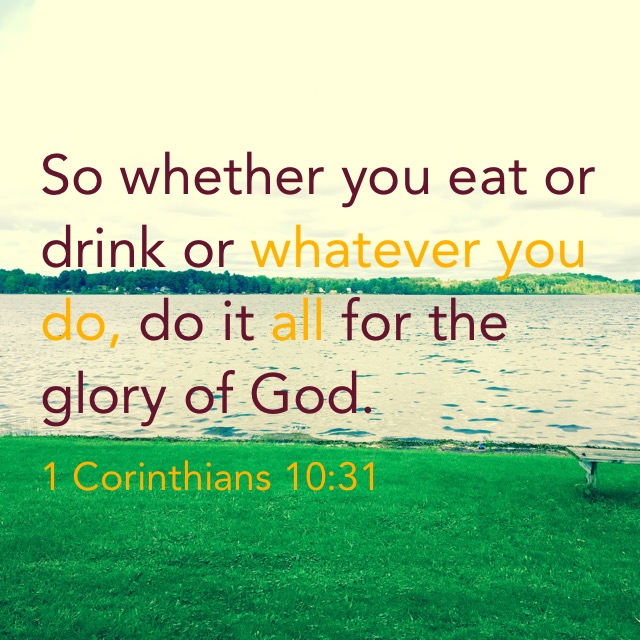
So many people—even Christians—think that there are spiritual goals and non-spiritual goals. But the Bible says, “So whether you eat or drink or whatever you do, do it all for the glory of God” (1 Corinthians 10:31). Every goal you set is a spiritual goal, because every goal should help you live your life wisely, in a way that honors and glorifies God.

(3) Make your goals S.M.A.R.T.

You may have heard these before, but I really like to use them. Make your goals:

  • Specific—not “I want to eat better” but “I want to eat two servings of fruits or vegetables each day.”
  • Measurable—have a way to track your progress toward your goal. How many pages did you read? how many calories did you eat? how many minutes did you work out?
  • Achievable—don’t set a goal to run 5 miles a day if you’ve only been a couch potato. Ramp your goals up little by little in a way that’s achievable for you.
  • Relevant—I like to ask a “so that?” question about each of my goals in make sure it’s moving me forward. “I want to exercise for 20 minute three times per week, so that my blood pressure comes down, so that I can live medicine-free, so that I can….” I think you get the idea. Keep going to make sure your goal is relevant for your life.
  • Time to review—set a date to revisit your goals and see if you need to adjust anything.

(4) Make a “stop doing” list.

You cannot do everything, so focus on the important, not the urgent. And remember not everything can stay on your calendar. For instance, if you want to read more in the evenings, you may have to eliminate some TV time; if you want to exercise in the mornings, you may have to eliminate that second cup of coffee.

Just a couple of verses after Moses challenges us to make the most of every day God has given us, he asks God for His helpMay the favor of the Lord our God rest upon us; establish the work of our hands for usyes, establish the work of our hands.

May God give you wisdom as you make new goals, and may He bless the work of your hands as you implement your new strategies.

7 Tips For A Better Night’s Sleep

Psalm 4.8It’s no secret that being tired can lead to a lot of not-so-nice consequences. Everything from automobile crashes, to poor work performance, to foot-in-mouth statements, to giving in to temptations, to health issues are all traced back to not getting enough peaceful sleep.

But did you know that sweet sleep is something God wants to give you?

Psalm 127 says, “God grants sleep to those He loves.” Guess what? God loves you, and wants you to have a peaceful night’s sleep!

Here are some benefits to getting solid sack time:

  1. Muscles are repaired—the body “turns off” muscles during sleep so they can repair themselves.
  2. The hormone leptin, that regulates your appetite, is adjusted.
  3. Your blood pressure is lowered.
  4. Your heart rate is lowered.
  5. The energy-producing cells we all need are restocked.
  6. Your immune system is re-energized.
  7. Memories are consolidated from short-term memory banks to long-term memories.
  8. The hormones that allow you to concentrate are replenished.
  9. Your “database” of decision-making options is re-calibrated.
  10. Bottom line—you get healthier physically, mentally, emotionally, relationally, and spiritually.

All of this God wants to give to those He loves. “God loves me, so I’m going to sleep peacefully tonight!”

The problem is we often sabotage God’s blessing of sweet sleep by our own poor decisions during the day. So here are seven things you can do to cooperate with God’s blessing of sleep:

  1. Reduce stress. Stress causes your body to release cortisol, which prepares your body for fight-or-flight. This means when you’re trying to quiet down for the night, your body is still screaming, “Go, go go!” Stress is mainly triggered by worrying over things outside of our control, so check out what Jesus said to us about not worrying—Matthew 6:25-34.
  2. Reduce late-day caffeine. Caffeine has a half-life of six hours, so if you are pouring it into your body late in the date, you might fall into bed exhausted but the caffeine is keeping your brain buzzing. As a result, you don’t have the normal deep sleep patterns.
  3. Eliminate emotional caffeine. Arguments with other people release cortisol and adrenaline in your bloodstream. If these disagreements are happening later in the day, your body is fighting against God’s plan for your tranquil sleep. So take care of any disagreements quickly (Ephesians 4:26).
  4. Exercise. Getting some movement into your daily routine flushes cortisol and adrenaline from your bloodstream.
  5. Go to bed and get up at the same time. There’s a reason God made the sun to rise and set at predictable times. Your body also functions best on a predictable schedule.
  6. Reduce “blue lights” close to bed time. The blue light waves of dawn tell our bodies to stop releasing melatonin, the sleepy hormone. The red light waves of dusk tell our bodies to increase melatonin so we can go to sleep. But when we’re staring into the blue light of our phones and tablets, our body is being sent a conflicting signal.
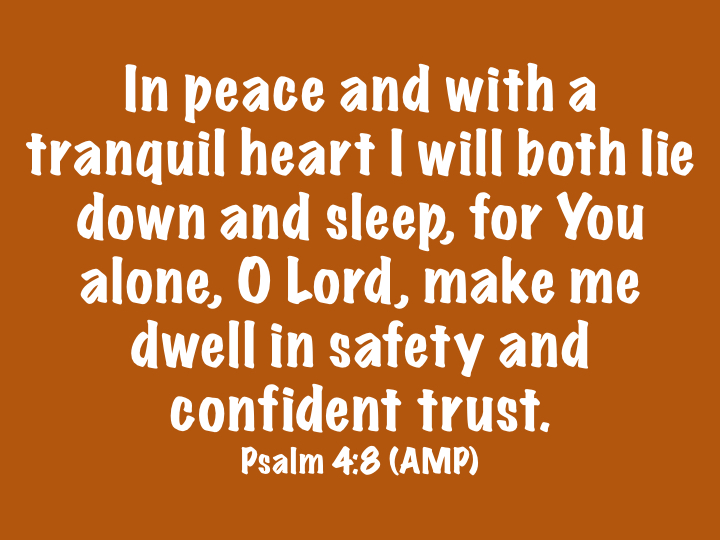
  7. Pray. Two great passages you can pray before bedtime are Psalm 4:8 and Proverbs 3:24. Claim those promises of sweet sleep!

God loves you. He wants to give you the blessing of peaceful sleep. If you’re going to sleep peacefully tonight, make sure you are not sabotaging what God wants to give you.

If you’ve missed any of the messages in this series, you can access the complete list by clicking here

Spend This Week For God

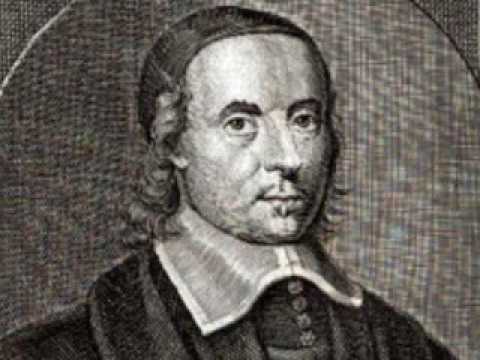
Joseph AlleineJoseph Alleine was very concerned about using every moment of his time to honor God. He wrote, “Give me a Christian that counts his time more precious than gold.” To help him do this, he built in reminders to his weekly journaling and prayer times.

At the beginning of each week he wrote in his journal—“Another week is now before us, let us spend this week for God.”

And each morning he wrote in his journal—“Let us live this one day well!”

The Bible instructs us to:

What can you do this week to make sure that you spend this week for God?

3 Quotes For Uncommen Husbands

Uncommen HusbandsI recently finished a reading plan on YouVersion called Uncommen Husbands. Here are some quotes that I especially appreciated from Brian Goins’ insights.

“Paul indicates there a came a time in his life when he grew out of an immature, boyish love and embraced a more mature, and dare we say, manly love [1 Corinthians 13:11]. If we’re going to love our wives like Christ loved the church, we must let the boy die. And in marriage, that’s far easier said than done. Check out the comparisons below:

  • Boys retaliate quickly when hurt; manly love is patient and kind.
  • Boys require constant affirmation; manly love is not arrogant or rude.
  • Boys stew, stammer, and hold grudges when they don’t get their way; manly love does not insist on its own way; it is not irritable or resentful.
  • Boys try to win every argument; manly love does not rejoice at wrongdoing, but rejoices with the truth.
  • Boys have a short fuse; manly love bears all things.
  • Boys write people off when wronged; manly love believes God’s best for the relationship.
  • Boys lose hope after they’re hurt; manly love always hopes for reconciliation regardless of the pain.
  • Boys expect to be served; manly love endures all things.”

“Paul says, ‘cherish’ our bride like we cherish our own bodies. The word means, ‘bring warmth to,’ and from which we derive our words, thermal and thermostat. … When Paul tells us to love our wives as we love our own bodies, he’s encouraging us to cherish their emotional needs in the same way we cherish our own physical needs. If she’s chilly, it’s our job to warm her up. If she’s steaming, then we help lower the mercury. In other words, the call to cherish means we have to engage when we’d rather shrink back.”

“I’m not sure Paul was the most popular men’s retreat speaker. When he spoke, some fell asleep…and then fell out a window (Acts 20:9). He admitted to the church at Corinth his messages were a bit convoluted (1 Corinthians 2:3-5). Even his buddy Peter threw him under the bus for his ivory tower verbiage (2 Peter 3:15-16).

“Then there was his unfortunate use of the word nourish in Ephesians 5:28. I’m pretty sure every guy in the audience cringed a bit when Paul said to husbands, ‘nourish’ your wife. We may think of nutritious foods, but in Paul’s day, the word often referred to nursing moms. Try and get that picture out of your head.

“When my wife used her God-given equipment to nourish our children I don’t ever remember a time when I asked her, ‘Honey, when was the last time you fed the baby?’ and she responded, ‘Oh, I don’t know, it’s been a few days.’ Because instinctively a mom knows her baby’s nourishment has to be consistent, catered to their tastes, and is crucial for their survival. In the same way, Paul calls husbands to nourish their brides. Is your love consistent? I don’t know about you, but I rarely miss a meal. Unless I’m fasting (for a very short time!), about every 4-5 hours I feed the beast. It’s all too common for our wives to go months between meals: a date night, taking a walk, go on an adventure, a simple text saying, ‘are you tired? You should be because you’ve been running through my mind all day long,’ or a well thought out letter. Nourishment must be ongoing. Is your love catered to her tastes? You’re not going to catch me at the all-you-can-eat tofu bar. Unless I’m on the mission field, I generally nourish my body with stuff I like. It’s common to give love the way we want to receive love. But your love language probably doesn’t match hers. Want to know if you are catering to her ‘love’ taste buds, ask this UNCOMMEN question: ‘Honey, do you feel the depth of my love? Not do you know it, but do you feel it? If not, how can I nourish your soul?’ Do you realize your love is crucial to her survival?”

Horatius Bonar On Spiritual Warfare

Horatius Bonar“The devil’s object in the present day is to persuade us that he does not exist, that we have to fight no such battle, that we need no sword nor shield, that we can do without anything beyond our own human power and skill.” [Ephesians 6:12]

“We must fight. There is no choice here. Whether we will or not, we must fight; for we are thrown upon a battlefield, and if we fight not, we perish. Woe be to the man who thinks there is no need of fighting now; that there is no danger and no enemy. Fight the good fight of faith.”

“satan persuades us that we can combat evil by the appliances of modern intellect and science and civilization. Let us beware. To try to suit religion to the spirit of the age, is to play into satan’s hands. Only divine weapons will avail in a battle with the powers of darkness.”

“Is the Christianity of our day of the lofty kind of which apostolic men have left us so bright an example? Is it not feeble, indolent, self-indulgent, second-rate? Is there in it anything of the presentation of ‘living sacrifices’ to God, which is our acceptable and reasonable service? Are we not seeking our own, not the things which are Jesus Christ’s? Are we not feasting when the world is starving? Are we not at ease in Zion? Are we not sitting still and in luxurious comfort, when many noble and self-sacrificing ones amongst us are rushing into the toil or the war, and, for want of being supported by their fellow Christians, are sinking under the burden and heat of the day?” [Philippians 4:19]

“It is inner warfare. The 7th of the Romans is the description of this, the battle between faith and unbelief, between the spirit and the flesh. This war is private, solitary, with no eye upon the warrior; fought in the closet, on the knees, with the Bible as his weapon. …

“It is outer warfare. The enemies are legion; the world, with all its enmities, snares, pomps, pleasures; satan, with his principalities and powers; both of these in combination hating, persecuting, attacking. This is ‘the great fight of afflictions’ (Hebrews 10:32). Thus it is so far public, before men; ‘we are made a spectacle to the world, and to angels, and to men.’ …

“It is daily warfare. It is not one great battle, but a multitude of battles, constant warring: there is no intermission and no discharge in this war. The enemy wearies not, ceases not; nor must we. We wake to warfare each morning, and go out to warfare each day. Everywhere we find the enemy posted, sometimes openly, sometimes in ambush. The conflict is life-long, and it is daily. …

“It is warfare not fought with human arms. The weapons of our warfare are not carnal. We do not war after the flesh. It is in divine strength; with the sword of the Spirit; clothed in the whole armor of God. …

“It is warfare in which we are sharers with Christ. He first fought the good fight, as the Captain of our salvation, the Lord strong and mighty; the Lord mighty in battle. The inner warfare indeed was not His, but all the rest was. He fought, when here, the same battles as we; and it is into His warfare that we are called to enter.”

All quotes from Horatius Bonar’s book Light And Truth.

12 Quotes From “I Stand At The Door And Knock”

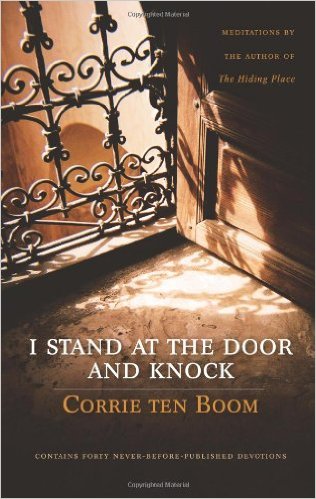
I Stand At The Door And KnockCorrie ten Boom was an amazing woman! To experience the horrors of a Nazi concentration camp, and still retain such a sweet, godly spirit is indeed a miracle of God’s grace. This beautiful spirit of hers come through loud and clear in her book I Stand At The Door And Knock (you may read my book review here). Below are just a few of the many quotes which I highlighted as I read.

“You see, if you and I want to be used, we needn’t rely on ourselves, because it is the Holy Spirit who does it. And that is why we can be at peace in our day-to-day lives. The fact that we wish to be used is a gift from the Holy Spirit in itself.”

“A piece of good advice is to forgive anyone immediately—and I mean immediately— if they say or do something against you. Then the devil won’t have a chance to keep a shadow in your heart.”

“Holiness can bring about a new conflict. We need to take care. The devil wants to lead us into the energy of our inner selves. Preaching yourself, relying on yourself, boasting about your faith, taking pride in your own experiences. And then the devil will say, ‘Revel in your own experiences.’ But that is not right. You should not rely on your past experiences. It may strengthen your faith, but holiness is living out the Jesus Christ living in you.” 

“Imagine, when I had a watchmaker’s shop, you came to me and you bought a gold watch with a gold strap. Imagine that when I wrapped it up for you, I removed the gold strap and hid it. When you came home, you saw that you only had a watch. What would you do? You would say to everybody, ‘Don’t ever buy something from Corrie ten Boom; she doesn’t give you value for money.’ If you and I do not give ourselves entirely to the Lord, we do not give Him the value He has paid for us on the Cross. We were bought at a very high price. That Cross was horrendous. It was an extremely high price to pay for you and me.”

“In my short-sightedness, I thought I had to do everything with my own power, according to my abilities. But everything depends on Hisability, Hispower.”

“The devil may laugh at our plans. He smiles when we are up to our eyes in work. But he quakes when we pray. When we are faithful intercessors he often says to us, ‘Shouldn’t you stop? You have been doing this for such a long time, and can’t you see, the Lord doesn’t listen.’ But he is a liar. Not one of our prayers is lost. … satan laughs when we try hard. He mocks our wisdom, but he trembles when we pray.”

“While I was imprisoned during the war, I knew the Morse code, but it didn’t really help me. What actually supported me was every text and every Christian song I knew by heart. Learning Bible texts and Christian songs by heart is a preparation which we can all do today.”

“Lord Jesus, please forgive us that we so often live a life poor in You, while You suffered so heavily on the Cross so that we would become the King’s rich children. Holy Spirit, open our eyes. Give us a vision, an understanding of our wealth.”

“Religion is no security. The Antichrist will be very religious. A world religion will develop, and he himself will become its god.” 

“Jesus said, ‘Do not let your hearts be troubled.’ Our citizenship is in heaven. We are heaven dwellers. Our home is there.”

“The Bible says, ‘Be filled with the Spirit’ (Ephesians 5:18), which means not only do I have the Holy Spirit, but also does the Holy Spirit have me?”

“We should not rely on our capacities, but on God’s capacities. We shouldn’t draw from our limited resources, but from His immense power.”

I will also be sharing some of Corrie’s quotes on Twitter and Tumblr, so follow me there for more great content.

6 Quotes From “Light & Truth—The Lesser Epistles”

Light & Truth The Lesser EpistlesHoratius Bonar’s insights on the Scriptures are amazing! So far I’ve read and reviewed three of the four commentaries he has prepared on the New Testament (you can read those reviews here, here and here). These are a few quotes from the third book on the epistles Galatians through Jude. Any reference in brackets is the passage from the Bible on which Bonar is commenting.

“It is a busy, lighthearted, laughing, pleasure-seeking world. But sin is here, and pain is here, and broken hearts are here, and weeping is here, and death is here, and the grave is here. Oh! in spite of all its laughter and vanity, it is an evil world. And the great proof of its evil is, that it cost the death of the Son of God to deliver you from it. … Give yourselves to Him Who came to deliver you from it, and Who stretches out His hands to you all day long, asking you to allow Him to deliver you. He yearns over you; and with sincere earnestness proffers to you His love, His friendship, His great salvation. Consent, O man, consent! His desire is to bless, and not to curse; to save, and not to destroy.” [Galatians 1:4]

“There never have been two gospels. There is not an Old Testament gospel and a New Testament Gospel. There is not one gospel for the Jew, and another for the Gentile, one gospel for the first century, and another for the nineteenth. It is but one gospel, as there is but one Cross and one Savior. Many ages, but one gospel; many sinners, but one gospel; many prophets and apostles, but one gospel. As our earth has had but one sun, so it has had but one gospel. Nor does it need more; that one is sufficient.” [Galatians 1:6-9]

“As the earth without rain or sunshine turns to barrenness, so is it with the Church or soul without the Spirit. … The age thinks it can do without the Spirit. Let the Church watch against this blasphemy. Let her keep hold of the Lord’s promise, the promise of the Father. Let her prize the gift; long for more of it. Let every saint seek more of it. Let our cry be continually: More of the Holy Spirit; more of His fullness; more of His gifts and graces!”

“Strength for the race is needed, hourly strength, superhuman strength; for it is no earthly race, but something lofty, supernatural, divine. Forgetting the supernatural source of strength, we betake ourselves to the internal or the simply external. And so we weary. For only God can supply the power which keeps us running. By Him only shall we run, and not be weary.” [Galatians 5:7]

“‘To Him who is able’—He is the Mighty One, the mighty God, the Lord God Almighty. Hear how this word ‘able’ is used. ‘He is able to subdue all things unto Himself’ (Philippians 3:21). ‘He is able to help them that are tempted’ (Hebrews 2:18). ‘He is able to save to the uttermost’ (Hebrews 7: 25). ‘He is able to keep us from falling’ (Jude 24). It is with the mighty God that we have to do; mightier than ourselves or our foes; mightier than earth or hell; omnipotent.” [Ephesians 3:20]

“Are you expecting the Lord? Are you living in this expectation? Is it a deep-seated, abiding, cherished hope? Is it a hope that tells upon your character, your life, your daily actings in public or private, your opinions, your whole man? Does it quicken you? Does it purify you? Does it keep you separate from the world? Does it keep you calm in the midst of earth’s most exciting events, or most untoward changes? Does it give you a new view of history as well as prophecy? … Let your expectation of the Lord’s coming be a calm and healthy one; not one that excites, but one that tranquilizes; not one that unfits for duty, but one that nerves you more firmly for it; not one that paralyzes exertion, but one that invigorates you for it; not one that makes you indifferent to present duty, but one that makes you doubly in earnest about everything that your hand findeth to do; not one that stops liberality, and prayer, and work, but one that increases all these a hundred fold; not one that dwells exclusively on the future’s dark side—the judgments that are at hand—but one that realizes the glory and the joy of Messiah’s approaching victory and triumphant reign.” [Philippians 3:20]

How To Make New Communications Habits

Making new habitsPreviously I wrote about NOT trying to change our bad behaviors. That’s because our behavior is a natural outcome of several other factors (read more about that by clicking here). The important progression goes like this: Thoughts → Values → Attitudes → Behaviors.

The two areas we can address are our thoughts and attitudes. When it comes to interacting with other people, notice carefully the words Jesus said: “Love your neighbor as yourself” (Mark 12:31).

Jesus says that our thoughts about ourselves can limit our thoughts about others. If your thoughts are limited, your value on people and healthy relationships will slide. If those values drop, your attitude about others will begin to sour. And with those thoughts, values and attitude dropping, isn’t it natural to expect that you will struggle getting along with others?

So you must get this clear—

  • God had a plan for you from before the beginning of time (Ephesians 2:10)
  • God knit you together in your mother’s womb (Psalm 139:13-18)
  • God put just the right gifts and talents in you to change the world (Romans 12:3-6; 1 Corinthians 12:4-7).
  • God made you unique (you-nique!).
  • You are a one-of-a-kind masterpiece!

Because you are you-nique, you hear and see the world uniquely, and you respond uniquely. You and I respond mostly by habit.

Habits are good when they are healthy. But unhealthy habits create assumptions and blind spots that can hinder our relationships.

To make new relationship habits requires three things:

  1. Knowledge (what do I need to do)
  2. Skill (how do I need to do it)
  3. Desire (I really want to make this change)

If you want to make some new communication habits, get knowledge from people who love you and from reading the Bible. Then read some books or attend some seminars that will give you new skills. Then combine those with your sincere desire to want to improve your relationship habits, and watch for great things to happen!

I am leading our church through a training on our communication styles. Please join us on Sunday as we learn how to better get along with others. I’d love for you to join us either in person or on our Periscope broadcast.

11 Quotes From “The Duty Of Pastors”

The Duty Of PastorsJohn Owen has some fascinating insights on pastors and ministers (hint: they’re not the same thing) in his book The Duty Of Pastors. Here are some of the quotes I liked from this book. Remember this book was written in the 17th-century, so don’t let the Old English keep you from discovering the rich truths in these passages.

“Why should any speak where the Holy Ghost is silent? … Where things are obscured, it is a safer way to prove the practice of men by God’s precept, charitably supposing them to have been obedient, than to wrest the divine rule to their observation, knowing how prone men are to deify themselves by mixing their inventions with the worship of God.”

“The lights which God maketh are sufficient to rule the seasons for which they are ordained. As, in creating of the world, God ‘made two great lights, the greater light to rule the day, and the lesser light to rule the night;’ so, in the erection of the new world of His church, He set up two great lights, the lesser light of the Old Testament to guide the night, the dark space of time under the law, and the greater light of the New Testament to rule the glorious day of the gospel. And these two lights do sufficiently enlighten every man that cometh into this new world. There is no need of the false fire of tradition where God sets up such glorious lights.”

“All faithful ministers of the gospel, inasmuch as they are ingrafted into Christ and are true believers, may, as all other true Christians, be called priests; but this inasmuch as they are members of Christ, not ministers of the gospel. It respecteth their persons, not their function, or not them as such.”

“Thus, this metaphorical appellation of priests is, in the first place an intimation of that transcendent privilege of grace and favour which Jesus Christ hath purchased for everyone that is sanctified with the blood of the covenant.”

“Not to lose myself and reader in this digression, the sum is, the unspeakable blessings which the priesthood of Christ hath obtained for us are a strong obligation for the duty of praise and thanksgiving; of which that in some measure we may discharge ourselves, He hath furnished us with sacrifices of that kind to be offered unto God.” 

“That the name of priests is nowhere in the Scripture attributed peculiarly and distinctively to the ministers of the gospel as such. … And yet, when Christ ascended on high, He gave some to be prophets, for the edification of His body, Eph. iv. 11; none, as we find, to be priests. Priests, then (like prelates), are a sort of church-officers whom Christ never appointed.”

“Never fear the equity of what God sets thee upon. No excuses of disability or any other impediment ought to take place; the Lord can and will supply all such defects.”

“God never sendeth any but whom He doth so extraordinarily and immediately call and ordain for that purpose; and that this may be manifested unto others, He always accompanieth them with His own almighty power, in the working of such miracles as may make them be believed, for the very works’ sake which God by them doth effect.”

“We do not read of any such miracles wrought by the prophet Amos, and yet he stands upon his extraordinary immediate vocation, ‘I was no prophet, neither was I a prophet’s son, but the Lord took me,’ etc. It sufficeth, then, that they be furnished with a supernatural power, either in, 1. Discerning; 2. Speaking; or 3. Working. … The sum is, that seeing such men pretend that their revelations and miracles are from heaven, let us search whether the doctrine they seek to confirm by them be from heaven or no.”

“There is a general obligation on all Christians to promote the conversion and instruction of sinners, and men erring from the right way.”

“For a public, formal, ministerial teaching, two things are required in the teacher: first, Gifts from God; secondly, Authority from the church (I speak now of ordinary cases). He that wants either is no true pastor.”

Be sure to check out my review of The Duty Of Pastors by clicking here.

3 Bible Studies For You To Try

Book by book studyLast week I spoke and wrote about some tools you might use to study your Bible. Now I’d like to share some Bible study projects you might try with those new tools. As always, I recommend that beginning Bible studies go verse by verse through the Bible. I believe you will lay a strong foundation for your faith when you systematically put God’s Word into your heart.

Book By Book

I’ll use the book of Ephesians as an example. Using my Bible atlas I find that the city of Ephesus is located along an important trade route, and it is the Roman capital of the province of Asia. My Full Life Study Bible tells me that because so much trade passed through this city, this letter was probably intended to be a circular letter for all of the communities near Ephesus. As a result, Paul is not addressing any specific problems in this church, but writes theological ideas for a broad spectrum of people.

As I begin reading, I paused in the first verse when I came to the phrase “the faithful in Christ.” I asked myself, “What does it mean to be faithful IN Christ? Can I be faithful outside of Him?” By the time I got to verse 3, I saw a similar phrase: “every spiritual blessing in Christ.” Now I went back and used a blue highlighter (there’s nothing special about blue, it just happened to be the first highlighter I grabbed), and marked those two “in Christ” phrases. I see two more in verse 4: “He chose us in Him” and “holy and blameless in His sight.” Going through the whole book I discovered 36 times the phrases “in Christ” or “in Him.” This is helpful to me to know the kind of security I have in Jesus.

Another thing that stood out to me were Paul’s prayers for the church. I see His very moving prayers in passages like 1:15-19 and in 3:14-21. I also see in 6:18 that he tells us to pray all kinds of prayers for ourselves and for others. And I see in 6:19 that Paul asked the church to pray for him too.

And always look for “therefore” phrases. For example in 4:24-25 or 4:32-5:1. The “therefore” phrases tell us how to live or think in light of the ideas that were just shared.

Chapter By Chapter

A good place to do this is in the Psalms or Proverbs. These are usually stand-alone chapters. When reading the chapters in these two books, I love reading them in parallel with other translations. For example, check out this from Psalm 1.

In Psalm 59, notice the superscript (or introduction). This gives us some background information to the psalm. Using my concordance, I found that this psalm was written this time in David’s life.

There is usually a theme to each chapter of the Proverbs, so try to discover that. In Proverbs 2, I noticed the “if … then” statements. In the first four verses I see things like “IF you will seek wisdom like this,” and then in verses 5-22 I see a whole bunch of blessings that follow the “then” that starts verse 5.

Word By Word

Sometimes I like to go really deep in a passage, so I slow down and look at it word by word. Here you need to use a Strong’s Concordance of the Bible. I like the one available on Blue Letter Bible. For example, next to 2 Peter 1:5, you can hover over the word “Tools” and select “Interlinear.” Clicking on “Interlinear” you will see all of the Greek words that make up this verse. By clicking on the Strong’s number, you can see the definition of that Greek word. Scrolling down a bit, you can see all of the other verses where that Greek word is used in the New Testament.

None of these tools are meant to take the place of the Holy Spirit. He is called the Spirit of Truth, and since He is the One who inspired all of the Scripture, ask His help before you begin any Bible study.

Here are two more Bible studies for you to try.

In this video I go into more detail on how I undertake all of these Bible studies. And be sure to join us next week as we take another look at different types of Bible studies.